A French Word to Live By
How to Conjugate Écharner in French
/e.ʃar.ne/
Écharner means to flesh — to scrape the flesh and fat from a hide before tanning.
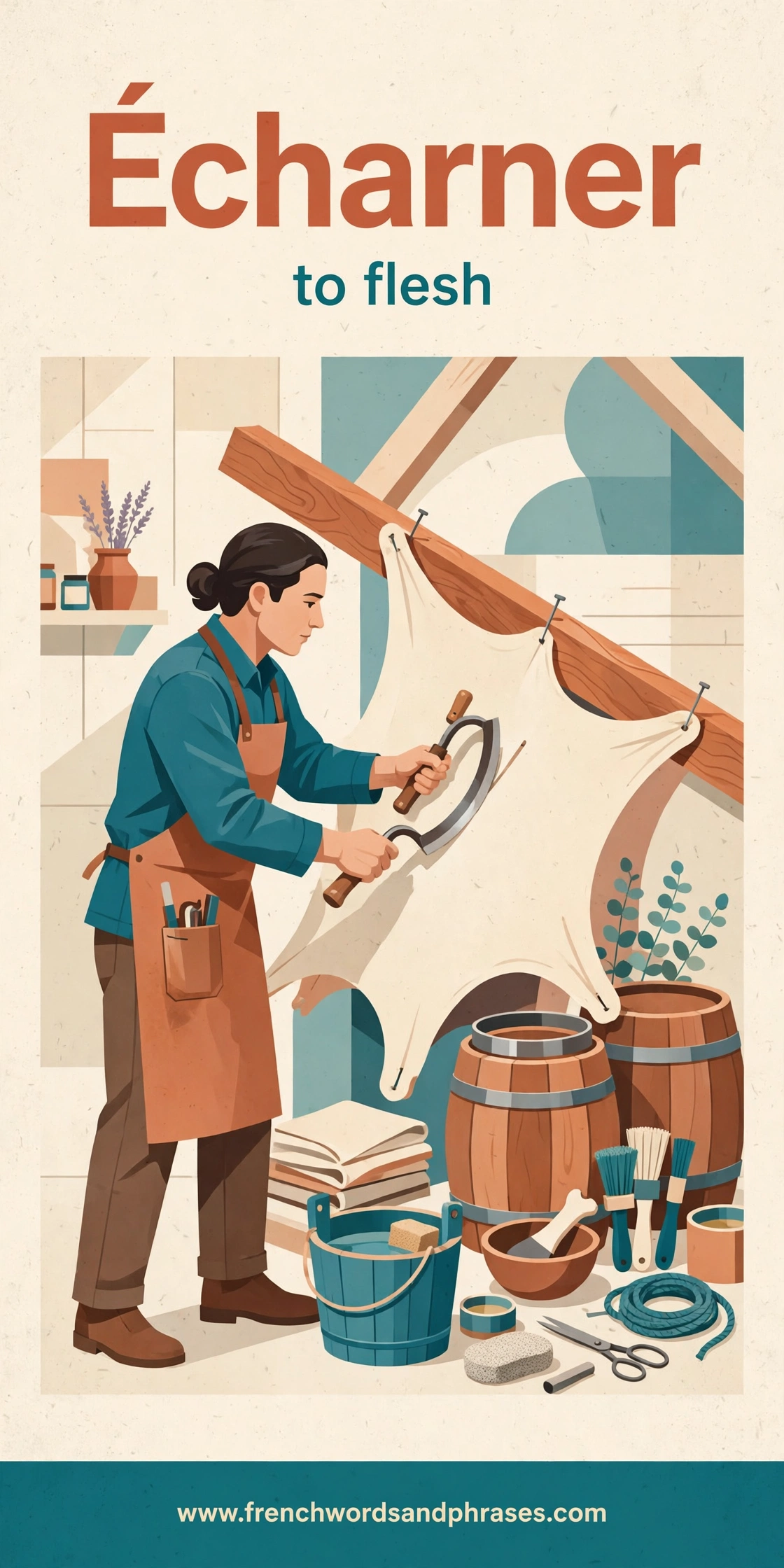
A hide stretched over a wooden beam, a curved knife moving in short, sure strokes, shavings of fat falling to the floor — écharner is the tanner’s verb for fleshing, the first hard step that turns a raw skin into leather.
In this guide, you’ll learn how to conjugate écharner in all the major French tenses and moods. Explore complete conjugation tables, French examples, English translations, and practice quizzes.
Understanding the French Verb Écharner
Écharner is a regular French verb belonging to the first group of verbs, those ending in -er.
It means to flesh. It is used in tanneries and leather workshops for removing flesh, fat and membrane from animal hides, in preparing skins for leather, gloves and parchment, and today mostly of the machines that have replaced the knife and the beam.
Verb classification: First group (-er)
Auxiliary verb: Avoir
Past participle: écharné
Present participle: écharnant
English equivalents: To flesh a hide, to scrape flesh from skins; l’écharnage — fleshing; un couteau à écharner — a fleshing knife.
One important detail: écharner keeps chair — flesh — inside it: the verb literally takes the chair off the skin. In the tannery the hide is stretched on a slanted beam, un chevalet, and worked with a two-handled curved knife, un couteau à écharner. The step has its own noun, l’écharnage, and it always comes before le tannage, the tanning itself: first you flesh the hide, then you tan it.
Experience the Word
Écharner is a craftsman’s verb — heavy, smelly, skilled work that most people only meet in the history of leather.
Imagine a tannery two hundred years ago. The apprentice leans over the beam, knife flat against the hide, and stroke by stroke the skin comes clean — heavy work, done by eye and by wrist, that no beginner is trusted with for long.
The hide has not yet become leather. It has been écharnée — fleshed, scraped clean, made ready for the tan pit.
How to Conjugate Écharner: Complete French Conjugation Guide
Let’s explore every major conjugation of écharner, beginning with the indicative mood.
How to Conjugate Écharner in the Indicative Mood
The indicative mood is used to express facts, observations, actions, and events.
How to Conjugate Écharner in the Present Tense (Présent)
Used for actions happening now, habitual actions, and general truths.
| Subject | Conjugation |
|---|---|
| je | écharne |
| tu | écharnes |
| il / elle | écharne |
| nous | écharnons |
| vous | écharnez |
| ils / elles | écharnent |
Example
L’ouvrier écharne les peaux avant le tannage.
The worker fleshes the hides before tanning.
Quick Quiz 1
Complete the sentence:
Nous ______ les peaux avant le tannage.
Reveal the answer
écharnons
Nous écharnons les peaux avant le tannage.
We flesh the hides before tanning.
How to Conjugate Écharner in the Passé Composé
Used for completed actions in the past. Écharner takes the auxiliary verb avoir.
| Subject | Conjugation |
|---|---|
| j’ | ai écharné |
| tu | as écharné |
| il / elle | a écharné |
| nous | avons écharné |
| vous | avez écharné |
| ils / elles | ont écharné |
Example
Ils ont écharné deux cents peaux cette semaine.
They fleshed two hundred hides this week.
How to Conjugate Écharner in the Imparfait (Imperfect Tense)
Used for habitual past actions, descriptions, and ongoing situations in the past.
| Subject | Conjugation |
|---|---|
| je | écharnais |
| tu | écharnais |
| il / elle | écharnait |
| nous | écharnions |
| vous | écharniez |
| ils / elles | écharnaient |
Example
Autrefois, les tanneurs écharnaient les peaux à la main, sur un chevalet.
In the old days, tanners used to flesh the hides by hand, on a beam.
Quick Quiz 2
Choose the correct form:
They fleshed the hides.
Ils ______ les peaux. (ont écharné / sont écharnés)
Reveal the answer
ont écharné
Ils ont écharné les peaux.
Écharner takes avoir.
How to Conjugate Écharner in the Plus-que-parfait
Used to describe an action that had already been completed before another past event.
| Subject | Conjugation |
|---|---|
| j’ | avais écharné |
| tu | avais écharné |
| il / elle | avait écharné |
| nous | avions écharné |
| vous | aviez écharné |
| ils / elles | avaient écharné |
Example
Elle avait écharné la peau avant de la saler.
She had fleshed the hide before salting it.
How to Conjugate Écharner in the Passé Simple
Primarily used in formal writing, literature, and historical narratives. It is rarely used in everyday conversation.
| Subject | Conjugation |
|---|---|
| je | écharnai |
| tu | écharnas |
| il / elle | écharna |
| nous | écharnâmes |
| vous | écharnâtes |
| ils / elles | écharnèrent |
Example
Le tanneur écharna la peau en quelques gestes sûrs.
The tanner fleshed the hide in a few sure strokes.
How to Conjugate Écharner in the Passé Antérieur
A literary tense used to express an action completed immediately before another past action, generally in the passé simple.
| Subject | Conjugation |
|---|---|
| j’ | eus écharné |
| tu | eus écharné |
| il / elle | eut écharné |
| nous | eûmes écharné |
| vous | eûtes écharné |
| ils / elles | eurent écharné |
Example
Quand il eut écharné la dernière peau, il rinça l’atelier.
When he had fleshed the last hide, he rinsed down the workshop.
How to Conjugate Écharner in the Future Tense (Futur Simple)
Used to describe actions that will take place in the future.
| Subject | Conjugation |
|---|---|
| je | écharnerai |
| tu | écharneras |
| il / elle | écharnera |
| nous | écharnerons |
| vous | écharnerez |
| ils / elles | écharneront |
Example
Demain, nous écharnerons les peaux de veau.
Tomorrow, we will flesh the calf hides.
How to Conjugate Écharner in the Futur Antérieur (Future Perfect)
Used for an action that will have been completed before a particular point in the future.
| Subject | Conjugation |
|---|---|
| j’ | aurai écharné |
| tu | auras écharné |
| il / elle | aura écharné |
| nous | aurons écharné |
| vous | aurez écharné |
| ils / elles | auront écharné |
Example
À midi, l’équipe aura écharné tout le lot.
By noon, the team will have fleshed the whole batch.
How to Conjugate Écharner in the Near Future (Futur Proche)
Used to describe something that is going to happen soon. Formed with aller + infinitive.
| Subject | Conjugation |
|---|---|
| je | vais écharner |
| tu | vas écharner |
| il / elle | va écharner |
| nous | allons écharner |
| vous | allez écharner |
| ils / elles | vont écharner |
Example
Je vais écharner cette peau sur le chevalet.
I am going to flesh this hide on the beam.
How to Conjugate Écharner in the Conditional Mood
The conditional mood expresses what would happen under certain circumstances. It is also frequently used to make polite requests or express wishes.
How to Conjugate Écharner in the Present Conditional
| Subject | Conjugation |
|---|---|
| je | écharnerais |
| tu | écharnerais |
| il / elle | écharnerait |
| nous | écharnerions |
| vous | écharneriez |
| ils / elles | écharneraient |
Example
Avec une machine moderne, on écharnerait dix fois plus vite.
With a modern machine, we would flesh ten times faster.
How to Conjugate Écharner in the Past Conditional
| Subject | Conjugation |
|---|---|
| j’ | aurais écharné |
| tu | aurais écharné |
| il / elle | aurait écharné |
| nous | aurions écharné |
| vous | auriez écharné |
| ils / elles | auraient écharné |
Example
Ils auraient écharné les peaux hier si la machine avait marché.
They would have fleshed the hides yesterday if the machine had worked.
Écharner in the Literary Past Conditional Form
This less common literary form uses the imperfect subjunctive of avoir.
| Subject | Conjugation |
|---|---|
| j’ | eusse écharné |
| tu | eusses écharné |
| il / elle | eût écharné |
| nous | eussions écharné |
| vous | eussiez écharné |
| ils / elles | eussent écharné |
Example
Le tanneur eût écharné les peaux avant la foire.
The tanner would have fleshed the hides before the fair.
How to Conjugate Écharner in the Subjunctive Mood
The subjunctive is used to express wishes, emotions, doubts, necessity, and uncertainty. It frequently follows expressions such as il faut que (it is necessary that) or bien que (although).
How to Conjugate Écharner in the Present Subjunctive
| Subject | Conjugation |
|---|---|
| que je | écharne |
| que tu | écharnes |
| qu’il / qu’elle | écharne |
| que nous | écharnions |
| que vous | écharniez |
| qu’ils / qu’elles | écharnent |
Example
Il faut que tu écharnes la peau sans la couper.
You must flesh the hide without cutting it.
Quick Quiz 3
Complete the sentence using the subjunctive:
Il faut que vous ______ les peaux à temps.
Reveal the answer
écharniez
Il faut que vous écharniez les peaux à temps.
You must flesh the hides in time.
How to Conjugate Écharner in the Imperfect Subjunctive
A literary tense, rarely encountered in modern spoken French.
| Subject | Conjugation |
|---|---|
| que je | écharnasse |
| que tu | écharnasses |
| qu’il / qu’elle | écharnât |
| que nous | écharnassions |
| que vous | écharnassiez |
| qu’ils / qu’elles | écharnassent |
Example
Le maître tanneur voulait que l’apprenti écharnât la peau lentement.
The master tanner wanted the apprentice to flesh the hide slowly.
How to Conjugate Écharner in the Pluperfect Subjunctive
A literary construction used to express an action completed before another past action.
| Subject | Conjugation |
|---|---|
| que j’ | eusse écharné |
| que tu | eusses écharné |
| qu’il / qu’elle | eût écharné |
| que nous | eussions écharné |
| que vous | eussiez écharné |
| qu’ils / qu’elles | eussent écharné |
Example
On vérifia qu’ils eussent écharné toutes les peaux du lot.
They checked that they had fleshed all the hides in the batch.
How to Conjugate Écharner in the Past Subjunctive
| Subject | Conjugation |
|---|---|
| que j’ | aie écharné |
| que tu | aies écharné |
| qu’il / qu’elle | ait écharné |
| que nous | ayons écharné |
| que vous | ayez écharné |
| qu’ils / qu’elles | aient écharné |
Example
Je suis content que vous ayez écharné les peaux à temps.
I am glad you fleshed the hides in time.
How to Conjugate Écharner in the Imperative
The imperative is used to give commands, instructions, invitations, or suggestions. Subject pronouns are omitted.
How to Conjugate Écharner in the Present Imperative
| Person | Conjugation |
|---|---|
| (tu) | écharne |
| (nous) | écharnons |
| (vous) | écharnez |
Example
Écharnez les peaux avant le salage !
Flesh the hides before salting!
Quick Quiz 4
How would you say Flesh this hide without cutting it (tu form)?
Reveal the answer
Écharne cette peau sans la couper !
French Participles of Écharner
Participles are verb forms that can be used in compound tenses and other grammatical constructions.
Present Participle of Écharner
écharnant
En écharnant la peau, il faut garder le couteau bien plat.
While fleshing the hide, you must keep the knife flat.
Past Participle of Écharner
écharné
Écharnée avec soin, la peau devient un cuir souple.
Fleshed with care, the hide becomes a supple leather.
Écharner in Everyday French: Real-Life Examples
Now that you know the conjugations, let’s see how écharner appears in everyday French.
Example 1 — Present
L’ouvrier écharne les peaux dans l’atelier.
The worker fleshes the hides in the workshop.
Example 2 — Passé composé
Ils ont écharné tout le lot ce matin.
They fleshed the whole batch this morning.
Example 3 — Imparfait
Les tanneurs écharnaient les peaux à la main.
The tanners used to flesh the hides by hand.
Example 4 — Future
Nous écharnerons les peaux de veau demain.
We will flesh the calf hides tomorrow.
Example 5 — Conditional
On écharnerait plus vite avec une machine.
We would flesh faster with a machine.
Example 6 — Imperative
Écharne cette peau sans la couper !
Flesh this hide without cutting it!
Beyond Translation: The Meaning of Écharner
English tanners use the verb to flesh for exactly the same stroke of the knife; French écharner is its precise cousin, built openly on chair, flesh.
A craft word that keeps the workshop visible.
Most French speakers will never écharner anything — but the verb preserves the whole chain in one word: la peau, the hide; l’écharnage, the fleshing; le tannage, the tanning; le cuir, the leather.
How to Remember the French Verb Écharner
Remember it this way: Écharner is about the tanner’s knife — flesh off, leather to come.
- Chair means flesh: écharner takes the flesh off the hide, scraping it clean for the tanner.
- L’écharnage comes before le tannage: first flesh the hide, then tan it.
- Regular -er: j’écharne, nous écharnons, past participle écharné.
The key idea is the tanner’s knife — flesh off, leather to come.
Test Your Knowledge of Écharner
Let’s see how much you’ve learned. Try answering these questions before revealing the answers.
Question 1
What is l’écharnage?
Reveal the answer
Fleshing — scraping the flesh and fat from a hide before tanning.
Question 2
How do you say The worker fleshes the hides in French?
Reveal the answer
L’ouvrier écharne les peaux.
Question 3
Translate: They fleshed the whole batch this morning.
Reveal the answer
Ils ont écharné tout le lot ce matin.
Question 4
What is the past participle of écharner?
Reveal the answer
Écharné.
Question 5
Complete the sentence:
Il faut que tu ______ la peau sans la couper.
Reveal the answer
écharnes
Il faut que tu écharnes la peau sans la couper.
You must flesh the hide without cutting it.
Your Final Challenge
Can You Use It?
How would you say this in French?
The tanner fleshes the hides from dawn, and the workshop smells of leather and wood.
Reveal the answer
Le tanneur écharne les peaux dès l’aube, et l’atelier sent le cuir et le bois.
The tanner fleshes the hides from dawn, and the workshop smells of leather and wood.
A little French. A little curiosity. A richer everyday life.
LEARN FRENCH ONE WORD AT A TIME