A French Word to Live By
How to Conjugate Soustraire in French
/sus.tʁɛʁ/
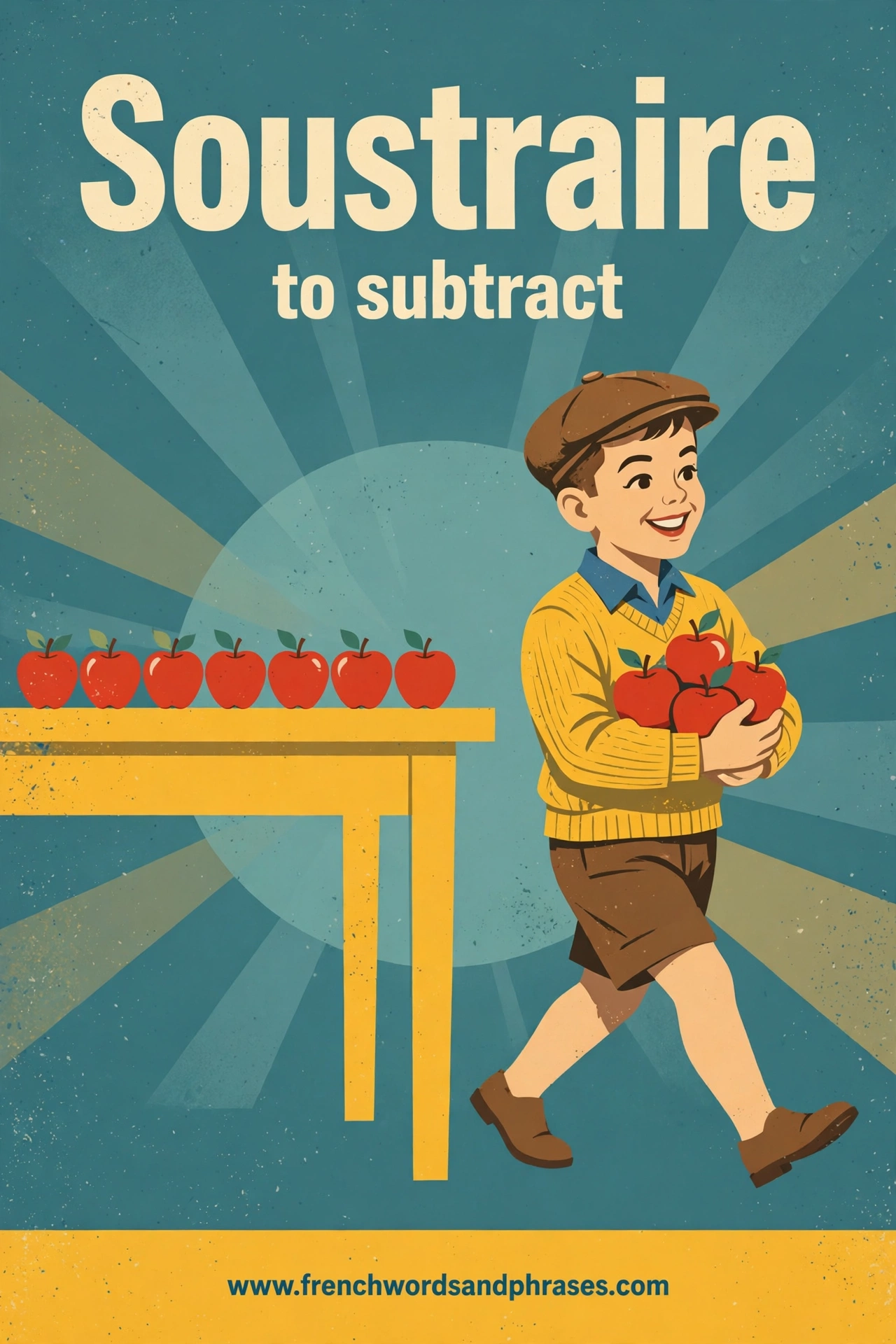
Soustraire means to subtract — to take one number away from another, the second of the four operations every French schoolchild learns; and, with à, to shield or remove someone from something: soustraire un enfant au danger.
A small hand counting on fingers under the desk, a shopkeeper doing the change in his head, a mother quietly moving a child out of harm’s way — soustraire is the verb of taking away: numbers from numbers, and people from danger.
In this guide, you’ll learn how to conjugate soustraire in all the major French tenses and moods. Explore complete conjugation tables, French examples, English translations, and practice quizzes.
Understanding the French Verb Soustraire
Soustraire is an irregular French verb ending in -re, conjugated like traire.
It means to subtract. At school it is pure arithmetic: soustraire, c’est ôter, to take away — the operation sign is moins, and the exercise is une soustraction. In its second life it protects: soustraire un témoin aux menaces, to remove a witness from threats; and reflexively, se soustraire à la justice, to evade justice — the same taking-away, turned to escape.
Verb classification: Irregular (-re, like traire)
Auxiliary verb: Avoir
Past participle: soustrait
Present participle: soustrayant
English equivalents: To subtract, to take away; soustraire cinq de vingt — to subtract five from twenty; soustraire quelqu’un à quelque chose — to shield someone from something, to remove them from it; se soustraire à — to evade, to escape an obligation; la soustraction — the subtraction.
One important detail: soustraire follows traire exactly — present je soustrais, tu soustrais, il soustrait, nous soustrayons, vous soustrayez, ils soustraient, past participle soustrait, present participle soustrayant. The stem soustray- carries the plural and imperfect forms; the singular present drops the y for i: soustrais, soustrait. No -s variants exist here — soustrait is the only past participle shape (feminine soustraite).
Experience the Word
Soustraire is the verb of the minus sign — and of the hand that quietly pulls something out of reach of harm.
Imagine the village school in 1960. Chalk dust, wooden desks, and on the board in perfect copperplate: soustrayez sept de quinze. Thirty small heads bend; thirty pencils count backwards towards the answer that the whole class will chant together.
Eight. The number that remains when you take away — soustrait, subtracted, and safe.
How to Conjugate Soustraire: Complete French Conjugation Guide
Let’s explore every major conjugation of soustraire, beginning with the indicative mood.
How to Conjugate Soustraire in the Indicative Mood
The indicative mood is used to express facts, observations, actions, and events.
How to Conjugate Soustraire in the Present Tense (Présent)
Used for actions happening now, habitual actions, and general truths.
| Subject | Conjugation |
|---|---|
| je | soustrais |
| tu | soustrais |
| il / elle | soustrait |
| nous | soustrayons |
| vous | soustrayez |
| ils / elles | soustraient |
Example
On soustrait les dépenses des recettes.
We subtract the expenses from the takings.
Quick Quiz 1
Complete the sentence:
Nous ______ les frais du total.
Reveal the answer
soustrayons
Nous soustrayons les frais du total.
We subtract the costs from the total.
How to Conjugate Soustraire in the Passé Composé
Used for completed actions in the past. Soustraire takes the auxiliary verb avoir.
| Subject | Conjugation |
|---|---|
| j’ | ai soustrait |
| tu | as soustrait |
| il / elle | a soustrait |
| nous | avons soustrait |
| vous | avez soustrait |
| ils / elles | ont soustrait |
Example
Elle a soustrait cinq de vingt pour vérifier.
She subtracted five from twenty to check.
How to Conjugate Soustraire in the Imparfait (Imperfect Tense)
Used for habitual past actions, descriptions, and ongoing situations in the past.
| Subject | Conjugation |
|---|---|
| je | soustrayais |
| tu | soustrayais |
| il / elle | soustrayait |
| nous | soustrayions |
| vous | soustrayiez |
| ils / elles | soustrayaient |
Example
À l’école, nous soustrayions sur nos doigts.
At school, we used to subtract on our fingers.
Quick Quiz 2
Choose the correct form:
She subtracted five from twenty.
Elle ______ cinq de vingt. (a soustrait / est soustraite)
Reveal the answer
a soustrait
Elle a soustrait cinq de vingt.
Soustraire takes avoir.
How to Conjugate Soustraire in the Plus-que-parfait
Used to describe an action that had already been completed before another past event.
| Subject | Conjugation |
|---|---|
| j’ | avais soustrait |
| tu | avais soustrait |
| il / elle | avait soustrait |
| nous | avions soustrait |
| vous | aviez soustrait |
| ils / elles | avaient soustrait |
Example
Le comptable avait soustrait deux fois la même somme.
The accountant had subtracted the same sum twice.
How to Conjugate Soustraire in the Passé Simple
Primarily used in formal writing, literature, and historical narratives. It is rarely used in everyday conversation.
| Subject | Conjugation |
|---|---|
| je | soustrayis |
| tu | soustrayis |
| il / elle | soustrayit |
| nous | soustrayîmes |
| vous | soustrayîtes |
| ils / elles | soustrayirent |
Example
Le trésorier soustrayit la taxe du total.
The treasurer subtracted the tax from the total.
How to Conjugate Soustraire in the Passé Antérieur
A literary tense used to express an action completed immediately before another past action, generally in the passé simple.
| Subject | Conjugation |
|---|---|
| j’ | eus soustrait |
| tu | eus soustrait |
| il / elle | eut soustrait |
| nous | eûmes soustrait |
| vous | eûtes soustrait |
| ils / elles | eurent soustrait |
Example
Quand il eut soustrait les frais, il annonça le bénéfice.
When he had subtracted the costs, he announced the profit.
How to Conjugate Soustraire in the Future Tense (Futur Simple)
Used to describe actions that will take place in the future.
| Subject | Conjugation |
|---|---|
| je | soustrairai |
| tu | soustrairas |
| il / elle | soustraira |
| nous | soustrairons |
| vous | soustrairez |
| ils / elles | soustrairont |
Example
Tu soustrairas la remise du prix affiché.
You will subtract the discount from the displayed price.
How to Conjugate Soustraire in the Futur Antérieur (Future Perfect)
Used for an action that will have been completed before a particular point in the future.
| Subject | Conjugation |
|---|---|
| j’ | aurai soustrait |
| tu | auras soustrait |
| il / elle | aura soustrait |
| nous | aurons soustrait |
| vous | aurez soustrait |
| ils / elles | auront soustrait |
Example
À la fin du mois, elle aura soustrait toutes les charges.
By the end of the month, she will have subtracted all the charges.
How to Conjugate Soustraire in the Near Future (Futur Proche)
Used to describe something that is going to happen soon. Formed with aller + infinitive.
| Subject | Conjugation |
|---|---|
| je | vais soustraire |
| tu | vas soustraire |
| il / elle | va soustraire |
| nous | allons soustraire |
| vous | allez soustraire |
| ils / elles | vont soustraire |
Example
Je vais soustraire dix pour cent du total.
I am going to subtract ten per cent from the total.
How to Conjugate Soustraire in the Conditional Mood
The conditional mood expresses what would happen under certain circumstances. It is also frequently used to make polite requests or express wishes.
How to Conjugate Soustraire in the Present Conditional
| Subject | Conjugation |
|---|---|
| je | soustrairais |
| tu | soustrairais |
| il / elle | soustrairait |
| nous | soustrairions |
| vous | soustrairiez |
| ils / elles | soustrairaient |
Example
Avec une calculatrice, tu soustrairais sans erreur.
With a calculator, you would subtract without mistakes.
How to Conjugate Soustraire in the Past Conditional
| Subject | Conjugation |
|---|---|
| j’ | aurais soustrait |
| tu | aurais soustrait |
| il / elle | aurait soustrait |
| nous | aurions soustrait |
| vous | auriez soustrait |
| ils / elles | auraient soustrait |
Example
Il aurait soustrait la mauvaise somme sans ton aide.
He would have subtracted the wrong sum without your help.
Soustraire in the Literary Past Conditional Form
This less common literary form uses the imperfect subjunctive of avoir.
| Subject | Conjugation |
|---|---|
| j’ | eusse soustrait |
| tu | eusses soustrait |
| il / elle | eût soustrait |
| nous | eussions soustrait |
| vous | eussiez soustrait |
| ils / elles | eussent soustrait |
Example
Le clerc eût soustrait les frais avant toute chose.
The clerk would have subtracted the costs before anything else.
How to Conjugate Soustraire in the Subjunctive Mood
The subjunctive is used to express wishes, emotions, doubts, necessity, and uncertainty. It frequently follows expressions such as il faut que (it is necessary that) or bien que (although).
How to Conjugate Soustraire in the Present Subjunctive
| Subject | Conjugation |
|---|---|
| que je | soustraie |
| que tu | soustraies |
| qu’il / qu’elle | soustraie |
| que nous | soustrayions |
| que vous | soustrayiez |
| qu’ils / qu’elles | soustraient |
Example
Il faut que tu soustraies les centimes aussi.
You must subtract the cents too.
Quick Quiz 3
Complete the sentence using the subjunctive:
Il faut que vous ______ la taxe.
Reveal the answer
soustrayiez
Il faut que vous soustrayiez la taxe.
You must subtract the tax.
How to Conjugate Soustraire in the Imperfect Subjunctive
A literary tense, rarely encountered in modern spoken French.
| Subject | Conjugation |
|---|---|
| que je | soustrayisse |
| que tu | soustrayisses |
| qu’il / qu’elle | soustrayît |
| que nous | soustrayissions |
| que vous | soustrayissiez |
| qu’ils / qu’elles | soustrayissent |
Example
Le maître exigeait que l’on soustrayît sans calculatrice.
The teacher demanded that we subtract without a calculator.
How to Conjugate Soustraire in the Pluperfect Subjunctive
A literary construction used to express an action completed before another past action.
| Subject | Conjugation |
|---|---|
| que j’ | eusse soustrait |
| que tu | eusses soustrait |
| qu’il / qu’elle | eût soustrait |
| que nous | eussions soustrait |
| que vous | eussiez soustrait |
| qu’ils / qu’elles | eussent soustrait |
Example
On craignait qu’il eût soustrait une somme de la caisse.
People feared he had taken a sum from the till.
How to Conjugate Soustraire in the Past Subjunctive
| Subject | Conjugation |
|---|---|
| que j’ | aie soustrait |
| que tu | aies soustrait |
| qu’il / qu’elle | ait soustrait |
| que nous | ayons soustrait |
| que vous | ayez soustrait |
| qu’ils / qu’elles | aient soustrait |
Example
Je suis content que vous ayez soustrait la bonne somme.
I am glad you subtracted the right sum.
How to Conjugate Soustraire in the Imperative
The imperative is used to give commands, instructions, invitations, or suggestions. Subject pronouns are omitted.
How to Conjugate Soustraire in the Present Imperative
| Person | Conjugation |
|---|---|
| (tu) | soustrais |
| (nous) | soustrayons |
| (vous) | soustrayez |
Example
Soustrais cinq de vingt et dis-moi le reste !
Subtract five from twenty and tell me the remainder!
Quick Quiz 4
How would you say Subtract five (tu form)?
Reveal the answer
Soustrais cinq !
French Participles of Soustraire
Participles are verb forms that can be used in compound tenses and other grammatical constructions.
Present Participle of Soustraire
soustrayant
En soustrayant les frais, on obtient le vrai prix.
By subtracting the costs, you get the true price.
Past Participle of Soustraire
soustrait
Soustraite du total, la taxe laisse un prix honnête.
Subtracted from the total, the tax leaves an honest price.
Soustraire in Everyday French: Real-Life Examples
Now that you know the conjugations, let’s see how soustraire appears in everyday French.
Example 1 — Present
On soustrait les dépenses des recettes.
We subtract the expenses from the takings.
Example 2 — Passé composé
Elle a soustrait cinq de vingt.
She subtracted five from twenty.
Example 3 — Imparfait
Nous soustrayions sur nos doigts.
We used to subtract on our fingers.
Example 4 — Future
Tu soustrairas la remise du prix.
You will subtract the discount from the price.
Example 5 — Conditional
Tu soustrairais sans erreur avec une calculatrice.
You would subtract without mistakes with a calculator.
Example 6 — Imperative
Soustrais cinq de vingt !
Subtract five from twenty!
Beyond Translation: The Meaning of Soustraire
Soustraire is Latin sub-trahere, to draw out from underneath — and French kept both hands of the gesture: the schoolroom hand that takes a smaller number out of a bigger one, and the protective hand that draws a person out from under a threat. Its reflexive is the shadow of the same image: se soustraire, to slip out from under an obligation, a duty, a law.
To subtract in French is to draw away from beneath — numbers, dangers and duties alike.
Learn it beside ajouter, its opposite, and the pair covers the first arithmetic of every French childhood and the bookkeeping of every French shop.
How to Remember the French Verb Soustraire
Remember it this way: Soustraire is about the small hand counting backwards under the desk — seven from fifteen leaves eight.
- Like traire, exactly: je soustrais, nous soustrayons — the y belongs to the plural stem.
- Past participle soustrait, present participle soustrayant; the noun is la soustraction.
- Two lives: soustraire cinq de vingt at school; soustraire quelqu’un au danger, to shield them from it.
The key idea is the small hand counting backwards under the desk — seven from fifteen leaves eight.
Test Your Knowledge of Soustraire
Let’s see how much you’ve learned. Try answering these questions before revealing the answers.
Question 1
Which verb is soustraire conjugated exactly like?
Reveal the answer
Traire — je soustrais, il soustrait, nous soustrayons, past participle soustrait.
Question 2
How do you say Subtract five from twenty in French?
Reveal the answer
Soustrais cinq de vingt.
Question 3
Translate: She subtracted the discount from the price.
Reveal the answer
Elle a soustrait la remise du prix.
Question 4
What is the past participle of soustraire?
Reveal the answer
Soustrait.
Question 5
Complete the sentence:
Il faut que tu ______ les centimes aussi.
Reveal the answer
soustraies
Il faut que tu soustraies les centimes aussi.
You must subtract the cents too.
Your Final Challenge
Can You Use It?
How would you say this in French?
Subtract seven from fifteen, and the remainder — eight — is the answer the whole class chants together.
Reveal the answer
Soustrayez sept de quinze, et le reste — huit — est la réponse que toute la classe chante ensemble.
Subtract seven from fifteen, and the remainder — eight — is the answer the whole class chants together.
A little French. A little curiosity. A richer everyday life.
LEARN FRENCH ONE WORD AT A TIME