A French Word to Live By
How to Conjugate Échardonner in French
/e.ʃar.dɔ.ne/
Échardonner means to clear of thistles.
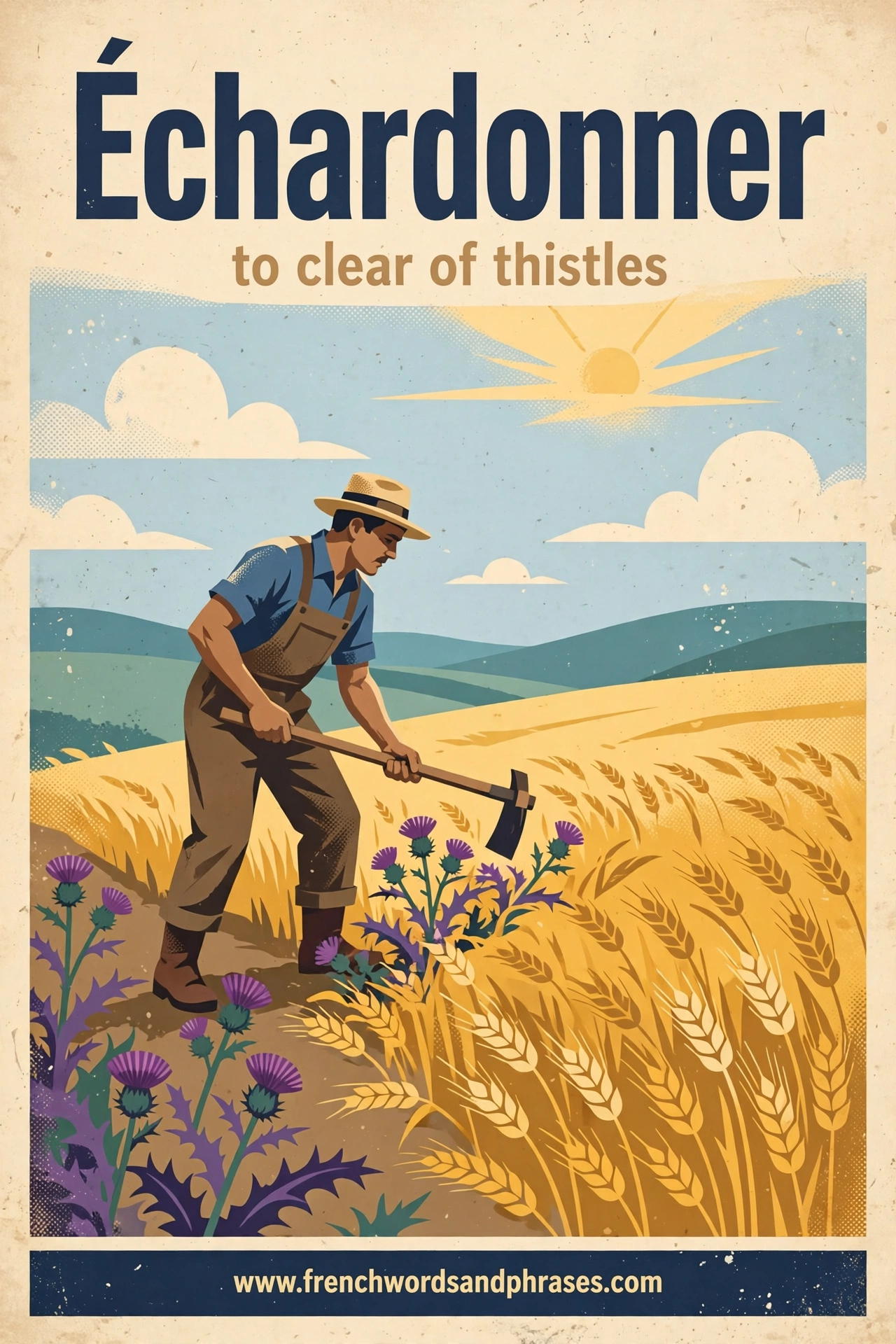
A purple-headed army marching across a pasture, each plant armed and ready to seed — échardonner is the farmer’s verb for clearing thistles out of meadows and fields before they flower and conquer the whole farm.
In this guide, you’ll learn how to conjugate échardonner in all the major French tenses and moods. Explore complete conjugation tables, French examples, English translations, and practice quizzes.
Understanding the French Verb Échardonner
Échardonner is a regular French verb belonging to the first group of verbs, those ending in -er.
It means to clear of thistles. It is commonly used for clearing meadows, pastures and field edges of thistles, with a hoe, by hand or by mowing, always with the same deadline — before the flowers open and the seeds fly.
Verb classification: First group (-er)
Auxiliary verb: Avoir
Past participle: échardonné
Present participle: échardonnant
English equivalents: To clear of thistles, to weed out thistles; un chardon — a thistle.
One important detail: échardonner is built on un chardon, a thistle — the prickly purple flower that is the emblem of Scotland and the enemy of every French pasture. The opening é- does the removing, as in many clearing verbs (compare écheniller, to clear of caterpillars). Timing is the whole craft: a meadow is échardonné avant la floraison, before the thistles flower, because one plant in seed can restock the whole field.
Experience the Word
Échardonner is the verb of the race against the seed — quiet, repetitive work that decides what the meadow will look like next year.
Imagine a June morning in a pasture. The farmer walks the field with a hoe, plant by plant, while the thistles stand purple and proud — by evening the grass is clean and the herd can graze without pricked noses.
The meadow has not been ploughed or replanted. It has been échardonné — cleared of its thistles, one root at a time.
How to Conjugate Échardonner: Complete French Conjugation Guide
Let’s explore every major conjugation of échardonner, beginning with the indicative mood.
How to Conjugate Échardonner in the Indicative Mood
The indicative mood is used to express facts, observations, actions, and events.
How to Conjugate Échardonner in the Present Tense (Présent)
Used for actions happening now, habitual actions, and general truths.
| Subject | Conjugation |
|---|---|
| je | échardonne |
| tu | échardonnes |
| il / elle | échardonne |
| nous | échardonnons |
| vous | échardonnez |
| ils / elles | échardonnent |
Example
Le fermier échardonne le pré avant la floraison.
The farmer clears the meadow of thistles before flowering.
Quick Quiz 1
Complete the sentence:
Nous ______ le pré au printemps.
Reveal the answer
échardonnons
Nous échardonnons le pré au printemps.
We clear the meadow of thistles in spring.
How to Conjugate Échardonner in the Passé Composé
Used for completed actions in the past. Échardonner takes the auxiliary verb avoir.
| Subject | Conjugation |
|---|---|
| j’ | ai échardonné |
| tu | as échardonné |
| il / elle | a échardonné |
| nous | avons échardonné |
| vous | avez échardonné |
| ils / elles | ont échardonné |
Example
Nous avons échardonné tout le champ ce matin.
We cleared the whole field of thistles this morning.
How to Conjugate Échardonner in the Imparfait (Imperfect Tense)
Used for habitual past actions, descriptions, and ongoing situations in the past.
| Subject | Conjugation |
|---|---|
| je | échardonnais |
| tu | échardonnais |
| il / elle | échardonnait |
| nous | échardonnions |
| vous | échardonniez |
| ils / elles | échardonnaient |
Example
Chaque printemps, on échardonnait les pâturages à la houe.
Every spring, people used to clear the pastures of thistles with a hoe.
Quick Quiz 2
Choose the correct form:
They cleared the field of thistles.
Ils ______ le champ. (ont échardonné / sont échardonnés)
Reveal the answer
ont échardonné
Ils ont échardonné le champ.
Échardonner takes avoir.
How to Conjugate Échardonner in the Plus-que-parfait
Used to describe an action that had already been completed before another past event.
| Subject | Conjugation |
|---|---|
| j’ | avais échardonné |
| tu | avais échardonné |
| il / elle | avait échardonné |
| nous | avions échardonné |
| vous | aviez échardonné |
| ils / elles | avaient échardonné |
Example
Ils avaient échardonné la parcelle avant les pluies.
They had cleared the plot of thistles before the rains.
How to Conjugate Échardonner in the Passé Simple
Primarily used in formal writing, literature, and historical narratives. It is rarely used in everyday conversation.
| Subject | Conjugation |
|---|---|
| je | échardonnai |
| tu | échardonnas |
| il / elle | échardonna |
| nous | échardonnâmes |
| vous | échardonnâtes |
| ils / elles | échardonnèrent |
Example
Le berger échardonna le pré en une journée.
The shepherd cleared the meadow of thistles in one day.
How to Conjugate Échardonner in the Passé Antérieur
A literary tense used to express an action completed immediately before another past action, generally in the passé simple.
| Subject | Conjugation |
|---|---|
| j’ | eus échardonné |
| tu | eus échardonné |
| il / elle | eut échardonné |
| nous | eûmes échardonné |
| vous | eûtes échardonné |
| ils / elles | eurent échardonné |
Example
Quand ils eurent échardonné le champ, ils semèrent la luzerne.
When they had cleared the field of thistles, they sowed the alfalfa.
How to Conjugate Échardonner in the Future Tense (Futur Simple)
Used to describe actions that will take place in the future.
| Subject | Conjugation |
|---|---|
| je | échardonnerai |
| tu | échardonneras |
| il / elle | échardonnera |
| nous | échardonnerons |
| vous | échardonnerez |
| ils / elles | échardonneront |
Example
Demain, j’échardonnerai le bord du chemin.
Tomorrow, I will clear the edge of the path of thistles.
How to Conjugate Échardonner in the Futur Antérieur (Future Perfect)
Used for an action that will have been completed before a particular point in the future.
| Subject | Conjugation |
|---|---|
| j’ | aurai échardonné |
| tu | auras échardonné |
| il / elle | aura échardonné |
| nous | aurons échardonné |
| vous | aurez échardonné |
| ils / elles | auront échardonné |
Example
À la fin de la semaine, nous aurons échardonné toutes les prairies.
By the end of the week, we will have cleared all the meadows of thistles.
How to Conjugate Échardonner in the Near Future (Futur Proche)
Used to describe something that is going to happen soon. Formed with aller + infinitive.
| Subject | Conjugation |
|---|---|
| je | vais échardonner |
| tu | vas échardonner |
| il / elle | va échardonner |
| nous | allons échardonner |
| vous | allez échardonner |
| ils / elles | vont échardonner |
Example
Je vais échardonner le potager avant qu’ils ne montent en graines.
I am going to clear the vegetable garden of thistles before they go to seed.
How to Conjugate Échardonner in the Conditional Mood
The conditional mood expresses what would happen under certain circumstances. It is also frequently used to make polite requests or express wishes.
How to Conjugate Échardonner in the Present Conditional
| Subject | Conjugation |
|---|---|
| je | échardonnerais |
| tu | échardonnerais |
| il / elle | échardonnerait |
| nous | échardonnerions |
| vous | échardonneriez |
| ils / elles | échardonneraient |
Example
Avec une bonne houe, on échardonnerait ce pré en une heure.
With a good hoe, we would clear this meadow of thistles in an hour.
How to Conjugate Échardonner in the Past Conditional
| Subject | Conjugation |
|---|---|
| j’ | aurais échardonné |
| tu | aurais échardonné |
| il / elle | aurait échardonné |
| nous | aurions échardonné |
| vous | auriez échardonné |
| ils / elles | auraient échardonné |
Example
Ils auraient échardonné plus tôt si le tracteur avait démarré.
They would have cleared the thistles earlier if the tractor had started.
Échardonner in the Literary Past Conditional Form
This less common literary form uses the imperfect subjunctive of avoir.
| Subject | Conjugation |
|---|---|
| j’ | eusse échardonné |
| tu | eusses échardonné |
| il / elle | eût échardonné |
| nous | eussions échardonné |
| vous | eussiez échardonné |
| ils / elles | eussent échardonné |
Example
Le métayer eût échardonné les chaumes avant l’hiver.
The tenant farmer would have cleared the stubble fields of thistles before winter.
How to Conjugate Échardonner in the Subjunctive Mood
The subjunctive is used to express wishes, emotions, doubts, necessity, and uncertainty. It frequently follows expressions such as il faut que (it is necessary that) or bien que (although).
How to Conjugate Échardonner in the Present Subjunctive
| Subject | Conjugation |
|---|---|
| que je | échardonne |
| que tu | échardonnes |
| qu’il / qu’elle | échardonne |
| que nous | échardonnions |
| que vous | échardonniez |
| qu’ils / qu’elles | échardonnent |
Example
Il faut que tu échardonnes avant que les chardons fleurissent.
You must clear the thistles before they flower.
Quick Quiz 3
Complete the sentence using the subjunctive:
Il faut que vous ______ les pâturages.
Reveal the answer
échardonniez
Il faut que vous échardonniez les pâturages.
You must clear the pastures of thistles.
How to Conjugate Échardonner in the Imperfect Subjunctive
A literary tense, rarely encountered in modern spoken French.
| Subject | Conjugation |
|---|---|
| que je | échardonnasse |
| que tu | échardonnasses |
| qu’il / qu’elle | échardonnât |
| que nous | échardonnassions |
| que vous | échardonnassiez |
| qu’ils / qu’elles | échardonnassent |
Example
Le propriétaire voulait que le fermier échardonnât le pré entier.
The owner wanted the farmer to clear the whole meadow of thistles.
How to Conjugate Échardonner in the Pluperfect Subjunctive
A literary construction used to express an action completed before another past action.
| Subject | Conjugation |
|---|---|
| que j’ | eusse échardonné |
| que tu | eusses échardonné |
| qu’il / qu’elle | eût échardonné |
| que nous | eussions échardonné |
| que vous | eussiez échardonné |
| qu’ils / qu’elles | eussent échardonné |
Example
On vérifia qu’ils eussent échardonné les parcelles louées.
They checked that they had cleared the rented plots of thistles.
How to Conjugate Échardonner in the Past Subjunctive
| Subject | Conjugation |
|---|---|
| que j’ | aie échardonné |
| que tu | aies échardonné |
| qu’il / qu’elle | ait échardonné |
| que nous | ayons échardonné |
| que vous | ayez échardonné |
| qu’ils / qu’elles | aient échardonné |
Example
Je suis ravi que vous ayez échardonné le jardin.
I am delighted you cleared the garden of thistles.
How to Conjugate Échardonner in the Imperative
The imperative is used to give commands, instructions, invitations, or suggestions. Subject pronouns are omitted.
How to Conjugate Échardonner in the Present Imperative
| Person | Conjugation |
|---|---|
| (tu) | échardonne |
| (nous) | échardonnons |
| (vous) | échardonnez |
Example
Échardonnez le pré avant la fin du mois !
Clear the meadow of thistles before the end of the month!
Quick Quiz 4
How would you say Clear this corner of thistles (tu form)?
Reveal the answer
Échardonne ce coin !
French Participles of Échardonner
Participles are verb forms that can be used in compound tenses and other grammatical constructions.
Present Participle of Échardonner
échardonnant
En échardonnant le pré, il a trouvé un nid de perdrix.
While clearing the meadow of thistles, he found a partridge’s nest.
Past Participle of Échardonner
échardonné
Échardonné à temps, le pré donne une herbe propre.
Cleared of thistles in time, the meadow gives clean grass.
Échardonner in Everyday French: Real-Life Examples
Now that you know the conjugations, let’s see how échardonner appears in everyday French.
Example 1 — Present
Le fermier échardonne son pré au printemps.
The farmer clears his meadow of thistles in spring.
Example 2 — Passé composé
Nous avons échardonné le potager hier.
We cleared the vegetable garden of thistles yesterday.
Example 3 — Imparfait
Mon grand-père échardonnait ses champs à la main.
My grandfather used to clear his fields of thistles by hand.
Example 4 — Future
J’échardonnerai le chemin avant l’été.
I will clear the path of thistles before summer.
Example 5 — Conditional
On échardonnerait plus vite avec une machine.
We would clear the thistles faster with a machine.
Example 6 — Imperative
Échardonne ce coin avant qu’il ne soit trop tard !
Clear this corner of thistles before it is too late!
Beyond Translation: The Meaning of Échardonner
English needs a whole phrase — to clear of thistles; French échardonner packs the weed, the tool and the deadline into a single farm verb.
The é- verbs do the clearing.
French builds a small family of them: échardonner (thistles), écheniller (caterpillars), désherber (weeds in general) — each one a morning’s work in a word.
How to Remember the French Verb Échardonner
Remember it this way: Échardonner is about out with the thistles, before they seed.
- Un chardon is a thistle; the é- takes it out: échardonner = to take the thistles out.
- Timing is everything: échardonner avant la floraison — before the thistles flower and seed.
- Regular -er: j’échardonne, nous échardonnons, past participle échardonné.
The key idea is out with the thistles, before they seed.
Test Your Knowledge of Échardonner
Let’s see how much you’ve learned. Try answering these questions before revealing the answers.
Question 1
What is un chardon?
Reveal the answer
A thistle — the prickly weed that échardonner removes.
Question 2
How do you say The farmer clears his meadow of thistles in French?
Reveal the answer
Le fermier échardonne son pré.
Question 3
Translate: We cleared the garden of thistles yesterday.
Reveal the answer
Nous avons échardonné le jardin hier.
Question 4
What is the past participle of échardonner?
Reveal the answer
Échardonné.
Question 5
Complete the sentence:
Il faut que tu ______ avant la floraison.
Reveal the answer
échardonnes
Il faut que tu échardonnes avant la floraison.
You must clear the thistles before flowering.
Your Final Challenge
Can You Use It?
How would you say this in French?
The farmer clears his meadow of thistles in spring, and the grass grows clean all summer.
Reveal the answer
Le fermier échardonne son pré au printemps, et l’herbe pousse propre tout l’été.
The farmer clears his meadow of thistles in spring, and the grass grows clean all summer.
A little French. A little curiosity. A richer everyday life.
LEARN FRENCH ONE WORD AT A TIME