A French Word to Live By
How to Conjugate Échampir in French
/e.ʃɑ̃.piʁ/
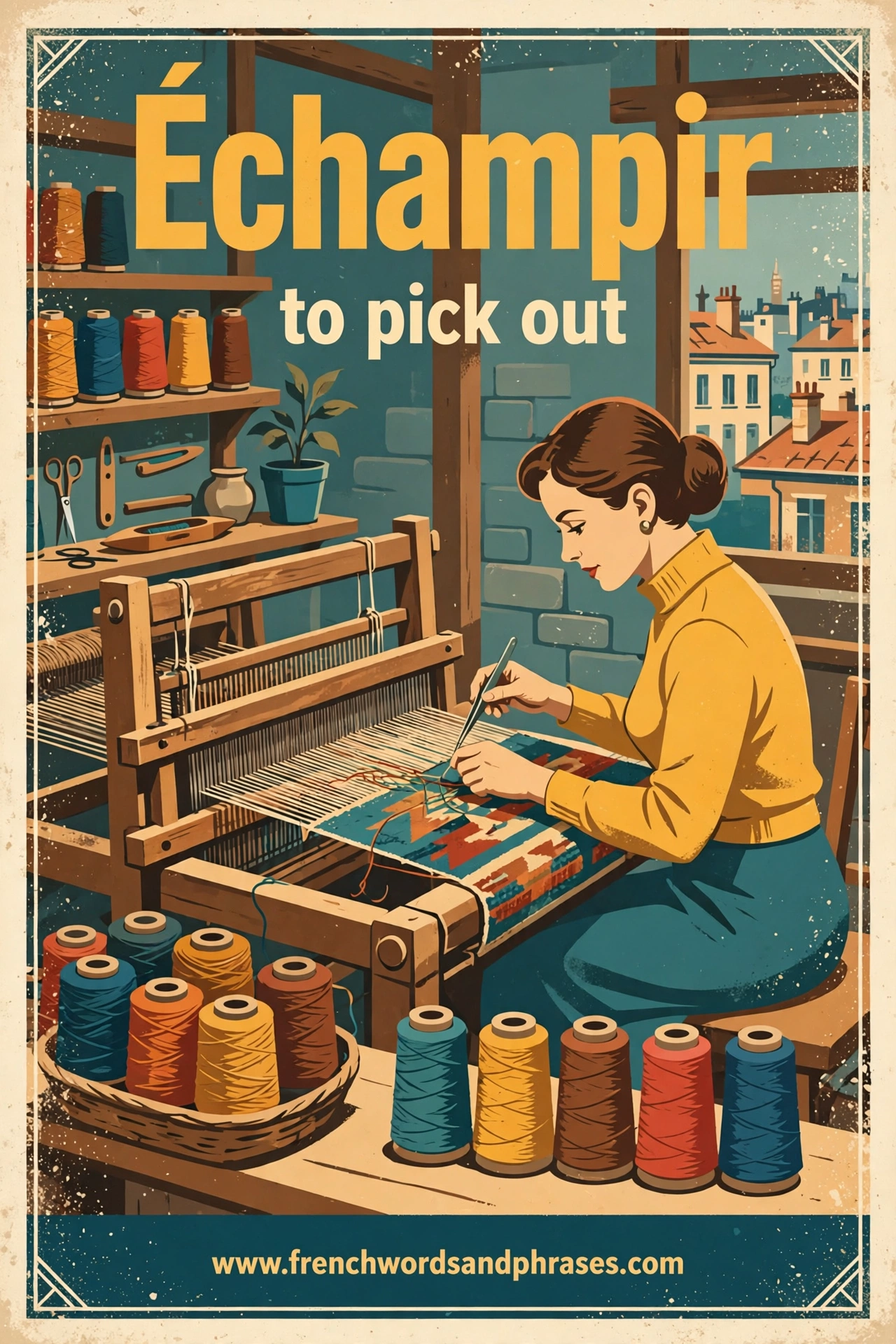
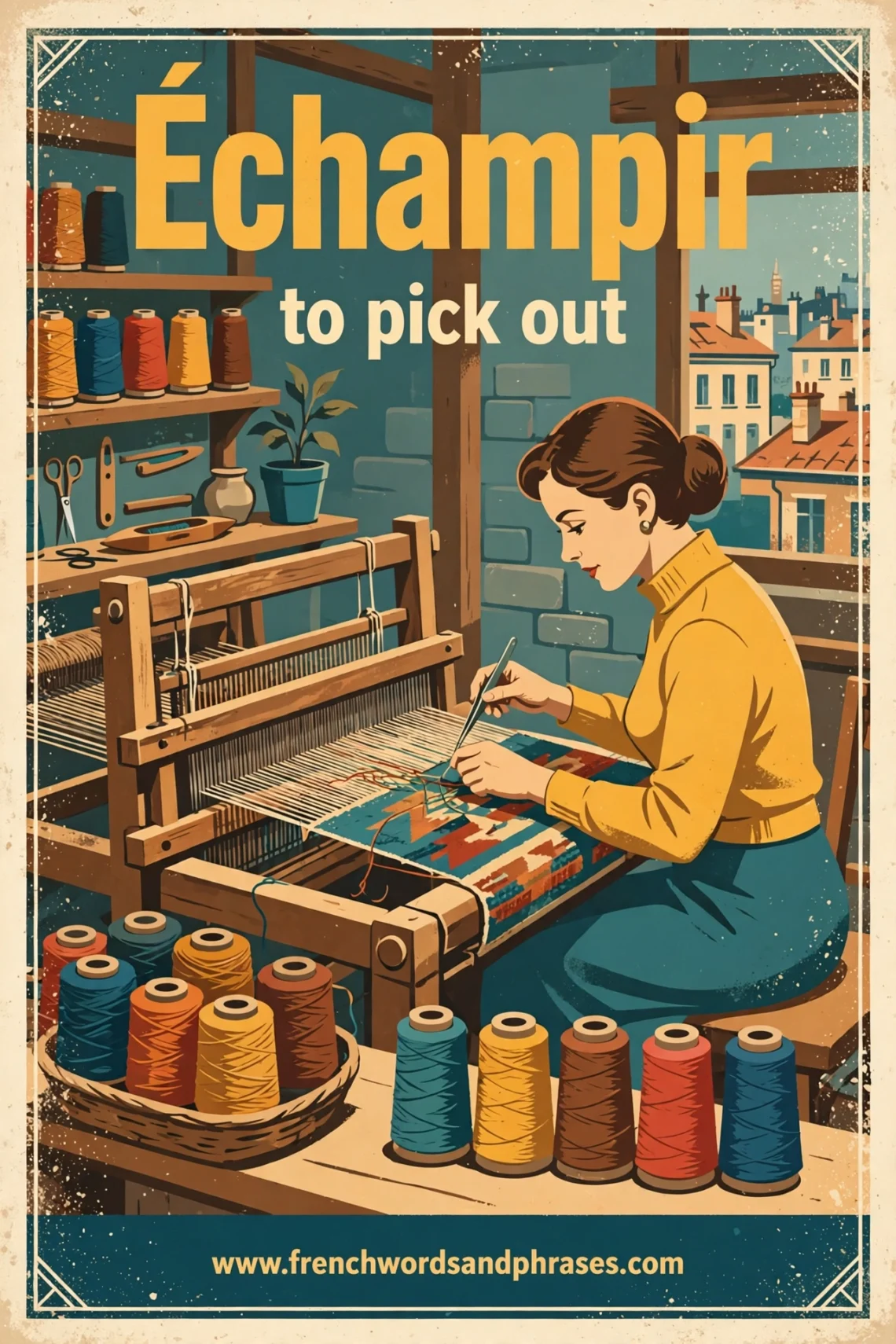
Échampir means to pick out — a weaver’s verb for singling out the pattern threads.
At a silk loom in Lyon, among a thousand plain threads, a weaver’s fingers isolate the few that will form the design — échampir is that rare, precise verb: to pick out, thread by thread, the pattern hidden in the cloth.
In this guide, you’ll learn how to conjugate échampir in all the major French tenses and moods. Explore complete conjugation tables, French examples, English translations, and practice quizzes.
Understanding the French Verb Échampir
Échampir is a regular French verb belonging to the second group of verbs, those ending in -ir.
It means to pick out. It is used in weaving mills and by textile historians for the operation of selecting and separating the threads of a pattern on brocaded and figured fabrics, and in descriptions of the great silk workshops of Lyon, where this patient picking-out decided the flowers, birds and scrolls of the finished cloth.
Verb classification: Second group (-ir)
Auxiliary verb: Avoir
Past participle: échampi
Present participle: échampissant
English equivalents: To pick out (in weaving: to single out the threads that form the pattern on figured fabric).
One important detail: échampir is a genuine second-group verb in -ir — j’échampis, nous échampissons, past participle échampi — despite ending in letters that might suggest otherwise. It is a specialist of the weaving trade: on figured cloth (étoffe façonnée), the weaver échampit — picks out — the warp threads that must rise to draw the motif, separating the design from the ground one thread at a time. Outside the mill it is rare, and meeting it in the wild is a small event for word-lovers.
Experience the Word
Échampir is the verb of the chosen thread — thousands lie side by side, and the pattern exists only in the ones picked out.
Imagine a Lyon workshop in 1850. Light falls across the loom; the weaver bends close, and échampit — picks out — the threads of a rose that will only become visible when the whole cloth is woven and unrolled.
The threads have not changed colour or place. They have been picked out — échampis — singled out to carry the design.
How to Conjugate Échampir: Complete French Conjugation Guide
Let’s explore every major conjugation of échampir, beginning with the indicative mood.
How to Conjugate Échampir in the Indicative Mood
The indicative mood is used to express facts, observations, actions, and events.
How to Conjugate Échampir in the Present Tense (Présent)
Used for actions happening now, habitual actions, and general truths.
| Subject | Conjugation |
|---|---|
| je | échampis |
| tu | échampis |
| il / elle | échampit |
| nous | échampissons |
| vous | échampissez |
| ils / elles | échampissent |
Example
Le tisserand échampit les fils du motif avec une patience infinie.
The weaver picks out the threads of the motif with infinite patience.
Quick Quiz 1
Complete the sentence:
Nous ______ les fils du dessin.
Reveal the answer
échampissons
Nous échampissons les fils du dessin.
We pick out the threads of the design.
How to Conjugate Échampir in the Passé Composé
Used for completed actions in the past. Échampir takes the auxiliary verb avoir.
| Subject | Conjugation |
|---|---|
| j’ | ai échampi |
| tu | as échampi |
| il / elle | a échampi |
| nous | avons échampi |
| vous | avez échampi |
| ils / elles | ont échampi |
Example
Elle a échampi les fils d’or avant de commencer le broché.
She picked out the gold threads before beginning the brocade.
How to Conjugate Échampir in the Imparfait (Imperfect Tense)
Used for habitual past actions, descriptions, and ongoing situations in the past.
| Subject | Conjugation |
|---|---|
| je | échampissais |
| tu | échampissais |
| il / elle | échampissait |
| nous | échampissions |
| vous | échampissiez |
| ils / elles | échampissaient |
Example
Dans les ateliers de Lyon, on échampissait la soie à la lumière du jour.
In the workshops of Lyon, they used to pick out the silk in daylight.
Quick Quiz 2
Choose the correct form:
She picked out the silver threads.
Elle ______ les fils d’argent. (a échampi / est échampie)
Reveal the answer
a échampi
Elle a échampi les fils d’argent.
Échampir takes avoir.
How to Conjugate Échampir in the Plus-que-parfait
Used to describe an action that had already been completed before another past event.
| Subject | Conjugation |
|---|---|
| j’ | avais échampi |
| tu | avais échampi |
| il / elle | avait échampi |
| nous | avions échampi |
| vous | aviez échampi |
| ils / elles | avaient échampi |
Example
Il avait échampi chaque fil du dessin la veille au soir.
He had picked out every thread of the design the evening before.
How to Conjugate Échampir in the Passé Simple
Primarily used in formal writing, literature, and historical narratives. It is rarely used in everyday conversation.
| Subject | Conjugation |
|---|---|
| je | échampis |
| tu | échampis |
| il / elle | échampit |
| nous | échampîmes |
| vous | échampîtes |
| ils / elles | échampirent |
Example
La tisserande échampit les fils un à un, sans une erreur.
The weaver picked out the threads one by one, without a single mistake.
How to Conjugate Échampir in the Passé Antérieur
A literary tense used to express an action completed immediately before another past action, generally in the passé simple.
| Subject | Conjugation |
|---|---|
| j’ | eus échampi |
| tu | eus échampi |
| il / elle | eut échampi |
| nous | eûmes échampi |
| vous | eûtes échampi |
| ils / elles | eurent échampi |
Example
Quand elle eut échampi les fils de chaîne, le motif apparut en creux.
When she had picked out the warp threads, the motif appeared in outline.
How to Conjugate Échampir in the Future Tense (Futur Simple)
Used to describe actions that will take place in the future.
| Subject | Conjugation |
|---|---|
| je | échampirai |
| tu | échampiras |
| il / elle | échampira |
| nous | échampirons |
| vous | échampirez |
| ils / elles | échampiront |
Example
Demain, nous échampirons les fils du nouveau dessin.
Tomorrow, we will pick out the threads of the new design.
How to Conjugate Échampir in the Futur Antérieur (Future Perfect)
Used for an action that will have been completed before a particular point in the future.
| Subject | Conjugation |
|---|---|
| j’ | aurai échampi |
| tu | auras échampi |
| il / elle | aura échampi |
| nous | aurons échampi |
| vous | aurez échampi |
| ils / elles | auront échampi |
Example
À la fin de la semaine, ils auront échampi toute la pièce de soie.
By the end of the week, they will have picked out the whole piece of silk.
How to Conjugate Échampir in the Near Future (Futur Proche)
Used to describe something that is going to happen soon. Formed with aller + infinitive.
| Subject | Conjugation |
|---|---|
| je | vais échampir |
| tu | vas échampir |
| il / elle | va échampir |
| nous | allons échampir |
| vous | allez échampir |
| ils / elles | vont échampir |
Example
Je vais échampir les fils bleus pour le motif central.
I am going to pick out the blue threads for the central motif.
How to Conjugate Échampir in the Conditional Mood
The conditional mood expresses what would happen under certain circumstances. It is also frequently used to make polite requests or express wishes.
How to Conjugate Échampir in the Present Conditional
| Subject | Conjugation |
|---|---|
| je | échampirais |
| tu | échampirais |
| il / elle | échampirait |
| nous | échampirions |
| vous | échampiriez |
| ils / elles | échampiraient |
Example
Avec une meilleure lampe, on échampirait les fils plus vite.
With a better lamp, we would pick out the threads faster.
How to Conjugate Échampir in the Past Conditional
| Subject | Conjugation |
|---|---|
| j’ | aurais échampi |
| tu | aurais échampi |
| il / elle | aurait échampi |
| nous | aurions échampi |
| vous | auriez échampi |
| ils / elles | auraient échampi |
Example
Elle aurait échampi le motif entier sans la panne du métier.
She would have picked out the whole motif without the loom’s breakdown.
Échampir in the Literary Past Conditional Form
This less common literary form uses the imperfect subjunctive of avoir.
| Subject | Conjugation |
|---|---|
| j’ | eusse échampi |
| tu | eusses échampi |
| il / elle | eût échampi |
| nous | eussions échampi |
| vous | eussiez échampi |
| ils / elles | eussent échampi |
Example
La canuse eût échampi les fils d’argent pour le manteau royal.
The silk-worker would have picked out the silver threads for the royal mantle.
How to Conjugate Échampir in the Subjunctive Mood
The subjunctive is used to express wishes, emotions, doubts, necessity, and uncertainty. It frequently follows expressions such as il faut que (it is necessary that) or bien que (although).
How to Conjugate Échampir in the Present Subjunctive
| Subject | Conjugation |
|---|---|
| que je | échampisse |
| que tu | échampisses |
| qu’il / qu’elle | échampisse |
| que nous | échampissions |
| que vous | échampissiez |
| qu’ils / qu’elles | échampissent |
Example
Il faut que vous échampissiez les fils du dessin avant midi.
You must pick out the threads of the design before noon.
Quick Quiz 3
Complete the sentence using the subjunctive:
Il faut que vous ______ les fils avant midi.
Reveal the answer
échampissiez
Il faut que vous échampissiez les fils avant midi.
You must pick out the threads before noon.
How to Conjugate Échampir in the Imperfect Subjunctive
A literary tense, rarely encountered in modern spoken French.
| Subject | Conjugation |
|---|---|
| que je | échampisse |
| que tu | échampisses |
| qu’il / qu’elle | échampît |
| que nous | échampissions |
| que vous | échampissiez |
| qu’ils / qu’elles | échampissent |
Example
Le maître voulait que l’apprenti échampît les fils sans se tromper.
The master wanted the apprentice to pick out the threads without making a mistake.
How to Conjugate Échampir in the Pluperfect Subjunctive
A literary construction used to express an action completed before another past action.
| Subject | Conjugation |
|---|---|
| que j’ | eusse échampi |
| que tu | eusses échampi |
| qu’il / qu’elle | eût échampi |
| que nous | eussions échampi |
| que vous | eussiez échampi |
| qu’ils / qu’elles | eussent échampi |
Example
On admira qu’elle eût échampi tant de fils en une journée.
People admired that she had picked out so many threads in one day.
How to Conjugate Échampir in the Past Subjunctive
| Subject | Conjugation |
|---|---|
| que j’ | aie échampi |
| que tu | aies échampi |
| qu’il / qu’elle | ait échampi |
| que nous | ayons échampi |
| que vous | ayez échampi |
| qu’ils / qu’elles | aient échampi |
Example
Je suis fier que tu aies échampi ce motif difficile.
I am proud that you picked out this difficult motif.
How to Conjugate Échampir in the Imperative
The imperative is used to give commands, instructions, invitations, or suggestions. Subject pronouns are omitted.
How to Conjugate Échampir in the Present Imperative
| Person | Conjugation |
|---|---|
| (tu) | échampis |
| (nous) | échampissons |
| (vous) | échampissez |
Example
Échampis les fils d’or, le motif en dépend !
Pick out the gold threads, the motif depends on it!
Quick Quiz 4
How would you say Pick out the gold threads (tu form)?
Reveal the answer
Échampis les fils d’or !
French Participles of Échampir
Participles are verb forms that can be used in compound tenses and other grammatical constructions.
Present Participle of Échampir
échampissant
En échampissant les fils, elle chantait doucement.
While picking out the threads, she sang softly.
Past Participle of Échampir
échampi
Échampis avec soin, les fils dessinaient déjà la rose.
Picked out with care, the threads already outlined the rose.
Échampir in Everyday French: Real-Life Examples
Now that you know the conjugations, let’s see how échampir appears in everyday French.
Example 1 — Present
Le tisserand échampit les fils du motif.
The weaver picks out the threads of the motif.
Example 2 — Passé composé
Nous avons échampi les fils d’argent hier.
We picked out the silver threads yesterday.
Example 3 — Imparfait
Les canuts échampissaient la soie dans les ateliers de la Croix-Rousse.
The silk workers used to pick out the silk in the Croix-Rousse workshops.
Example 4 — Future
Vous échampirez les fils du nouveau dessin demain.
You will pick out the threads of the new design tomorrow.
Example 5 — Conditional
On échampirait plus vite avec deux apprentis.
We would pick out faster with two apprentices.
Example 6 — Imperative
Échampissez les fils bleus d’abord !
Pick out the blue threads first!
Beyond Translation: The Meaning of Échampir
English has no everyday verb for this gesture at all; French échampir preserves it like a thread in amber.
It is a fossil of the silk age.
The great mills have mostly fallen silent, but the word remains — a reminder that patterns, in cloth as in life, appear only when someone picks out the right threads from the thousand.
How to Remember the French Verb Échampir
Remember it this way: Échampir is about the weaver’s chosen threads — the pattern picked out of the thousand.
- A weaver’s verb: échampir is picking out the pattern threads on figured cloth.
- Lyon’s silk workers, les canuts, are its classic subjects.
- Second group -ir: j’échampis, nous échampissons, past participle échampi.
The key idea is the weaver’s chosen threads — the pattern picked out of the thousand.
Test Your Knowledge of Échampir
Let’s see how much you’ve learned. Try answering these questions before revealing the answers.
Question 1
Who échampit, traditionally?
Reveal the answer
The weaver — picking out the threads that form the pattern on figured fabric.
Question 2
How do you say The weaver picks out the threads of the motif in French?
Reveal the answer
Le tisserand échampit les fils du motif.
Question 3
Translate: She picked out the gold threads.
Reveal the answer
Elle a échampi les fils d’or.
Question 4
What is the past participle of échampir?
Reveal the answer
Échampi.
Question 5
Complete the sentence:
Il faut que vous ______ les fils du dessin avant midi.
Reveal the answer
échampissiez
Il faut que vous échampissiez les fils du dessin avant midi.
You must pick out the threads of the design before noon.
Your Final Challenge
Can You Use It?
How would you say this in French?
The weaver picks out the threads one by one, and the rose is born in the silk.
Reveal the answer
Le tisserand échampit les fils un à un, et la rose naît dans la soie.
The weaver picks out the threads one by one, and the rose is born in the silk.
A little French. A little curiosity. A richer everyday life.
LEARN FRENCH ONE WORD AT A TIME