A French Word to Live By
How to Conjugate Échancrer in French
/e.ʃɑ̃.kʁe/
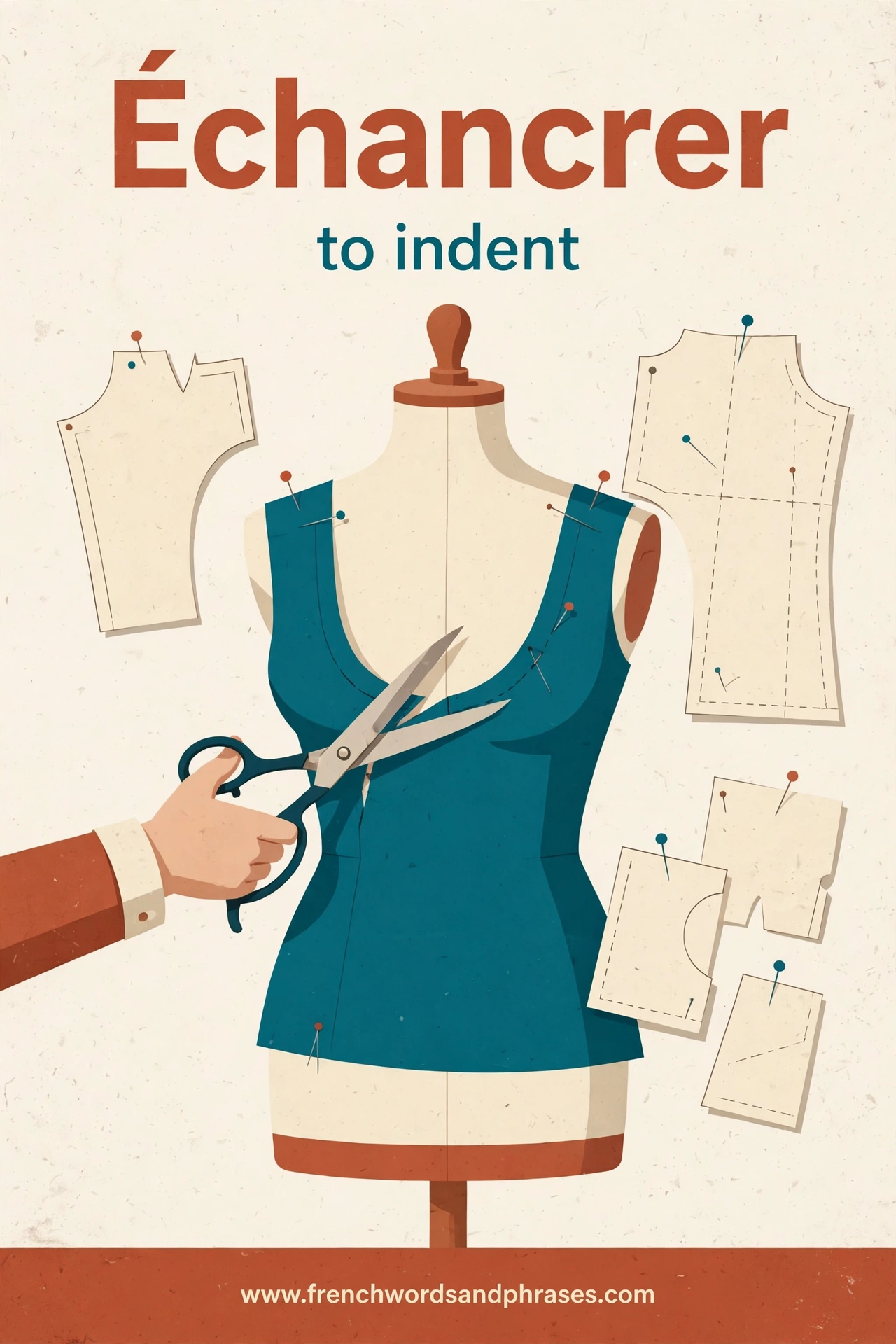
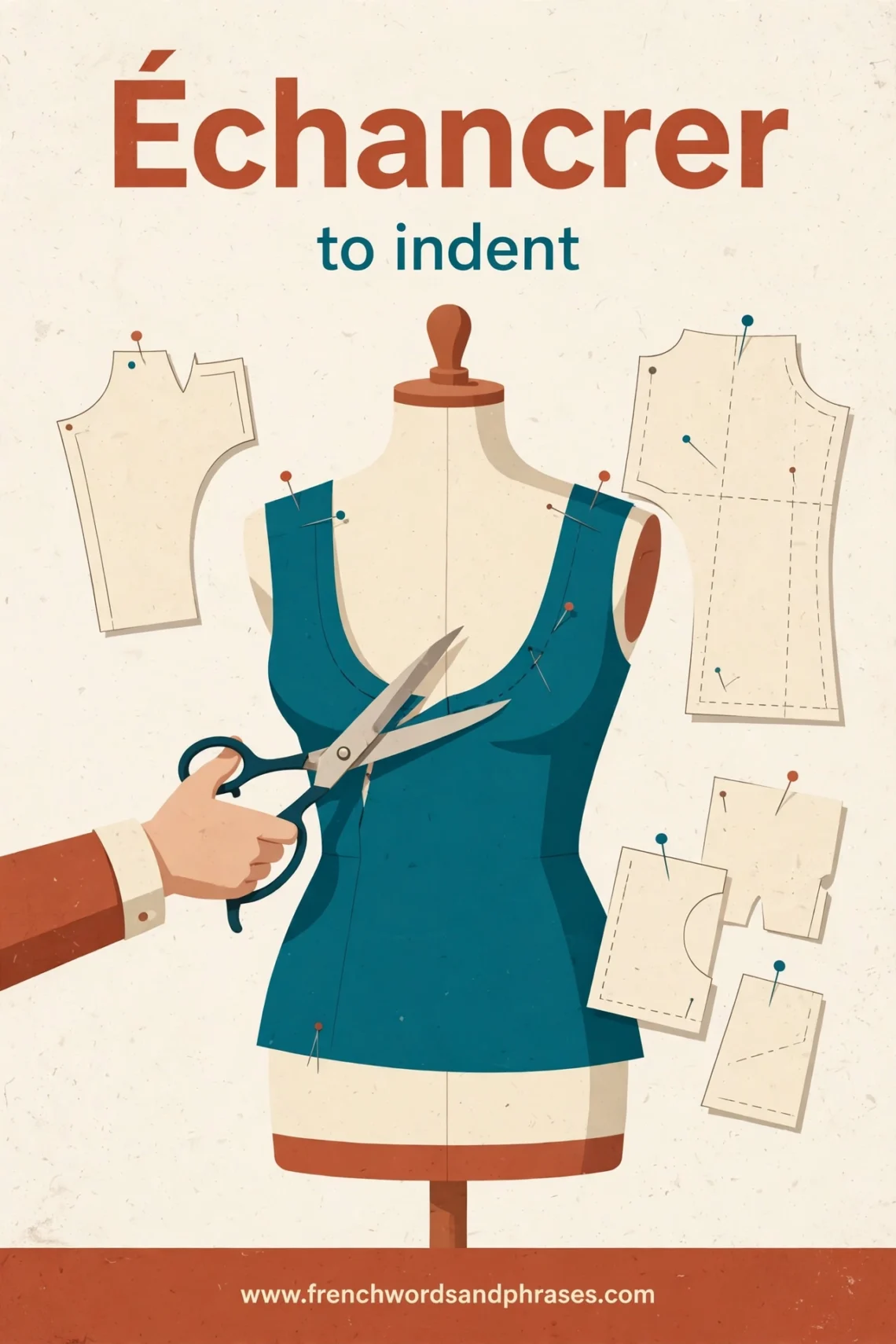
Échancrer means to indent — to cut a hollow or a scoop out of an edge.
A neckline scooped low on a summer dress, a coastline bitten into bays and inlets — échancrer is the verb of the cut-out curve, the hollow carved from an edge, whether the tool is scissors or the sea.
In this guide, you’ll learn how to conjugate échancrer in all the major French tenses and moods. Explore complete conjugation tables, French examples, English translations, and practice quizzes.
Understanding the French Verb Échancrer
Échancrer is a regular French verb belonging to the first group of verbs, those ending in -er.
It means to indent. It is commonly used in sewing for cutting out necklines and armholes, in fashion writing for low-cut and backless garments, and in geography for coasts indented with bays, coves and inlets — anywhere an edge gains a graceful hollow.
Verb classification: First group (-er)
Auxiliary verb: Avoir
Past participle: échancré
Present participle: échancrant
English equivalents: To indent, to cut out, to scoop; une échancrure — a cut-out, a neckline, an inlet; une robe échancrée — a low-cut dress.
One important detail: échancrer is best learned with its noun, une échancrure — the hollow the verb leaves behind. In dressmaking the échancrure is the neckline or armhole: une robe échancrée dans le dos, a dress cut low at the back. On a map the same word names the bite of a bay in the coast: les échancrures de la côte bretonne, the inlets of the Breton coast. One verb for the dressmaker’s scissors and the ocean’s patience.
Experience the Word
Échancrer is the verb of the missing curve — beauty made by taking an edge away.
Imagine a dressmaker’s atelier in Paris. The summer dress hangs almost finished; the scissors pause, then échancrent — scoop out — the back in one long curve, and the dress is transformed.
Nothing has been added. An edge has been cut away — échancré — and the shape is new.
How to Conjugate Échancrer: Complete French Conjugation Guide
Let’s explore every major conjugation of échancrer, beginning with the indicative mood.
How to Conjugate Échancrer in the Indicative Mood
The indicative mood is used to express facts, observations, actions, and events.
How to Conjugate Échancrer in the Present Tense (Présent)
Used for actions happening now, habitual actions, and general truths.
| Subject | Conjugation |
|---|---|
| je | échancre |
| tu | échancres |
| il / elle | échancre |
| nous | échancrons |
| vous | échancrez |
| ils / elles | échancrent |
Example
La couturière échancre le dos de la robe pour l’été.
The dressmaker cuts the back of the dress low for summer.
Quick Quiz 1
Complete the sentence:
Nous ______ l’encolure de la robe.
Reveal the answer
échancrons
Nous échancrons l’encolure de la robe.
We cut out the neckline of the dress.
How to Conjugate Échancrer in the Passé Composé
Used for completed actions in the past. Échancrer takes the auxiliary verb avoir.
| Subject | Conjugation |
|---|---|
| j’ | ai échancré |
| tu | as échancré |
| il / elle | a échancré |
| nous | avons échancré |
| vous | avez échancré |
| ils / elles | ont échancré |
Example
Elle a échancré l’encolure avec précaution.
She cut out the neckline with care.
How to Conjugate Échancrer in the Imparfait (Imperfect Tense)
Used for habitual past actions, descriptions, and ongoing situations in the past.
| Subject | Conjugation |
|---|---|
| je | échancrais |
| tu | échancrais |
| il / elle | échancrait |
| nous | échancrions |
| vous | échancriez |
| ils / elles | échancraient |
Example
La mer échancrait la côte un peu plus chaque hiver.
The sea used to indent the coast a little more each winter.
Quick Quiz 2
Choose the correct form:
She cut out the neckline.
Elle ______ l’encolure. (a échancré / est échancrée)
Reveal the answer
a échancré
Elle a échancré l’encolure.
Échancrer takes avoir.
How to Conjugate Échancrer in the Plus-que-parfait
Used to describe an action that had already been completed before another past event.
| Subject | Conjugation |
|---|---|
| j’ | avais échancré |
| tu | avais échancré |
| il / elle | avait échancré |
| nous | avions échancré |
| vous | aviez échancré |
| ils / elles | avaient échancré |
Example
Le tailleur avait échancré les manches avant l’essayage.
The tailor had cut out the armholes before the fitting.
How to Conjugate Échancrer in the Passé Simple
Primarily used in formal writing, literature, and historical narratives. It is rarely used in everyday conversation.
| Subject | Conjugation |
|---|---|
| je | échancrai |
| tu | échancras |
| il / elle | échancra |
| nous | échancrâmes |
| vous | échancrâtes |
| ils / elles | échancrèrent |
Example
D’un coup de ciseaux, elle échancra le décolleté.
With one snip of the scissors, she scooped out the neckline.
How to Conjugate Échancrer in the Passé Antérieur
A literary tense used to express an action completed immediately before another past action, generally in the passé simple.
| Subject | Conjugation |
|---|---|
| j’ | eus échancré |
| tu | eus échancré |
| il / elle | eut échancré |
| nous | eûmes échancré |
| vous | eûtes échancré |
| ils / elles | eurent échancré |
Example
Quand la couturière eut échancré la robe, la cliente sourit.
When the dressmaker had cut the dress low, the client smiled.
How to Conjugate Échancrer in the Future Tense (Futur Simple)
Used to describe actions that will take place in the future.
| Subject | Conjugation |
|---|---|
| je | échancrerai |
| tu | échancreras |
| il / elle | échancrera |
| nous | échancrerons |
| vous | échancrerez |
| ils / elles | échancreront |
Example
Pour ce modèle, nous échancrerons davantage le dos.
For this design, we will cut the back lower.
How to Conjugate Échancrer in the Futur Antérieur (Future Perfect)
Used for an action that will have been completed before a particular point in the future.
| Subject | Conjugation |
|---|---|
| j’ | aurai échancré |
| tu | auras échancré |
| il / elle | aura échancré |
| nous | aurons échancré |
| vous | aurez échancré |
| ils / elles | auront échancré |
Example
À la fin du siècle, la marée aura échancré toute cette falaise.
By the end of the century, the tide will have indented this whole cliff.
How to Conjugate Échancrer in the Near Future (Futur Proche)
Used to describe something that is going to happen soon. Formed with aller + infinitive.
| Subject | Conjugation |
|---|---|
| je | vais échancrer |
| tu | vas échancrer |
| il / elle | va échancrer |
| nous | allons échancrer |
| vous | allez échancrer |
| ils / elles | vont échancrer |
Example
Je vais échancrer l’encolure, elle est trop fermée.
I am going to scoop out the neckline, it is too closed.
How to Conjugate Échancrer in the Conditional Mood
The conditional mood expresses what would happen under certain circumstances. It is also frequently used to make polite requests or express wishes.
How to Conjugate Échancrer in the Present Conditional
| Subject | Conjugation |
|---|---|
| je | échancrerais |
| tu | échancrerais |
| il / elle | échancrerait |
| nous | échancrerions |
| vous | échancreriez |
| ils / elles | échancreraient |
Example
Avec ce tissu léger, on échancrerait le dos sans hésiter.
With this light fabric, we would cut the back low without hesitating.
How to Conjugate Échancrer in the Past Conditional
| Subject | Conjugation |
|---|---|
| j’ | aurais échancré |
| tu | aurais échancré |
| il / elle | aurait échancré |
| nous | aurions échancré |
| vous | auriez échancré |
| ils / elles | auraient échancré |
Example
Elle aurait échancré la robe si la cliente l’avait demandé.
She would have cut the dress low if the client had asked.
Échancrer in the Literary Past Conditional Form
This less common literary form uses the imperfect subjunctive of avoir.
| Subject | Conjugation |
|---|---|
| j’ | eusse échancré |
| tu | eusses échancré |
| il / elle | eût échancré |
| nous | eussions échancré |
| vous | eussiez échancré |
| ils / elles | eussent échancré |
Example
La vague eût échancré le rocher en une arche parfaite.
The wave would have carved the rock into a perfect arch.
How to Conjugate Échancrer in the Subjunctive Mood
The subjunctive is used to express wishes, emotions, doubts, necessity, and uncertainty. It frequently follows expressions such as il faut que (it is necessary that) or bien que (although).
How to Conjugate Échancrer in the Present Subjunctive
| Subject | Conjugation |
|---|---|
| que je | échancre |
| que tu | échancres |
| qu’il / qu’elle | échancre |
| que nous | échancrions |
| que vous | échancriez |
| qu’ils / qu’elles | échancrent |
Example
Il faut que tu échancres les emmanchures avant de coudre.
You must cut out the armholes before sewing.
Quick Quiz 3
Complete the sentence using the subjunctive:
Il faut que vous ______ le dos avec élégance.
Reveal the answer
échancriez
Il faut que vous échancriez le dos avec élégance.
You must cut the back low with elegance.
How to Conjugate Échancrer in the Imperfect Subjunctive
A literary tense, rarely encountered in modern spoken French.
| Subject | Conjugation |
|---|---|
| que je | échancrasse |
| que tu | échancrasses |
| qu’il / qu’elle | échancrât |
| que nous | échancrassions |
| que vous | échancrassiez |
| qu’ils / qu’elles | échancrassent |
Example
La cliente souhaitait que l’on échancrât le dos avec élégance.
The client wanted the back cut low with elegance.
How to Conjugate Échancrer in the Pluperfect Subjunctive
A literary construction used to express an action completed before another past action.
| Subject | Conjugation |
|---|---|
| que j’ | eusse échancré |
| que tu | eusses échancré |
| qu’il / qu’elle | eût échancré |
| que nous | eussions échancré |
| que vous | eussiez échancré |
| qu’ils / qu’elles | eussent échancré |
Example
On admira que la mer eût échancré la côte en criques secrètes.
People admired that the sea had indented the coast into secret coves.
How to Conjugate Échancrer in the Past Subjunctive
| Subject | Conjugation |
|---|---|
| que j’ | aie échancré |
| que tu | aies échancré |
| qu’il / qu’elle | ait échancré |
| que nous | ayons échancré |
| que vous | ayez échancré |
| qu’ils / qu’elles | aient échancré |
Example
Je suis contente que vous ayez échancré l’encolure comme prévu.
I am glad you cut out the neckline as planned.
How to Conjugate Échancrer in the Imperative
The imperative is used to give commands, instructions, invitations, or suggestions. Subject pronouns are omitted.
How to Conjugate Échancrer in the Present Imperative
| Person | Conjugation |
|---|---|
| (tu) | échancre |
| (nous) | échancrons |
| (vous) | échancrez |
Example
Échancre le dos de la robe, mais pas trop !
Cut the back of the dress low, but not too much!
Quick Quiz 4
How would you say Cut out the neckline with care (tu form)?
Reveal the answer
Échancre l’encolure avec soin !
French Participles of Échancrer
Participles are verb forms that can be used in compound tenses and other grammatical constructions.
Present Participle of Échancrer
échancrant
En échancrant la côte, la mer crée des criques abritées.
By indenting the coast, the sea creates sheltered coves.
Past Participle of Échancrer
échancré
Échancrée dans le dos, la robe attirait tous les regards.
Cut low at the back, the dress drew every eye.
Échancrer in Everyday French: Real-Life Examples
Now that you know the conjugations, let’s see how échancrer appears in everyday French.
Example 1 — Present
Cette robe échancre joliment le dos.
This dress scoops the back prettily.
Example 2 — Passé composé
La couturière a échancré l’encolure.
The dressmaker cut out the neckline.
Example 3 — Imparfait
La côte s’échancrait en petites baies abritées.
The coast was indented with small sheltered bays.
Example 4 — Future
Nous échancrerons les manches demain.
We will cut out the armholes tomorrow.
Example 5 — Conditional
Tu échancrerais le dos un peu plus, toi ?
Would you cut the back a little lower?
Example 6 — Imperative
Échancrez l’encolure avec soin !
Cut out the neckline with care!
Beyond Translation: The Meaning of Échancrer
English divides this between the tailor (cut low, scoop) and the geographer (indent); French échancrer refuses to choose.
The dress and the coastline share one curve.
An échancrure is a hollow with good manners — in silk it is elegance, in granite it is a harbour — and the verb keeps both addresses at once.
How to Remember the French Verb Échancrer
Remember it this way: Échancrer is about the scooped-out curve — scissors on silk, sea on stone.
- Une échancrure — the hollow itself: a neckline in sewing, an inlet on a coast.
- Une robe échancrée — a low-cut dress; une côte échancrée — an indented coast.
- Regular -er: j’échancre, nous échancrons, past participle échancré.
The key idea is the scooped-out curve — scissors on silk, sea on stone.
Test Your Knowledge of Échancrer
Let’s see how much you’ve learned. Try answering these questions before revealing the answers.
Question 1
What is une échancrure?
Reveal the answer
A cut-out hollow — a neckline in a garment, or an inlet in a coastline.
Question 2
How do you say The dressmaker cut out the neckline in French?
Reveal the answer
La couturière a échancré l’encolure.
Question 3
Translate: Cut low at the back, the dress drew every eye.
Reveal the answer
Échancrée dans le dos, la robe attirait tous les regards.
Question 4
What is the past participle of échancrer?
Reveal the answer
Échancré.
Question 5
Complete the sentence:
Il faut que tu ______ les emmanchures avant de coudre.
Reveal the answer
échancres
Il faut que tu échancres les emmanchures avant de coudre.
You must cut out the armholes before sewing.
Your Final Challenge
Can You Use It?
How would you say this in French?
The sea indents the Breton coast into a thousand coves, and every cove keeps a secret.
Reveal the answer
La mer échancre la côte bretonne en mille criques, et chaque crique garde un secret.
The sea indents the Breton coast into a thousand coves, and every cove keeps a secret.
A little French. A little curiosity. A richer everyday life.
LEARN FRENCH ONE WORD AT A TIME