A French Word to Live By
How to Conjugate Échafauder in French
/e.ʃa.fo.de/
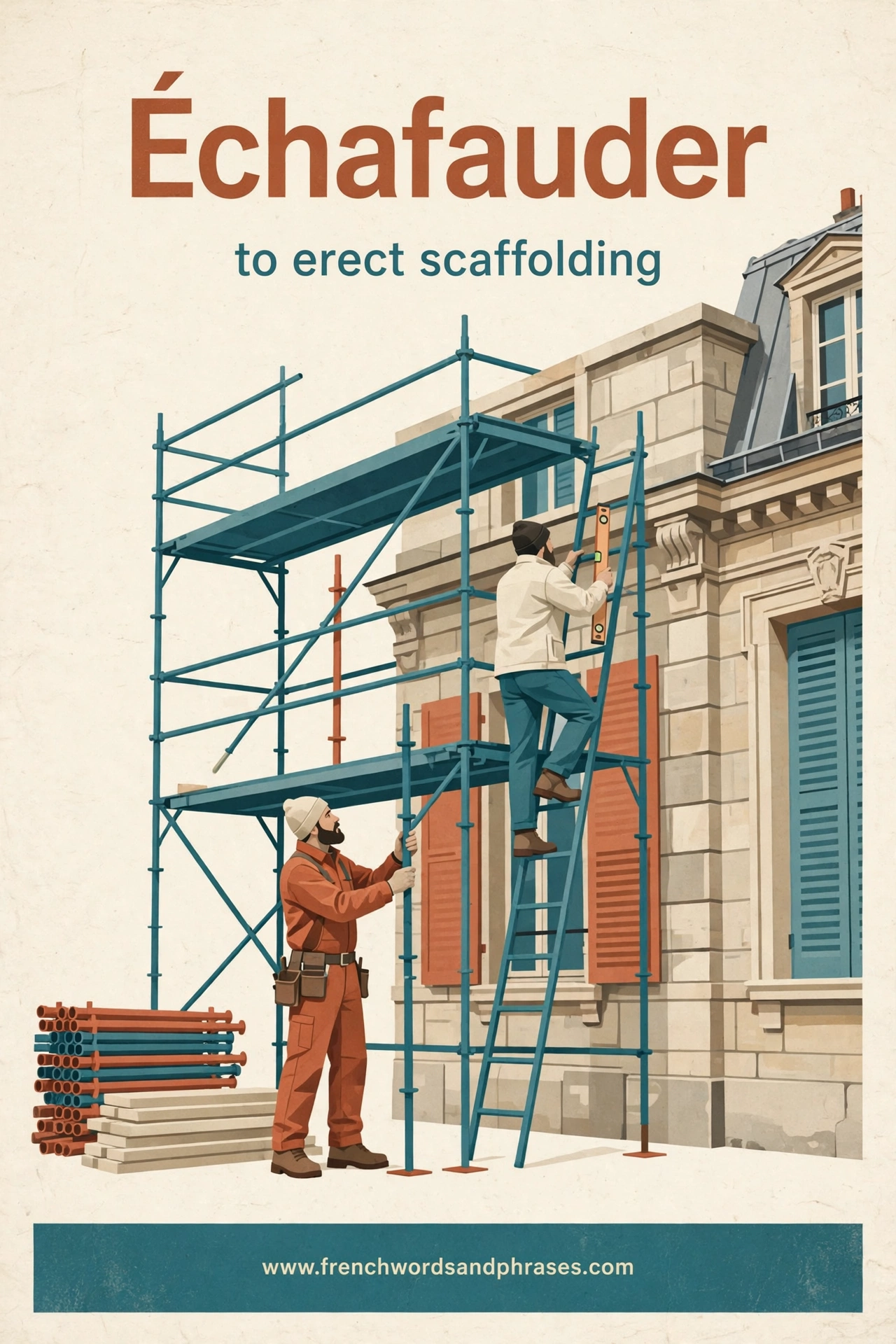
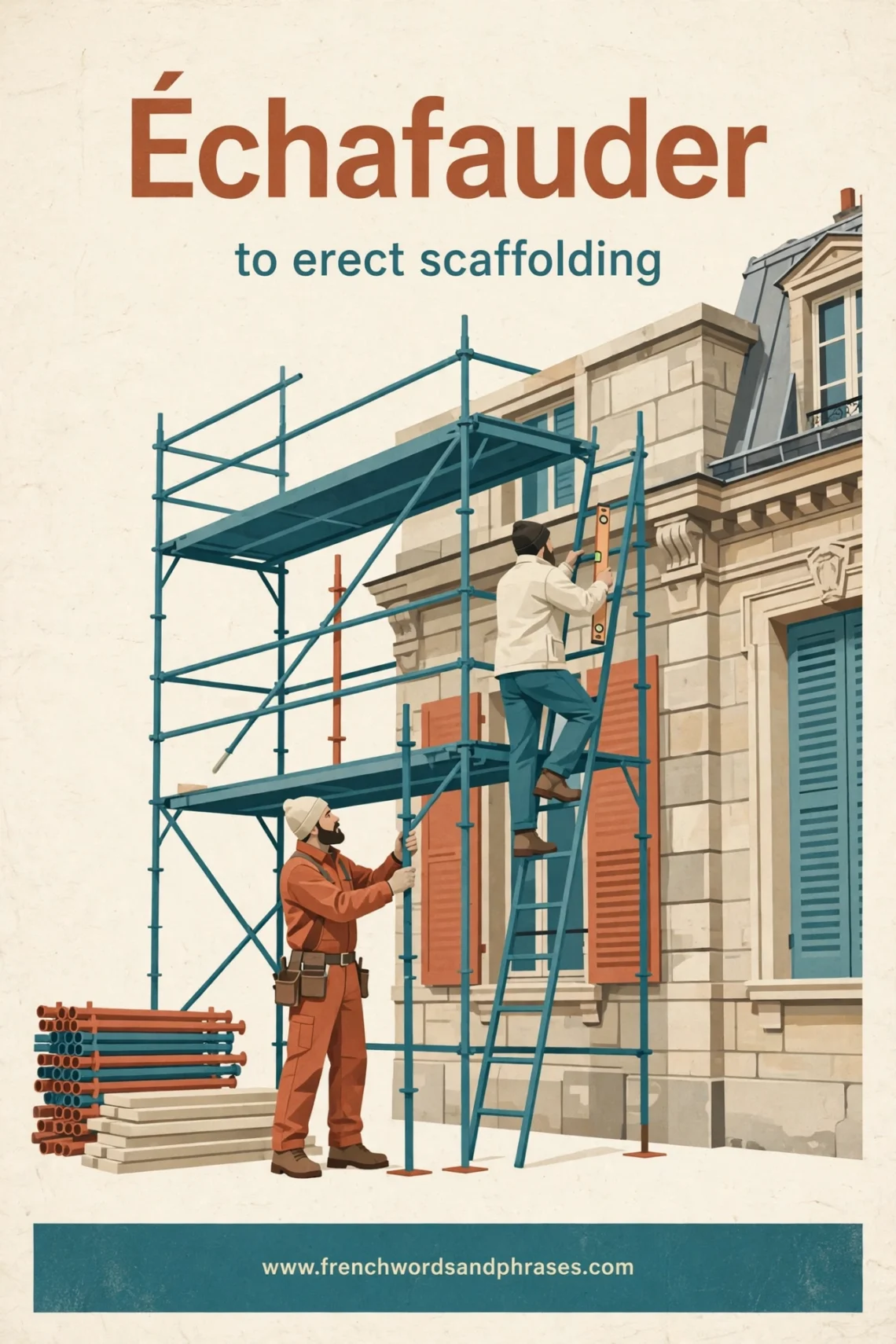
Échafauder means to erect scaffolding — and, figuratively, to build up plans and theories.
Steel tubes rising floor by floor along a cathedral wall, planks laid for the masons — and, in a quieter room, a mind piling idea on idea until a whole plan stands: échafauder is the verb of building scaffolding, in stone and in thought.
In this guide, you’ll learn how to conjugate échafauder in all the major French tenses and moods. Explore complete conjugation tables, French examples, English translations, and practice quizzes.
Understanding the French Verb Échafauder
Échafauder is a regular French verb belonging to the first group of verbs, those ending in -er.
It means to erect scaffolding. It is commonly used on building sites for putting up scaffolding around churches, towers and façades, and figuratively for constructing plans, projects, excuses and theories — anywhere French imagines ideas being assembled piece by piece into a structure that may or may not stand.
Verb classification: First group (-er)
Auxiliary verb: Avoir
Past participle: échafaudé
Present participle: échafaudant
English equivalents: To erect scaffolding; (figurative) to hatch, to build up — échafauder un plan, des projets, une théorie.
One important detail: échafauder has a famous family. The scaffolding itself is un échafaudage — the tubes and planks on every French building site. But its shorter cousin un échafaud is the scaffold of executions, the platform of the guillotine: same ancestor, two destinies. The figurative use is now the commonest: échafauder un plan, to hatch a plan, plank by plank, often with a hint that the structure is shaky — des théories échafaudées can sound more ingenious than solid.
Experience the Word
Échafauder is the verb of temporary structures — the frame you build so that the real work can begin.
Imagine the restoration of a village church. In a week, the tower disappears behind a cage of steel and planks; the masons climb to their aerial workshop, and the échafaudage becomes a second building wrapped around the first.
Nothing of the church has changed yet. The scaffolding has been érigé — échafaudé — and now everything is possible.
How to Conjugate Échafauder: Complete French Conjugation Guide
Let’s explore every major conjugation of échafauder, beginning with the indicative mood.
How to Conjugate Échafauder in the Indicative Mood
The indicative mood is used to express facts, observations, actions, and events.
How to Conjugate Échafauder in the Present Tense (Présent)
Used for actions happening now, habitual actions, and general truths.
| Subject | Conjugation |
|---|---|
| je | échafaude |
| tu | échafaudes |
| il / elle | échafaude |
| nous | échafaudons |
| vous | échafaudez |
| ils / elles | échafaudent |
Example
Les ouvriers échafaudent la tour du château pour la restaurer.
The workers are putting scaffolding up the castle tower to restore it.
Quick Quiz 1
Complete the sentence:
Nous ______ la façade de la mairie.
Reveal the answer
échafaudons
Nous échafaudons la façade de la mairie.
We scaffold the town hall façade.
How to Conjugate Échafauder in the Passé Composé
Used for completed actions in the past. Échafauder takes the auxiliary verb avoir.
| Subject | Conjugation |
|---|---|
| j’ | ai échafaudé |
| tu | as échafaudé |
| il / elle | a échafaudé |
| nous | avons échafaudé |
| vous | avez échafaudé |
| ils / elles | ont échafaudé |
Example
Ils ont échafaudé un plan pour sauver l’entreprise.
They hatched a plan to save the company.
How to Conjugate Échafauder in the Imparfait (Imperfect Tense)
Used for habitual past actions, descriptions, and ongoing situations in the past.
| Subject | Conjugation |
|---|---|
| je | échafaudais |
| tu | échafaudais |
| il / elle | échafaudait |
| nous | échafaudions |
| vous | échafaudiez |
| ils / elles | échafaudaient |
Example
Chaque printemps, on échafaudait la façade de la mairie.
Every spring, they used to put scaffolding up the town hall façade.
Quick Quiz 2
Choose the correct form:
They hatched a plan.
Ils ______ un plan. (ont échafaudé / sont échafaudés)
Reveal the answer
ont échafaudé
Ils ont échafaudé un plan.
Échafauder takes avoir.
How to Conjugate Échafauder in the Plus-que-parfait
Used to describe an action that had already been completed before another past event.
| Subject | Conjugation |
|---|---|
| j’ | avais échafaudé |
| tu | avais échafaudé |
| il / elle | avait échafaudé |
| nous | avions échafaudé |
| vous | aviez échafaudé |
| ils / elles | avaient échafaudé |
Example
Elle avait échafaudé toute une théorie sur des indices fragiles.
She had built a whole theory on fragile clues.
How to Conjugate Échafauder in the Passé Simple
Primarily used in formal writing, literature, and historical narratives. It is rarely used in everyday conversation.
| Subject | Conjugation |
|---|---|
| je | échafaudai |
| tu | échafaudas |
| il / elle | échafauda |
| nous | échafaudâmes |
| vous | échafaudâtes |
| ils / elles | échafaudèrent |
Example
En trois jours, l’équipe échafauda le clocher entier.
In three days, the team scaffolded the whole bell tower.
How to Conjugate Échafauder in the Passé Antérieur
A literary tense used to express an action completed immediately before another past action, generally in the passé simple.
| Subject | Conjugation |
|---|---|
| j’ | eus échafaudé |
| tu | eus échafaudé |
| il / elle | eut échafaudé |
| nous | eûmes échafaudé |
| vous | eûtes échafaudé |
| ils / elles | eurent échafaudé |
Example
Quand les maçons eurent échafaudé la nef, les travaux commencèrent.
When the masons had scaffolded the nave, the work began.
How to Conjugate Échafauder in the Future Tense (Futur Simple)
Used to describe actions that will take place in the future.
| Subject | Conjugation |
|---|---|
| je | échafauderai |
| tu | échafauderas |
| il / elle | échafaudera |
| nous | échafauderons |
| vous | échafauderez |
| ils / elles | échafauderont |
Example
Lundi, nous échafauderons le mur sud de l’église.
On Monday, we will put scaffolding up the south wall of the church.
How to Conjugate Échafauder in the Futur Antérieur (Future Perfect)
Used for an action that will have been completed before a particular point in the future.
| Subject | Conjugation |
|---|---|
| j’ | aurai échafaudé |
| tu | auras échafaudé |
| il / elle | aura échafaudé |
| nous | aurons échafaudé |
| vous | aurez échafaudé |
| ils / elles | auront échafaudé |
Example
À la fin du mois, ils auront échafaudé tout le château d’eau.
By the end of the month, they will have scaffolded the whole water tower.
How to Conjugate Échafauder in the Near Future (Futur Proche)
Used to describe something that is going to happen soon. Formed with aller + infinitive.
| Subject | Conjugation |
|---|---|
| je | vais échafauder |
| tu | vas échafauder |
| il / elle | va échafauder |
| nous | allons échafauder |
| vous | allez échafauder |
| ils / elles | vont échafauder |
Example
Il va échafauder un projet de voyage autour du monde.
He is going to build up a plan for a trip around the world.
How to Conjugate Échafauder in the Conditional Mood
The conditional mood expresses what would happen under certain circumstances. It is also frequently used to make polite requests or express wishes.
How to Conjugate Échafauder in the Present Conditional
| Subject | Conjugation |
|---|---|
| je | échafauderais |
| tu | échafauderais |
| il / elle | échafauderait |
| nous | échafauderions |
| vous | échafauderiez |
| ils / elles | échafauderaient |
Example
Sans autorisation, on n’échafauderait pas la façade.
Without permission, we would not scaffold the façade.
How to Conjugate Échafauder in the Past Conditional
| Subject | Conjugation |
|---|---|
| j’ | aurais échafaudé |
| tu | aurais échafaudé |
| il / elle | aurait échafaudé |
| nous | aurions échafaudé |
| vous | auriez échafaudé |
| ils / elles | auraient échafaudé |
Example
Ils auraient échafaudé des excuses si le directeur n’était pas intervenu.
They would have built up excuses if the director had not stepped in.
Échafauder in the Literary Past Conditional Form
This less common literary form uses the imperfect subjunctive of avoir.
| Subject | Conjugation |
|---|---|
| j’ | eusse échafaudé |
| tu | eusses échafaudé |
| il / elle | eût échafaudé |
| nous | eussions échafaudé |
| vous | eussiez échafaudé |
| ils / elles | eussent échafaudé |
Example
L’architecte eût échafaudé des merveilles sur ces fondations.
The architect would have raised marvels on these foundations.
How to Conjugate Échafauder in the Subjunctive Mood
The subjunctive is used to express wishes, emotions, doubts, necessity, and uncertainty. It frequently follows expressions such as il faut que (it is necessary that) or bien que (although).
How to Conjugate Échafauder in the Present Subjunctive
| Subject | Conjugation |
|---|---|
| que je | échafaude |
| que tu | échafaudes |
| qu’il / qu’elle | échafaude |
| que nous | échafaudions |
| que vous | échafaudiez |
| qu’ils / qu’elles | échafaudent |
Example
Il faut que l’entreprise échafaude le beffroi avant l’hiver.
The firm must scaffold the belfry before winter.
Quick Quiz 3
Complete the sentence using the subjunctive:
Il faut que vous ______ la tour avant l’hiver.
Reveal the answer
échafaudiez
Il faut que vous échafaudiez la tour avant l’hiver.
You must scaffold the tower before winter.
How to Conjugate Échafauder in the Imperfect Subjunctive
A literary tense, rarely encountered in modern spoken French.
| Subject | Conjugation |
|---|---|
| que je | échafaudasse |
| que tu | échafaudasses |
| qu’il / qu’elle | échafaudât |
| que nous | échafaudassions |
| que vous | échafaudassiez |
| qu’ils / qu’elles | échafaudassent |
Example
Le maire souhaitait que l’on échafaudât la tour sans fermer la place.
The mayor wanted the tower scaffolded without closing the square.
How to Conjugate Échafauder in the Pluperfect Subjunctive
A literary construction used to express an action completed before another past action.
| Subject | Conjugation |
|---|---|
| que j’ | eusse échafaudé |
| que tu | eusses échafaudé |
| qu’il / qu’elle | eût échafaudé |
| que nous | eussions échafaudé |
| que vous | eussiez échafaudé |
| qu’ils / qu’elles | eussent échafaudé |
Example
On sourit qu’il eût échafaudé tant de projets sur un seul espoir.
People smiled that he had built so many plans on a single hope.
How to Conjugate Échafauder in the Past Subjunctive
| Subject | Conjugation |
|---|---|
| que j’ | aie échafaudé |
| que tu | aies échafaudé |
| qu’il / qu’elle | ait échafaudé |
| que nous | ayons échafaudé |
| que vous | ayez échafaudé |
| qu’ils / qu’elles | aient échafaudé |
Example
Je suis impressionné qu’ils aient échafaudé la coupole en un mois.
I am impressed that they scaffolded the dome in one month.
How to Conjugate Échafauder in the Imperative
The imperative is used to give commands, instructions, invitations, or suggestions. Subject pronouns are omitted.
How to Conjugate Échafauder in the Present Imperative
| Person | Conjugation |
|---|---|
| (tu) | échafaude |
| (nous) | échafaudons |
| (vous) | échafaudez |
Example
Échafaudez le mur nord, les maçons arrivent demain !
Scaffold the north wall, the masons arrive tomorrow!
Quick Quiz 4
How would you say Scaffold the north wall (tu form)?
Reveal the answer
Échafaude le mur nord !
French Participles of Échafauder
Participles are verb forms that can be used in compound tenses and other grammatical constructions.
Present Participle of Échafauder
échafaudant
En échafaudant ses projets, il oubliait le temps qui passe.
While building up his plans, he forgot the passing of time.
Past Participle of Échafauder
échafaudé
Échafaudé en une semaine, le clocher attendait ses maçons.
Scaffolded in a week, the bell tower awaited its masons.
Échafauder in Everyday French: Real-Life Examples
Now that you know the conjugations, let’s see how échafauder appears in everyday French.
Example 1 — Present
Les maçons échafaudent la façade de l’école.
The masons are scaffolding the school façade.
Example 2 — Passé composé
Elle a échafaudé un plan pour ouvrir sa librairie.
She hatched a plan to open her bookshop.
Example 3 — Imparfait
On échafaudait le château chaque été pour les réparations.
They used to scaffold the castle every summer for repairs.
Example 4 — Future
Nous échafauderons la tour au printemps.
We will scaffold the tower in spring.
Example 5 — Conditional
Tu échafauderais quel projet, toi, avec un an de liberté ?
What plan would you build up, with a year of freedom?
Example 6 — Imperative
Échafaudez solidement, le vent se lève !
Scaffold solidly, the wind is rising!
Beyond Translation: The Meaning of Échafauder
English scaffold stays on the building site; French échafauder climbs down and goes to work in the mind.
Every grand plan is an échafaudage.
French hears the planks and poles inside an ambitious project — impressive, yes, but also temporary, assembled, and just possibly one bolt away from collapse. The metaphor is built into the verb.
How to Remember the French Verb Échafauder
Remember it this way: Échafauder is about scaffolding in steel and in thought — the frame before the work.
- Un échafaudage — scaffolding; un échafaud — the execution scaffold, its grim cousin.
- Échafauder un plan — to hatch a plan, with a hint the structure may be shaky.
- Regular -er: j’échafaude, nous échafaudons, past participle échafaudé.
The key idea is scaffolding in steel and in thought — the frame before the work.
Test Your Knowledge of Échafauder
Let’s see how much you’ve learned. Try answering these questions before revealing the answers.
Question 1
What is un échafaudage?
Reveal the answer
Scaffolding — the tubes and planks put up around a building.
Question 2
How do you say They hatched a plan to save the company in French?
Reveal the answer
Ils ont échafaudé un plan pour sauver l’entreprise.
Question 3
Translate: The workers are putting scaffolding up the castle tower.
Reveal the answer
Les ouvriers échafaudent la tour du château.
Question 4
What is the past participle of échafauder?
Reveal the answer
Échafaudé.
Question 5
Complete the sentence:
Il faut que l’entreprise ______ le beffroi avant l’hiver.
Reveal the answer
échafaude
Il faut que l’entreprise échafaude le beffroi avant l’hiver.
The firm must scaffold the belfry before winter.
Your Final Challenge
Can You Use It?
How would you say this in French?
The workers scaffold the bell tower, and the whole village follows the work.
Reveal the answer
Les ouvriers échafaudent le clocher, et le village entier suit les travaux.
The workers scaffold the bell tower, and the whole village follows the work.
A little French. A little curiosity. A richer everyday life.
LEARN FRENCH ONE WORD AT A TIME