A French Word to Live By
How to Conjugate Écaler in French
/e.ka.le/
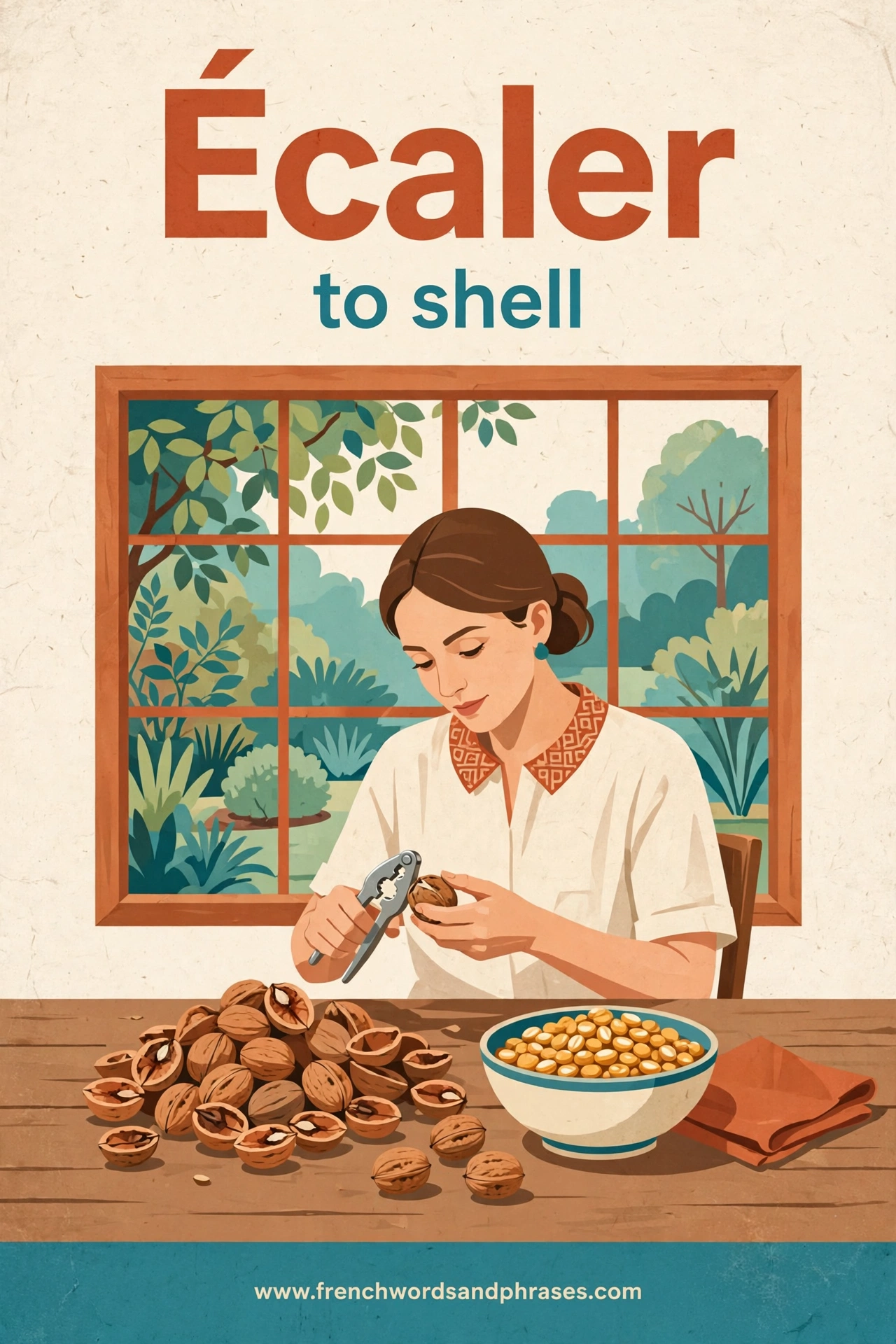
Écaler means to shell — to take the hard shell off an egg or a nut.
A boiled egg tapped against the rim of a bowl, walnuts cracked open on an autumn table, shell falling away in curved pieces — écaler is the verb of removing the hard shell, the small satisfying moment when the food inside is finally free.
In this guide, you’ll learn how to conjugate écaler in all the major French tenses and moods. Explore complete conjugation tables, French examples, English translations, and practice quizzes.
Understanding the French Verb Écaler
Écaler is a regular French verb belonging to the first group of verbs, those ending in -er.
It means to shell. It is commonly used for shelling hard-boiled eggs at breakfast and in salads, for shelling walnuts, hazelnuts and chestnuts in autumn cooking, and in the reflexive for shells that split open by themselves — at hatching time, or when heat and ripeness do the work.
Verb classification: First group (-er)
Auxiliary verb: Avoir
Past participle: écalé
Present participle: écalant
English equivalents: To shell (a boiled egg, nuts); s’écaler — (of a shell) to split open, to crack by itself.
One important detail: écaler is for hard shells — eggs and nuts. The shell itself is la coquille (for an egg or a nut) and the verb works in the kitchen every day: écaler un œuf dur, to shell a hard-boiled egg; écaler des noix, to shell walnuts. The reflexive s’écaler describes the shell splitting open on its own — a ripe chestnut bursting, an egg cracking as the chick pushes from inside. Do not confuse it with écosser, which pods peas and beans.
Experience the Word
Écaler is the verb of the hard outside giving way — a few taps, a crack, and the smooth egg appears.
Imagine a farmhouse kitchen in October. A bowl of walnuts from the garden tree, a small hammer, two patient hands — and all afternoon the shells are écalées one by one while the kernels pile up for a tart.
The shell has done its protecting. Now it is removed — écalé — and the good part is ready.
How to Conjugate Écaler: Complete French Conjugation Guide
Let’s explore every major conjugation of écaler, beginning with the indicative mood.
How to Conjugate Écaler in the Indicative Mood
The indicative mood is used to express facts, observations, actions, and events.
How to Conjugate Écaler in the Present Tense (Présent)
Used for actions happening now, habitual actions, and general truths.
| Subject | Conjugation |
|---|---|
| je | écale |
| tu | écales |
| il / elle | écale |
| nous | écalons |
| vous | écalez |
| ils / elles | écalent |
Example
Elle écale les œufs durs pour la salade.
She shells the hard-boiled eggs for the salad.
Quick Quiz 1
Complete the sentence:
Nous ______ les noix pour la tarte.
Reveal the answer
écalons
Nous écalons les noix pour la tarte.
We shell the walnuts for the tart.
How to Conjugate Écaler in the Passé Composé
Used for completed actions in the past. Écaler takes the auxiliary verb avoir.
| Subject | Conjugation |
|---|---|
| j’ | ai écalé |
| tu | as écalé |
| il / elle | a écalé |
| nous | avons écalé |
| vous | avez écalé |
| ils / elles | ont écalé |
Example
Nous avons écalé deux kilos de noix ce matin.
We shelled two kilos of walnuts this morning.
How to Conjugate Écaler in the Imparfait (Imperfect Tense)
Used for habitual past actions, descriptions, and ongoing situations in the past.
| Subject | Conjugation |
|---|---|
| je | écalais |
| tu | écalais |
| il / elle | écalait |
| nous | écalions |
| vous | écaliez |
| ils / elles | écalaient |
Example
Ma grand-mère écalait les noix en écoutant la radio.
My grandmother used to shell walnuts while listening to the radio.
Quick Quiz 2
Choose the correct form:
She shelled the eggs.
Elle ______ les œufs. (a écalé / est écalée)
Reveal the answer
a écalé
Elle a écalé les œufs.
Écaler takes avoir.
How to Conjugate Écaler in the Plus-que-parfait
Used to describe an action that had already been completed before another past event.
| Subject | Conjugation |
|---|---|
| j’ | avais écalé |
| tu | avais écalé |
| il / elle | avait écalé |
| nous | avions écalé |
| vous | aviez écalé |
| ils / elles | avaient écalé |
Example
La coquille s’était écalée pendant la cuisson.
The shell had split open during cooking.
How to Conjugate Écaler in the Passé Simple
Primarily used in formal writing, literature, and historical narratives. It is rarely used in everyday conversation.
| Subject | Conjugation |
|---|---|
| je | écalai |
| tu | écalas |
| il / elle | écala |
| nous | écalâmes |
| vous | écalâtes |
| ils / elles | écalèrent |
Example
Il écala son œuf d’un geste précis et le salit à peine.
He shelled his egg with one precise movement and barely dirtied it.
How to Conjugate Écaler in the Passé Antérieur
A literary tense used to express an action completed immediately before another past action, generally in the passé simple.
| Subject | Conjugation |
|---|---|
| j’ | eus écalé |
| tu | eus écalé |
| il / elle | eut écalé |
| nous | eûmes écalé |
| vous | eûtes écalé |
| ils / elles | eurent écalé |
Example
Quand elle eut écalé les châtaignes, elle les mit dans le lait chaud.
When she had shelled the chestnuts, she put them in the hot milk.
How to Conjugate Écaler in the Future Tense (Futur Simple)
Used to describe actions that will take place in the future.
| Subject | Conjugation |
|---|---|
| je | écalerai |
| tu | écaleras |
| il / elle | écalera |
| nous | écalerons |
| vous | écalerez |
| ils / elles | écaleront |
Example
Demain, nous écalerons les noisettes pour le gâteau.
Tomorrow, we will shell the hazelnuts for the cake.
How to Conjugate Écaler in the Futur Antérieur (Future Perfect)
Used for an action that will have been completed before a particular point in the future.
| Subject | Conjugation |
|---|---|
| j’ | aurai écalé |
| tu | auras écalé |
| il / elle | aura écalé |
| nous | aurons écalé |
| vous | aurez écalé |
| ils / elles | auront écalé |
Example
À midi, elle aura écalé tous les œufs de la salade niçoise.
By noon, she will have shelled all the eggs for the salade niçoise.
How to Conjugate Écaler in the Near Future (Futur Proche)
Used to describe something that is going to happen soon. Formed with aller + infinitive.
| Subject | Conjugation |
|---|---|
| je | vais écaler |
| tu | vas écaler |
| il / elle | va écaler |
| nous | allons écaler |
| vous | allez écaler |
| ils / elles | vont écaler |
Example
Je vais écaler les œufs, l’eau bout déjà.
I am going to shell the eggs, the water is already boiling.
How to Conjugate Écaler in the Conditional Mood
The conditional mood expresses what would happen under certain circumstances. It is also frequently used to make polite requests or express wishes.
How to Conjugate Écaler in the Present Conditional
| Subject | Conjugation |
|---|---|
| je | écalerais |
| tu | écalerais |
| il / elle | écalerait |
| nous | écalerions |
| vous | écaleriez |
| ils / elles | écaleraient |
Example
Avec un peu d’eau froide, on écalerait ces œufs sans effort.
With a little cold water, we would shell these eggs effortlessly.
How to Conjugate Écaler in the Past Conditional
| Subject | Conjugation |
|---|---|
| j’ | aurais écalé |
| tu | aurais écalé |
| il / elle | aurait écalé |
| nous | aurions écalé |
| vous | auriez écalé |
| ils / elles | auraient écalé |
Example
Elle aurait écalé les noix hier si le casse-noix n’avait pas disparu.
She would have shelled the walnuts yesterday if the nutcracker had not disappeared.
Écaler in the Literary Past Conditional Form
This less common literary form uses the imperfect subjunctive of avoir.
| Subject | Conjugation |
|---|---|
| j’ | eusse écalé |
| tu | eusses écalé |
| il / elle | eût écalé |
| nous | eussions écalé |
| vous | eussiez écalé |
| ils / elles | eussent écalé |
Example
La fermière eût écalé les œufs avant même le chant du coq.
The farmer’s wife would have shelled the eggs before the cock even crowed.
How to Conjugate Écaler in the Subjunctive Mood
The subjunctive is used to express wishes, emotions, doubts, necessity, and uncertainty. It frequently follows expressions such as il faut que (it is necessary that) or bien que (although).
How to Conjugate Écaler in the Present Subjunctive
| Subject | Conjugation |
|---|---|
| que je | écale |
| que tu | écales |
| qu’il / qu’elle | écale |
| que nous | écalions |
| que vous | écaliez |
| qu’ils / qu’elles | écalent |
Example
Il faut que tu écales les œufs pendant qu’ils sont tièdes.
You must shell the eggs while they are still warm.
Quick Quiz 3
Complete the sentence using the subjunctive:
Il faut que vous ______ les châtaignes.
Reveal the answer
écaliez
Il faut que vous écaliez les châtaignes.
You must shell the chestnuts.
How to Conjugate Écaler in the Imperfect Subjunctive
A literary tense, rarely encountered in modern spoken French.
| Subject | Conjugation |
|---|---|
| que je | écalasse |
| que tu | écalasses |
| qu’il / qu’elle | écalât |
| que nous | écalassions |
| que vous | écalassiez |
| qu’ils / qu’elles | écalassent |
Example
Je voulais qu’elle écalât les châtaignes avant le dîner.
I wanted her to shell the chestnuts before dinner.
How to Conjugate Écaler in the Pluperfect Subjunctive
A literary construction used to express an action completed before another past action.
| Subject | Conjugation |
|---|---|
| que j’ | eusse écalé |
| que tu | eusses écalé |
| qu’il / qu’elle | eût écalé |
| que nous | eussions écalé |
| que vous | eussiez écalé |
| qu’ils / qu’elles | eussent écalé |
Example
Il était content que la coquille se fût écalée si nettement.
He was pleased that the shell had split open so cleanly.
How to Conjugate Écaler in the Past Subjunctive
| Subject | Conjugation |
|---|---|
| que j’ | aie écalé |
| que tu | aies écalé |
| qu’il / qu’elle | ait écalé |
| que nous | ayons écalé |
| que vous | ayez écalé |
| qu’ils / qu’elles | aient écalé |
Example
Je suis ravi que vous ayez écalé les noix pour la tarte.
I am delighted that you shelled the walnuts for the tart.
How to Conjugate Écaler in the Imperative
The imperative is used to give commands, instructions, invitations, or suggestions. Subject pronouns are omitted.
How to Conjugate Écaler in the Present Imperative
| Person | Conjugation |
|---|---|
| (tu) | écale |
| (nous) | écalons |
| (vous) | écalez |
Example
Écale les œufs doucement, la coquille est fine !
Shell the eggs gently, the shell is thin!
Quick Quiz 4
How would you say Shell the eggs gently (tu form)?
Reveal the answer
Écale les œufs doucement !
French Participles of Écaler
Participles are verb forms that can be used in compound tenses and other grammatical constructions.
Present Participle of Écaler
écalant
En écalant son œuf, il écoutait les nouvelles du village.
While shelling his egg, he was listening to the village news.
Past Participle of Écaler
écalé
Écalés et coupés en deux, les œufs garnissent la salade.
Shelled and cut in half, the eggs garnish the salad.
Écaler in Everyday French: Real-Life Examples
Now that you know the conjugations, let’s see how écaler appears in everyday French.
Example 1 — Present
J’écale un œuf dur pour mon petit-déjeuner.
I shell a hard-boiled egg for my breakfast.
Example 2 — Passé composé
Ils ont écalé les noix du jardin.
They shelled the walnuts from the garden.
Example 3 — Imparfait
On écalait les châtaignes près du feu.
We used to shell the chestnuts by the fire.
Example 4 — Future
Nous écalerons les œufs pour le pique-nique.
We will shell the eggs for the picnic.
Example 5 — Conditional
Tu écalerais ces noisettes pour moi ?
Would you shell these hazelnuts for me?
Example 6 — Imperative
Écalez les œufs et mettez-les dans l’eau froide !
Shell the eggs and put them in cold water!
Beyond Translation: The Meaning of Écaler
English shell does every job at once — peas, eggs, nuts, even artillery; French splits the work with care.
Écaler is the hard-shell verb.
Eggs and walnuts are écalés, peas are écossés, prawns are décortiqués — three verbs where English keeps one, and each one pictures a different pair of hands at work.
How to Remember the French Verb Écaler
Remember it this way: Écaler is about the hard shell coming off — eggs and walnuts freed.
- La coquille — the shell; écaler is taking the coquille off an egg or a nut.
- S’écaler — the shell splits open by itself, as at hatching time.
- Regular -er: j’écale, nous écalons, past participle écalé.
The key idea is the hard shell coming off — eggs and walnuts freed.
Test Your Knowledge of Écaler
Let’s see how much you’ve learned. Try answering these questions before revealing the answers.
Question 1
How do you say to shell a hard-boiled egg in French?
Reveal the answer
Écaler un œuf dur.
Question 2
How do you say She shells the eggs for the salad in French?
Reveal the answer
Elle écale les œufs pour la salade.
Question 3
Translate: We shelled two kilos of walnuts this morning.
Reveal the answer
Nous avons écalé deux kilos de noix ce matin.
Question 4
What is the past participle of écaler?
Reveal the answer
Écalé.
Question 5
Complete the sentence:
Il faut que tu ______ les œufs pendant qu’ils sont tièdes.
Reveal the answer
écales
Il faut que tu écales les œufs pendant qu’ils sont tièdes.
You must shell the eggs while they are still warm.
Your Final Challenge
Can You Use It?
How would you say this in French?
She shells the eggs one by one, and the Sunday salad takes shape.
Reveal the answer
Elle écale les œufs un à un, et la salade du dimanche prend forme.
She shells the eggs one by one, and the Sunday salad takes shape.
A little French. A little curiosity. A richer everyday life.
LEARN FRENCH ONE WORD AT A TIME