A French Word to Live By
How to Conjugate Écailler in French
/e.ka.je/
Écailler means to scale a fish — to strip off its scales before cooking.
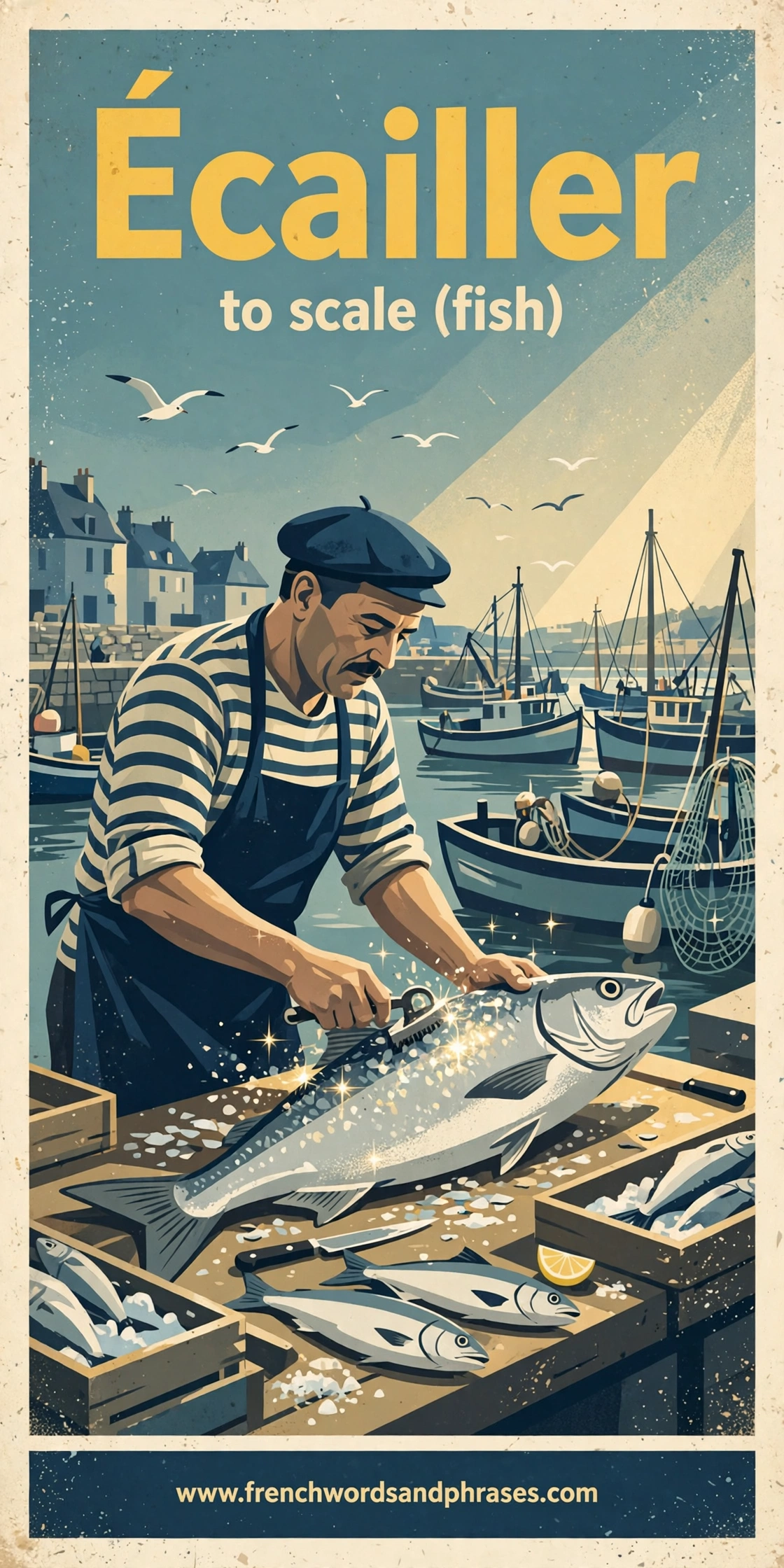
Scales flying like silver confetti over a quayside, a fishmonger’s knife working in short, practised strokes — écailler is the verb of preparing a fish: scraping away its scales so it can be gutted, rinsed and cooked.
In this guide, you’ll learn how to conjugate écailler in all the major French tenses and moods. Explore complete conjugation tables, French examples, English translations, and practice quizzes.
Understanding the French Verb Écailler
Écailler is a regular French verb belonging to the first group of verbs, those ending in -er.
It means to scale (fish). It is commonly used at the fishmonger’s and in the kitchen for scaling sea bass, bream, trout and salmon before cooking, and in the reflexive for paint, varnish and enamel flaking off walls, doors and old furniture.
Verb classification: First group (-er)
Auxiliary verb: Avoir
Past participle: écaillé
Present participle: écaillant
English equivalents: To scale (a fish); s’écailler — (of paint or varnish) to flake off; une écaille — a scale (of a fish, a tortoise, a pine cone).
One important detail: écailler is built on une écaille, a scale — the scale of a fish, but also of a tortoise, a butterfly’s wing or a pine cone. The fishmonger’s verb strips those scales away. But watch the reflexive: s’écailler belongs to paint and varnish — la peinture s’écaille, the paint flakes off in little scale-like pieces. One noun, two trades: the fish stall and the old door.
Experience the Word
Écailler is the verb of the bright mess before the good meal — nobody cooks the fish until somebody has done the scaling.
Imagine a harbour market at dawn. The stall is silver with fish, and the fishmonger’s hands never stop: a bass is écaillé in twenty strokes, scales sparkling in the air like tiny coins, then rinsed, wrapped and gone.
The fish has not yet been cooked, or even opened. It has been scaled — made ready, its armour removed.
How to Conjugate Écailler: Complete French Conjugation Guide
Let’s explore every major conjugation of écailler, beginning with the indicative mood.
How to Conjugate Écailler in the Indicative Mood
The indicative mood is used to express facts, observations, actions, and events.
How to Conjugate Écailler in the Present Tense (Présent)
Used for actions happening now, habitual actions, and general truths.
| Subject | Conjugation |
|---|---|
| je | écaille |
| tu | écailles |
| il / elle | écaille |
| nous | écaillons |
| vous | écaillez |
| ils / elles | écaillent |
Example
Le poissonnier écaille le bar en quelques gestes.
The fishmonger scales the sea bass in a few strokes.
Quick Quiz 1
Complete the sentence:
Nous ______ les dorades ce soir.
Reveal the answer
écaillons
Nous écaillons les dorades ce soir.
We are scaling the sea bream this evening.
How to Conjugate Écailler in the Passé Composé
Used for completed actions in the past. Écailler takes the auxiliary verb avoir.
| Subject | Conjugation |
|---|---|
| j’ | ai écaillé |
| tu | as écaillé |
| il / elle | a écaillé |
| nous | avons écaillé |
| vous | avez écaillé |
| ils / elles | ont écaillé |
Example
Elle a écaillé deux dorades pour le dîner.
She scaled two sea bream for dinner.
How to Conjugate Écailler in the Imparfait (Imperfect Tense)
Used for habitual past actions, descriptions, and ongoing situations in the past.
| Subject | Conjugation |
|---|---|
| je | écaillais |
| tu | écaillais |
| il / elle | écaillait |
| nous | écaillions |
| vous | écailliez |
| ils / elles | écaillaient |
Example
Mon grand-père écaillait ses truites au bord de la rivière.
My grandfather used to scale his trout by the river.
Quick Quiz 2
Choose the correct form:
She scaled two sea bream.
Elle ______ deux dorades. (a écaillé / est écaillée)
Reveal the answer
a écaillé
Elle a écaillé deux dorades.
Écailler takes avoir.
How to Conjugate Écailler in the Plus-que-parfait
Used to describe an action that had already been completed before another past event.
| Subject | Conjugation |
|---|---|
| j’ | avais écaillé |
| tu | avais écaillé |
| il / elle | avait écaillé |
| nous | avions écaillé |
| vous | aviez écaillé |
| ils / elles | avaient écaillé |
Example
Le cuisinier avait écaillé le poisson avant l’arrivée des clients.
The cook had scaled the fish before the customers arrived.
How to Conjugate Écailler in the Passé Simple
Primarily used in formal writing, literature, and historical narratives. It is rarely used in everyday conversation.
| Subject | Conjugation |
|---|---|
| je | écaillai |
| tu | écaillas |
| il / elle | écailla |
| nous | écaillâmes |
| vous | écaillâtes |
| ils / elles | écaillèrent |
Example
Le pêcheur écailla sa prise sur le quai.
The fisherman scaled his catch on the quay.
How to Conjugate Écailler in the Passé Antérieur
A literary tense used to express an action completed immediately before another past action, generally in the passé simple.
| Subject | Conjugation |
|---|---|
| j’ | eus écaillé |
| tu | eus écaillé |
| il / elle | eut écaillé |
| nous | eûmes écaillé |
| vous | eûtes écaillé |
| ils / elles | eurent écaillé |
Example
Quand elle eut écaillé le saumon, elle le rinça à l’eau froide.
When she had scaled the salmon, she rinsed it in cold water.
How to Conjugate Écailler in the Future Tense (Futur Simple)
Used to describe actions that will take place in the future.
| Subject | Conjugation |
|---|---|
| je | écaillerai |
| tu | écailleras |
| il / elle | écaillera |
| nous | écaillerons |
| vous | écaillerez |
| ils / elles | écailleront |
Example
Demain, nous écaillerons les rougets pour la bouillabaisse.
Tomorrow, we will scale the red mullet for the bouillabaisse.
How to Conjugate Écailler in the Futur Antérieur (Future Perfect)
Used for an action that will have been completed before a particular point in the future.
| Subject | Conjugation |
|---|---|
| j’ | aurai écaillé |
| tu | auras écaillé |
| il / elle | aura écaillé |
| nous | aurons écaillé |
| vous | aurez écaillé |
| ils / elles | auront écaillé |
Example
À six heures, le poissonnier aura écaillé tous les bars.
By six o’clock, the fishmonger will have scaled all the sea bass.
How to Conjugate Écailler in the Near Future (Futur Proche)
Used to describe something that is going to happen soon. Formed with aller + infinitive.
| Subject | Conjugation |
|---|---|
| je | vais écailler |
| tu | vas écailler |
| il / elle | va écailler |
| nous | allons écailler |
| vous | allez écailler |
| ils / elles | vont écailler |
Example
Je vais écailler ce poisson dehors, les écailles volent partout.
I am going to scale this fish outside, the scales fly everywhere.
How to Conjugate Écailler in the Conditional Mood
The conditional mood expresses what would happen under certain circumstances. It is also frequently used to make polite requests or express wishes.
How to Conjugate Écailler in the Present Conditional
| Subject | Conjugation |
|---|---|
| je | écaillerais |
| tu | écaillerais |
| il / elle | écaillerait |
| nous | écaillerions |
| vous | écailleriez |
| ils / elles | écailleraient |
Example
Avec un bon couteau, on écaillerait ce poisson en une minute.
With a good knife, you would scale this fish in a minute.
How to Conjugate Écailler in the Past Conditional
| Subject | Conjugation |
|---|---|
| j’ | aurais écaillé |
| tu | aurais écaillé |
| il / elle | aurait écaillé |
| nous | aurions écaillé |
| vous | auriez écaillé |
| ils / elles | auraient écaillé |
Example
Sans son aide, je n’aurais jamais écaillé ce brochet.
Without his help, I would never have scaled that pike.
Écailler in the Literary Past Conditional Form
This less common literary form uses the imperfect subjunctive of avoir.
| Subject | Conjugation |
|---|---|
| j’ | eusse écaillé |
| tu | eusses écaillé |
| il / elle | eût écaillé |
| nous | eussions écaillé |
| vous | eussiez écaillé |
| ils / elles | eussent écaillé |
Example
Le pêcheur eût écaillé sa truite au bord du ruisseau.
The fisherman would have scaled his trout by the stream.
How to Conjugate Écailler in the Subjunctive Mood
The subjunctive is used to express wishes, emotions, doubts, necessity, and uncertainty. It frequently follows expressions such as il faut que (it is necessary that) or bien que (although).
How to Conjugate Écailler in the Present Subjunctive
| Subject | Conjugation |
|---|---|
| que je | écaille |
| que tu | écailles |
| qu’il / qu’elle | écaille |
| que nous | écaillions |
| que vous | écailliez |
| qu’ils / qu’elles | écaillent |
Example
Il faut que tu écailles le poisson avant de le vider.
You must scale the fish before gutting it.
Quick Quiz 3
Complete the sentence using the subjunctive:
Il faut que vous ______ le poisson avant de le vider.
Reveal the answer
écailliez
Il faut que vous écailliez le poisson avant de le vider.
You must scale the fish before gutting it.
How to Conjugate Écailler in the Imperfect Subjunctive
A literary tense, rarely encountered in modern spoken French.
| Subject | Conjugation |
|---|---|
| que je | écaillasse |
| que tu | écaillasses |
| qu’il / qu’elle | écaillât |
| que nous | écaillassions |
| que vous | écaillassiez |
| qu’ils / qu’elles | écaillassent |
Example
Le chef voulait que l’apprenti écaillât les dorades.
The chef wanted the apprentice to scale the sea bream.
How to Conjugate Écailler in the Pluperfect Subjunctive
A literary construction used to express an action completed before another past action.
| Subject | Conjugation |
|---|---|
| que j’ | eusse écaillé |
| que tu | eusses écaillé |
| qu’il / qu’elle | eût écaillé |
| que nous | eussions écaillé |
| que vous | eussiez écaillé |
| qu’ils / qu’elles | eussent écaillé |
Example
On vérifia que le poissonnier eût écaillé tous les poissons.
They checked that the fishmonger had scaled all the fish.
How to Conjugate Écailler in the Past Subjunctive
| Subject | Conjugation |
|---|---|
| que j’ | aie écaillé |
| que tu | aies écaillé |
| qu’il / qu’elle | ait écaillé |
| que nous | ayons écaillé |
| que vous | ayez écaillé |
| qu’ils / qu’elles | aient écaillé |
Example
Je suis content que vous ayez écaillé le bar, il est prêt.
I am glad you scaled the sea bass, it is ready.
How to Conjugate Écailler in the Imperative
The imperative is used to give commands, instructions, invitations, or suggestions. Subject pronouns are omitted.
How to Conjugate Écailler in the Present Imperative
| Person | Conjugation |
|---|---|
| (tu) | écaille |
| (nous) | écaillons |
| (vous) | écaillez |
Example
Écaille le poisson au-dessus de l’évier !
Scale the fish over the sink!
Quick Quiz 4
How would you say Scale the fish outside (tu form)?
Reveal the answer
Écaille le poisson dehors !
French Participles of Écailler
Participles are verb forms that can be used in compound tenses and other grammatical constructions.
Present Participle of Écailler
écaillant
En écaillant la dorade, elle s’est couverte d’écailles brillantes.
While scaling the sea bream, she covered herself in shiny scales.
Past Participle of Écailler
écaillé
Écaillé et rincé, le bar attend sa cuisson.
Scaled and rinsed, the sea bass awaits cooking.
Écailler in Everyday French: Real-Life Examples
Now that you know the conjugations, let’s see how écailler appears in everyday French.
Example 1 — Present
La peinture s’écaille sur la vieille porte.
The paint is flaking off the old door.
Example 2 — Passé composé
Le poissonnier a écaillé trois bars ce matin.
The fishmonger scaled three sea bass this morning.
Example 3 — Imparfait
On écaillait les truites au bord de l’eau.
We used to scale the trout by the water’s edge.
Example 4 — Future
Nous écaillerons les dorades ce soir.
We will scale the sea bream this evening.
Example 5 — Conditional
Tu écaillerais ce poisson plus vite avec cet outil.
You would scale this fish faster with this tool.
Example 6 — Imperative
Écaille le poisson dehors !
Scale the fish outside!
Beyond Translation: The Meaning of Écailler
English to scale a fish is plain kitchen language; French écailler keeps the scale itself — une écaille — visible inside the verb.
And the same word flakes your paint.
Because paint, too, leaves in little scales, French lets one verb serve the fishmonger at dawn and the decorator at noon: le poisson est écaillé, la peinture s’écaille.
How to Remember the French Verb Écailler
Remember it this way: Écailler is about the fishmonger’s strokes — scales off the fish, flakes off the paint.
- Une écaille — a scale: of a fish, a tortoise or a pine cone; écailler removes them.
- La peinture s’écaille — paint flakes off, in little scale-like pieces (reflexive).
- Regular -er: j’écaille, nous écaillons, past participle écaillé.
The key idea is the fishmonger’s strokes — scales off the fish, flakes off the paint.
Test Your Knowledge of Écailler
Let’s see how much you’ve learned. Try answering these questions before revealing the answers.
Question 1
What is une écaille?
Reveal the answer
A scale — of a fish, a tortoise or a pine cone; écailler is removing them.
Question 2
How do you say The paint is flaking off the old door in French?
Reveal the answer
La peinture s’écaille sur la vieille porte.
Question 3
Translate: The fishmonger scaled three sea bass this morning.
Reveal the answer
Le poissonnier a écaillé trois bars ce matin.
Question 4
What is the past participle of écailler?
Reveal the answer
Écaillé.
Question 5
Complete the sentence:
Il faut que tu ______ le poisson avant de le vider.
Reveal the answer
écailles
Il faut que tu écailles le poisson avant de le vider.
You must scale the fish before gutting it.
Your Final Challenge
Can You Use It?
How would you say this in French?
The fishmonger scales the sea bass in twenty strokes, and the scales shine like silver coins.
Reveal the answer
Le poissonnier écaille le bar en vingt gestes, et les écailles brillent comme des pièces d’argent.
The fishmonger scales the sea bass in twenty strokes, and the scales shine like silver coins.
A little French. A little curiosity. A richer everyday life.
LEARN FRENCH ONE WORD AT A TIME