
A French Word to Live By
How to Conjugate Écarquiller in French
/e.kaʁ.ki.je/
Écarquiller means to open wide — almost always the eyes.
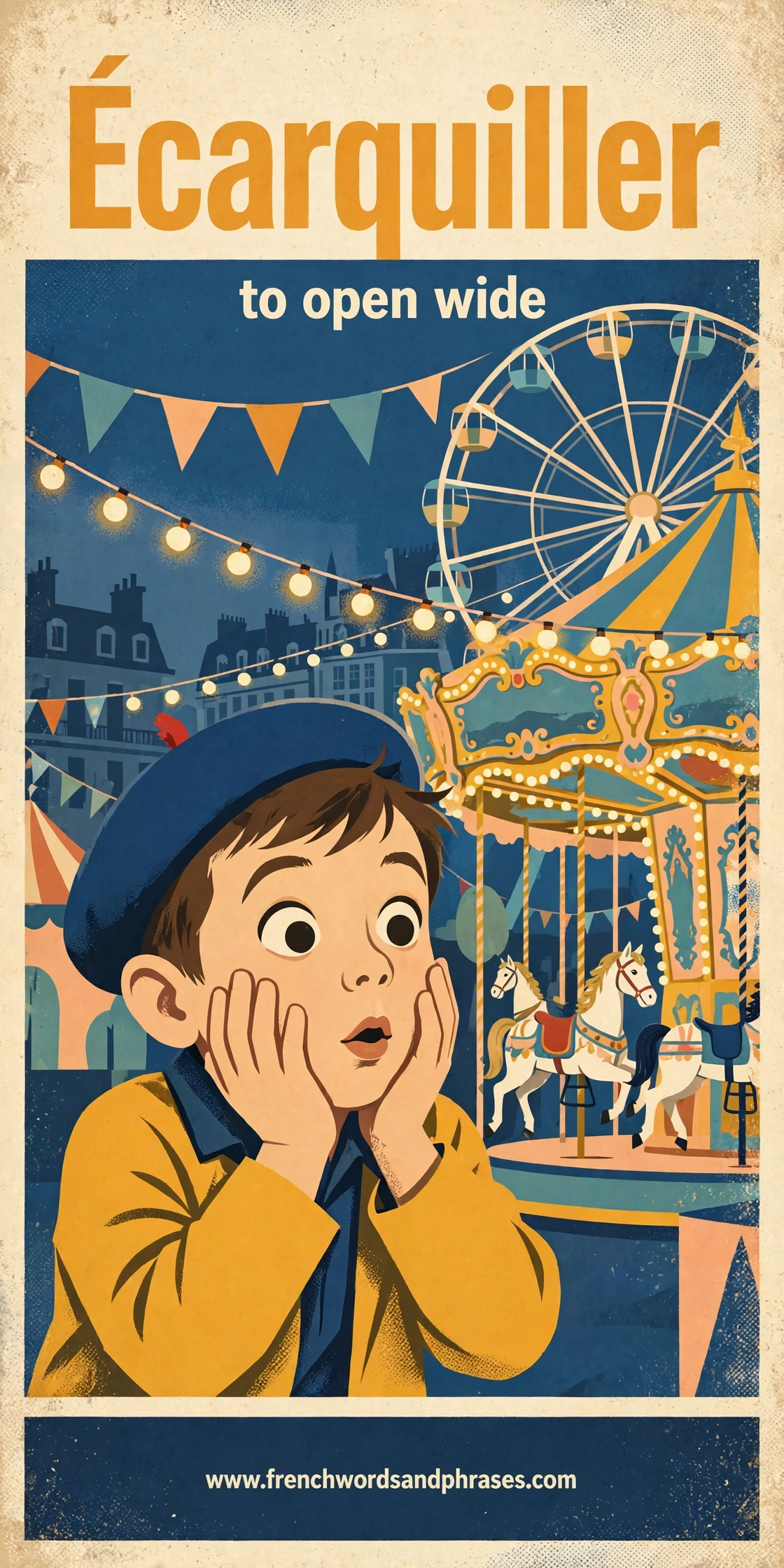
A child before a shop window full of cakes, a face hearing unbelievable news, eyes stretched to their widest — écarquiller is the verb of eyes opening wide, and it is so faithful to the eyes that French hardly uses it for anything else.
In this guide, you’ll learn how to conjugate écarquiller in all the major French tenses and moods. Explore complete conjugation tables, French examples, English translations, and practice quizzes.
Understanding the French Verb Écarquiller
Écarquiller is a regular French verb belonging to the first group of verbs, those ending in -er.
It means to open wide. It is commonly used for children staring at wonders, for faces frozen by astonishing news, in storytelling for owls, cats and cartoon-wide eyes, and in the past participle — les yeux écarquillés — wherever French describes amazement, fear or delighted disbelief.
Verb classification: First group (-er)
Auxiliary verb: Avoir
Past participle: écarquillé
Present participle: écarquillant
English equivalents: To open wide — used above all in écarquiller les yeux, to open one’s eyes wide, to stare in wonder or disbelief.
One important detail: écarquiller lives in one fixed partnership — écarquiller les yeux. Doors and windows are simply grands ouverts, but eyes are écarquillés: des yeux écarquillés, wide-open eyes, is the adjective form you will meet in every novel. The middle of the word, -quill-, is pronounced as in quille — /e.kaʁ.ki.je/ — a little skittle of a syllable inside the word.
Experience the Word
Écarquiller is the verb of the face before the mind has caught up — the eyes decide first, and they open wide.
Imagine a small boy arriving at the circus for the first time. The tent glows, the trapeze swings far above, and he stands at the entrance, écarquillant les yeux, trying to see everything at once.
He has not said a word. His eyes have opened wide — écarquillés — and said it all.
How to Conjugate Écarquiller: Complete French Conjugation Guide
Let’s explore every major conjugation of écarquiller, beginning with the indicative mood.
How to Conjugate Écarquiller in the Indicative Mood
The indicative mood is used to express facts, observations, actions, and events.
How to Conjugate Écarquiller in the Present Tense (Présent)
Used for actions happening now, habitual actions, and general truths.
| Subject | Conjugation |
|---|---|
| je | écarquille |
| tu | écarquilles |
| il / elle | écarquille |
| nous | écarquillons |
| vous | écarquillez |
| ils / elles | écarquillent |
Example
L’enfant écarquille les yeux devant la vitrine de jouets.
The child opens his eyes wide in front of the toy-shop window.
Quick Quiz 1
Complete the sentence:
Nous ______ les yeux devant le spectacle.
Reveal the answer
écarquillons
Nous écarquillons les yeux devant le spectacle.
We open our eyes wide in front of the show.
How to Conjugate Écarquiller in the Passé Composé
Used for completed actions in the past. Écarquiller takes the auxiliary verb avoir.
| Subject | Conjugation |
|---|---|
| j’ | ai écarquillé |
| tu | as écarquillé |
| il / elle | a écarquillé |
| nous | avons écarquillé |
| vous | avez écarquillé |
| ils / elles | ont écarquillé |
Example
Elle a écarquillé les yeux en entendant le prix.
She opened her eyes wide on hearing the price.
How to Conjugate Écarquiller in the Imparfait (Imperfect Tense)
Used for habitual past actions, descriptions, and ongoing situations in the past.
| Subject | Conjugation |
|---|---|
| je | écarquillais |
| tu | écarquillais |
| il / elle | écarquillait |
| nous | écarquillions |
| vous | écarquilliez |
| ils / elles | écarquillaient |
Example
Le chat écarquillait les yeux dans le noir du grenier.
The cat used to open its eyes wide in the darkness of the attic.
Quick Quiz 2
Choose the correct form:
She opened her eyes wide.
Elle ______ les yeux. (a écarquillé / est écarquillée)
Reveal the answer
a écarquillé
Elle a écarquillé les yeux.
Écarquiller takes avoir.
How to Conjugate Écarquiller in the Plus-que-parfait
Used to describe an action that had already been completed before another past event.
| Subject | Conjugation |
|---|---|
| j’ | avais écarquillé |
| tu | avais écarquillé |
| il / elle | avait écarquillé |
| nous | avions écarquillé |
| vous | aviez écarquillé |
| ils / elles | avaient écarquillé |
Example
Il avait écarquillé les yeux, incrédule, avant de rire.
He had opened his eyes wide, in disbelief, before laughing.
How to Conjugate Écarquiller in the Passé Simple
Primarily used in formal writing, literature, and historical narratives. It is rarely used in everyday conversation.
| Subject | Conjugation |
|---|---|
| je | écarquillai |
| tu | écarquillas |
| il / elle | écarquilla |
| nous | écarquillâmes |
| vous | écarquillâtes |
| ils / elles | écarquillèrent |
Example
À cette annonce, toute la salle écarquilla les yeux.
At this announcement, the whole room opened its eyes wide.
How to Conjugate Écarquiller in the Passé Antérieur
A literary tense used to express an action completed immediately before another past action, generally in the passé simple.
| Subject | Conjugation |
|---|---|
| j’ | eus écarquillé |
| tu | eus écarquillé |
| il / elle | eut écarquillé |
| nous | eûmes écarquillé |
| vous | eûtes écarquillé |
| ils / elles | eurent écarquillé |
Example
Quand elle eut écarquillé les yeux, elle reconnut enfin son frère.
When she had opened her eyes wide, she finally recognised her brother.
How to Conjugate Écarquiller in the Future Tense (Futur Simple)
Used to describe actions that will take place in the future.
| Subject | Conjugation |
|---|---|
| je | écarquillerai |
| tu | écarquilleras |
| il / elle | écarquillera |
| nous | écarquillerons |
| vous | écarquillerez |
| ils / elles | écarquilleront |
Example
Tu écarquilleras les yeux quand tu verras la surprise.
You will open your eyes wide when you see the surprise.
How to Conjugate Écarquiller in the Futur Antérieur (Future Perfect)
Used for an action that will have been completed before a particular point in the future.
| Subject | Conjugation |
|---|---|
| j’ | aurai écarquillé |
| tu | auras écarquillé |
| il / elle | aura écarquillé |
| nous | aurons écarquillé |
| vous | aurez écarquillé |
| ils / elles | auront écarquillé |
Example
À la fin du tour de magie, les enfants auront écarquillé les yeux dix fois.
By the end of the magic trick, the children will have opened their eyes wide ten times.
How to Conjugate Écarquiller in the Near Future (Futur Proche)
Used to describe something that is going to happen soon. Formed with aller + infinitive.
| Subject | Conjugation |
|---|---|
| je | vais écarquiller |
| tu | vas écarquiller |
| il / elle | va écarquiller |
| nous | allons écarquiller |
| vous | allez écarquiller |
| ils / elles | vont écarquiller |
Example
Regarde, le bébé va écarquiller les yeux devant le sapin.
Look, the baby is going to open his eyes wide in front of the Christmas tree.
How to Conjugate Écarquiller in the Conditional Mood
The conditional mood expresses what would happen under certain circumstances. It is also frequently used to make polite requests or express wishes.
How to Conjugate Écarquiller in the Present Conditional
| Subject | Conjugation |
|---|---|
| je | écarquillerais |
| tu | écarquillerais |
| il / elle | écarquillerait |
| nous | écarquillerions |
| vous | écarquilleriez |
| ils / elles | écarquilleraient |
Example
N’importe qui écarquillerait les yeux devant un tel spectacle.
Anyone would open their eyes wide at such a sight.
How to Conjugate Écarquiller in the Past Conditional
| Subject | Conjugation |
|---|---|
| j’ | aurais écarquillé |
| tu | aurais écarquillé |
| il / elle | aurait écarquillé |
| nous | aurions écarquillé |
| vous | auriez écarquillé |
| ils / elles | auraient écarquillé |
Example
Elle aurait écarquillé les yeux si elle avait vu la taille du gâteau.
She would have opened her eyes wide if she had seen the size of the cake.
Écarquiller in the Literary Past Conditional Form
This less common literary form uses the imperfect subjunctive of avoir.
| Subject | Conjugation |
|---|---|
| j’ | eusse écarquillé |
| tu | eusses écarquillé |
| il / elle | eût écarquillé |
| nous | eussions écarquillé |
| vous | eussiez écarquillé |
| ils / elles | eussent écarquillé |
Example
La bergère eût écarquillé les yeux devant la fée marraine.
The shepherdess would have opened her eyes wide before the fairy godmother.
How to Conjugate Écarquiller in the Subjunctive Mood
The subjunctive is used to express wishes, emotions, doubts, necessity, and uncertainty. It frequently follows expressions such as il faut que (it is necessary that) or bien que (although).
How to Conjugate Écarquiller in the Present Subjunctive
| Subject | Conjugation |
|---|---|
| que je | écarquille |
| que tu | écarquilles |
| qu’il / qu’elle | écarquille |
| que nous | écarquillions |
| que vous | écarquilliez |
| qu’ils / qu’elles | écarquillent |
Example
Il est normal que le petit écarquille les yeux, tout est nouveau pour lui.
It is normal for the little one to open his eyes wide, everything is new to him.
Quick Quiz 3
Complete the sentence using the subjunctive:
Il est normal que vous ______ les yeux de surprise.
Reveal the answer
écarquilliez
Il est normal que vous écarquilliez les yeux de surprise.
It is normal for you to open your eyes wide in surprise.
How to Conjugate Écarquiller in the Imperfect Subjunctive
A literary tense, rarely encountered in modern spoken French.
| Subject | Conjugation |
|---|---|
| que je | écarquillasse |
| que tu | écarquillasses |
| qu’il / qu’elle | écarquillât |
| que nous | écarquillassions |
| que vous | écarquillassiez |
| qu’ils / qu’elles | écarquillassent |
Example
Rien n’exigeait qu’elle écarquillât les yeux de cette façon.
Nothing required her to open her eyes wide like that.
How to Conjugate Écarquiller in the Pluperfect Subjunctive
A literary construction used to express an action completed before another past action.
| Subject | Conjugation |
|---|---|
| que j’ | eusse écarquillé |
| que tu | eusses écarquillé |
| qu’il / qu’elle | eût écarquillé |
| que nous | eussions écarquillé |
| que vous | eussiez écarquillé |
| qu’ils / qu’elles | eussent écarquillé |
Example
On aurait dit qu’il eût écarquillé les yeux toute la soirée.
It looked as if he had kept his eyes wide open all evening.
How to Conjugate Écarquiller in the Past Subjunctive
| Subject | Conjugation |
|---|---|
| que j’ | aie écarquillé |
| que tu | aies écarquillé |
| qu’il / qu’elle | ait écarquillé |
| que nous | ayons écarquillé |
| que vous | ayez écarquillé |
| qu’ils / qu’elles | aient écarquillé |
Example
Je suis amusé qu’elle ait écarquillé les yeux en voyant le cadeau.
I am amused that she opened her eyes wide on seeing the present.
How to Conjugate Écarquiller in the Imperative
The imperative is used to give commands, instructions, invitations, or suggestions. Subject pronouns are omitted.
How to Conjugate Écarquiller in the Present Imperative
| Person | Conjugation |
|---|---|
| (tu) | écarquille |
| (nous) | écarquillons |
| (vous) | écarquillez |
Example
Écarquille les yeux et cherche bien, le trésor est caché ici !
Open your eyes wide and search carefully, the treasure is hidden here!
Quick Quiz 4
How would you say Open your eyes wide (tu form)?
Reveal the answer
Écarquille les yeux !
French Participles of Écarquiller
Participles are verb forms that can be used in compound tenses and other grammatical constructions.
Present Participle of Écarquiller
écarquillant
Écarquillant les yeux, l’enfant regardait passer les jongleurs.
Opening his eyes wide, the child watched the jugglers go past.
Past Participle of Écarquiller
écarquillé
Les yeux écarquillés, elle écoutait l’histoire sans respirer.
Her eyes wide open, she listened to the story without breathing.
Écarquiller in Everyday French: Real-Life Examples
Now that you know the conjugations, let’s see how écarquiller appears in everyday French.
Example 1 — Present
Le bébé écarquille les yeux devant les lumières.
The baby opens his eyes wide in front of the lights.
Example 2 — Passé composé
Il a écarquillé les yeux en voyant la note.
He opened his eyes wide on seeing the bill.
Example 3 — Imparfait
Les enfants écarquillaient les yeux devant le magicien.
The children used to open their eyes wide in front of the magician.
Example 4 — Future
Vous écarquillerez les yeux devant ce paysage.
You will open your eyes wide in front of this landscape.
Example 5 — Conditional
Qui n’écarquillerait pas les yeux devant un tel trésor ?
Who would not open their eyes wide at such a treasure?
Example 6 — Imperative
Écarquillez les yeux, le spectacle commence !
Open your eyes wide, the show is starting!
Beyond Translation: The Meaning of Écarquiller
English says wide-eyed and leaves the verb behind; French écarquiller makes the widening itself an action, something eyes do in a split second of wonder.
It is the verb form of the wide-eyed look.
A novelist writes les yeux écarquillés and the reader sees the whole face — surprise, innocence and delight in a single participle.
How to Remember the French Verb Écarquiller
Remember it this way: Écarquiller is about eyes stretched wide — wonder written on the face.
- One fixed partnership: écarquiller les yeux — to open one’s eyes wide.
- Des yeux écarquillés — wide-open eyes, the form novels love.
- Regular -er: j’écarquille, nous écarquillons, past participle écarquillé.
The key idea is eyes stretched wide — wonder written on the face.
Test Your Knowledge of Écarquiller
Let’s see how much you’ve learned. Try answering these questions before revealing the answers.
Question 1
What goes with écarquiller, almost every time?
Reveal the answer
Les yeux — écarquiller les yeux, to open one’s eyes wide.
Question 2
How do you say She opened her eyes wide in French?
Reveal the answer
Elle a écarquillé les yeux.
Question 3
Translate: The child opens his eyes wide in front of the toy-shop window.
Reveal the answer
L’enfant écarquille les yeux devant la vitrine de jouets.
Question 4
What is the past participle of écarquiller?
Reveal the answer
Écarquillé.
Question 5
Complete the sentence:
Il est normal que le petit ______ les yeux, tout est nouveau.
Reveal the answer
écarquille
Il est normal que le petit écarquille les yeux, tout est nouveau.
It is normal for the little one to open his eyes wide, everything is new.
Your Final Challenge
Can You Use It?
How would you say this in French?
The child opens his eyes wide in front of the lit-up tree, and Christmas begins.
Reveal the answer
L’enfant écarquille les yeux devant le sapin illuminé, et Noël commence.
The child opens his eyes wide in front of the lit-up tree, and Christmas begins.
A little French. A little curiosity. A richer everyday life.
LEARN FRENCH ONE WORD AT A TIME




