A French Word to Live By
Translate Nature to English
/na.tyʁ/
La nature means nature.
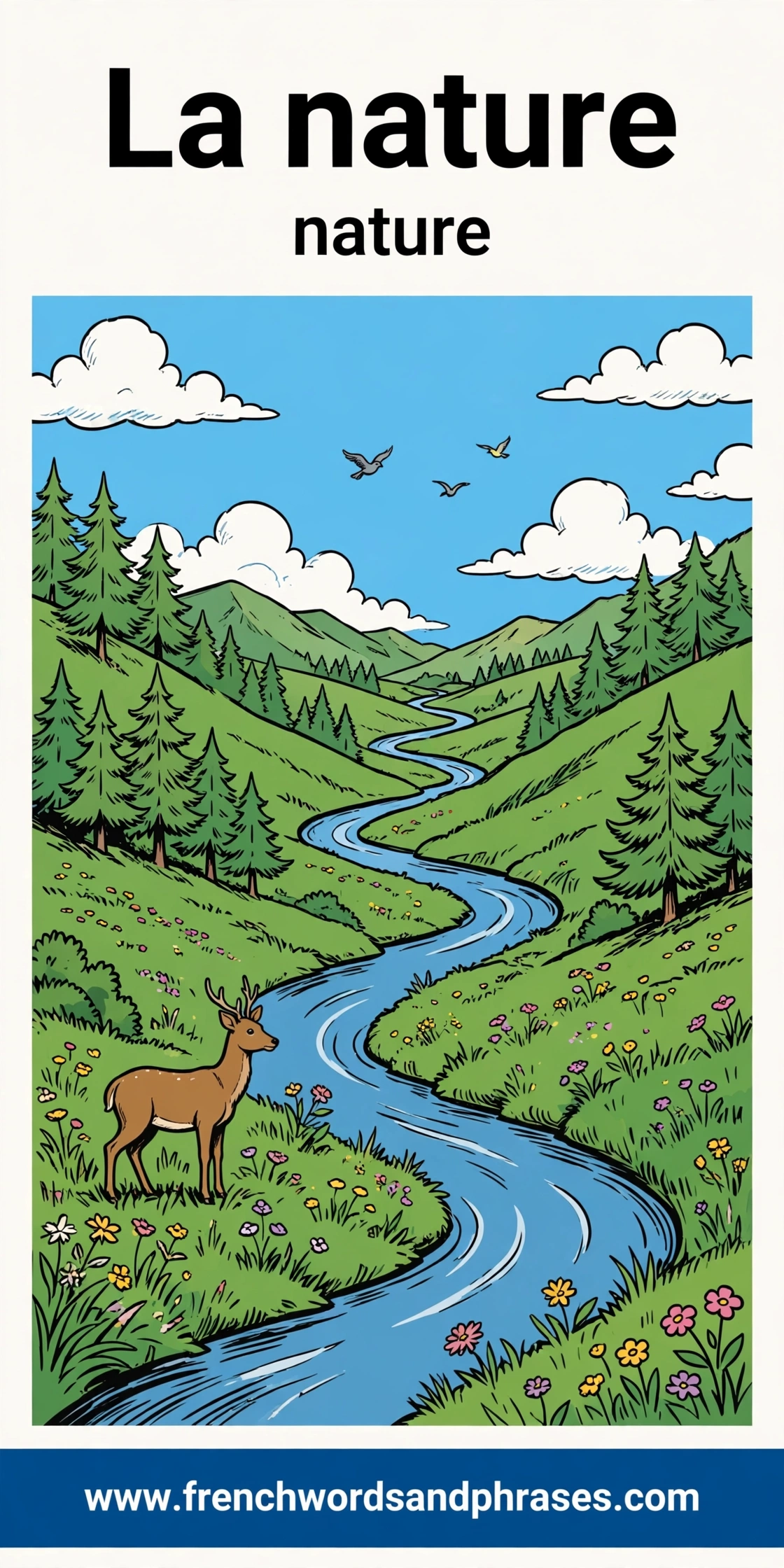
Mist on the river at dawn, the first green of March, a fox crossing the field at dusk: la nature, nature — the whole living world that was here before us, and the deep character inside each of us that no education quite rewrites.
In this guide, you’ll learn what nature means in English, how to use it with its articles, how to form its plural, and how it appears in everyday French. Explore French examples, English translations, and practice quizzes.
Understanding the French Noun Nature
Nature is a feminine French noun, learned with its article: la nature, une nature. It comes from the Latin natura, birth and character, from nasci, to be born. French keeps its two great senses side by side: the natural world outdoors, and the inborn character of a person or thing — la nature humaine, human nature, la nature d’un problème, the nature of a problem.
Outdoors first: aimer la nature, to love nature, se promener dans la nature, to walk in nature, protéger la nature, to protect nature — and the painter’s une nature morte, a still life, literally dead nature. Then the inner sense: il est généreux de nature, he is generous by nature, la nature des choses, the nature of things. The word even serves at the café: un café nature, a black coffee with nothing in it, une omelette nature, a plain omelette — nature as the adjective of plainness.
Gender: Feminine — la nature
Definite article: la — la nature (nature)
Indefinite article: une — une nature (a nature, a character)
Plural: les natures — for kinds of character: des natures différentes
Spelling note: from Latin natura, birth — from nasci, to be born
Two great senses: the natural world, and inborn character
English equivalents: Nature.
For the countryside world, French often says dans la nature where English says in the wild or outdoors. The character sense loves the frame de nature: calme de nature, calm by nature. And the café sense is a small daily pleasure: nature after a dish means plain, unadorned — des crêpes nature, plain crêpes, un yaourt nature, a plain yoghurt.
Experience the Word
Nature is the word where the forest and the soul meet — what grows outside us, and what was born inside us.
Imagine the first walk after a long winter: the hedges loud with birds, the fields steaming in the sun, and the whole valley smelling of rain and green — la nature se réveille, and everyone on the path is walking a little slower.
You have not just named the outdoors. You have named the born character of everything — la nature, outside and in.
How to Use Nature in French: Complete Guide
Let’s explore how nature works in French, beginning with its articles — la nature, dans la nature, de nature.
Nature with the Definite Article (La, Les)
Used for nature itself — the world outdoors, or the character of a thing.
| Form | French |
|---|---|
| Feminine singular | la nature |
| Plural | les natures |
Example
La nature reprend ses droits au printemps.
Nature reclaims its rights in spring.
Nature with the Indefinite Article (Une, Des)
Used for a nature — a character, a temperament of a person.
| Form | French |
|---|---|
| Feminine singular | une nature |
| Plural | des natures |
Example
C’est une nature calme et patiente.
She is a calm and patient nature.
Nature with Its Prepositions (Dans, En, De…)
Nature is walked in, lived close to, and born with — its prepositions tell the story.
| Expression | French |
|---|---|
| in nature, outdoors | dans la nature |
| close to nature | près de la nature |
| by nature | de nature |
| against nature | contre nature |
| in the wild state | à l’état de nature |
Example
Nous passons le week-end dans la nature.
We are spending the weekend in the countryside.
Quick Quiz 1
Complete the sentence:
______ nature est belle en automne. (nature / the nature)
Reveal the answer
La
La nature est belle en automne.
Nature is beautiful in autumn — nature is feminine, so la.
The Plural of Nature
The plural les natures belongs to the character sense — kinds of temperaments.
| Number | French |
|---|---|
| Singular | la nature |
| Plural | les natures |
Example
Les natures sensibles souffrent du bruit de la ville.
Sensitive natures suffer from the noise of the city.
Nature with Possessive Adjectives (Ma, Ta, Sa…)
Possessives agree with the noun: nature is feminine, so ma, ta, sa in the singular — used for a person’s character.
| Owner | French |
|---|---|
| my | ma nature |
| your (tu) | ta nature |
| his / her | sa nature |
| our | notre nature |
| your (vous) | votre nature |
| their | leur nature |
Example
Sa nature généreuse le pousse à aider tout le monde.
His generous nature leads him to help everyone.
Quick Quiz 2
Complete the sentence:
Il est optimiste de ______, il voit toujours le bon côté. (nature)
Reveal the answer
nature
Il est optimiste de nature, il voit toujours le bon côté.
He is an optimist by nature, he always sees the good side — de nature, by nature.
Nature with Demonstrative Adjectives (Cette, Ces)
Used to point: cette nature, this nature — this landscape, this temperament.
| Form | French |
|---|---|
| Feminine singular | cette nature |
| Plural | ces natures |
Example
Cette nature sauvage attire les photographes.
This wild nature attracts photographers.
Nature with Adjectives
Adjectives agree with nature — feminine singular: la nature humaine, une nature généreuse.
| Adjective | With Nature |
|---|---|
| humaine (human) | la nature humaine |
| sauvage (wild) | la nature sauvage |
| généreuse (generous) | une nature généreuse |
| morte (still life) | une nature morte |
| profonde (deep) | la nature profonde des choses |
Example
Le peintre expose une nature morte aux pommes.
The painter is exhibiting a still life with apples.
Quick Quiz 3
Complete the sentence:
C’est une nature très ______. (generous)
Reveal the answer
généreuse
C’est une nature très généreuse.
She is a very generous nature — généreuse, feminine, to agree with nature.
Everyday Expressions with Nature
Forests, characters and crêpes — the nature phrases of daily life.
| Expression | In English |
|---|---|
| dans la nature | in the countryside, outdoors |
| de nature | by nature (calme de nature) |
| une nature morte | a still life (painting) |
| la nature humaine | human nature |
| un yaourt nature | a plain yoghurt |
Example
Pour le dessert, des crêpes nature ou au sucre ?
For dessert, plain crêpes or with sugar?
Words from the Same Family as Nature
The born world — the words that travel with nature.
| French | In English |
|---|---|
| naturel | natural (adjective) |
| la naissance | birth |
| le paysage | the landscape, the countryside |
| sauvage | wild |
| l’environnement | the environment |
Example
Protéger l’environnement, c’est protéger la nature.
Protecting the environment means protecting nature.
Quick Quiz 4
What is une nature morte, in a museum?
Reveal the answer
A still life — a painting of inanimate objects, literally « dead nature ».
Cette nature morte représente des fruits et un verre.
This still life shows fruit and a glass.
Nature in Everyday French: Real-Life Examples
Now that you know the word, let’s see how nature appears in everyday French.
Example 1 — A walk
Dimanche, nous nous promenons dans la nature.
On Sunday, we walk in the countryside.
Example 2 — Protection
Il faut protéger la nature pour nos enfants.
We must protect nature for our children.
Example 3 — Character
Elle est de nature joyeuse et généreuse.
She is joyful and generous by nature.
Example 4 — Art
Le musée expose une nature morte de Cézanne.
The museum is showing a still life by Cézanne.
Example 5 — At the café
Un yaourt nature et un café, s’il vous plaît.
A plain yoghurt and a coffee, please.
Example 6 — Spring
Au printemps, la nature se réveille.
In spring, nature wakes up.
Beyond Translation: The Meaning of Nature
Nature is Latin natura — birth — and French has never separated the two things the word was born carrying: the world that is born around us, and the character that is born within us. The language lets them reflect each other endlessly: a person is calme de nature the way a valley is calme; the painter’s nature morte freezes the born world into stillness; and the café’s nature — plain, unadorned — is the smallest compliment the word pays to things as they are born.
To say nature is to name both the forest and the temperament — everything as it was born to be.
It evokes dawn mist, spring hedges and the plain yoghurt of every French breakfast table.
How to Remember the French Noun Nature
Remember it this way: Nature is feminine — la nature — for the living world and for inborn character; de nature means by nature.
- Always feminine — la nature, une nature, ma nature.
- The two senses — the outdoors (dans la nature) and character (calme de nature).
- The café sense — un yaourt nature, plain; une nature morte, a still life.
The key idea is la nature — nature, feminine; de nature = by nature.
Test Your Knowledge of Nature
Let’s see how much you’ve learned. Try answering these questions before revealing the answers.
Question 1
Is nature masculine or feminine?
Reveal the answer
Feminine — la nature, une nature.
Question 2
How do you say by nature?
Reveal the answer
De nature — calme de nature, calm by nature.
Question 3
Translate: We are spending the weekend in the countryside.
Reveal the answer
Nous passons le week-end dans la nature.
Question 4
What is un yaourt nature?
Reveal the answer
A plain yoghurt — nature here means plain, with nothing added.
Question 5
Complete the sentence:
______ nature humaine est complexe. (the)
Reveal the answer
La
La nature humaine est complexe.
Human nature is complex.
Your Final Challenge
Can You Use It?
How would you say this in French?
“In spring, nature wakes up.”
Reveal the answer
Au printemps, la nature se réveille.
In spring, nature wakes up.
A little French. A little curiosity. A richer everyday life.
LEARN FRENCH ONE WORD AT A TIME