
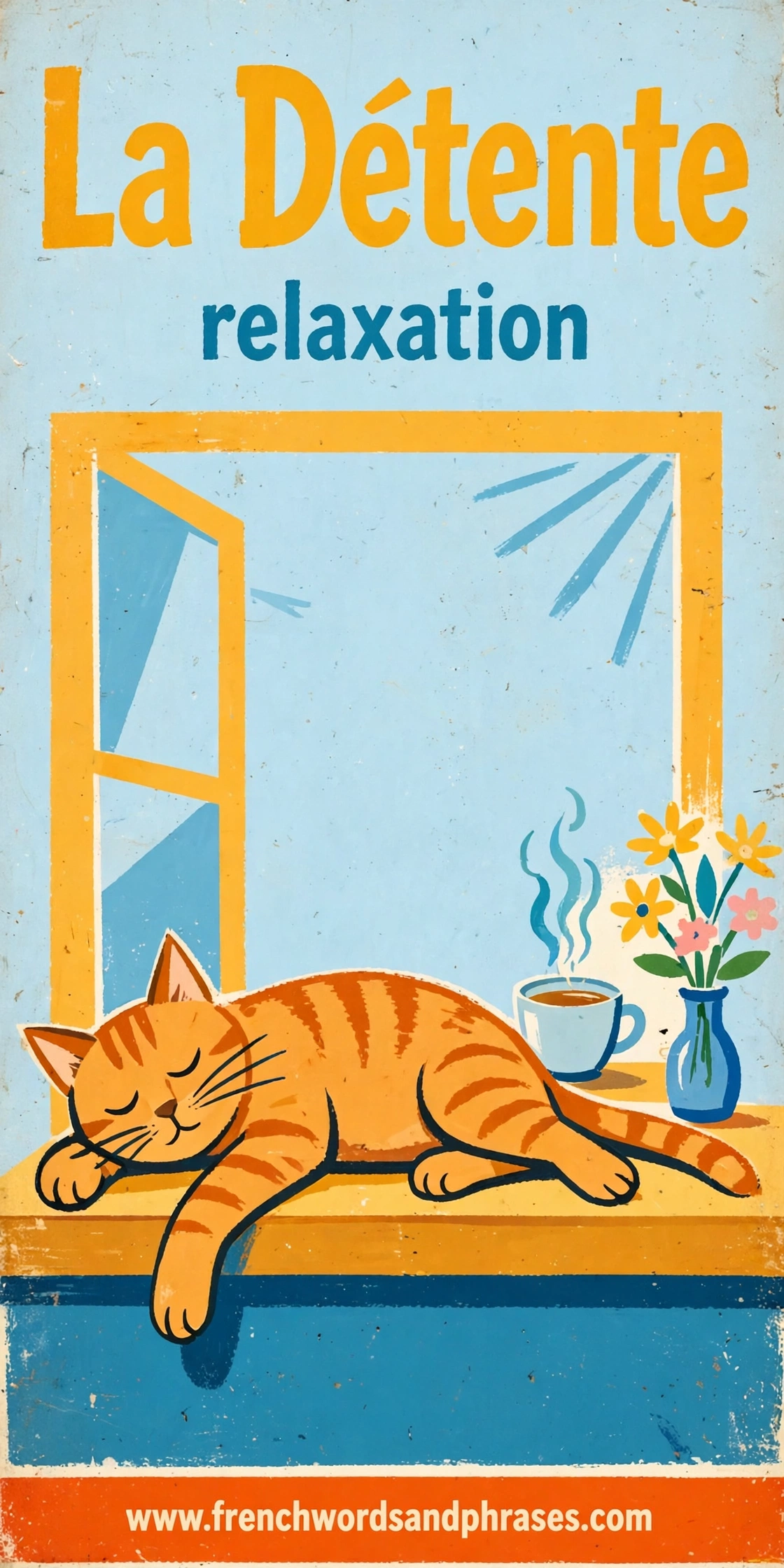
A French Word to Live By
Translate Détente to English
/de.tɑ̃t/
La détente means relaxation.
Friday, seven o’clock. The laptop closes, the phone goes face down, and the shoulders drop a full two centimetres. The working week is over; the French word for what happens next is la détente.
In this guide, you’ll learn what détente means in English, how to use it with its articles, how to form its plural, and how it appears in everyday French. Explore French examples, English translations, and practice quizzes.
Understanding the French Noun Détente
Détente is a feminine French noun. It is learned together with its article: la détente. It comes from the verb se détendre, to relax, to unwind — literally, to un-tense yourself.
It means relaxation — the state of letting go of tension: after work, on holiday, in a garden chair with nothing to do. Détente is an abstract noun, so it mostly lives with la, with possessives, and inside expressions like un moment de détente, a moment of relaxation. French also uses the word in politics: la détente between two countries is the easing of tensions.
Gender: Feminine
Definite article: la — la détente (relaxation)
Indefinite article: une — une détente (a relaxation, a moment of unwinding)
Plural: les détentes (rare — usually used in the singular)
English equivalents: Relaxation; unwinding; in politics, détente, an easing of tensions.
One important usage detail: détente has a second, surprising life. On a gun, la détente is the trigger — appuyer sur la détente, to pull the trigger. Both meanings grow from the same root: a release of tension, in a hammock or on a spring.
Experience the Word
Détente is more than doing nothing. It is the deliberate art of unwinding — the bath drawn, the book opened, the Sunday morning with no alarm and no plan.
Imagine the first evening of the holidays: bags unpacked, sea air through the window, and that long breath out that the whole year has been waiting for. That breath is la détente.
You have not just stopped working. You have un-tensed — and that is a skill in itself.
How to Use Détente in French: Complete Guide
Let’s explore how détente works in French, beginning with its articles.
Détente with the Definite Article (La, Les)
Relaxation in general takes la — la détente, the great French art of unwinding.
| Number | French |
|---|---|
| Singular | la détente |
| Plural | les détentes (rare) |
Example
La détente est importante pour la santé.
Relaxation is important for your health.
Détente with the Indefinite Article (Une, Des)
Une détente appears when one particular spell of unwinding is meant — more often, French says un moment de détente.
| Number | French |
|---|---|
| Singular | une détente |
| Plural | des détentes (rare) |
Example
Après cette semaine, une vraie détente s’impose.
After this week, some real relaxation is called for.
Moments de Détente: Where Relaxation Lives
Chairs, baths and long Sundays — the places and moments where la détente is found.
| French | In English |
|---|---|
| un moment de détente | a moment of relaxation |
| la pause | the break |
| la sieste | the nap, the siesta |
| le week-end | the weekend |
| les vacances | the holidays |
| un bain chaud | a hot bath |
Example
Un moment de détente dans le jardin, c’est tout ce qu’il me faut.
A moment of relaxation in the garden is all I need.
Quick Quiz 1
What is la sieste?
Reveal the answer
The nap — the short afternoon sleep, and one of France’s favourite moments de détente.
Après le déjeuner, il fait une petite sieste.
After lunch, he has a short nap.
The Plural of Détente
Détente can take an -s — les détentes — but as an abstract noun it almost always stays in the singular.
| Number | French |
|---|---|
| Singular | la détente |
| Plural | les détentes (rarely used) |
Example
On parle rarement des détentes ; on dit plutôt des moments de détente.
People rarely say les détentes; they usually say moments of relaxation.
Détente with Possessive Adjectives (Ma, Ta, Sa…)
Possessives agree with the noun, not with the owner — and détente is feminine, so it takes ma, ta, sa.
| Owner | French |
|---|---|
| my | ma détente |
| your (tu) | ta détente |
| his / her | sa détente |
| our | notre détente |
| your (vous) | votre détente |
| their | leur détente |
Example
Ma détente du soir, c’est un bain chaud et un bon livre.
My evening relaxation is a hot bath and a good book.
Quick Quiz 2
Complete the sentence:
______ détente à elle, c’est la natation. (Her)
Reveal the answer
Sa
Sa détente à elle, c’est la natation.
Her way of relaxing is swimming.
Détente with Demonstrative Adjectives (Cette, Ces)
Used to point: this relaxation here, the one this holiday finally brought.
| Number | French |
|---|---|
| Singular | cette détente |
| Plural | ces détentes (rare) |
Example
Cette détente totale, je ne l’ai connue qu’en vacances.
That total relaxation — I have only known it on holiday.
Détente with Adjectives
Adjectives agree with détente, feminine — totale, bienvenue, profonde.
| Adjective | With Détente |
|---|---|
| totale (total) | une détente totale |
| bienvenue (welcome) | une détente bienvenue |
| profonde (deep) | une détente profonde |
| vraie (real, true) | une vraie détente |
| complète (complete) | une détente complète |
Example
Après l’examen, une détente totale enfin !
After the exam, total relaxation at last!
Quick Quiz 3
Complete the sentence:
Ces vacances sont une détente ______. (total)
Reveal the answer
totale
Ces vacances sont une détente totale.
This holiday is total relaxation.
Everyday Expressions with Détente
Evenings, weekends and holidays — the détente phrases of daily life.
| Expression | In English |
|---|---|
| un moment de détente | a moment of relaxation |
| se détendre | to relax, to unwind |
| une journée détente | a relaxation day, a chill-out day |
| la détente après le travail | relaxation after work |
| un espace détente | a relaxation area (in a spa or office) |
| détente et bien-être | relaxation and well-being |
Example
Le dimanche, c’est journée détente : rien au programme.
Sunday is a relaxation day: nothing planned.
Words from the Same Family as Détente
Unwinding, resting and their opposites — the words that travel with détente.
| French | In English |
|---|---|
| se détendre | to relax, to unwind |
| détendu | relaxed |
| le repos | rest |
| la relaxation | relaxation (the technique) |
| tendu | tense, stressed |
| la tension | tension, stress |
Example
Il est tendu toute la semaine et détendu le week-end.
He is tense all week and relaxed at the weekend.
Quick Quiz 4
In the sentence « Il a appuyé sur la détente », what is la détente?
Reveal the answer
The trigger — on a gun, la détente is the trigger you pull. Same word, same idea of release.
Il a appuyé sur la détente et le coup est parti.
He pulled the trigger and the shot went off.
Détente in Everyday French: Real-Life Examples
Now that you know the word, let’s see how détente appears in everyday French.
Example 1 — After work
Après le travail, un peu de détente devant un film.
After work, a bit of relaxation in front of a film.
Example 2 — At the spa
L’hôtel propose un espace détente avec un sauna.
The hotel offers a relaxation area with a sauna.
Example 3 — Weekend plans
Ce week-end, ce sera détente et lecture au jardin.
This weekend it will be relaxation and reading in the garden.
Example 4 — Good advice
Tu as l’air fatigué ; il te faut un moment de détente.
You look tired; you need a moment of relaxation.
Example 5 — On holiday
Les vacances, c’est la détente totale, loin des e-mails.
Holidays mean total relaxation, far from emails.
Example 6 — In the news
Les journaux parlent d’une détente entre les deux pays.
The newspapers are talking about an easing of tensions between the two countries.
Beyond Translation: The Meaning of Détente
Détente is built on a beautiful image: tendre is to stretch tight, so se détendre is to let the stretched thing go slack — a bowstring released, shoulders dropping, a held breath let out. French diplomats borrowed the same word for the thaw between nations, and English borrowed it straight back.
To say détente is to let go — of tension, of the week, of everything held tight.
It evokes the spa towel and the garden chair, the first evening of the holidays, and the deep French conviction that unwinding is not a luxury but a necessity.
How to Remember the French Noun Détente
Remember it this way: Détente is relaxation — feminine, from se détendre, to un-tense yourself.
- You unwind — après le travail, un moment de détente.
- You use its verb — se détendre, to relax, and its adjective détendu, relaxed.
- You spot the second life — sur une arme, la détente is the trigger.
The key idea is la détente lets go — shoulders, springs and triggers.
Test Your Knowledge of Détente
Let’s see how much you’ve learned. Try answering these questions before revealing the answers.
Question 1
Is détente masculine or feminine?
Reveal the answer
Feminine — la détente, une détente.
Question 2
What verb gives us détente?
Reveal the answer
Se détendre — to relax, literally to un-tense yourself.
Question 3
Translate: I need a moment of relaxation.
Reveal the answer
J’ai besoin d’un moment de détente.
Question 4
What is the opposite of détendu?
Reveal the answer
Tendu — tense. Détendu means relaxed.
Question 5
Complete the sentence:
Le soir, elle cherche ______ détente après sa journée.
Reveal the answer
la
Le soir, elle cherche la détente après sa journée.
In the evening, she looks for relaxation after her day.
Your Final Challenge
Can You Use It?
How would you say this in French?
“After a long week, everyone needs some relaxation.”
Reveal the answer
Après une longue semaine, tout le monde a besoin de détente.
After a long week, everyone needs some relaxation.
A little French. A little curiosity. A richer everyday life.
LEARN FRENCH ONE WORD AT A TIME




