
A French Word to Live By
Translate Passe-temps to English
/pɑs.tɑ̃/
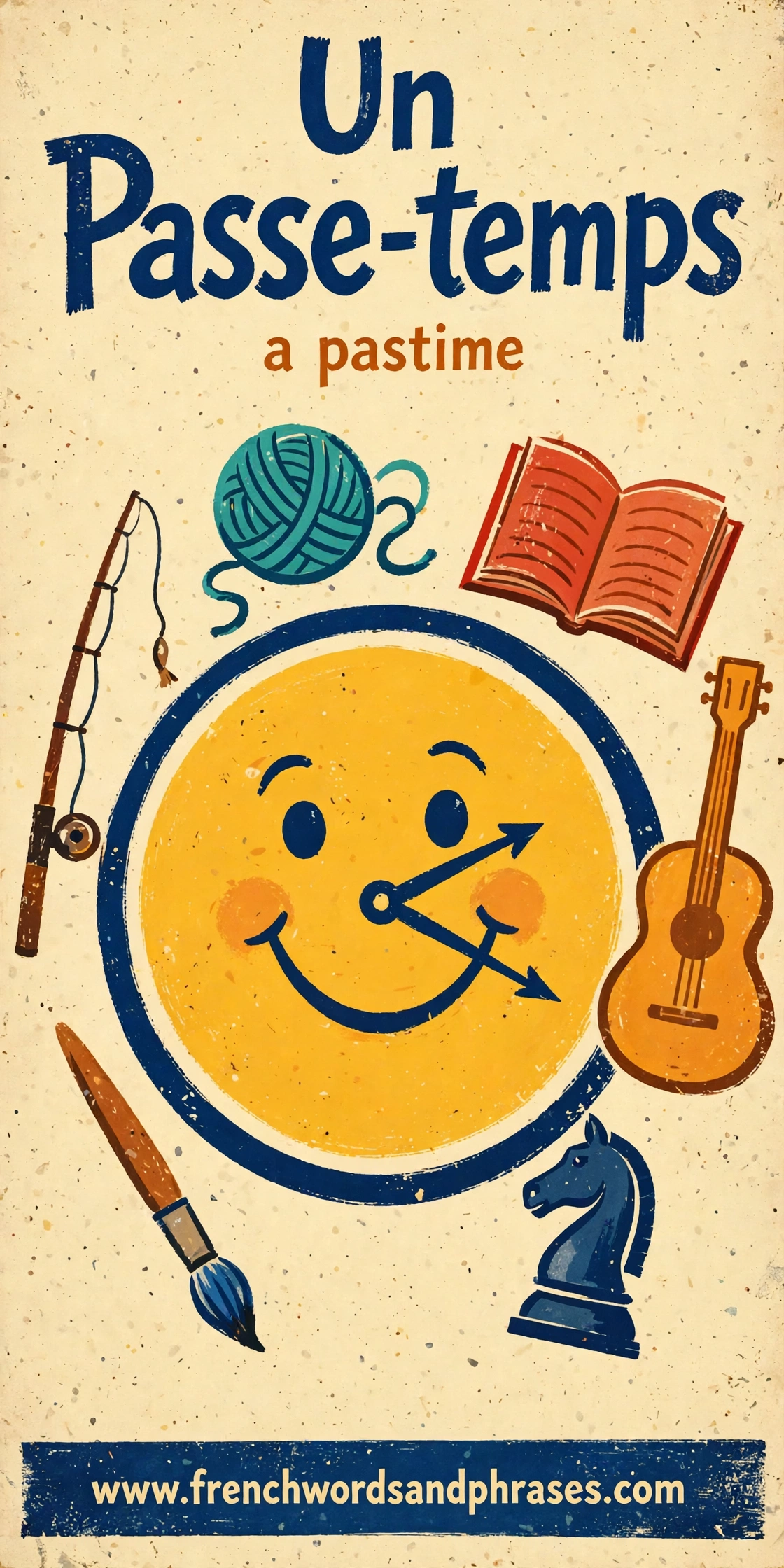
Le passe-temps means a pastime, a hobby.
Retirement day, first morning. The alarm clock stays silent, the coffee is slow, and a whole empty day stretches ahead. What will fill it? In French, the happy answer is a good passe-temps.
In this guide, you’ll learn what passe-temps means in English, how to use it with its articles, how to form its plural, and how it appears in everyday French. Explore French examples, English translations, and practice quizzes.
Understanding the French Noun Passe-temps
Passe-temps is a masculine French noun. It is learned together with its article: le passe-temps, un passe-temps. It is a compound of two everyday words: passer, to pass or spend, and le temps, time — literally, a time-passer.
It means a pastime, a hobby — the activity you choose for pleasure in your free time: reading, gardening, fishing, knitting, playing chess. French also has the borrowed word le hobby, but passe-temps is the classic French word, and it carries a gentle idea: this is how you pass the time well, not how you kill it.
Gender: Masculine
Definite article: le — le passe-temps (the pastime)
Indefinite article: un — un passe-temps (a pastime)
Plural: les passe-temps (the word itself never changes)
English equivalents: A pastime, a hobby.
One important usage detail: passe-temps is invariable in the plural. Because the word already ends in -s, one pastime and three pastimes are spelled exactly the same: un passe-temps, des passe-temps. Only the article tells you how many there are.
Experience the Word
Passe-temps is more than something to do. It is the shape you give your free hours — the garden on Saturdays, the chess club on Thursdays, the novel waiting by the chair.
Imagine two old friends comparing retirements: one has taken up painting, the other restores old bicycles, and both agree on the essential — il faut un bon passe-temps, you need a good pastime.
You have not just filled an hour. You have passed the time the way it deserves — on purpose.
How to Use Passe-temps in French: Complete Guide
Let’s explore how passe-temps works in French, beginning with its articles.
Passe-temps with the Definite Article (Le, Les)
Used for the pastime everyone in the conversation knows — his gardening, her chess.
| Number | French |
|---|---|
| Singular | le passe-temps |
| Plural | les passe-temps |
Example
Le jardinage est le passe-temps préféré de mon père.
Gardening is my father’s favourite pastime.
Passe-temps with the Indefinite Article (Un, Des)
Used for a pastime in general — the one you are looking for, the ones people list.
| Number | French |
|---|---|
| Singular | un passe-temps |
| Plural | des passe-temps |
Example
Tout le monde devrait avoir un passe-temps créatif.
Everyone should have a creative pastime.
Favourite Passe-temps in France
Gardens, books and chessboards — the classic ways France passes its free time.
| French | In English |
|---|---|
| la lecture | reading |
| le jardinage | gardening |
| la pêche | fishing |
| les échecs | chess |
| le tricot | knitting |
| la cuisine | cooking |
Example
La lecture et la pêche sont des passe-temps très calmes.
Reading and fishing are very calm pastimes.
Quick Quiz 1
What are les échecs?
Reveal the answer
Chess — the board game, and a classic French passe-temps.
Il joue aux échecs avec son voisin le dimanche.
He plays chess with his neighbour on Sundays.
The Plural of Passe-temps
The plural surprise: passe-temps never changes. The -s is already there, so only the article moves — les passe-temps.
| Number | French |
|---|---|
| Singular | le passe-temps |
| Plural | les passe-temps |
Example
Les passe-temps de ma grand-mère sont le tricot et les mots croisés.
My grandmother’s pastimes are knitting and crosswords.
Passe-temps with Possessive Adjectives (Mon, Ton, Son…)
Possessives agree with the noun, not with the owner — and passe-temps is masculine, so it takes mon, ton, son.
| Owner | French |
|---|---|
| my | mon passe-temps |
| your (tu) | ton passe-temps |
| his / her | son passe-temps |
| our | notre passe-temps |
| your (vous) | votre passe-temps |
| their | leur passe-temps |
Example
Mon passe-temps du moment, c’est la photographie.
My pastime of the moment is photography.
Quick Quiz 2
Complete the sentence:
______ passe-temps favori est la peinture. (Her)
Reveal the answer
Son
Son passe-temps favori est la peinture.
Her favourite pastime is painting.
Passe-temps with Demonstrative Adjectives (Ce, Ces)
Used to point: this pastime here, those pastimes there.
| Number | French |
|---|---|
| Singular | ce passe-temps |
| Plural | ces passe-temps |
Example
Ce passe-temps demande beaucoup de patience.
This pastime requires a lot of patience.
Passe-temps with Adjectives
Adjectives agree with passe-temps, masculine — favori, créatif, calme.
| Adjective | With Passe-temps |
|---|---|
| favori (favourite) | un passe-temps favori |
| créatif (creative) | un passe-temps créatif |
| calme (calm) | un passe-temps calme |
| nouveau (new) | un nouveau passe-temps |
| coûteux (expensive) | un passe-temps coûteux |
Example
La voile est un passe-temps coûteux mais magnifique.
Sailing is an expensive but magnificent pastime.
Quick Quiz 3
Complete the sentence:
Il cherche un passe-temps ______. (creative)
Reveal the answer
créatif
Il cherche un passe-temps créatif.
He is looking for a creative pastime.
Everyday Expressions with Passe-temps
Finding one, loving one, listing three — the passe-temps phrases of the week.
| Expression | In English |
|---|---|
| avoir un passe-temps | to have a pastime |
| un passe-temps favori | a favourite pastime |
| trouver un passe-temps | to find a pastime, to take up a hobby |
| passer le temps | to pass the time |
| les passe-temps et loisirs | pastimes and leisure activities (on forms and websites) |
| un passe-temps d’intérieur | an indoor pastime |
Example
Depuis sa retraite, il a trouvé un nouveau passe-temps : la poterie.
Since retiring, he has found a new pastime: pottery.
Words from the Same Family as Passe-temps
Time, leisure and pleasure — the words that travel with passe-temps.
| French | In English |
|---|---|
| passer | to pass, to spend (time) |
| le temps | time |
| le temps libre | free time |
| le loisir | leisure |
| le hobby | the hobby (borrowed from English) |
| s’occuper | to keep oneself busy |
Example
Avec un bon passe-temps, on ne voit pas le temps passer.
With a good pastime, you don’t notice the time passing.
Quick Quiz 4
How do you write the plural — les passe-tempss or les passe-temps?
Reveal the answer
Les passe-temps — the word never changes; its final -s is already there in the singular.
Elle a trois passe-temps : la danse, la lecture et le vélo.
She has three pastimes: dancing, reading and cycling.
Passe-temps in Everyday French: Real-Life Examples
Now that you know the word, let’s see how passe-temps appears in everyday French.
Example 1 — Small talk
Quel est ton passe-temps préféré ?
What is your favourite pastime?
Example 2 — Retirement
Depuis sa retraite, son passe-temps, c’est le jardinage.
Since retiring, his pastime is gardening.
Example 3 — Rainy day
Les jeux de société sont un bon passe-temps pour les jours de pluie.
Board games are a good pastime for rainy days.
Example 4 — On a form
Sur le formulaire, écrivez vos passe-temps et vos loisirs.
On the form, write down your pastimes and leisure activities.
Example 5 — New hobby
Je cherche un passe-temps pour les longues soirées d’hiver.
I am looking for a pastime for the long winter evenings.
Example 6 — Weekend plans
Son passe-temps du week-end, c’est la randonnée en montagne.
His weekend pastime is hiking in the mountains.
Beyond Translation: The Meaning of Passe-temps
Passe-temps wears its philosophy on its face: time is something to be passed, well and deliberately, the way you pass a pleasant afternoon in good company. Where English kills time, French passes it — passer le temps — and a passe-temps is the chosen companion for the journey.
To name your passe-temps is to say how you spend the hours that are truly yours.
It evokes the allotment gardens at the edge of town, the chess players in the park, the knitting bag by the armchair — France’s free time, filled with care.
How to Remember the French Noun Passe-temps
Remember it this way: Passe-temps is the pastime — masculine, built from passer and le temps, and it never changes in the plural.
- You build the word — passer plus le temps, a time-passer.
- You list yours — la lecture, le jardinage, la pêche sont des passe-temps.
- You keep the plural still — un passe-temps, des passe-temps, the word never moves.
The key idea is le passe-temps passes the time — and never changes.
Test Your Knowledge of Passe-temps
Let’s see how much you’ve learned. Try answering these questions before revealing the answers.
Question 1
Is passe-temps masculine or feminine?
Reveal the answer
Masculine — le passe-temps, un passe-temps.
Question 2
What two words make passe-temps?
Reveal the answer
Passer and temps — to pass, and time: a time-passer.
Question 3
Translate: Gardening is her favourite pastime.
Reveal the answer
Le jardinage est son passe-temps favori.
Question 4
What is le loisir?
Reveal the answer
Leisure — free time itself, while a passe-temps is the activity that fills it.
Question 5
Complete the sentence:
Les enfants ont beaucoup de ______ en été.
Reveal the answer
passe-temps
Les enfants ont beaucoup de passe-temps en été.
The children have lots of pastimes in summer.
Your Final Challenge
Can You Use It?
How would you say this in French?
“His favourite pastime is fishing with his friends.”
Reveal the answer
Son passe-temps favori, c’est la pêche avec ses amis.
His favourite pastime is fishing with his friends.
A little French. A little curiosity. A richer everyday life.
LEARN FRENCH ONE WORD AT A TIME




