
A French Word to Live By
Translate Repos to English
/ʁə.po/
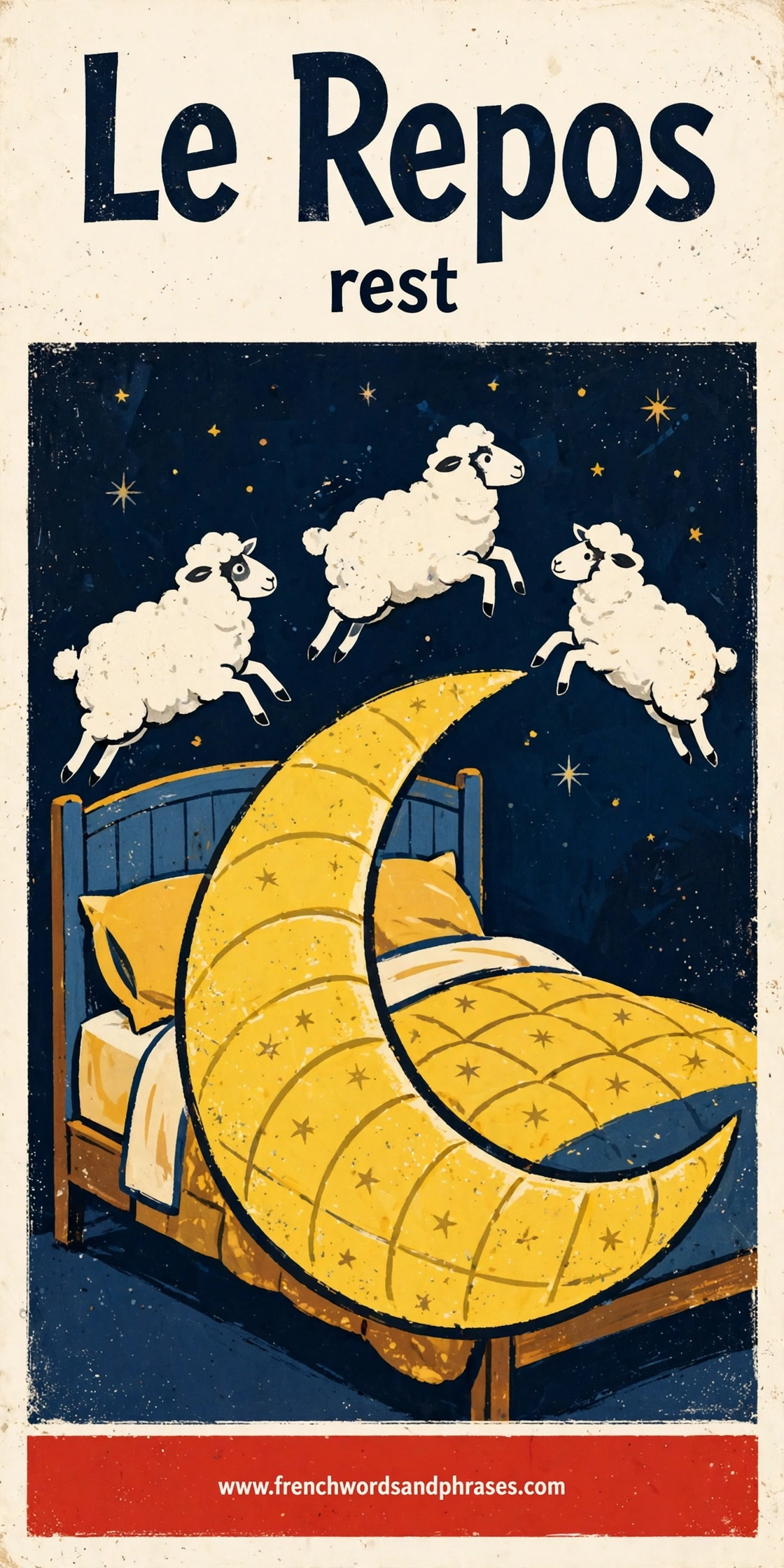
Le repos means rest.
Sunday, two o’clock. Lunch is finished, the shutters are half closed against the sun, and the whole street has gone quiet. It is the sacred hour the French protect above all others — le repos.
In this guide, you’ll learn what repos means in English, how to use it with its articles, how to form its plural, and how it appears in everyday French. Explore French examples, English translations, and practice quizzes.
Understanding the French Noun Repos
Repos is a masculine French noun. It is learned together with its article: le repos, un repos. It comes from the verb se reposer, to rest — and it names both a short pause and the deep rest of a whole day off.
It means rest — the pause that restores you: a sit-down after work, a day off in the week, a good night’s sleep. French law and French life both protect it: le repos hebdomadaire is the weekly day of rest, and un jour de repos is a day off. It is close to la détente, relaxation, but repos is simpler and deeper: the body stopping, and recovering.
Gender: Masculine
Definite article: le — le repos (rest)
Indefinite article: un — un repos (a rest)
Plural: les repos (the word itself never changes)
English equivalents: Rest; a rest; a day off (un jour de repos).
One important usage detail: repos already ends in -s, so the plural is spelled exactly like the singular — un repos, des repos. And listen for it at work: un jour de repos is a day off, while être au repos means to be resting, out of action — said of a patient, a horse, or a machine.
Experience the Word
Repos is more than stopping. It is the pause with a purpose — the body and mind being repaired, quietly, so that tomorrow is possible.
Imagine the nurse at the end of a night shift, the farmer at noon under a tree, the grandmother in her chair after lunch: different lives, the same word on their lips — un peu de repos, a little rest.
You have not just done nothing. You have rested — and resting, in French, is serious business.
How to Use Repos in French: Complete Guide
Let’s explore how repos works in French, beginning with its articles.
Repos with the Definite Article (Le, Les)
Used for rest in general, and for the rest everyone is talking about — Sunday’s, the doctor’s orders.
| Number | French |
|---|---|
| Singular | le repos |
| Plural | les repos |
Example
Le repos du dimanche est sacré dans ce village.
Sunday rest is sacred in this village.
Repos with the Indefinite Article (Un, Des)
Used for a rest in particular — the one you take, the ones the rota allows.
| Number | French |
|---|---|
| Singular | un repos |
| Plural | des repos |
Example
Après six heures de route, un repos s’impose.
After six hours on the road, a rest is in order.
Repos in Working Life
Days off, weekly rest and doctor’s orders — repos is a word with a timetable.
| French | In English |
|---|---|
| un jour de repos | a day off |
| le repos hebdomadaire | the weekly rest day |
| le repos dominical | Sunday rest |
| prendre du repos | to take some rest |
| être au repos | to be resting, to be out of action |
| le repos éternel | eternal rest |
Example
Son jour de repos, c’est le lundi.
Her day off is Monday.
Quick Quiz 1
What is un jour de repos?
Reveal the answer
A day off — a rest day in the working week.
Je prends un jour de repos vendredi.
I am taking a day off on Friday.
The Plural of Repos
Repos ends in -s already, so the plural is spelled the same — only the article changes: les repos.
| Number | French |
|---|---|
| Singular | le repos |
| Plural | les repos |
Example
Les repos sont courts pendant la saison touristique.
Rest breaks are short during the tourist season.
Repos with Possessive Adjectives (Mon, Ton, Son…)
Possessives agree with the noun, not with the owner — and repos is masculine, so it takes mon, ton, son.
| Owner | French |
|---|---|
| my | mon repos |
| your (tu) | ton repos |
| his / her | son repos |
| our | notre repos |
| your (vous) | votre repos |
| their | leur repos |
Example
Mon repos du dimanche, personne n’y touche.
Nobody touches my Sunday rest.
Quick Quiz 2
Complete the sentence:
Le médecin lui a ordonné ______ repos complet. (some — use le)
Reveal the answer
le
Le médecin lui a ordonné le repos complet.
The doctor ordered him complete rest.
Repos with Demonstrative Adjectives (Ce, Ces)
Used to point: this rest here, the one the holidays finally gave you.
| Number | French |
|---|---|
| Singular | ce repos |
| Plural | ces repos |
Example
Ce repos lui a fait beaucoup de bien.
This rest did him a lot of good.
Repos with Adjectives
Adjectives agree with repos, masculine — bien mérité, complet, éternel.
| Adjective | With Repos |
|---|---|
| bien mérité (well-earned) | un repos bien mérité |
| complet (complete) | un repos complet |
| long (long) | un long repos |
| éternel (eternal) | le repos éternel |
| court (short) | un court repos |
Example
Après le marathon, un repos bien mérité !
After the marathon, a well-earned rest!
Quick Quiz 3
Complete the sentence:
Après cette course, ils prennent un repos bien ______. (earned)
Reveal the answer
mérité
Après cette course, ils prennent un repos bien mérité.
After that race, they take a well-earned rest.
Everyday Expressions with Repos
Days off, sick notes and Sunday afternoons — the repos phrases of the week.
| Expression | In English |
|---|---|
| prendre du repos | to take some rest, to get some rest |
| un jour de repos | a day off |
| se reposer | to rest, to have a rest |
| être au repos | to be resting, to be out of action |
| repos forcé | enforced rest |
| bon repos ! | have a good rest! |
Example
Tu travailles trop ; prends un peu de repos.
You work too much; take a bit of rest.
Words from the Same Family as Repos
Sleeping, pausing and recovering — the words that travel with repos.
| French | In English |
|---|---|
| se reposer | to rest |
| reposant | restful, relaxing |
| la pause | the break, the pause |
| le sommeil | sleep |
| dormir | to sleep |
| fatigué | tired |
Example
Une sieste reposante et on repart en forme.
A restful nap and off we go again, full of energy.
Quick Quiz 4
What is the difference between une pause and le repos?
Reveal the answer
Une pause is a short break — a coffee, ten minutes. Le repos is real rest: a day off, a night’s sleep, recovery.
Une pause café, puis le repos du dimanche.
A coffee break, then Sunday rest.
Repos in Everyday French: Real-Life Examples
Now that you know the word, let’s see how repos appears in everyday French.
Example 1 — At work
Mon jour de repos tombe un jeudi cette semaine.
My day off falls on a Thursday this week.
Example 2 — Doctor’s orders
Le médecin lui conseille deux jours de repos.
The doctor advises him two days of rest.
Example 3 — After sport
Après le match, les joueurs ont besoin de repos.
After the match, the players need rest.
Example 4 — On the road
Nous faisons une pause repos toutes les deux heures.
We take a rest break every two hours.
Example 5 — Sunday afternoon
Le repos de l’après-midi, c’est sacré chez mes parents.
The afternoon rest is sacred at my parents’ house.
Example 6 — Wishing well
Bon repos, et à demain en pleine forme !
Have a good rest, and see you tomorrow full of energy!
Beyond Translation: The Meaning of Repos
Repos is one of the words French law takes seriously: the repos hebdomadaire, the weekly rest, is written into the labour code, and the repos dominical still keeps most shops shut on Sundays. Rest, in France, is not what is left when work is done — it is a right, defended like one.
To say repos is to close the door on the world for a while — with the law’s blessing.
It evokes the half-closed shutters at noon, the quiet street, the day off circled on the kitchen calendar: the pause that French life is built around.
How to Remember the French Noun Repos
Remember it this way: Repos is rest — masculine, with le and un, and its spelling never changes in the plural.
- You take it — après le travail, un peu de repos.
- You count your days off — un jour de repos, a day off.
- You keep the plural still — un repos, des repos, the -s is already there.
The key idea is le repos restores — un jour de repos is a day off.
Test Your Knowledge of Repos
Let’s see how much you’ve learned. Try answering these questions before revealing the answers.
Question 1
Is repos masculine or feminine?
Reveal the answer
Masculine — le repos, un repos.
Question 2
How do you say a day off in French?
Reveal the answer
Un jour de repos — literally, a rest day.
Question 3
Translate: The doctor ordered her complete rest.
Reveal the answer
Le médecin lui a ordonné le repos complet.
Question 4
What does reposant mean?
Reveal the answer
Restful — une sieste reposante, a restful nap.
Question 5
Complete the sentence:
Après le travail, je prends un peu de ______.
Reveal the answer
repos
Après le travail, je prends un peu de repos.
After work, I take a bit of rest.
Your Final Challenge
Can You Use It?
How would you say this in French?
“After the long walk, we need a good rest.”
Reveal the answer
Après la longue marche, nous avons besoin d’un bon repos.
After the long walk, we need a good rest.
A little French. A little curiosity. A richer everyday life.
LEARN FRENCH ONE WORD AT A TIME




