A French Word to Live By
Translate De to English
/də/
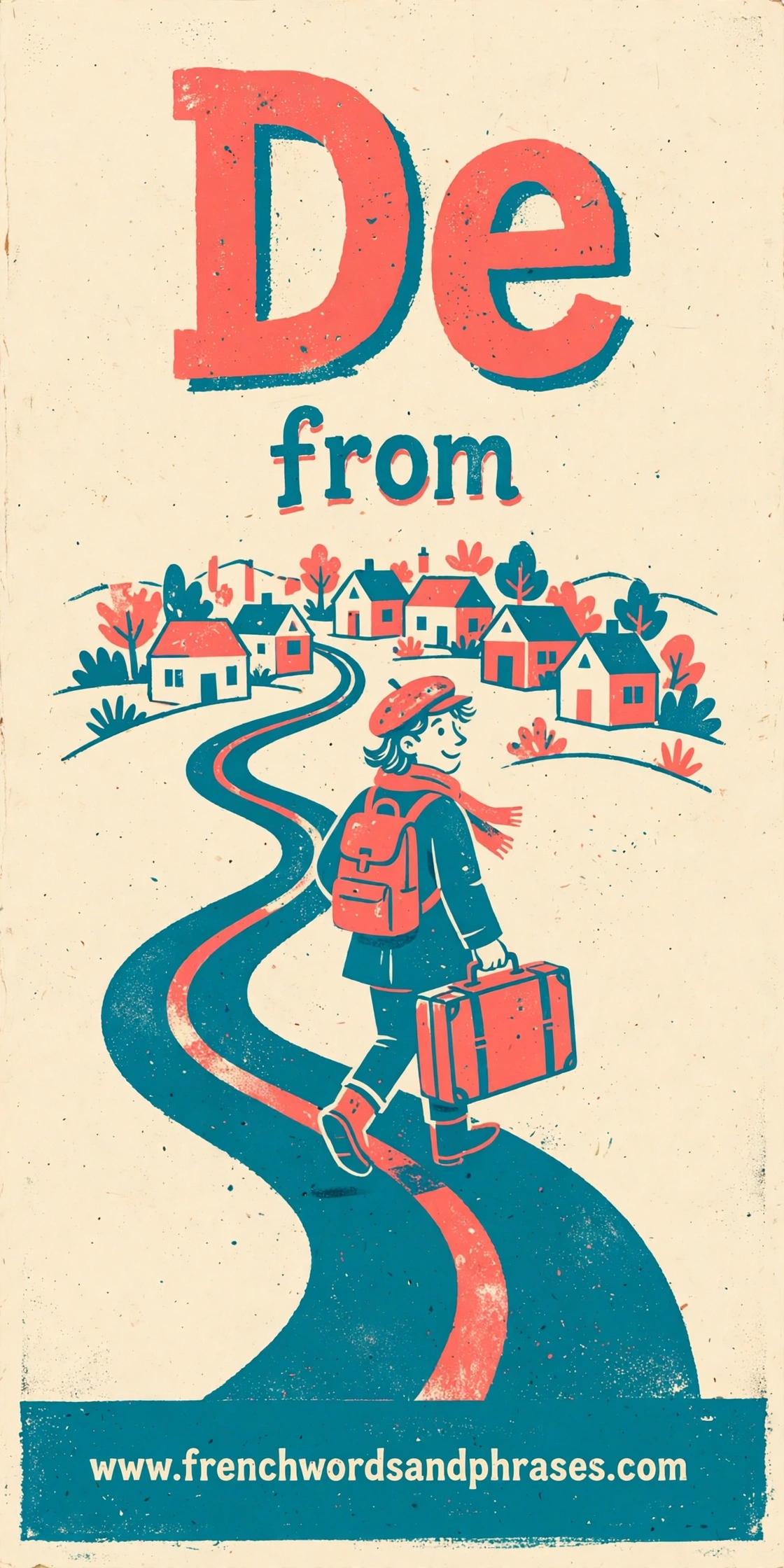
De means from / of.
At a small station in Provence, the loudspeaker crackles and a train sighs to a stop. « Le train de Marseille arrive. » The train from Marseille is arriving. Two minutes later a girl on the platform holds up a bottle: « C’est du jus de raisin, de la ferme de mon oncle. » It is grape juice, from my uncle’s farm. De is the hardest-working word in French — from, of, and a dozen other jobs in two letters.
Let’s explore how de works in French, beginning with the whole word on one card.
Understanding the French Preposition De
De is a French preposition of origin and belonging — the most frequent preposition in the language. It marks where things come from (de Paris), whose they are (le livre de Marie), what they are made or full of (un verre de vin), and it introduces infinitives after many verbs and adjectives.
It means from and of — and the two meanings are really one: a link pointing back to a source. The train de Marseille comes FROM Marseille; le toit de la maison is the roof OF the house, the part that belongs to it. Follow the link backwards and you always land on the source.
Type: Preposition — origin, possession, content, material
Answers the question: D’où ? De qui ? De quoi ? — From where? Whose? Of what?
What follows it: A noun, a place, a pronoun, or an infinitive: de loin, de moi, de partir
Watch the contractions: de + le = du, de + les = des — never optional
One important usage detail: de has a starting-point twin, à partir de — de marks the origin itself (le train de Lyon), while à partir de marks the moment or point where something BEGINS (à partir de demain, from tomorrow onwards; à partir de la gare, starting from the station). When the idea is ‘from now on’, à partir de is the phrase.
Experience the Word
De is the thread every French sentence is sewn with — pull it, and half the language follows.
Imagine a market stall piled with labels: confiture de fraises, fromage de chèvre, huile d’olive, jus de pomme — strawberry jam, goat’s cheese, olive oil, apple juice — every label a little arrow pointing back to a source.
You have not just linked two nouns. You have told the listener where to look for the origin of everything.
How to Use De in French: Complete Guide
Let’s explore how de works in French, beginning with the whole word on one card.
De at a Glance
The Whole Word on One Card
Meaning, jobs, pattern and contractions — de in four lines.
| Point | De |
|---|---|
| Meaning | from / of |
| Jobs | origin, possession, content, material, quantity |
| What follows | a noun, place, pronoun, quantity, or infinitive |
| Contractions | de + le = du; de + les = des; de + vowel = d’ |
Example
Le train de Paris arrive à l’heure.
The train from Paris is arriving on time.
The Pattern in Action: Every Arrow Points Back to a Source
De links a thing to where it comes from — a place, a person, a substance, a number.
| Pattern | Example |
|---|---|
| origin: de + place | elle vient de Bordeaux — she comes from Bordeaux |
| possession: noun + de + owner | le livre de Marie — Marie’s book |
| content: container + de + substance | un verre de vin — a glass of wine |
| description: noun + de + noun | la ville de Paris — the city of Paris; une robe de soie — a silk dress |
Example
La clé de la voiture est sur la table.
The car key is on the table.
Quick Quiz 1
“Marie’s book” — how does French order it with de?
Reveal the answer
Le livre de Marie — the thing first, then de, then the owner.
Le livre de Marie est ouvert.
Marie’s book is open.
The Tricky Bit: De’s Many Jobs, and Its Starting-Point Twin À partir de
One small word, a whole toolbox — plus the phrase French uses when the origin is a starting line.
| Job | Example |
|---|---|
| origin and home towns | je suis de Lille — I am from Lille |
| quantity + de (no article) | beaucoup de monde — lots of people; un kilo de pommes — a kilo of apples |
| de + infinitive after verbs/adjectives | il essaie de comprendre — he is trying to understand; content de partir — happy to leave |
| à partir de: the starting point | à partir de demain — from tomorrow onwards; à partir de cent euros — starting at a hundred euros |
Example
À partir de lundi, le magasin ouvre à huit heures.
From Monday onwards, the shop opens at eight o’clock.
Where It Goes: Between the Thing and Its Source
De glues a noun to its source, contracts with le and les, and shortens to d’ before a vowel.
| Position / pattern | Example |
|---|---|
| noun + de + source | le toit de la maison — the roof of the house |
| de + le = du | le train du matin — the morning train (never ‘de le’) |
| de + les = des | le bruit des voitures — the noise of the cars |
| de + vowel = d’ | un verre d’eau — a glass of water; la porte d’entrée — the front door |
Example
Le parfum des fleurs remplit le jardin.
The scent of the flowers fills the garden.
Quick Quiz 2
Complete: le chien ______ voisin (the neighbour’s dog) — de le, du, or des?
Reveal the answer
du — de + le always contracts to du.
Le chien du voisin aboie.
The neighbour’s dog is barking.
Everyday Expressions with De
De hides inside dozens of everyday phrases — times, manners and one very useful ‘of course not’.
| Expression | In English |
|---|---|
| de temps en temps | from time to time |
| de plus en plus | more and more |
| de rien | you’re welcome (it was nothing) |
| de nos jours | nowadays, in our time |
| de bonne heure | early (at a good hour) |
Example
De temps en temps, elle écrit à sa grand-mère.
From time to time, she writes to her grandmother.
Close Cousins: The Source Family
Four ways to point at an origin — French picks by precision and by grammar.
| Word | The difference |
|---|---|
| de | the origin itself: le train de Lyon |
| à partir de | the starting point onward: à partir de Lyon, le paysage change |
| depuis | from a point in time until now: depuis lundi — since Monday |
| chez (for people as places) | not a source but a home base: il vient de chez Paul — he is coming from Paul’s place (de + chez!) |
Example
Depuis ce matin, le train de Lyon a du retard.
Since this morning, the train from Lyon has been delayed.
Quick Quiz 3
“From tomorrow onwards, no cars” — de or à partir de?
Reveal the answer
à partir de — it marks the starting point of a new rule or period.
À partir de demain, pas de voitures.
From tomorrow onwards, no cars.
De and Its Neighbours
The link shelf: of/from, to/at, with, without, for.
| French | In English |
|---|---|
| de | of / from (the source) |
| à | to / at (the destination) |
| avec | with |
| sans | without |
| pour | for (the aim) |
Example
Le train de Lyon va à Paris avec un peu de retard.
The train from Lyon is going to Paris, a little late.
Watch Out: The Traps Around De
The traps: missing contractions, stray articles after quantities, and the partitive look-alike.
| Trap | The truth |
|---|---|
| writing ‘de le’ or ‘de les’ | always contract: de + le = du, de + les = des: le toit du hangar, le bruit des voitures |
| article after a quantity | beaucoup de sucre, never ‘beaucoup du sucre’ — quantity + de drops the article |
| de vs du partitive | je bois de l’eau (some water) is the partitive; de alone links sources — do not mix the jobs |
| possession with names | le livre de Marie — never ‘le livre de la Marie’; names take de with no article |
Example
Il y a beaucoup de monde au marché de la ville.
There are lots of people at the town market.
Quick Quiz 4
Complete: un litre ______ lait (a litre of milk) — de, du, or de la?
Reveal the answer
de — after a quantity, de stands alone with no article.
Un litre de lait, s’il vous plaît.
A litre of milk, please.
De in Everyday French: Real-Life Examples
Now that you know the word, let’s see how de appears in everyday French.
Example Example 1 — Travel
Le train de Marseille est en retard.
The train from Marseille is late.
Example Example 2 — Possession
C’est le vélo de mon frère.
It is my brother’s bike.
Example Example 3 — Content
Je voudrais un verre de jus d’orange.
I would like a glass of orange juice.
Example Example 4 — Origin
Elle est de Nantes, mais elle habite à Rennes.
She is from Nantes, but she lives in Rennes.
Example Example 5 — Quantity
Il reste peu de temps avant le départ.
There is little time left before departure.
Example Example 6 — Starting point
À partir de septembre, les jours raccourcissent.
From September onwards, the days get shorter.
Beyond Translation: The Meaning of De
English splits the work between “of” and “from” and a possessive apostrophe; French hands all of it to two letters: de. Le livre de Marie, le train de Lyon, un verre de vin — possession, origin and content flow through the same little gate, because in French they are the same idea: a link back to a source.
To say de is to point backwards — to the owner, the hometown, the substance — and say: it comes from there.
Learn de well and you hold the thread of the whole language: it is the most common preposition in French, and it appears in hundreds of phrases, from de rien to de plus en plus.
How to Remember the French Preposition De
Remember it this way: Remember it this way: De is a backwards arrow — whatever follows it is the source of what came before.
- You follow the arrow home — de always lands on an origin: a place, an owner, a substance.
- You contract without mercy — de + le = du, de + les = des, and d’ before a vowel.
- You call the twin for starting lines — à partir de demain when a period begins.
The key idea is de means from/of, marks origin, possession and content, contracts to du/des, and à partir de marks the starting point.
Test Your Knowledge of De
Let’s see how much you’ve learned. Try answering these questions before revealing the answers.
Question 1
What does de mean?
Reveal the answer
From and of — one backwards link to a source: origin, owner or content.
Question 2
How do you say ‘a glass of wine’?
Reveal the answer
Un verre de vin — container + de + content, with no article after de.
Question 3
Translate: The train from Paris is arriving.
Reveal the answer
Le train de Paris arrive.
Question 4
When do you use à partir de instead of plain de?
Reveal the answer
For a starting point onwards — à partir de demain (from tomorrow onwards), à partir de la gare (starting from the station).
Question 5
Complete the sentence:
C’est la voiture ______ mon voisin. (my neighbour’s car)
Reveal the answer
de
C’est la voiture de mon voisin.
It is my neighbour’s car.
Your Final Challenge
Can You Use It?
How would you say this in French?
“How would you say this in French?”
Reveal the answer
Le train de Marseille arrive.
The train from Marseille is arriving.
A little French. A little curiosity. A richer everyday life.
LEARN FRENCH ONE WORD AT A TIME