A French Word to Live By
Translate D’abord to English
/da.bɔʁ/
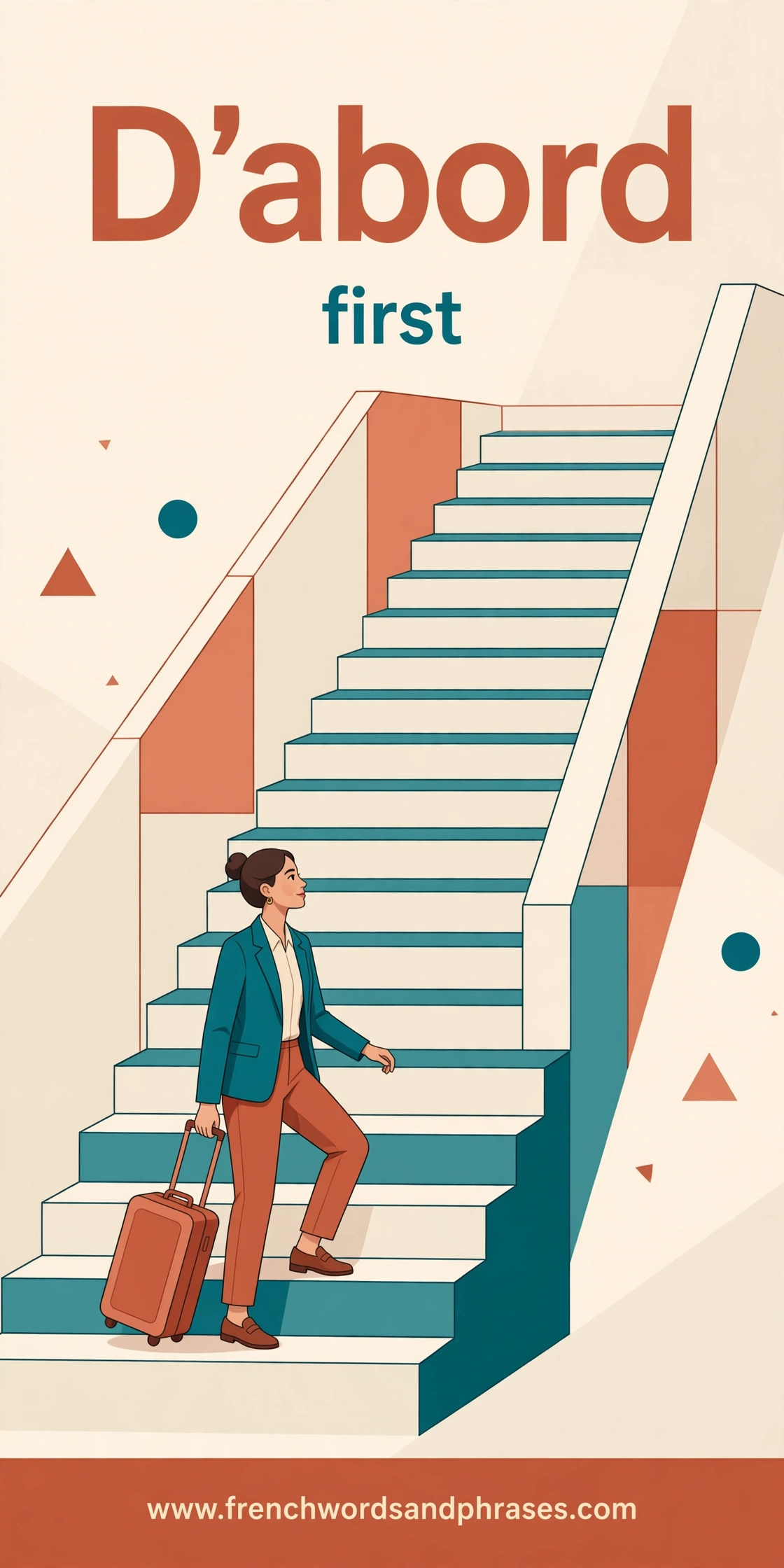
D’abord means first.
The classroom door opens, the children hang up their coats, wash their hands, and only then sit down to work. Every well-run day begins with a first step, taken before all the others. That is d’abord.
In this guide, you’ll learn what d’abord means in English, where it stands in a sentence, how it opens a story step by step, and how it links arms with ensuite, puis and enfin. Explore French examples, English translations, and practice quizzes.
Understanding the French Adverb D’abord
D’abord is a French adverb of sequence. It is really two words holding hands — the little de and abord, a word for an approach or a landing — worn smooth by centuries of use until they became one. Adverbs do not change their form, so d’abord works everywhere, exactly as it is.
It means first — the first step of a series, the first thing you do before anything else. A cook tastes the soup d’abord, then seasons it; a traveller checks the map d’abord, then chooses the road. D’abord does not mean the best or the most important: it simply puts one action at the head of the queue.
Type: Adverb of sequence (ordering actions in time)
Answers the question: In what order? — what comes first?
Changes form: Never — d’abord is invariable
English equivalents: First; first of all; in the first place.
One important usage detail: d’abord loves the head of a sentence or a clause — D’abord, je me lève, ensuite je déjeune. At the start, it acts like a signpost: step one. It can also end a short order — Écoute d’abord ! (Listen first!) — but the signpost position is its home.
Experience the Word
D’abord is the adverb of calm beginnings. It is the word that turns a muddle of jobs into a simple list: this one first, the rest will follow.
Imagine a grandmother teaching a child to make crêpes: first the flour, then the eggs, then the milk, slowly, so there are no lumps. Every family recipe in France is carried by a d’abord.
You have not just started a task. You have put the first stone in its place.
How to Use D’abord in French: Complete Guide
Let’s explore how d’abord works in French, beginning with the word on one card.
D’abord: The First Step of Every Story
Every list, every recipe and every good story told in French begins the same way — with one small word that says: start here.
D’abord at a Glance
Before the details, here is the whole word on one card.
| Point | D’abord |
|---|---|
| Meaning | first, first of all |
| Type | adverb of sequence |
| Usual position | at the head of the sentence or clause |
| Form | invariable — never changes |
Example
D’abord, on se lave les mains.
First, we wash our hands.
Where D’abord Goes in the Sentence
D’abord is a signpost word, and signposts stand at the front. It can also close a short command, telling someone to do this before anything else.
| Situation | Pattern |
|---|---|
| Opening a sentence | D’abord, + sentence — D’abord, je range la cuisine |
| Opening the next clause | …, d’abord + verb — il respire, d’abord |
| In a command | verb + d’abord — Regarde d’abord ! |
| In an argument | d’abord, … — je ne suis pas d’accord, d’abord |
Example
D’abord, nous achetons les billets, ensuite nous choisissons les places.
First, we buy the tickets, then we choose the seats.
Quick Quiz 1
Where does d’abord usually stand?
Reveal the answer
At the head of the sentence or clause
D’abord, je me lève.
First, I get up.
Telling a Story in Order
D’abord never travels alone for long. It opens the sequence that ensuite, puis and enfin carry to the end — the backbone of every French story and recipe.
| Step | You Say |
|---|---|
| Step one | d’abord — first |
| Step two | ensuite — then, next |
| Another step | puis — then |
| The last step | enfin — finally |
| A full story | D’abord…, ensuite…, puis…, enfin… |
Example
D’abord, il a ouvert la lettre, puis il l’a lue deux fois, enfin il a souri.
First, he opened the letter, then he read it twice, finally he smiled.
D’abord with Different Tenses
The adverb never changes — it simply leads whatever tense the story needs, from this morning’s routine to a tale of long ago.
| Tense | Example |
|---|---|
| Present | D’abord, je bois un café. |
| Passé composé | D’abord, nous avons visité le musée. |
| Imparfait | D’abord, il fermait la boutique à clé. |
| Future | D’abord, tu finiras tes devoirs. |
| Infinitive (instructions) | D’abord mélanger la farine et le sucre. |
Example
D’abord, elle a téléphoné à sa mère, puis elle est partie.
First, she phoned her mother, then she left.
Quick Quiz 2
Which word usually closes the sequence that d’abord opens?
Reveal the answer
Enfin
D’abord le train, ensuite le bus, enfin la maison.
First the train, then the bus, finally home.
Everyday Expressions with D’abord
D’abord has a second life in conversation — insisting, objecting, and putting first things first.
| Expression | In English |
|---|---|
| tout d’abord | first of all, before anything else |
| d’abord et avant tout | first and foremost |
| ce n’est pas d’abord… | it is not primarily… |
| non, mais d’abord ! | just a minute! (hold on a moment) |
| d’abord, je ne suis pas d’accord | for a start, I don’t agree |
Example
Tout d’abord, merci d’être venus si nombreux.
First of all, thank you for coming in such numbers.
D’abord and Its Neighbours
Learn d’abord with the whole sequence family, and you can narrate anything in French.
| French | In English |
|---|---|
| ensuite | then, next (the step that follows) |
| puis | then (a lighter link between steps) |
| enfin | finally (the last step) |
| premièrement | firstly (formal, for written lists) |
| après | after, afterwards |
Example
Premièrement le budget, ensuite les dates, enfin les invitations.
Firstly the budget, then the dates, finally the invitations.
Quick Quiz 3
What does tout d’abord mean?
Reveal the answer
First of all
Tout d’abord, bienvenue à tous.
First of all, welcome, everyone.
D’abord in Instructions and Recipes
In the kitchen and the classroom, d’abord is the teacher’s favourite word — each step begins under its flag.
| Context | Example |
|---|---|
| A recipe | D’abord, faites fondre le beurre. |
| A lesson | D’abord, lisez le texte à voix haute. |
| Directions | D’abord, tournez à gauche au feu. |
| A game | D’abord, on distribue les cartes. |
| At the doctor’s | D’abord, respirez profondément. |
Example
D’abord, préchauffez le four à 180 degrés.
First, preheat the oven to 180 degrees.
Watch Out: Common Mistakes with D’abord
Two traps wait for English speakers — one of spelling, one of meaning.
| Mistake | Correct French |
|---|---|
| Writing « dabord » or « d’abords » | d’abord — apostrophe, no final s |
| Using d’abord for « the first » of two people or things | le premier / la première — c’est le premier train |
| Translating « first » as a rank (first prize) | le premier prix — d’abord is for actions in order |
| Dropping it mid-sentence, English-style | D’abord, je pars. / Je pars d’abord. |
Example
C’est la première fois que je viens, et d’abord je visite la cathédrale.
It is my first time here, and first I am visiting the cathedral.
Quick Quiz 4
Correct this sentence:
Dabord, nous mangeons, ensuite nous parlons.
Reveal the answer
D’abord, nous mangeons, ensuite nous parlons.
The apostrophe matters — d’abord is two old words joined: de + abord.
D’abord in Everyday French: Real-Life Examples
Now that you know the word, let’s see how d’abord appears in everyday French.
Example 1 — Morning routine
D’abord, je me brosse les dents, ensuite je m’habille.
First, I brush my teeth, then I get dressed.
Example 2 — In the kitchen
D’abord, mets la table, s’il te plaît.
First, set the table, please.
Example 3 — Telling a story
D’abord, nous avons perdu le train, puis tout s’est arrangé.
First, we missed the train, then everything worked out.
Example 4 — At work
D’abord, finissons ce rapport, le reste peut attendre.
First, let’s finish this report; the rest can wait.
Example 5 — Giving directions
D’abord, allez tout droit, puis tournez à droite.
First, go straight ahead, then turn right.
Example 6 — Objecting politely
D’abord, je n’ai jamais dit ça !
For a start, I never said that!
Beyond Translation: The Meaning of D’abord
English says first for the meaning of d’abord — but the French word carries an old picture inside it: abord is the approach to a shore, the moment a boat touches land. To do something d’abord is to land on it first, before sailing anywhere else.
To say d’abord is to give the day a starting point.
It evokes the teacher’s raised finger, the cook’s first instruction, the storyteller clearing his throat — the small ceremony by which French turns a jumble of events into a story with a beginning.
How to Remember the French Adverb D’abord
Remember it this way: D’abord is the first step of every sequence — the signpost that opens stories, recipes and routines.
- You start the story — D’abord, il était une fois…
- You give the first instruction — D’abord, lisez la question.
- You object — d’abord, je ne suis pas d’accord.
The key idea is d’abord opens the sequence, ensuite and puis follow, enfin closes it.
Test Your Knowledge of D’abord
Let’s see how much you’ve learned. Try answering these questions before revealing the answers.
Question 1
What does d’abord mean?
Reveal the answer
First — the first step of a series of actions.
Question 2
Where does d’abord usually stand in a sentence?
Reveal the answer
At the head of the sentence or clause — D’abord, je me lève.
Question 3
Translate: First, we wash our hands.
Reveal the answer
D’abord, on se lave les mains.
Question 4
Which three words usually follow d’abord in a story?
Reveal the answer
Ensuite, puis, enfin — then, then, finally.
Question 5
Complete the sentence:
______, tournez à gauche au feu rouge.
Reveal the answer
D’abord
D’abord, tournez à gauche au feu rouge.
First, turn left at the traffic light.
Your Final Challenge
Can You Use It?
How would you say this in French?
“First, I drink a coffee, then I leave for work.”
Reveal the answer
D’abord, je bois un café, ensuite je pars travailler.
First, I drink a coffee, then I leave for work.
A little French. A little curiosity. A richer everyday life.
LEARN FRENCH ONE WORD AT A TIME