A French Word to Live By
How to Conjugate Croire in French
Pronunciation: /kʁwaʁ/
Croire means “to believe,” “to think,” or “to have faith.”
Belief is a powerful thing. We believe in people, trust in possibilities, and sometimes simply choose to believe that everything will work out. In French, one little verb captures all of these ideas: croire.
You’ll encounter it in everyday expressions such as Je crois en toi (I believe in you), Je ne le crois pas (I don’t believe it), and Je crois qu’il a raison (I think he’s right).
In this guide, you’ll learn how to conjugate croire in every major tense and mood, understand its irregular forms, and discover how French speakers use it to express belief, trust, and opinion.
Understanding the French Verb Croire
Croire is an irregular third-group French verb. Although it ends in -oire, its conjugation has several distinctive patterns, particularly in the present tense and subjunctive.
Auxiliary verb: avoir
Past participle: cru
Present participle: croyant
English equivalents: to believe, to think, to suppose, to have faith.
The past participle cru has four written forms when agreement is required:
- cru — masculine singular
- crus — masculine plural
- crue — feminine singular
- crues — feminine plural
Because croire uses avoir in compound tenses, its past participle normally does not agree with the subject. Agreement occurs when a preceding direct object requires it.
For example:
J’ai cru cette histoire.
I believed that story.
But:
Cette histoire, je l’ai crue.
That story, I believed it.
One useful distinction is the difference between croire à, croire en, and croire que:
- croire à quelque chose — to believe in something or believe something exists.
- croire en quelqu’un — to believe in someone or have confidence in them.
- croire que… — to believe or think that something is true.
Experience the Word
Imagine a friend is preparing for an important examination. You want to encourage them, so you say:
Je crois en toi.
I believe in you.
Later, someone tells you an unbelievable story. You might respond:
Je n’arrive pas à le croire !
I can’t believe it!
And when you’re sharing your opinion about something:
Je crois que tu as raison.
I think you’re right.
These examples show how naturally croire fits into everyday French conversation.
How to Conjugate Croire: Complete French Conjugation Guide
Indicatif (Indicative Mood)
How to Conjugate Croire in the Présent
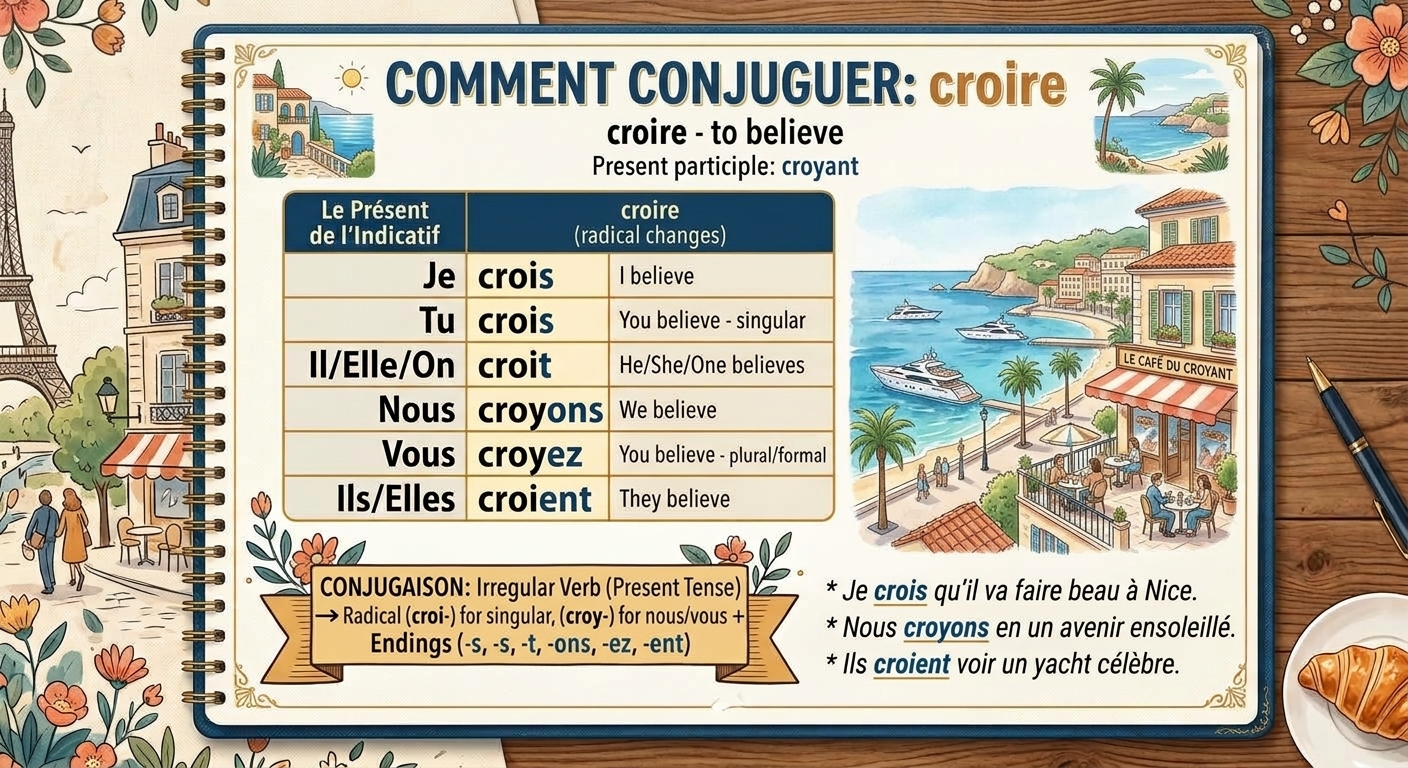
The present tense expresses what someone believes, thinks, or has faith in right now. Notice the change between croi- and croy- in the different subject forms.
| Subject | Conjugation |
|---|---|
| je | je crois |
| tu | tu crois |
| il / elle | il croit / elle croit |
| nous | nous croyons |
| vous | vous croyez |
| ils / elles | ils croient / elles croient |
Je crois que cette histoire est vraie.
I believe that this story is true.
How to Conjugate Croire in the Passé Composé
The passé composé describes a belief or opinion held at a particular point in the past. It is formed using the present tense of avoir and the past participle cru.
| Subject | Conjugation |
|---|---|
| j’ | j’ai cru |
| tu | tu as cru |
| il / elle | il a cru / elle a cru |
| nous | nous avons cru |
| vous | vous avez cru |
| ils / elles | ils ont cru / elles ont cru |
J’ai cru entendre quelqu’un frapper à la porte.
I thought I heard someone knock at the door.
How to Conjugate Croire in the Imparfait
The imparfait expresses a belief or opinion that existed over a period of time in the past. It can also describe what someone used to believe.
| Subject | Conjugation |
|---|---|
| je | je croyais |
| tu | tu croyais |
| il / elle | il croyait / elle croyait |
| nous | nous croyions |
| vous | vous croyiez |
| ils / elles | ils croyaient / elles croyaient |
Quand j’étais enfant, je croyais aux contes de fées.
When I was a child, I believed in fairy tales.
How to Conjugate Croire in the Plus-que-parfait
The plus-que-parfait describes something someone had believed before another event in the past. It is formed with the imparfait of avoir and the past participle cru.
| Subject | Conjugation |
|---|---|
| j’ | j’avais cru |
| tu | tu avais cru |
| il / elle | il avait cru / elle avait cru |
| nous | nous avions cru |
| vous | vous aviez cru |
| ils / elles | ils avaient cru / elles avaient cru |
J’avais cru qu’il viendrait à la fête.
I had believed he would come to the party.
How to Conjugate Croire in the Passé Simple
The passé simple is primarily used in literature, historical writing, and formal storytelling. It describes a completed act of believing or thinking in the past.
| Subject | Conjugation |
|---|---|
| je | je crus |
| tu | tu crus |
| il / elle | il crut / elle crut |
| nous | nous crûmes |
| vous | vous crûtes |
| ils / elles | ils crurent / elles crurent |
Il crut reconnaître la voix de son ami.
He thought he recognized his friend’s voice.
How to Conjugate Croire in the Passé Antérieur
The passé antérieur is a literary tense used to describe an action completed before another past event, usually in a sentence using the passé simple.
| Subject | Conjugation |
|---|---|
| j’ | j’eus cru |
| tu | tu eus cru |
| il / elle | il eut cru / elle eut cru |
| nous | nous eûmes cru |
| vous | vous eûtes cru |
| ils / elles | ils eurent cru / elles eurent cru |
Dès qu’il eut cru comprendre la situation, il prit une décision.
As soon as he thought he understood the situation, he made a decision.
How to Conjugate Croire in the Futur Simple
The futur simple expresses something that someone will believe or think in the future. The future stem is croir-.
| Subject | Conjugation |
|---|---|
| je | je croirai |
| tu | tu croiras |
| il / elle | il croira / elle croira |
| nous | nous croirons |
| vous | vous croirez |
| ils / elles | ils croiront / elles croiront |
Je croirai en toi, quoi qu’il arrive.
I will believe in you, whatever happens.
How to Conjugate Croire in the Futur Antérieur
The futur antérieur describes something that someone will have believed by a particular point in the future. It is formed with the future tense of avoir and the past participle cru.
| Subject | Conjugation |
|---|---|
| j’ | j’aurai cru |
| tu | tu auras cru |
| il / elle | il aura cru / elle aura cru |
| nous | nous aurons cru |
| vous | vous aurez cru |
| ils / elles | ils auront cru / elles auront cru |
À ce moment-là, tu auras cru à toutes ses promesses.
By that time, you will have believed all his promises.
How to Conjugate Croire in the Futur Proche
The futur proche describes something someone is going to believe or think. It is formed with the present tense of aller followed by the infinitive croire.
| Subject | Conjugation |
|---|---|
| je | je vais croire |
| tu | tu vas croire |
| il / elle | il va croire / elle va croire |
| nous | nous allons croire |
| vous | vous allez croire |
| ils / elles | ils vont croire / elles vont croire |
Tu vas croire ce que je vais te raconter.
You’re going to believe what I’m going to tell you.
Conditionnel (Conditional Mood)
How to Conjugate Croire in the Conditionnel Présent
The conditional present expresses what someone would believe or think under certain circumstances. It is also useful for expressing an opinion cautiously or politely.
| Subject | Conjugation |
|---|---|
| je | je croirais |
| tu | tu croirais |
| il / elle | il croirait / elle croirait |
| nous | nous croirions |
| vous | vous croiriez |
| ils / elles | ils croiraient / elles croiraient |
Je croirais cette histoire si elle était vraie.
I would believe this story if it were true.
How to Conjugate Croire in the Conditionnel Passé
The conditional past expresses something someone would have believed under different circumstances. It can also describe a belief that might have existed but did not.
| Subject | Conjugation |
|---|---|
| j’ | j’aurais cru |
| tu | tu aurais cru |
| il / elle | il aurait cru / elle aurait cru |
| nous | nous aurions cru |
| vous | vous auriez cru |
| ils / elles | ils auraient cru / elles auraient cru |
J’aurais cru que tu étais déjà parti.
I would have thought that you had already left.
How to Conjugate Croire in the Conditionnel Passé – Literary Alternative
French also has a literary alternative to the conditional past, formed with the imperfect subjunctive of avoir and the past participle cru. It is rarely heard in everyday conversation and is mainly found in classical or highly formal writing.
| Subject | Conjugation |
|---|---|
| j’ | j’eusse cru |
| tu | tu eusses cru |
| il / elle | il eût cru / elle eût cru |
| nous | nous eussions cru |
| vous | vous eussiez cru |
| ils / elles | ils eussent cru / elles eussent cru |
J’eusse cru cette histoire si elle avait été mieux expliquée.
I would have believed this story if it had been better explained.
Subjonctif (Subjunctive Mood)
How to Conjugate Croire in the Subjonctif Présent
The present subjunctive is used after expressions of doubt, uncertainty, emotion, and judgment. It is often introduced by phrases such as je doute que (I doubt that) or il faut que (it is necessary that).
| Subject | Conjugation |
|---|---|
| que je | que je croie |
| que tu | que tu croies |
| qu’il / qu’elle | qu’il croie / qu’elle croie |
| que nous | que nous croyions |
| que vous | que vous croyiez |
| qu’ils / qu’elles | qu’ils croient / qu’elles croient |
Je ne pense pas qu’il croie cette histoire.
I don’t think he believes this story.
How to Conjugate Croire in the Subjonctif Imparfait
The imperfect subjunctive is a literary tense, primarily encountered in classical literature and very formal writing. It is used in subordinate clauses referring to a past context.
| Subject | Conjugation |
|---|---|
| que je | que je crusse |
| que tu | que tu crusses |
| qu’il / qu’elle | qu’il crût / qu’elle crût |
| que nous | que nous crussions |
| que vous | que vous crussiez |
| qu’ils / qu’elles | qu’ils crussent / qu’elles crussent |
Il souhaitait que je crusse en ses paroles.
He wished that I would believe his words.
How to Conjugate Croire in the Subjonctif Plus-que-parfait
The pluperfect subjunctive is another literary form. It describes something that someone might have believed before another past event.
| Subject | Conjugation |
|---|---|
| que j’ | que j’eusse cru |
| que tu | que tu eusses cru |
| qu’il / qu’elle | qu’il eût cru / qu’elle eût cru |
| que nous | que nous eussions cru |
| que vous | que vous eussiez cru |
| qu’ils / qu’elles | qu’ils eussent cru / qu’elles eussent cru |
Il regrettait que nous eussions cru ses mensonges.
He regretted that we had believed his lies.
How to Conjugate Croire in the Subjonctif Passé
The past subjunctive expresses a belief or opinion that has already occurred. It is formed with the present subjunctive of avoir and the past participle cru.
| Subject | Conjugation |
|---|---|
| que j’ | que j’aie cru |
| que tu | que tu aies cru |
| qu’il / qu’elle | qu’il ait cru / qu’elle ait cru |
| que nous | que nous ayons cru |
| que vous | que vous ayez cru |
| qu’ils / qu’elles | qu’ils aient cru / qu’elles aient cru |
Je suis heureux que tu aies cru en moi.
I’m happy that you believed in me.
Impératif (Imperative Mood)
How to Conjugate Croire in the Impératif Présent
The imperative is used to give commands, instructions, or encouragement. The verb croire has three imperative forms: crois, croyons, and croyez.
| Subject | Conjugation |
|---|---|
| (tu) | crois |
| (nous) | croyons |
| (vous) | croyez |
Crois en toi et n’abandonne jamais.
Believe in yourself and never give up.
French Participles: Croire
Présent Participe (Present Participle)
The present participle of croire is croyant. It can describe someone who is believing or holding a particular opinion. It can also introduce a phrase explaining the circumstances of an action.
Present participle: croyant
croyant
believing
For example:
Croyant avoir raison, il refusa de changer d’avis.
Believing he was right, he refused to change his mind.
Participe Passé (Past Participle)
The past participle of croire is cru. It is used with the auxiliary verb avoir to form compound tenses.
Past participle forms:
- cru — masculine singular
- crus — masculine plural
- crue — feminine singular
- crues — feminine plural
cru
crus
crue
crues
For example:
Les histoires que j’ai crues étaient fausses.
The stories I believed were false.
Croire in Everyday French: Six Useful Examples
Here are six examples showing how croire appears in different tenses and moods.
1. Present – Je crois
Je crois en toi.
I believe in you.
2. Passé composé – J’ai cru
J’ai cru entendre un bruit.
I thought I heard a noise.
3. Imparfait – Je croyais
Je croyais que tu étais malade.
I thought you were sick.
4. Futur simple – Je croirai
Je croirai toujours en mes rêves.
I will always believe in my dreams.
5. Conditional present – Je croirais
Je croirais cette histoire si elle était possible.
I would believe this story if it were possible.
6. Subjunctive present – Que je croie
Il faut que je croie en mes capacités.
I must believe in my abilities.
Beyond Translation: The Meaning of Croire
Although croire is usually translated as “to believe,” its meaning changes depending on the words that follow it.
1. Croire que – to believe or think that
Je crois qu’il est sincère.
I believe he is sincere.
2. Croire en – to believe in someone or something
Elle croit en son avenir.
She believes in her future.
3. Croire à – to believe in or believe something exists
Il croit aux fantômes.
He believes in ghosts.
4. Croire quelqu’un – to believe someone
Je te crois.
I believe you.
There is also an important grammatical difference between croire que and ne pas croire que. When expressing doubt or uncertainty in a negative construction, French commonly uses the subjunctive:
Je ne crois pas qu’il soit malade.
I don’t think he is sick.
But when expressing a positive belief, the indicative is normally used:
Je crois qu’il est malade.
I think he is sick.
Understanding these small differences will make your French sound much more natural.
How to Remember Croire
Because croire is irregular, it helps to remember its most frequently used forms as complete expressions.
- Je crois — I believe / I think.
- Je croyais — I believed / I used to think.
- J’ai cru — I believed / I thought.
- Je croirai — I will believe.
- Je croirais — I would believe.
- J’aurais cru — I would have believed.
- Je vais croire — I am going to believe.
Remember the three especially useful expressions:
- Je crois que… — I think that…
- Je crois en toi. — I believe in you.
- Je n’arrive pas à le croire ! — I can’t believe it!
Once you become comfortable with these expressions, you’ll recognize croire in countless everyday conversations.
Test Your Knowledge of Croire
Try these five questions to see how well you understand the verb.
1. What is the present tense form of croire for nous?
Show answer
Nous croyons.
2. How do you say “I believed you” in the passé composé?
Show answer
Je t’ai cru.
3. What is the future tense form of croire for ils?
Show answer
Ils croiront.
4. What does “Je crois en toi” mean?
Show answer
“I believe in you.”
5. What is the present subjunctive form for que vous?
Show answer
Que vous croyiez.
Final Challenge
Translate this sentence into French:
“I thought you believed in me.”
Reveal the answer
Je croyais que tu croyais en moi.
A little French. A little curiosity. A richer everyday life.
LEARN FRENCH ONE WORD AT A TIME