A French Word to Live By
How to Conjugate Trouver in French
/tʁu.ve/
Trouver means “to find” in French.
Sometimes finding something is easy. Sometimes it takes a little searching. And sometimes, what we find is something we never expected. The French verb trouver is an essential everyday word, used for everything from finding lost keys to expressing an opinion about the world around us.
In this guide, you’ll learn how to conjugate trouver in all the major French tenses and moods, with practical examples, pronunciation guidance, and quizzes to help you remember each form.
Understanding the French Verb Trouver
Trouver is a regular first-group French verb ending in -er. It follows the standard conjugation pattern for regular -er verbs, making it a useful model for learning many other French verbs.
- Infinitive: trouver
- Meaning: to find
- Verb group: First group (-er)
- Auxiliary verb: avoir
- Past participle: trouvé
- Present participle: trouvant
What Does Trouver Mean?
The most common meaning of trouver is “to find,” but it has several related uses.
- To find something: J’ai trouvé mes clés. (I found my keys.)
- To discover: Elle a trouvé une solution. (She found a solution.)
- To think or consider: Je trouve ce film intéressant. (I think this film is interesting.)
- To find someone or something in a particular state: Je le trouve sympathique. (I find him pleasant.)
Trouver vs. Retrouver
These two verbs are related, but they are not always interchangeable.
- Trouver: to find or discover something.
- Retrouver: to find again, recover, or meet someone again.
J’ai trouvé un nouveau café.
I found a new café.
J’ai retrouvé mon ami au restaurant.
I met my friend again at the restaurant.
A Useful Expression: Trouver Que
In everyday French, trouver que is commonly used to express an opinion.
Je trouve que cette ville est magnifique.
I think this city is beautiful.
Notice that the French expression literally means something like “I find that this city is beautiful.” It is a natural way to express what you think about something.
Experience the Word
Imagine arriving in a beautiful French village. You wander through narrow streets, discover a little café, and find a quiet table in the sunshine.
J’ai trouvé un endroit magnifique.
I found a beautiful place.
That simple sentence captures the everyday usefulness of trouver. It can describe a discovery, an opinion, or the moment something finally turns up.
How to Conjugate Trouver: Complete French Conjugation Guide
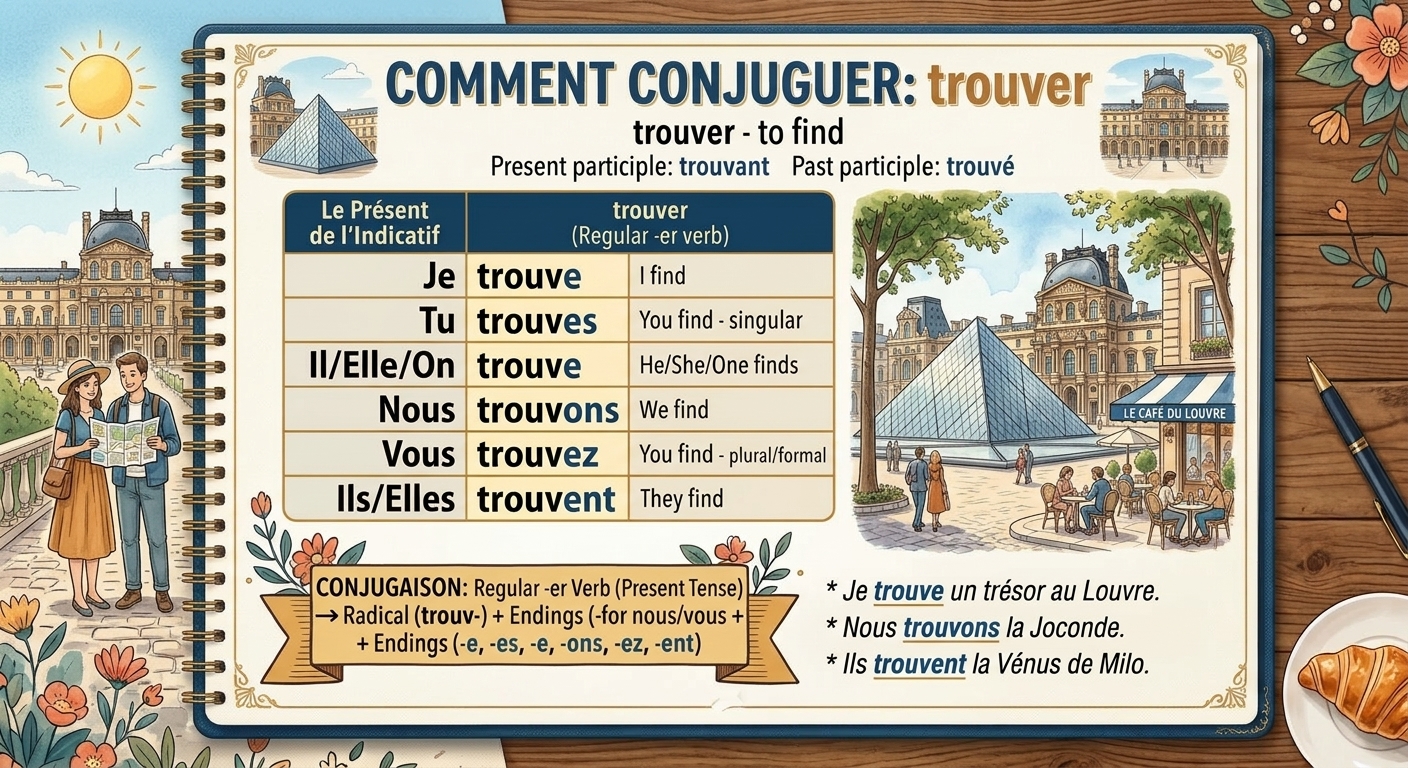
Because trouver is a regular -er verb, its conjugations follow a consistent pattern. The stem is trouv-, and the endings change according to the tense and subject.
Indicatif – The Indicative Mood
The indicative mood is used to describe facts, actions, events, and things that are presented as real or certain.
How to Conjugate Trouver in the Présent (Present Tense)
The present tense describes something happening now, a habit, or a general truth.
| Subject | Conjugation |
|---|---|
| je | je trouve |
| tu | tu trouves |
| il / elle | il trouve / elle trouve |
| nous | nous trouvons |
| vous | vous trouvez |
| ils / elles | ils trouvent / elles trouvent |
Example:
Je trouve ce livre passionnant.
I find this book fascinating.
Quick Quiz
How do you say “We find” in French?
Reveal the answer
Nous trouvons.
How to Conjugate Trouver in the Passé Composé (Past Tense)
The passé composé describes a completed action in the past. It is formed with the present tense of avoir and the past participle trouvé.
| Subject | Conjugation |
|---|---|
| j’ | j’ai trouvé |
| tu | tu as trouvé |
| il / elle | il a trouvé / elle a trouvé |
| nous | nous avons trouvé |
| vous | vous avez trouvé |
| ils / elles | ils ont trouvé / elles ont trouvé |
Example:
J’ai trouvé mon téléphone sous le canapé.
I found my phone under the sofa.
Remember: Trouver uses avoir as its auxiliary. The past participle normally remains trouvé, regardless of the subject. It agrees with a preceding direct object when French agreement rules require it.
How to Conjugate Trouver in the Imparfait (Imperfect Tense)
The imparfait describes ongoing or repeated actions in the past, habits, and background situations.
| Subject | Conjugation |
|---|---|
| je | je trouvais |
| tu | tu trouvais |
| il / elle | il trouvait / elle trouvait |
| nous | nous trouvions |
| vous | vous trouviez |
| ils / elles | ils trouvaient / elles trouvaient |
Example:
Quand j’étais petit, je trouvais toujours des trésors dans le jardin.
When I was little, I always found treasures in the garden.
Quick Quiz
Which tense would you use to describe something you regularly found as a child?
Reveal the answer
L’imparfait. For example: Je trouvais.
How to Conjugate Trouver in the Plus-que-parfait (Pluperfect Tense)
The plus-que-parfait describes an action that had already happened before another past action. It is formed with the imparfait of avoir and the past participle trouvé.
| Subject | Conjugation |
|---|---|
| j’ | j’avais trouvé |
| tu | tu avais trouvé |
| il / elle | il avait trouvé / elle avait trouvé |
| nous | nous avions trouvé |
| vous | vous aviez trouvé |
| ils / elles | ils avaient trouvé / elles avaient trouvé |
Example:
J’avais déjà trouvé la réponse quand le professeur est arrivé.
I had already found the answer when the teacher arrived.
How to Conjugate Trouver in the Passé Simple (Simple Past)
The passé simple is primarily used in formal writing, literature, and historical narration. In everyday conversation, the passé composé usually takes its place.
| Subject | Conjugation |
|---|---|
| je | je trouvai |
| tu | tu trouvas |
| il / elle | il trouva / elle trouva |
| nous | nous trouvâmes |
| vous | vous trouvâtes |
| ils / elles | ils trouvèrent / elles trouvèrent |
Example:
Après de longues recherches, il trouva enfin la vérité.
After a long search, he finally found the truth.
How to Conjugate Trouver in the Passé Antérieur
The passé antérieur is a literary tense used to describe an action completed immediately before another past action, usually in a narrative written in the passé simple.
| Subject | Conjugation |
|---|---|
| j’ | j’eus trouvé |
| tu | tu eus trouvé |
| il / elle | il eut trouvé / elle eut trouvé |
| nous | nous eûmes trouvé |
| vous | vous eûtes trouvé |
| ils / elles | ils eurent trouvé / elles eurent trouvé |
Example:
Dès qu’il eut trouvé le document, il quitta la pièce.
As soon as he had found the document, he left the room.
How to Conjugate Trouver in the Futur Simple (Simple Future)
The futur simple describes an action that will happen in the future. For regular -er verbs, the infinitive is followed by the future endings.
| Subject | Conjugation |
|---|---|
| je | je trouverai |
| tu | tu trouveras |
| il / elle | il trouvera / elle trouvera |
| nous | nous trouverons |
| vous | vous trouverez |
| ils / elles | ils trouveront / elles trouveront |
Example:
Tu trouveras certainement une solution.
You will certainly find a solution.
How to Conjugate Trouver in the Futur Antérieur (Future Perfect)
The futur antérieur describes an action that will have been completed before a particular point in the future. It is formed with the future tense of avoir and the past participle trouvé.
| Subject | Conjugation |
|---|---|
| j’ | j’aurai trouvé |
| tu | tu auras trouvé |
| il / elle | il aura trouvé / elle aura trouvé |
| nous | nous aurons trouvé |
| vous | vous aurez trouvé |
| ils / elles | ils auront trouvé / elles auront trouvé |
Example:
Demain, j’aurai trouvé une réponse à cette question.
Tomorrow, I will have found an answer to this question.
How to Conjugate Trouver in the Futur Proche (Near Future)
The futur proche describes an action that is going to happen soon. It is formed with the present tense of aller followed by the infinitive trouver.
| Subject | Conjugation |
|---|---|
| je | je vais trouver |
| tu | tu vas trouver |
| il / elle | il va trouver / elle va trouver |
| nous | nous allons trouver |
| vous | vous allez trouver |
| ils / elles | ils vont trouver / elles vont trouver |
Example:
Je vais trouver un endroit où déjeuner.
I’m going to find somewhere to have lunch.
Le Conditionnel – The Conditional Mood
The conditional mood expresses what would happen under certain circumstances. It is also used to make polite requests and express possibilities.
How to Conjugate Trouver in the Conditionnel Présent (Present Conditional)
The present conditional is often translated as “would find.” It is also useful when expressing hypothetical situations.
| Subject | Conjugation |
|---|---|
| je | je trouverais |
| tu | tu trouverais |
| il / elle | il trouverait / elle trouverait |
| nous | nous trouverions |
| vous | vous trouveriez |
| ils / elles | ils trouveraient / elles trouveraient |
Example:
Je trouverais cela plus facile avec ton aide.
I would find that easier with your help.
How to Conjugate Trouver in the Conditionnel Passé (Past Conditional)
The past conditional describes what would have happened under different circumstances. It is formed with the conditional of avoir and the past participle trouvé.
| Subject | Conjugation |
|---|---|
| j’ | j’aurais trouvé |
| tu | tu aurais trouvé |
| il / elle | il aurait trouvé / elle aurait trouvé |
| nous | nous aurions trouvé |
| vous | vous auriez trouvé |
| ils / elles | ils auraient trouvé / elles auraient trouvé |
Example:
J’aurais trouvé la maison sans ton aide.
I would have found the house without your help.
Conditionnel Passé – Literary Alternative
The literary form of the past conditional uses the imperfect subjunctive of avoir followed by the past participle. It is rare in modern everyday French and appears mainly in formal or literary writing.
| Subject | Conjugation |
|---|---|
| j’ | j’eusse trouvé |
| tu | tu eusses trouvé |
| il / elle | il eût trouvé / elle eût trouvé |
| nous | nous eussions trouvé |
| vous | vous eussiez trouvé |
| ils / elles | ils eussent trouvé / elles eussent trouvé |
Example:
Sans son aide, j’eusse trouvé la tâche bien difficile.
Without his help, I would have found the task very difficult.
Le Subjonctif – The Subjunctive Mood
The subjunctive is used to express feelings, doubt, uncertainty, necessity, and wishes. It often follows expressions such as il faut que, je veux que, and bien que.
How to Conjugate Trouver in the Subjonctif Présent (Present Subjunctive)
The present subjunctive is used when the action is uncertain, desired, or necessary.
| Subject | Conjugation |
|---|---|
| que je | que je trouve |
| que tu | que tu trouves |
| qu’il / qu’elle | qu’il trouve / qu’elle trouve |
| que nous | que nous trouvions |
| que vous | que vous trouviez |
| qu’ils / qu’elles | qu’ils trouvent / qu’elles trouvent |
Example:
Il faut que je trouve une solution rapidement.
I have to find a solution quickly.
Quick Quiz
Complete the sentence: Il faut que tu ______ la réponse.
Reveal the answer
trouves — Il faut que tu trouves la réponse.
How to Conjugate Trouver in the Subjonctif Imparfait (Imperfect Subjunctive)
The imperfect subjunctive is a literary tense, rarely used in modern spoken French. You may encounter it in classic literature and formal writing.
| Subject | Conjugation |
|---|---|
| que je | que je trouvasse |
| que tu | que tu trouvasses |
| qu’il / qu’elle | qu’il trouvât / qu’elle trouvât |
| que nous | que nous trouvassions |
| que vous | que vous trouvassiez |
| qu’ils / qu’elles | qu’ils trouvassent / qu’elles trouvassent |
Example:
Il souhaitait que je trouvasse une réponse.
He wished that I would find an answer.
How to Conjugate Trouver in the Subjonctif Plus-que-parfait (Pluperfect Subjunctive)
The pluperfect subjunctive is another literary tense. It describes an action that had been completed before another past action in a subjunctive context.
| Subject | Conjugation |
|---|---|
| que j’ | que j’eusse trouvé |
| que tu | que tu eusses trouvé |
| qu’il / qu’elle | qu’il eût trouvé / qu’elle eût trouvé |
| que nous | que nous eussions trouvé |
| que vous | que vous eussiez trouvé |
| qu’ils / qu’elles | qu’ils eussent trouvé / qu’elles eussent trouvé |
Example:
Il regrettait que nous n’eussions pas trouvé la bonne adresse.
He regretted that we had not found the correct address.
How to Conjugate Trouver in the Subjonctif Passé (Past Subjunctive)
The past subjunctive describes an action that has been completed before the action of the main clause. It is formed with the present subjunctive of avoir and the past participle trouvé.
| Subject | Conjugation |
|---|---|
| que j’ | que j’aie trouvé |
| que tu | que tu aies trouvé |
| qu’il / qu’elle | qu’il ait trouvé / qu’elle ait trouvé |
| que nous | que nous ayons trouvé |
| que vous | que vous ayez trouvé |
| qu’ils / qu’elles | qu’ils aient trouvé / qu’elles aient trouvé |
Example:
Je suis heureux que tu aies trouvé un nouvel emploi.
I’m happy that you found a new job.
L’Impératif – The Imperative Mood
The imperative is used to give commands, instructions, suggestions, or advice. It has three forms: tu, nous, and vous. The subject pronoun is omitted.
How to Conjugate Trouver in the Impératif Présent
| Subject | Conjugation |
|---|---|
| (tu) | trouve |
| (nous) | trouvons |
| (vous) | trouvez |
Examples:
Trouve ton chemin !
Find your way!
Trouvons une solution ensemble.
Let’s find a solution together.
Quick Quiz
How would you tell a friend to “Find the answer” using the informal imperative?
Reveal the answer
Trouve la réponse !
French Participles: Trouver
Participles are useful verb forms that appear in compound tenses and other grammatical constructions.
Participe Présent (Present Participle)
trouvant
The present participle can describe an action happening at the same time as another action. It can also appear in certain formal constructions.
En trouvant la bonne adresse, nous avons découvert un joli quartier.
While finding the correct address, we discovered a lovely neighborhood.
Participe Passé (Past Participle)
The past participle of trouver is trouvé.
Its written forms are:
- trouvé
- trouvés
- trouvée
- trouvées
These forms are used when agreement is required. With the auxiliary avoir, the past participle generally does not agree with the subject. It agrees with a preceding direct object when the rules require it.
Les clés que j’ai trouvées étaient sur la table.
The keys that I found were on the table.
Trouver in Everyday French: Six Useful Examples
Here are six examples showing how trouver appears in everyday French.
1. Present:
Je trouve cette idée excellente.
I think this idea is excellent.
2. Passé composé:
Nous avons trouvé une petite boulangerie.
We found a little bakery.
3. Imparfait:
Je trouvais toujours cette histoire amusante.
I always found that story amusing.
4. Futur simple:
Vous trouverez les informations sur le site.
You will find the information on the website.
5. Conditional:
Je trouverais cela merveilleux.
I would find that wonderful.
6. Subjunctive:
Il faut que nous trouvions une solution.
We need to find a solution.
Beyond Translation: The Many Uses of Trouver
Learning a French verb is more than memorizing its English equivalent. The real value comes from understanding how French speakers use it in everyday situations.
Here are a few common expressions worth adding to your vocabulary:
- trouver son chemin – to find one’s way
- trouver une solution – to find a solution
- trouver du travail – to find work
- trouver le temps – to find the time
- trouver quelqu’un sympathique – to find someone pleasant
- se trouver – to be located or to find oneself
For example:
Le restaurant se trouve près de la gare.
The restaurant is located near the train station.
Notice the reflexive form se trouver. It is commonly used to describe where a place or object is located.
How to Remember the Conjugations of Trouver
There is good news when learning trouver: it is a regular -er verb. Once you understand the pattern, you can apply much of what you learn to hundreds of other French verbs.
- Present: Start with the stem trouv- and add the regular -er endings.
- Past: Remember avoir + trouvé.
- Imperfect: Use the stem trouv- with the imperfect endings.
- Future: Add the future endings to the infinitive trouver.
- Conditional: Use the same future stem with the imperfect endings.
A useful way to practice is to make a sentence with trouver every day. Find something, describe an opinion, or talk about something you hope to discover.
Test Your Knowledge: Trouver
Try these five questions to see how well you remember the verb.
Question 1
What does trouver mean?
Reveal the answer
To find.
Question 2
Which auxiliary verb is used to form the passé composé of trouver?
Reveal the answer
Avoir. For example: j’ai trouvé.
Question 3
How do you say “They found” in French?
Reveal the answer
Ils ont trouvé or elles ont trouvé.
Question 4
What is the present participle of trouver?
Reveal the answer
Trouvant.
Question 5
How do you say “I would find” in French?
Reveal the answer
Je trouverais.
Your Final Challenge
Translate this sentence into French:
“I found a wonderful little restaurant, and I think you will like it.”
Reveal the translation
J’ai trouvé un petit restaurant merveilleux, et je pense qu’il te plaira.
I found a wonderful little restaurant, and I think you will like it.
A little French. A little curiosity. A richer everyday life.
LEARN FRENCH ONE WORD AT A TIME