A French Word to Live By
Translate Égal to English
/e.ɡal/
Égal means equal.
Two glasses poured to exactly the same line, two children given the same number of strawberries, two runners crossing the line together: égal is the adjective of the level balance — the word French reaches for whenever fairness must be measured and nobody is to have more than anyone else.
In this guide, you’ll learn what égal means in English, how its feminine égale and its masculine plural égaux are formed, where it stands in the sentence, and the famous phrase cela m’est égal. Explore French examples, English translations, and practice quizzes.
Understanding the French Adjective Égal
Égal is a French adjective of measure and fairness. It comes from the Latin aequalis, level, even — from aequus, flat. Its feminine is égale: un droit égal, une part égale. Its masculine plural is the trap of the family: égaux, with an x — des droits égaux. It describes things that match in size, quantity, value or rights, and it lives in the great motto of the Republic: Liberté, Égalité, Fraternité.
It means equal — the same in amount, size, value or standing: à parts égales, in equal shares; des chances égales, equal chances; égal à, equal to. And it has a second, very French life of indifference: cela m’est égal means I don’t mind, it’s all the same to me — the equality of two choices so perfectly balanced that the heart cannot tip either way.
Type: Adjective of measure — equality of size, quantity, value, rights
Answers the question: How much / how great? — the same, level, equal
Changes form: Feminine égale — égal / égale; masculine plural égaux (with x), feminine plural égales
English equivalents: Equal; the same; (cela m’est égal) I don’t mind.
One important usage detail: the masculine plural of égal is égaux — des droits égaux, never des droits égals. The feminine is regular: égale, égales. And learn the indifference phrase as a block: cela m’est égal, it’s all the same to me — with lui, vous, nous for other people: cela lui est égal, cela nous est égal.
Experience the Word
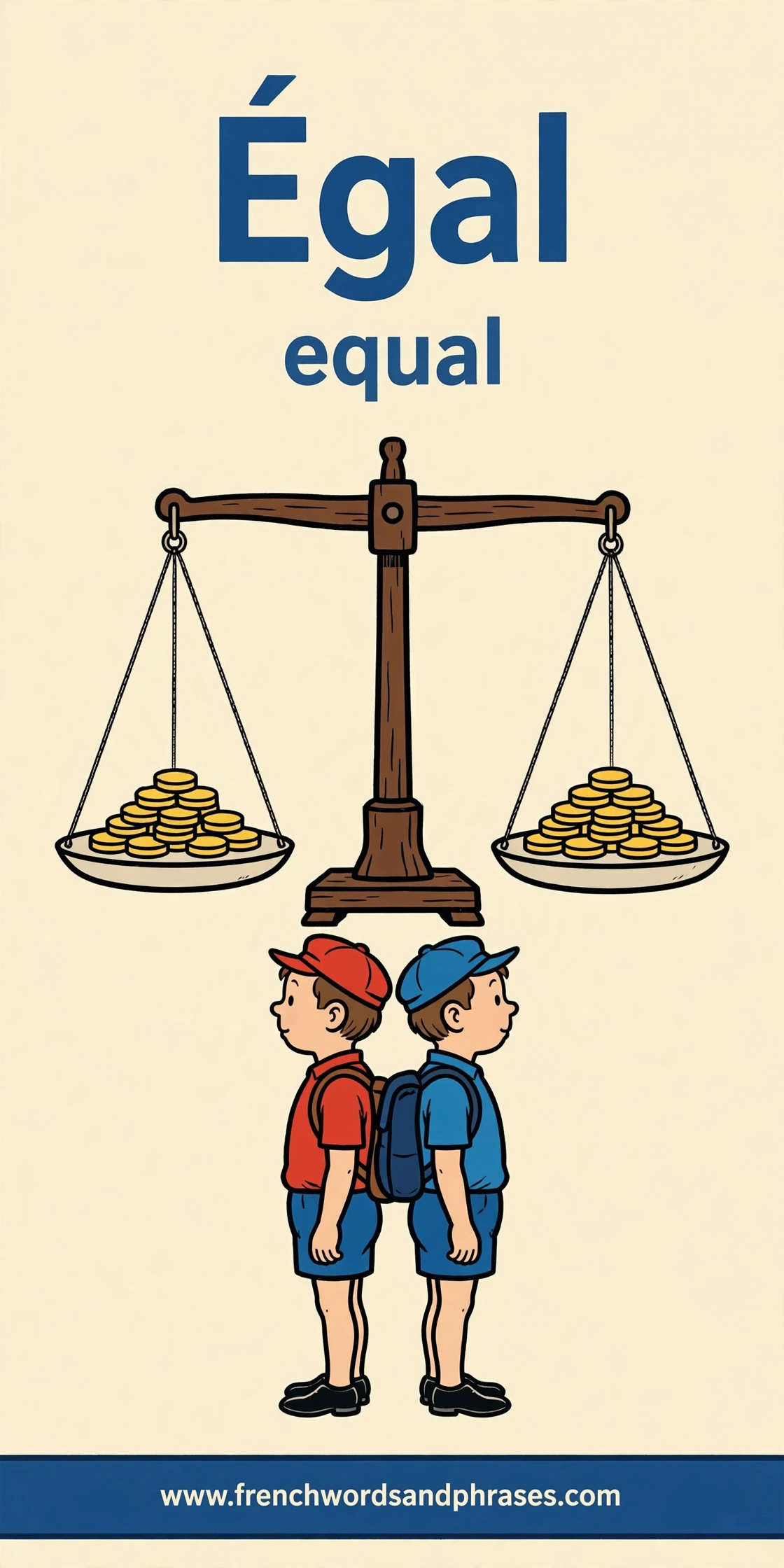
Égal is the adjective of the steady scale — two pans, two weights, and the needle resting exactly in the middle.
Imagine the grandmother cutting the cake with the concentration of a surgeon: six grandchildren, six slices, and a ruler’s eye. « À parts égales ! » — in equal shares — because in her kitchen, égal is not mathematics, it is love with a knife.
You have not just said “the same”. You have invoked fairness itself — égal, the level balance.
How to Use Égal in French: Complete Guide
Let’s explore how égal works in French, beginning with the whole word on one card.
Égal at a Glance
Before the details, here is the whole word on one card.
The Whole Word on One Card
Meaning, type, position and forms — égal in four lines.
| Point | Égal |
|---|---|
| Meaning | equal — the same in size, quantity, value or rights |
| Type | adjective of measure and fairness |
| Usual position | after the noun — une part égale |
| Form | égal / égale — égaux / égales in the plural |
Example
Les deux équipes ont un nombre égal de points.
The two teams have an equal number of points.
The Four Forms of Égal
Égal follows the -al pattern: the feminine adds -e, but the masculine plural trades -al for -aux.
| Form | Égal | Example |
|---|---|---|
| Masculine singular | égal | un droit égal — an equal right |
| Feminine singular | égale | une part égale — an equal share |
| Masculine plural | égaux | des droits égaux — equal rights |
| Feminine plural | égales | des parts égales — equal shares |
Example
Ils ont reçu des parts égales du gâteau.
They received equal shares of the cake.
Quick Quiz 1
What is the masculine plural of égal?
Reveal the answer
égaux
Des droits égaux — adjectives in -al form their masculine plural in -aux.
Equal rights.
The Feminine of Égal: Égale
Égale is formed in the simplest way — add -e — and its plural adds -s: égales.
| Situation | Example |
|---|---|
| Masculine | un salaire égal — an equal salary |
| Feminine | une somme égale — an equal sum |
| Why | the feminine of -al adjectives adds -e: égal → égale |
| The plural | add s to the feminine — des sommes égales, equal sums |
Example
Les deux sœurs ont reçu une somme égale.
The two sisters received an equal sum.
Where Égal Goes: After the Noun
Égal follows the noun it describes, and it lives in two fixed frames: égal à (equal to) and à parts égales (in equal shares).
| Pattern | Example |
|---|---|
| After the noun | une part égale — an equal share |
| With à | égal à zéro — equal to zero |
| In shares | à parts égales — in equal shares |
| Indifference | cela m’est égal — I don’t mind |
Example
On partage les frais à parts égales.
We split the costs in equal shares.
Quick Quiz 2
How do you say ‘equal rights’ — des droits égals or des droits égaux?
Reveal the answer
des droits égaux
The masculine plural of égal is égaux, with an x — never égals.
Equal rights.
More Égal: Comparing with Égal
Equality compares a little strangely — plus égal is rare; French prefers aussi égal and the noun égalité.
| Degree | Example |
|---|---|
| As equal as | aussi égal que — as equal as |
| Perfectly equal | parfaitement égal — perfectly equal |
| Almost equal | presque égal — almost equal |
| Not equal | pas égal / inégal — unequal (the opposite, inégal) |
Example
Les deux verres sont presque égaux.
The two glasses are almost equal.
Everyday Expressions with Égal
Égal appears wherever France measures fairness — and wherever it shrugs.
| Expression | In English |
|---|---|
| à parts égales | in equal shares |
| cela m’est égal | I don’t mind, it’s all the same to me |
| des droits égaux | equal rights |
| à égalité | level, tied (in a game or vote) |
| l’égalité | equality — the noun, second word of the Republic’s motto |
Example
À la mi-temps, les deux équipes sont à égalité.
At half-time, the two teams are level.
Quick Quiz 3
What does cela m’est égal mean?
Reveal the answer
I don’t mind — it’s all the same to me
Cela m’est égal — the two choices are so equal that I have no preference.
I don’t mind.
Égal and Its Neighbours
Égal keeps company with the other words of sameness — and faces its opposite, inégal.
| French | In English |
|---|---|
| le même / la même | the same (one) — identity, not measure |
| pareil | the same, alike — the everyday word |
| identique | identical |
| équivalent | equivalent |
| inégal | unequal — the opposite |
| juste | fair, just — fairness as justice |
Example
Pareil au quotidien, égal dans les textes : les deux parlent de la même mesure.
Pareil in everyday speech, égal in written texts: both speak of the same measure.
Watch Out: The Traps Around Égal
The traps here are the masculine plural in -aux and the double life of the word: equality and indifference.
| Trap | The truth |
|---|---|
| The masculine plural | des droits égaux — the plural of -al adjectives is -aux, never -als |
| The feminine | une part égale, des parts égales — add -e, then -s |
| Equality or indifference | égal measures sameness; cela m’est égal means I don’t mind — context decides |
| Égal vs même | égal compares amounts; même names identity — le même livre, the same book |
Example
Ce n’est pas le même poids, mais les deux sacs sont égaux.
It is not the same weight — wait, yes it is: the two bags are equal.
Quick Quiz 4
How do you say ‘in equal shares’?
Reveal the answer
à parts égales
À parts égales — the feminine plural égales, agreeing with parts.
In equal shares.
Égal in Everyday French: Real-Life Examples
Now that you know the word, let’s see how égal appears in everyday French.
Example 1 — The cake
Coupez le gâteau en parts égales !
Cut the cake into equal shares!
Example 2 — Rights
Tous les citoyens ont des droits égaux.
All citizens have equal rights.
Example 3 — Indifference
Thé ou café ? Cela m’est égal.
Tea or coffee? I don’t mind.
Example 4 — Sport
Les deux joueurs sont à égalité.
The two players are level.
Example 5 — Maths
Deux plus deux est égal à quatre.
Two plus two equals four.
Example 6 — At work
Ils reçoivent un salaire égal pour le même travail.
They receive equal pay for the same work.
Beyond Translation: The Meaning of Égal
Égal carries the Republic on its back: aequalis, level, became the second word of France’s motto — Liberté, Égalité, Fraternité — and l’égalité is still the promise French politics argues about daily. The everyday word kept a charming second life: because two perfectly equal choices cannot be told apart, cela m’est égal came to mean the scales do not move me — I don’t mind.
Égal is the adjective of the level scale — fairness measured, and indifference confessed.
Learn it beside même and pareil: même for identity, pareil for likeness, égal for the exact, weighed equality of shares and rights.
How to Remember the French Adjective Égal
Remember it this way: Égal is the equal adjective — égal, égale, and the masculine plural égaux with an x; cela m’est égal means I don’t mind.
- You learn the four forms together — égal, égale, égaux, égales.
- You never write égals — le pluriel masculin, c’est égaux, comme des droits égaux.
- You keep the shrug in your pocket — cela m’est égal, je n’ai pas de préférence.
The key idea is égal / égale / égaux means equal; à parts égales = in equal shares; cela m’est égal = I don’t mind.
Test Your Knowledge of Égal
Let’s see how much you’ve learned. Try answering these questions before revealing the answers.
Question 1
What does égal mean?
Reveal the answer
Equal — the same in size, quantity, value or rights.
Question 2
What is the masculine plural of égal?
Reveal the answer
égaux — adjectives in -al form their masculine plural in -aux.
Question 3
Translate: in equal shares.
Reveal the answer
À parts égales.
Question 4
Complete the sentence:
Les deux équipes ont un nombre ______ de points.
Reveal the answer
égal
Les deux équipes ont un nombre égal de points.
The two teams have an equal number of points.
Question 5
How do you say I don’t mind in French, using égal?
Reveal the answer
Cela m’est égal — literally, it is equal to me.
Your Final Challenge
Can You Use It?
How would you say this in French?
“Cut the cake into equal shares!”
Reveal the answer
Coupez le gâteau en parts égales !
Cut the cake into equal shares!
A little French. A little curiosity. A richer everyday life.
LEARN FRENCH ONE WORD AT A TIME