
A French Word to Live By
How to Conjugate Couper in French
/ku.pe/
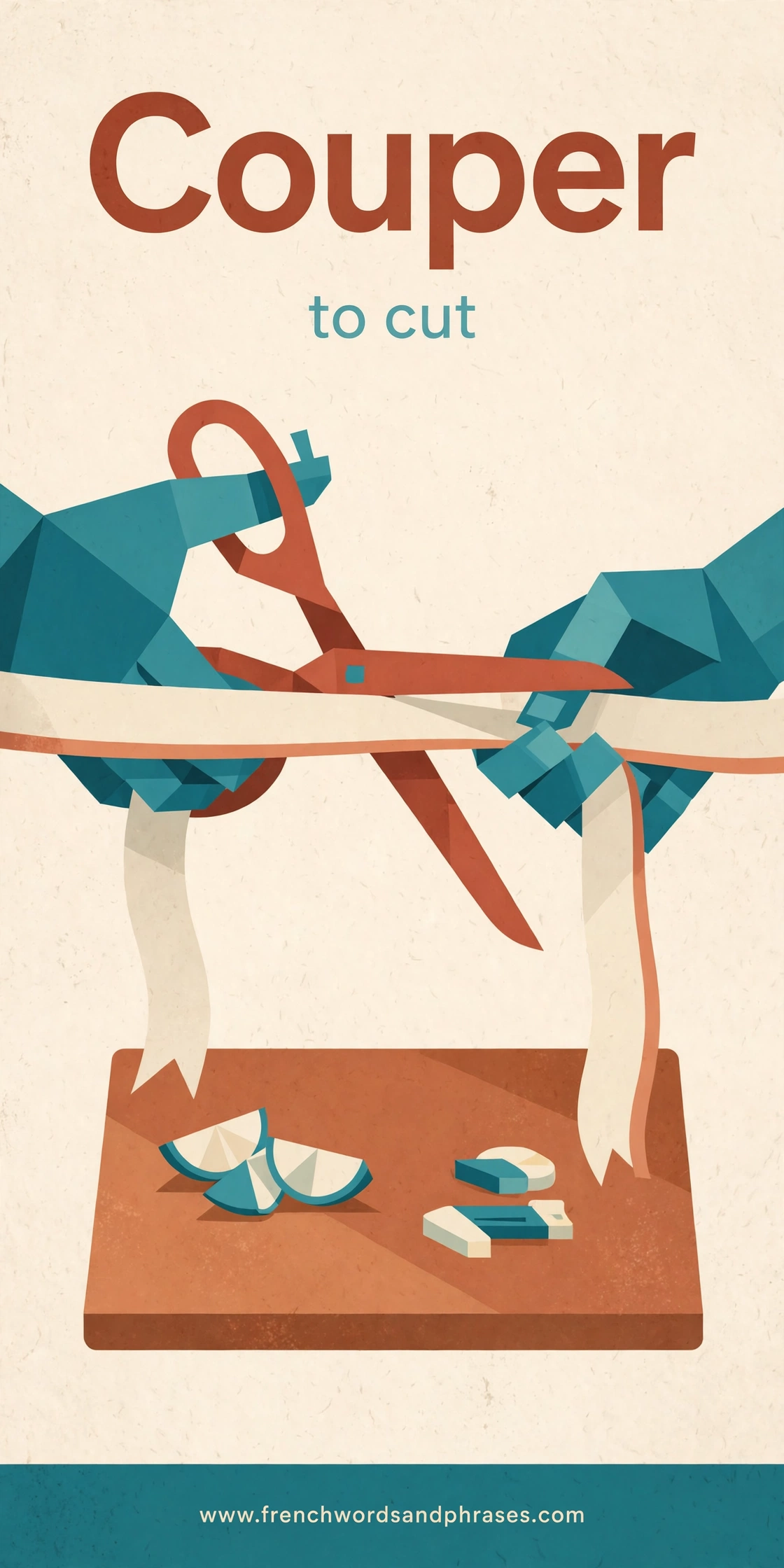
Couper means to cut.
A knife through warm bread, scissors around a ribbon, a cake divided into equal shares — couper is the kitchen’s hardest-working verb, the clean stroke that turns one thing into portions.
In this guide, you’ll learn how to conjugate couper in all the major French tenses and moods. Explore complete conjugation tables, French examples, English translations, and practice quizzes.
Understanding the French Verb Couper
Couper is a regular French verb belonging to the first group of verbs, those ending in -er.
It means to cut. It is commonly used for cutting bread, meat, vegetables and cakes, for cutting hair and cloth outside the kitchen, for cutting off water or electricity (couper l’eau, couper le courant), and for the reflexive mishap every cook knows — se couper le doigt.
Verb classification: First group (-er)
Auxiliary verb: Avoir
Past participle: coupé
Present participle: coupant
English equivalents: To cut, to slice off, to chop; (se) to cut oneself; to interrupt (couper la parole).
One important detail: couper reaches far beyond the kitchen. You coupez la parole — you interrupt someone mid-sentence; a driver coupe la route, cuts across your path; and the reflexive is the cook’s small accident: je me suis coupé le doigt, I cut my finger. In the kitchen itself, couper is the general word — couper en dés (into cubes), couper en rondelles (into rounds), couper en deux (in half).
Experience the Word
Couper is the verb of the decisive stroke — before it, a whole loaf, a whole cheese, a whole cake; after it, shares for everyone.
Imagine a farmhouse table on a Sunday. The roast rests, the knives come out, and the grandfather cuts the first slice with the seriousness of a ceremony while the children count the pieces.
Nothing has been destroyed. It has been cut — shared out, made ready for the table.
How to Conjugate Couper: Complete French Conjugation Guide
Let’s explore every major conjugation of couper, beginning with the indicative mood.
How to Conjugate Couper in the Indicative Mood
The indicative mood is used to express facts, observations, actions, and events.
How to Conjugate Couper in the Present Tense (Présent)
Used for actions happening now, habitual actions, and general truths.
| Subject | Conjugation |
|---|---|
| je | coupe |
| tu | coupes |
| il / elle | coupe |
| nous | coupons |
| vous | coupez |
| ils / elles | coupent |
Example
Elle coupe les oignons en petits dés.
She cuts the onions into small cubes.
Quick Quiz 1
Complete the sentence:
Nous ______ le pain à la main.
Reveal the answer
coupons
Nous coupons le pain à la main.
We cut the bread by hand.
How to Conjugate Couper in the Passé Composé
Used for completed actions in the past. Couper takes the auxiliary verb avoir.
| Subject | Conjugation |
|---|---|
| j’ | ai coupé |
| tu | as coupé |
| il / elle | a coupé |
| nous | avons coupé |
| vous | avez coupé |
| ils / elles | ont coupé |
Example
Il a coupé le pain en tranches épaisses.
He cut the bread into thick slices.
How to Conjugate Couper in the Imparfait (Imperfect Tense)
Used for habitual past actions, descriptions, and ongoing situations in the past.
| Subject | Conjugation |
|---|---|
| je | coupais |
| tu | coupais |
| il / elle | coupait |
| nous | coupions |
| vous | coupiez |
| ils / elles | coupaient |
Example
Chaque matin, le boulanger coupait la pâte en parts égales.
Every morning, the baker used to cut the dough into equal pieces.
Quick Quiz 2
Choose the correct form:
He cut the onions.
Il ______ les oignons. (a coupé / est coupé)
Reveal the answer
a coupé
Il a coupé les oignons.
Couper takes avoir.
How to Conjugate Couper in the Plus-que-parfait
Used to describe an action that had already been completed before another past event.
| Subject | Conjugation |
|---|---|
| j’ | avais coupé |
| tu | avais coupé |
| il / elle | avait coupé |
| nous | avions coupé |
| vous | aviez coupé |
| ils / elles | avaient coupé |
Example
Nous avions coupé les légumes avant l’arrivée des invités.
We had cut the vegetables before the guests arrived.
How to Conjugate Couper in the Passé Simple
Primarily used in formal writing, literature, and historical narratives. It is rarely used in everyday conversation.
| Subject | Conjugation |
|---|---|
| je | coupai |
| tu | coupas |
| il / elle | coupa |
| nous | coupâmes |
| vous | coupâtes |
| ils / elles | coupèrent |
Example
Le chef coupa la viande avec un couteau bien aiguisé.
The chef cut the meat with a well-sharpened knife.
How to Conjugate Couper in the Passé Antérieur
A literary tense used to express an action completed immediately before another past action, generally in the passé simple.
| Subject | Conjugation |
|---|---|
| j’ | eus coupé |
| tu | eus coupé |
| il / elle | eut coupé |
| nous | eûmes coupé |
| vous | eûtes coupé |
| ils / elles | eurent coupé |
Example
Quand il eut coupé le gâteau, les enfants applaudirent.
When he had cut the cake, the children clapped.
How to Conjugate Couper in the Future Tense (Futur Simple)
Used to describe actions that will take place in the future.
| Subject | Conjugation |
|---|---|
| je | couperai |
| tu | couperas |
| il / elle | coupera |
| nous | couperons |
| vous | couperez |
| ils / elles | couperont |
Example
Demain, nous couperons le jambon pour le pique-nique.
Tomorrow, we will cut the ham for the picnic.
How to Conjugate Couper in the Futur Antérieur (Future Perfect)
Used for an action that will have been completed before a particular point in the future.
| Subject | Conjugation |
|---|---|
| j’ | aurai coupé |
| tu | auras coupé |
| il / elle | aura coupé |
| nous | aurons coupé |
| vous | aurez coupé |
| ils / elles | auront coupé |
Example
À midi, elle aura coupé toutes les pommes de terre.
By noon, she will have cut all the potatoes.
How to Conjugate Couper in the Near Future (Futur Proche)
Used to describe something that is going to happen soon. Formed with aller + infinitive.
| Subject | Conjugation |
|---|---|
| je | vais couper |
| tu | vas couper |
| il / elle | va couper |
| nous | allons couper |
| vous | allez couper |
| ils / elles | vont couper |
Example
Je vais couper le citron en deux.
I am going to cut the lemon in half.
How to Conjugate Couper in the Conditional Mood
The conditional mood expresses what would happen under certain circumstances. It is also frequently used to make polite requests or express wishes.
How to Conjugate Couper in the Present Conditional
| Subject | Conjugation |
|---|---|
| je | couperais |
| tu | couperais |
| il / elle | couperait |
| nous | couperions |
| vous | couperiez |
| ils / elles | couperaient |
Example
Avec un meilleur couteau, je couperais le pain sans l’écraser.
With a better knife, I would cut the bread without crushing it.
How to Conjugate Couper in the Past Conditional
| Subject | Conjugation |
|---|---|
| j’ | aurais coupé |
| tu | aurais coupé |
| il / elle | aurait coupé |
| nous | aurions coupé |
| vous | auriez coupé |
| ils / elles | auraient coupé |
Example
Elle aurait coupé les parts plus petites pour les enfants.
She would have cut smaller portions for the children.
Couper in the Literary Past Conditional Form
This less common literary form uses the imperfect subjunctive of avoir.
| Subject | Conjugation |
|---|---|
| j’ | eusse coupé |
| tu | eusses coupé |
| il / elle | eût coupé |
| nous | eussions coupé |
| vous | eussiez coupé |
| ils / elles | eussent coupé |
Example
Il eût coupé le rôti devant tous les invités.
He would have carved the roast in front of all the guests.
How to Conjugate Couper in the Subjunctive Mood
The subjunctive is used to express wishes, emotions, doubts, necessity, and uncertainty. It frequently follows expressions such as il faut que (it is necessary that) or bien que (although).
How to Conjugate Couper in the Present Subjunctive
| Subject | Conjugation |
|---|---|
| que je | coupe |
| que tu | coupes |
| qu’il / qu’elle | coupe |
| que nous | coupions |
| que vous | coupiez |
| qu’ils / qu’elles | coupent |
Example
Il faut que tu coupes le poulet en morceaux.
You must cut the chicken into pieces.
Quick Quiz 3
Complete the sentence using the subjunctive:
Il faut que vous ______ le fromage.
Reveal the answer
coupiez
Il faut que vous coupiez le fromage.
You must cut the cheese.
How to Conjugate Couper in the Imperfect Subjunctive
A literary tense, rarely encountered in modern spoken French.
| Subject | Conjugation |
|---|---|
| que je | coupasse |
| que tu | coupasses |
| qu’il / qu’elle | coupât |
| que nous | coupassions |
| que vous | coupassiez |
| qu’ils / qu’elles | coupassent |
Example
Je voulais qu’elle coupât le gâteau en huit parts.
I wanted her to cut the cake into eight portions.
How to Conjugate Couper in the Pluperfect Subjunctive
A literary construction used to express an action completed before another past action.
| Subject | Conjugation |
|---|---|
| que j’ | eusse coupé |
| que tu | eusses coupé |
| qu’il / qu’elle | eût coupé |
| que nous | eussions coupé |
| que vous | eussiez coupé |
| qu’ils / qu’elles | eussent coupé |
Example
Il regrettait que nous eussions coupé la tarte si tôt.
He regretted that we had cut the tart so early.
How to Conjugate Couper in the Past Subjunctive
| Subject | Conjugation |
|---|---|
| que j’ | aie coupé |
| que tu | aies coupé |
| qu’il / qu’elle | ait coupé |
| que nous | ayons coupé |
| que vous | ayez coupé |
| qu’ils / qu’elles | aient coupé |
Example
Je suis content que tu aies coupé le melon, il est parfait.
I am glad you cut the melon, it is perfect.
How to Conjugate Couper in the Imperative
The imperative is used to give commands, instructions, invitations, or suggestions. Subject pronouns are omitted.
How to Conjugate Couper in the Present Imperative
| Person | Conjugation |
|---|---|
| (tu) | coupe |
| (nous) | coupons |
| (vous) | coupez |
Example
Coupe les carottes en rondelles, s’il te plaît !
Cut the carrots into rounds, please!
Quick Quiz 4
How would you say Cut the cake (tu form)?
Reveal the answer
Coupe le gâteau !
French Participles of Couper
Participles are verb forms that can be used in compound tenses and other grammatical constructions.
Present Participle of Couper
coupant
En coupant les oignons, elle a eu les larmes aux yeux.
While cutting the onions, her eyes watered.
Past Participle of Couper
coupé
Coupé en dés, l’avocat se mélange facilement à la salade.
Cut into cubes, the avocado mixes easily into the salad.
Couper in Everyday French: Real-Life Examples
Now that you know the conjugations, let’s see how couper appears in everyday French.
Example 1 — Present
Je coupe toujours le pain à la main.
I always cut the bread by hand.
Example 2 — Passé composé
Il a coupé les tomates pour la salade.
He cut the tomatoes for the salad.
Example 3 — Imparfait
Le dimanche, papa coupait le rôti.
On Sundays, Dad used to carve the roast.
Example 4 — Future
Nous couperons le gâteau après le dîner.
We will cut the cake after dinner.
Example 5 — Conditional
Tu couperais le fromage, s’il te plaît ?
Would you cut the cheese, please?
Example 6 — Imperative
Coupez le beurre en petits morceaux !
Cut the butter into small pieces!
Beyond Translation: The Meaning of Couper
English cut is one blunt word for a hundred jobs; French couper matches it job for job — bread, hair, cloth, conversation — and then adds its own elegance.
Its prepositions do the fine work.
Couper en deux, en dés, en rondelles, en morceaux — in half, into cubes, into rounds, into pieces: say how you cut it, and the recipe is already half written.
How to Remember the French Verb Couper
Remember it this way: Couper is about the clean stroke — bread, cakes and shares for everyone.
- Couper en dés, en rondelles, en deux — the little phrase after couper names the shape.
- Se couper le doigt — the reflexive is the cook’s classic accident.
- Regular -er: je coupe, nous coupons, past participle coupé.
The key idea is the clean stroke — bread, cakes and shares for everyone.
Test Your Knowledge of Couper
Let’s see how much you’ve learned. Try answering these questions before revealing the answers.
Question 1
How do you say I cut my finger in French?
Reveal the answer
Je me suis coupé le doigt.
Question 2
How do you say Cut the lemon in half in French?
Reveal the answer
Coupe le citron en deux.
Question 3
Translate: She cuts the onions into small cubes.
Reveal the answer
Elle coupe les oignons en petits dés.
Question 4
What is the past participle of couper?
Reveal the answer
Coupé.
Question 5
Complete the sentence:
Il faut que tu ______ le poulet en morceaux.
Reveal the answer
coupes
Il faut que tu coupes le poulet en morceaux.
You must cut the chicken into pieces.
Your Final Challenge
Can You Use It?
How would you say this in French?
She cuts the still-warm bread and everyone helps themselves.
Reveal the answer
Elle coupe le pain encore chaud et tout le monde se sert.
She cuts the still-warm bread and everyone helps themselves.
A little French. A little curiosity. A richer everyday life.
LEARN FRENCH ONE WORD AT A TIME




