
A French Word to Live By
How to Conjugate Trancher in French
/tʁɑ̃.ʃe/
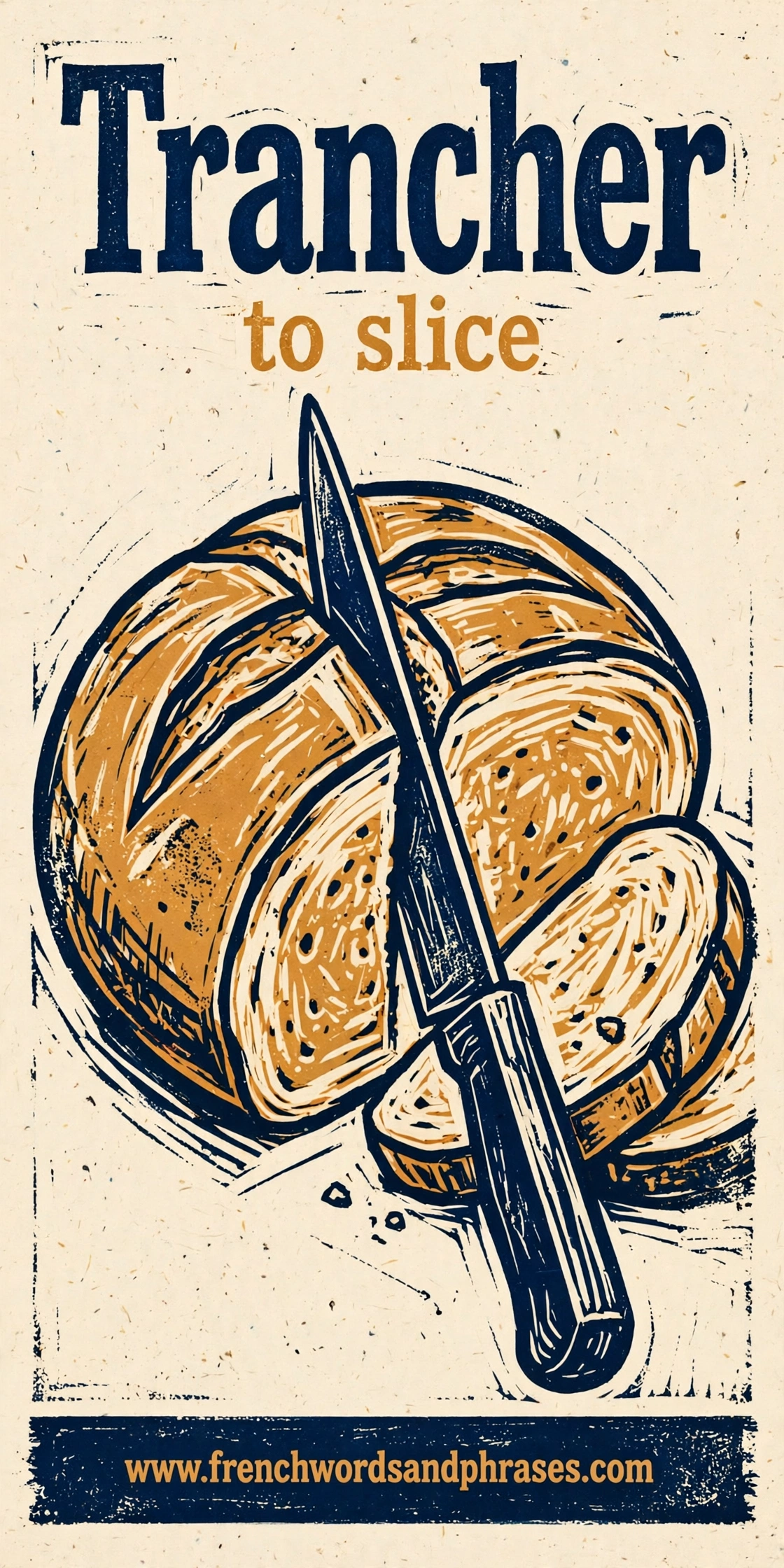
Trancher means to slice — cleanly, decisively, in one stroke.
A ham sliced paper-thin at the delicatessen, a loaf divided on the board, a long argument ended by one firm sentence — trancher is couper with decision behind it: the stroke that settles things.
In this guide, you’ll learn how to conjugate trancher in all the major French tenses and moods. Explore complete conjugation tables, French examples, English translations, and practice quizzes.
Understanding the French Verb Trancher
Trancher is a regular French verb belonging to the first group of verbs, those ending in -er.
It means to slice. It is commonly used for slicing bread, ham, cheese and roasts, for carving at the table, for settling questions, debates and disputes (trancher un différend), and in the phrase trancher sur — to stand out sharply against a background.
Verb classification: First group (-er)
Auxiliary verb: Avoir
Past participle: tranché
Present participle: tranchant
English equivalents: To slice, to carve; to settle or decide (trancher une question); to stand out (trancher sur).
One important detail: trancher gives French its word for a slice — une tranche — une tranche de pain, une tranche de jambon. And the verb carries its slicing spirit into debate: trancher une question, to settle a question once and for all, the way a knife settles a loaf. A person who speaks firmly tranche too — ses paroles tranchent, his words are cutting and final.
Experience the Word
Trancher is the verb of the clean decision — one stroke, no sawing, no going back.
Imagine the charcuterie on market morning. The customer asks for ham, very thin, and the blade rises and falls in a calm rhythm, each tranche landing like a card dealt by an expert.
Nothing has been hacked at. It has been sliced — evenly, expertly, decisively.
How to Conjugate Trancher: Complete French Conjugation Guide
Let’s explore every major conjugation of trancher, beginning with the indicative mood.
How to Conjugate Trancher in the Indicative Mood
The indicative mood is used to express facts, observations, actions, and events.
How to Conjugate Trancher in the Present Tense (Présent)
Used for actions happening now, habitual actions, and general truths.
| Subject | Conjugation |
|---|---|
| je | tranche |
| tu | tranches |
| il / elle | tranche |
| nous | tranchons |
| vous | tranchez |
| ils / elles | tranchent |
Example
Elle tranche le jambon très fin.
She slices the ham very thin.
Quick Quiz 1
Complete the sentence:
Nous ______ le pain de campagne.
Reveal the answer
tranchons
Nous tranchons le pain de campagne.
We slice the country loaf.
How to Conjugate Trancher in the Passé Composé
Used for completed actions in the past. Trancher takes the auxiliary verb avoir.
| Subject | Conjugation |
|---|---|
| j’ | ai tranché |
| tu | as tranché |
| il / elle | a tranché |
| nous | avons tranché |
| vous | avez tranché |
| ils / elles | ont tranché |
Example
Il a tranché la question en cinq minutes.
He settled the question in five minutes.
How to Conjugate Trancher in the Imparfait (Imperfect Tense)
Used for habitual past actions, descriptions, and ongoing situations in the past.
| Subject | Conjugation |
|---|---|
| je | tranchais |
| tu | tranchais |
| il / elle | tranchait |
| nous | tranchions |
| vous | tranchiez |
| ils / elles | tranchaient |
Example
Le charcutier tranchait le saucisson devant les clients.
The pork butcher used to slice the sausage in front of the customers.
Quick Quiz 2
Choose the correct form:
She settled the debate.
Elle ______ le débat. (a tranché / est tranchée)
Reveal the answer
a tranché
Elle a tranché le débat.
Trancher takes avoir.
How to Conjugate Trancher in the Plus-que-parfait
Used to describe an action that had already been completed before another past event.
| Subject | Conjugation |
|---|---|
| j’ | avais tranché |
| tu | avais tranché |
| il / elle | avait tranché |
| nous | avions tranché |
| vous | aviez tranché |
| ils / elles | avaient tranché |
Example
Nous avions tranché le pain de campagne avant de servir.
We had sliced the country loaf before serving.
How to Conjugate Trancher in the Passé Simple
Primarily used in formal writing, literature, and historical narratives. It is rarely used in everyday conversation.
| Subject | Conjugation |
|---|---|
| je | tranchai |
| tu | tranchas |
| il / elle | trancha |
| nous | tranchâmes |
| vous | tranchâtes |
| ils / elles | tranchèrent |
Example
Elle trancha le rôti et le servit aussitôt.
She carved the roast and served it at once.
How to Conjugate Trancher in the Passé Antérieur
A literary tense used to express an action completed immediately before another past action, generally in the passé simple.
| Subject | Conjugation |
|---|---|
| j’ | eus tranché |
| tu | eus tranché |
| il / elle | eut tranché |
| nous | eûmes tranché |
| vous | eûtes tranché |
| ils / elles | eurent tranché |
Example
Quand le jury eut tranché le débat, tout le monde applaudit.
When the jury had settled the debate, everyone applauded.
How to Conjugate Trancher in the Future Tense (Futur Simple)
Used to describe actions that will take place in the future.
| Subject | Conjugation |
|---|---|
| je | trancherai |
| tu | trancheras |
| il / elle | tranchera |
| nous | trancherons |
| vous | trancherez |
| ils / elles | trancheront |
Example
Demain, tu trancheras le fromage pour le plateau.
Tomorrow, you will slice the cheese for the board.
How to Conjugate Trancher in the Futur Antérieur (Future Perfect)
Used for an action that will have been completed before a particular point in the future.
| Subject | Conjugation |
|---|---|
| j’ | aurai tranché |
| tu | auras tranché |
| il / elle | aura tranché |
| nous | aurons tranché |
| vous | aurez tranché |
| ils / elles | auront tranché |
Example
À la fin du repas, il aura tranché tout le saucisson.
By the end of the meal, he will have sliced all the sausage.
How to Conjugate Trancher in the Near Future (Futur Proche)
Used to describe something that is going to happen soon. Formed with aller + infinitive.
| Subject | Conjugation |
|---|---|
| je | vais trancher |
| tu | vas trancher |
| il / elle | va trancher |
| nous | allons trancher |
| vous | allez trancher |
| ils / elles | vont trancher |
Example
Je vais trancher le melon pour le dessert.
I am going to slice the melon for dessert.
How to Conjugate Trancher in the Conditional Mood
The conditional mood expresses what would happen under certain circumstances. It is also frequently used to make polite requests or express wishes.
How to Conjugate Trancher in the Present Conditional
| Subject | Conjugation |
|---|---|
| je | trancherais |
| tu | trancherais |
| il / elle | trancherait |
| nous | trancherions |
| vous | trancheriez |
| ils / elles | trancheraient |
Example
Avec cette machine, nous trancherions le pain en un instant.
With this machine, we would slice the bread in an instant.
How to Conjugate Trancher in the Past Conditional
| Subject | Conjugation |
|---|---|
| j’ | aurais tranché |
| tu | aurais tranché |
| il / elle | aurait tranché |
| nous | aurions tranché |
| vous | auriez tranché |
| ils / elles | auraient tranché |
Example
Elle aurait tranché le débat plus tôt si elle avait osé.
She would have settled the debate earlier if she had dared.
Trancher in the Literary Past Conditional Form
This less common literary form uses the imperfect subjunctive of avoir.
| Subject | Conjugation |
|---|---|
| j’ | eusse tranché |
| tu | eusses tranché |
| il / elle | eût tranché |
| nous | eussions tranché |
| vous | eussiez tranché |
| ils / elles | eussent tranché |
Example
Il eût tranché la question sans hésiter.
He would have settled the question without hesitating.
How to Conjugate Trancher in the Subjunctive Mood
The subjunctive is used to express wishes, emotions, doubts, necessity, and uncertainty. It frequently follows expressions such as il faut que (it is necessary that) or bien que (although).
How to Conjugate Trancher in the Present Subjunctive
| Subject | Conjugation |
|---|---|
| que je | tranche |
| que tu | tranches |
| qu’il / qu’elle | tranche |
| que nous | tranchions |
| que vous | tranchiez |
| qu’ils / qu’elles | tranchent |
Example
Il faut que tu tranches le pain avant l’arrivée des invités.
You must slice the bread before the guests arrive.
Quick Quiz 3
Complete the sentence using the subjunctive:
Il faut que vous ______ le fromage.
Reveal the answer
tranchiez
Il faut que vous tranchiez le fromage.
You must slice the cheese.
How to Conjugate Trancher in the Imperfect Subjunctive
A literary tense, rarely encountered in modern spoken French.
| Subject | Conjugation |
|---|---|
| que je | tranchasse |
| que tu | tranchasses |
| qu’il / qu’elle | tranchât |
| que nous | tranchassions |
| que vous | tranchassiez |
| qu’ils / qu’elles | tranchassent |
Example
Je craignais qu’il tranchât le jambon trop épais.
I feared he might slice the ham too thick.
How to Conjugate Trancher in the Pluperfect Subjunctive
A literary construction used to express an action completed before another past action.
| Subject | Conjugation |
|---|---|
| que j’ | eusse tranché |
| que tu | eusses tranché |
| qu’il / qu’elle | eût tranché |
| que nous | eussions tranché |
| que vous | eussiez tranché |
| qu’ils / qu’elles | eussent tranché |
Example
Il regrettait que le jury eût tranché si vite.
He regretted that the jury had decided so quickly.
How to Conjugate Trancher in the Past Subjunctive
| Subject | Conjugation |
|---|---|
| que j’ | aie tranché |
| que tu | aies tranché |
| qu’il / qu’elle | ait tranché |
| que nous | ayons tranché |
| que vous | ayez tranché |
| qu’ils / qu’elles | aient tranché |
Example
Je suis content que vous ayez tranché cette vieille dispute.
I am glad you settled that old argument.
How to Conjugate Trancher in the Imperative
The imperative is used to give commands, instructions, invitations, or suggestions. Subject pronouns are omitted.
How to Conjugate Trancher in the Present Imperative
| Person | Conjugation |
|---|---|
| (tu) | tranche |
| (nous) | tranchons |
| (vous) | tranchez |
Example
Tranche le saucisson, on sert l’apéritif !
Slice the sausage, we are serving the aperitif!
Quick Quiz 4
How would you say Settle the question (tu form)?
Reveal the answer
Tranche la question !
French Participles of Trancher
Participles are verb forms that can be used in compound tenses and other grammatical constructions.
Present Participle of Trancher
tranchant
En tranchant le pain, il racontait sa journée.
While slicing the bread, he was telling us about his day.
Past Participle of Trancher
tranché
Tranché finement, le radis devient presque transparent.
Sliced thinly, the radish becomes almost transparent.
Trancher in Everyday French: Real-Life Examples
Now that you know the conjugations, let’s see how trancher appears in everyday French.
Example 1 — Present
On tranche le pain à table, chez nous.
At our house, we slice the bread at the table.
Example 2 — Passé composé
Elle a tranché le débat d’une seule phrase.
She settled the debate with a single sentence.
Example 3 — Imparfait
Le boucher tranchait la viande sur commande.
The butcher used to slice the meat to order.
Example 4 — Future
Je trancherai le gâteau en parts égales.
I will slice the cake into equal portions.
Example 5 — Conditional
Tu trancherais le jambon, s’il te plaît ?
Would you slice the ham, please?
Example 6 — Imperative
Tranchez le fromage pour le plateau !
Slice the cheese for the board!
Beyond Translation: The Meaning of Trancher
English slice stays in the kitchen; French trancher walks straight from the chopping board into the meeting room.
One verb for the loaf and for the argument.
Il faut trancher — a decision must be made, cleanly. When a French speaker tranches a question, the debate does not fade away; it is cut, finished, served.
How to Remember the French Verb Trancher
Remember it this way: Trancher is about the decisive slice — ham, loaves and settled questions.
- Une tranche is a slice — trancher is the verb that makes tranches.
- Trancher une question — to settle a question once and for all.
- Regular -er: je tranche, nous tranchons, past participle tranché.
The key idea is the decisive slice — ham, loaves and settled questions.
Test Your Knowledge of Trancher
Let’s see how much you’ve learned. Try answering these questions before revealing the answers.
Question 1
What is une tranche?
Reveal the answer
A slice — une tranche de pain, une tranche de jambon.
Question 2
How do you say He settled the question in French?
Reveal the answer
Il a tranché la question.
Question 3
Translate: Slice the sausage into thin slices.
Reveal the answer
Tranche le saucisson en tranches fines.
Question 4
What is the past participle of trancher?
Reveal the answer
Tranché.
Question 5
Complete the sentence:
Il faut que tu ______ le pain avant le dîner.
Reveal the answer
tranches
Il faut que tu tranches le pain avant le dîner.
You must slice the bread before dinner.
Your Final Challenge
Can You Use It?
How would you say this in French?
He slices the bread, then he settles the question: we are staying at the table.
Reveal the answer
Il tranche le pain, puis il tranche la question : on reste à table.
He slices the bread, then he settles the question: we are staying at the table.
A little French. A little curiosity. A richer everyday life.
LEARN FRENCH ONE WORD AT A TIME




