A French Word to Live By
How to Conjugate Corriger in French
/kɔ.ʁi.ʒe/
Corriger means to correct — and, for teachers, to mark.
A red pen moving down a page of homework, a proofreader catching the last typo, a friend gently fixing your French — corriger is the verb of making things right, one error at a time.
In this guide, you’ll learn how to conjugate corriger in all the major French tenses and moods. Explore complete conjugation tables, French examples, English translations, and practice quizzes.
Understanding the French Verb Corriger
Corriger is a regular French verb belonging to the first group of verbs, those ending in -er.
It means to correct, to mark. It is commonly used for correcting mistakes, texts and accents, for teachers marking homework and exams, for fixing a child’s behaviour in older speech (corriger un enfant), and for adjusting anything slightly — corriger le tir, to adjust one’s aim, literally and figuratively.
Verb classification: First group (-er)
Auxiliary verb: Avoir
Past participle: corrigé
Present participle: corrigeant
English equivalents: To correct, to mark (homework, exams), to put right.
One important detail: corriger is a -ger verb, like bouger — the g stays soft before a and o with an added e: nous corrigeons, je corrigeais — but before i, no e: nous corrigions, vous corrigiez. In school life, corriger is what teachers do to copies: corriger les copies, to mark the homework — and le corrigé is the answer key itself.
Experience the Word
Corriger is the verb of the second chance — nothing is finished while a kind eye can still pass over it and put it right.
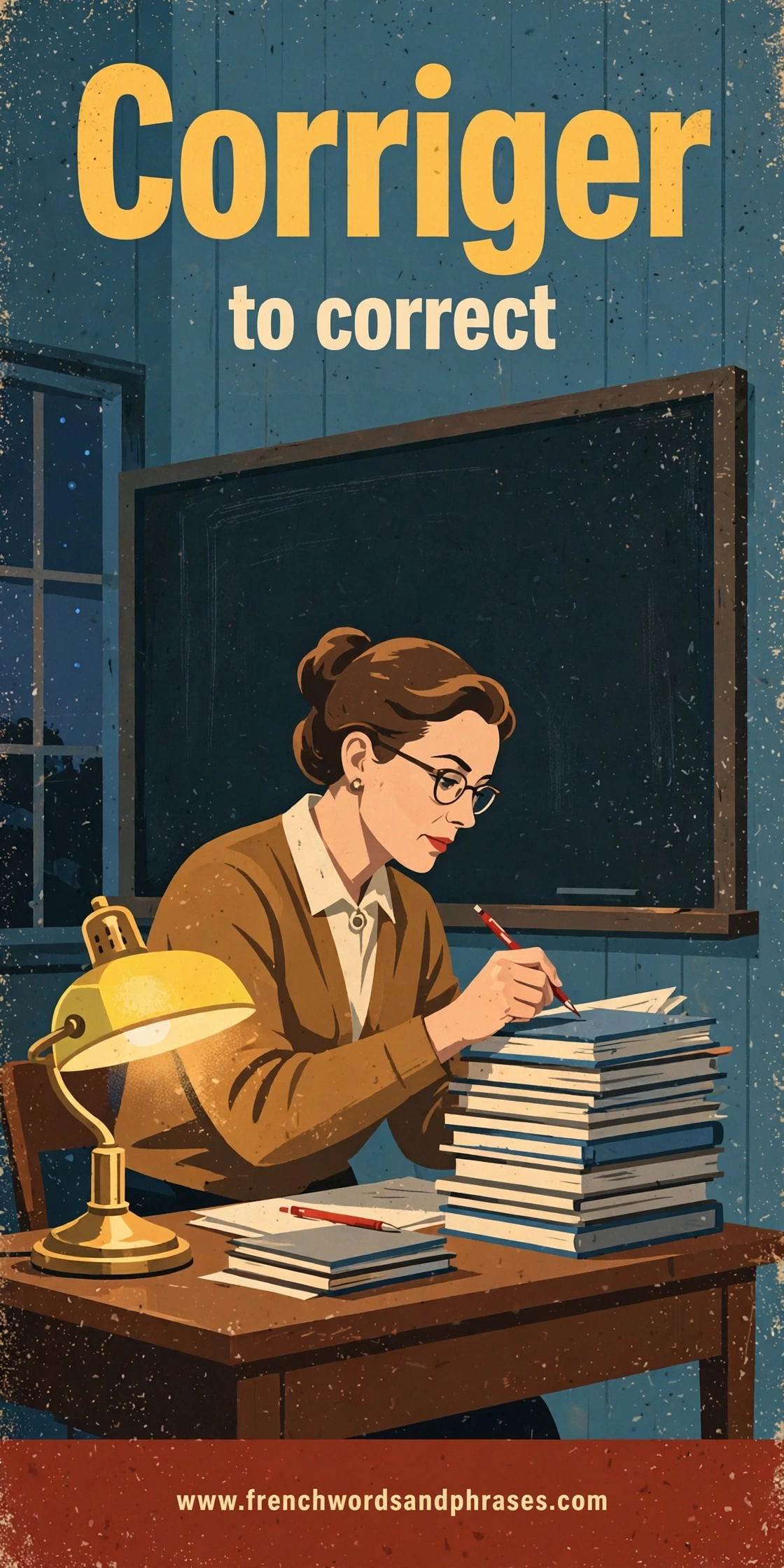
Imagine a village schoolteacher at her kitchen table on a Sunday night, a pile of exercise books, a red pen, and a cup of tea going cold. Corriger les copies: unglamorous, essential, done for love.
The page is not ruined by its errors. It has been corrected — and the pupil will do better.
How to Conjugate Corriger: Complete French Conjugation Guide
Let’s explore every major conjugation of corriger, beginning with the indicative mood.
How to Conjugate Corriger in the Indicative Mood
The indicative mood is used to express facts, observations, actions, and events.
How to Conjugate Corriger in the Present Tense (Présent)
Used for actions happening now, habitual actions, and general truths.
| Subject | Conjugation |
|---|---|
| je | corrige |
| tu | corriges |
| il / elle | corrige |
| nous | corrigeons |
| vous | corrigez |
| ils / elles | corrigent |
Example
Le professeur corrige les copies le soir.
The teacher marks the homework in the evening.
Quick Quiz 1
Complete the sentence:
Nous ______ les copies ce soir.
Reveal the answer
corrigeons
Nous corrigeons les copies ce soir.
We are marking the papers this evening. Note the soft-g e in corrigeons.
How to Conjugate Corriger in the Passé Composé
Used for completed actions in the past. Corriger takes the auxiliary verb avoir.
| Subject | Conjugation |
|---|---|
| j’ | ai corrigé |
| tu | as corrigé |
| il / elle | a corrigé |
| nous | avons corrigé |
| vous | avez corrigé |
| ils / elles | ont corrigé |
Example
Elle a corrigé toutes les fautes de mon texte.
She corrected all the mistakes in my text.
How to Conjugate Corriger in the Imparfait (Imperfect Tense)
Used for habitual past actions, descriptions, and ongoing situations in the past.
| Subject | Conjugation |
|---|---|
| je | corrigeais |
| tu | corrigeais |
| il / elle | corrigeait |
| nous | corrigions |
| vous | corrigiez |
| ils / elles | corrigeaient |
Example
Autrefois, on corrigeait à l’encre rouge.
In the old days, people used to mark in red ink.
Quick Quiz 2
Choose the correct form:
She corrected the text.
Elle ______ le texte. (a corrigé / est corrigée)
Reveal the answer
a corrigé
Elle a corrigé le texte.
Corriger takes avoir.
How to Conjugate Corriger in the Plus-que-parfait
Used to describe an action that had already been completed before another past event.
| Subject | Conjugation |
|---|---|
| j’ | avais corrigé |
| tu | avais corrigé |
| il / elle | avait corrigé |
| nous | avions corrigé |
| vous | aviez corrigé |
| ils / elles | avaient corrigé |
Example
Nous avions corrigé l’exercice avant le cours.
We had corrected the exercise before the lesson.
How to Conjugate Corriger in the Passé Simple
Primarily used in formal writing, literature, and historical narratives. It is rarely used in everyday conversation.
| Subject | Conjugation |
|---|---|
| je | corrigeai |
| tu | corrigeas |
| il / elle | corrigea |
| nous | corrigeâmes |
| vous | corrigeâtes |
| ils / elles | corrigeèrent |
Example
L’éditeur corrigea le manuscrit en une nuit.
The editor corrected the manuscript in one night.
How to Conjugate Corriger in the Passé Antérieur
A literary tense used to express an action completed immediately before another past action, generally in the passé simple.
| Subject | Conjugation |
|---|---|
| j’ | eus corrigé |
| tu | eus corrigé |
| il / elle | eut corrigé |
| nous | eûmes corrigé |
| vous | eûtes corrigé |
| ils / elles | eurent corrigé |
Example
Quand elle eut corrigé la dernière copie, elle souffla enfin.
When she had marked the last paper, she finally breathed out.
How to Conjugate Corriger in the Future Tense (Futur Simple)
Used to describe actions that will take place in the future.
| Subject | Conjugation |
|---|---|
| je | corrigerai |
| tu | corrigeras |
| il / elle | corrigera |
| nous | corrigerons |
| vous | corrigeront |
| ils / elles | corrigeront |
Example
Je corrigerai ton article demain matin.
I will correct your article tomorrow morning.
How to Conjugate Corriger in the Futur Antérieur (Future Perfect)
Used for an action that will have been completed before a particular point in the future.
| Subject | Conjugation |
|---|---|
| j’ | aurai corrigé |
| tu | auras corrigé |
| il / elle | aura corrigé |
| nous | aurons corrigé |
| vous | aurez corrigé |
| ils / elles | auront corrigé |
Example
À ce soir, il aura corrigé trente copies.
By this evening, he will have marked thirty papers.
How to Conjugate Corriger in the Near Future (Futur Proche)
Used to describe something that is going to happen soon. Formed with aller + infinitive.
| Subject | Conjugation |
|---|---|
| je | vais corriger |
| tu | vas corriger |
| il / elle | va corriger |
| nous | allons corriger |
| vous | allez corriger |
| ils / elles | vont corriger |
Example
Tu vas corriger cette faute, elle saute aux yeux.
You are going to correct that mistake, it sticks out a mile.
How to Conjugate Corriger in the Conditional Mood
The conditional mood expresses what would happen under certain circumstances. It is also frequently used to make polite requests or express wishes.
How to Conjugate Corriger in the Present Conditional
| Subject | Conjugation |
|---|---|
| je | corrigerais |
| tu | corrigerais |
| il / elle | corrigerait |
| nous | corrigerions |
| vous | corrigeriez |
| ils / elles | corrigeraient |
Example
Je corrigerais volontiers ton texte ce soir.
I would gladly correct your text this evening.
How to Conjugate Corriger in the Past Conditional
| Subject | Conjugation |
|---|---|
| j’ | aurais corrigé |
| tu | aurais corrigé |
| il / elle | aurait corrigé |
| nous | aurions corrigé |
| vous | auriez corrigé |
| ils / elles | auraient corrigé |
Example
Elle aurait corrigé l’erreur si elle l’avait vue.
She would have corrected the error if she had seen it.
Corriger in the Literary Past Conditional Form
This less common literary form uses the imperfect subjunctive of avoir.
| Subject | Conjugation |
|---|---|
| j’ | eusse corrigé |
| tu | eusses corrigé |
| il / elle | eût corrigé |
| nous | eussions corrigé |
| vous | eussiez corrigé |
| ils / elles | eussent corrigé |
Example
Il eût corrigé le manuscrit avec plus de soin.
He would have corrected the manuscript with more care.
How to Conjugate Corriger in the Subjunctive Mood
The subjunctive is used to express wishes, emotions, doubts, necessity, and uncertainty. It frequently follows expressions such as il faut que (it is necessary that) or bien que (although).
How to Conjugate Corriger in the Present Subjunctive
| Subject | Conjugation |
|---|---|
| que je | corrige |
| que tu | corriges |
| qu’il / qu’elle | corrige |
| que nous | corrigions |
| que vous | corrigiez |
| qu’ils / qu’elles | corrigent |
Example
Il faut que tu corriges tes fautes d’accord.
You must correct your agreement mistakes.
Quick Quiz 3
Complete the sentence using the subjunctive:
Il faut que vous ______ l’exercice.
Reveal the answer
corrigiez
Il faut que vous corrigiez l’exercice.
You must correct the exercise. No extra e before i in corrigiez.
How to Conjugate Corriger in the Imperfect Subjunctive
A literary tense, rarely encountered in modern spoken French.
| Subject | Conjugation |
|---|---|
| que je | corrigasse |
| que tu | corrigasses |
| qu’il / qu’elle | corrigât |
| que nous | corrigassions |
| que vous | corrigassiez |
| qu’ils / qu’elles | corrigassent |
Example
Je voulais qu’il corrigeât sa copie avant de sortir.
I wanted him to correct his work before going out.
How to Conjugate Corriger in the Pluperfect Subjunctive
A literary construction used to express an action completed before another past action.
| Subject | Conjugation |
|---|---|
| que j’ | eusse corrigé |
| que tu | eusses corrigé |
| qu’il / qu’elle | eût corrigé |
| que nous | eussions corrigé |
| que vous | eussiez corrigé |
| ils / elles | eussent corrigé |
Example
Il regrettait que nous eussions corrigé si sévèrement.
He regretted that we had marked so severely.
How to Conjugate Corriger in the Past Subjunctive
| Subject | Conjugation |
|---|---|
| que j’ | aie corrigé |
| que tu | aies corrigé |
| qu’il / qu’elle | ait corrigé |
| que nous | ayons corrigé |
| que vous | ayez corrigé |
| ils / elles | aient corrigé |
Example
Je suis content que tu aies corrigé ton erreur.
I am glad you corrected your mistake.
How to Conjugate Corriger in the Imperative
The imperative is used to give commands, instructions, invitations, or suggestions. Subject pronouns are omitted.
How to Conjugate Corriger in the Present Imperative
| Person | Conjugation |
|---|---|
| (tu) | corrige |
| (nous) | corrigeons |
| (vous) | corrigez |
Example
Corrige cette phrase, elle est pleine de fautes !
Correct this sentence, it is full of mistakes!
Quick Quiz 4
How would you say Correct this mistake (tu form)?
Reveal the answer
Corrige cette faute !
French Participles of Corriger
Participles are verb forms that can be used in compound tenses and other grammatical constructions.
Present Participle of Corriger
corrigeant
En corrigeant les copies, elle buvait son thé.
While marking the papers, she drank her tea.
Past Participle of Corriger
corrigé
Corrigé par la maîtresse, l’exercice devenait clair.
Corrected by the teacher, the exercise became clear.
Corriger in Everyday French: Real-Life Examples
Now that you know the conjugations, let’s see how corriger appears in everyday French.
Example 1 — Present
Le maître corrige les devoirs chaque soir.
The teacher marks the homework every evening.
Example 2 — Passé composé
J’ai corrigé trois fautes dans ma dictée.
I corrected three mistakes in my dictation.
Example 3 — Imparfait
Nous corrigions l’exercice ensemble en classe.
We used to correct the exercise together in class.
Example 4 — Future
Elle corrigera les examens cette semaine.
She will mark the exams this week.
Example 5 — Conditional
Tu corrigerais ton texte avec un dictionnaire ?
Would you correct your text with a dictionary?
Example 6 — Imperative
Corrigez la deuxième phrase, s’il vous plaît !
Correct the second sentence, please!
Beyond Translation: The Meaning of Corriger
English correct is about right answers; French corriger includes the whole classroom ritual — the pile of copies, the red pen, the marks in the margin.
And its noun is a student’s treasure.
Le corrigé — the corrected version, the answer key — is the page every pupil dreams of peeking at, and every teacher guards until the work is done.
How to Remember the French Verb Corriger
Remember it this way: Corriger is about making right — red pens, copies and answer keys.
- The -ger spelling: nous corrigeons, je corrigeais — but nous corrigions without the e.
- Corriger les copies — THE school phrase: to mark the homework.
- Regular -er: je corrige, il corrige, past participle corrigé; le corrigé = the answer key.
The key idea is making right — red pens, copies and answer keys.
Test Your Knowledge of Corriger
Let’s see how much you’ve learned. Try answering these questions before revealing the answers.
Question 1
How do you write we correct with corriger, keeping the g soft?
Reveal the answer
Nous corrigeons
— the extra e keeps the g soft before o.
Question 2
How do you say The teacher marks the homework in French?
Reveal the answer
Le professeur corrige les copies.
Question 3
Translate: She corrected all the mistakes.
Reveal the answer
Elle a corrigé toutes les fautes.
Question 4
What is the past participle of corriger?
Reveal the answer
Corrigé.
Question 5
Complete the sentence:
Il faut que tu ______ tes fautes.
Reveal the answer
corriges
Il faut que tu corriges tes fautes.
You must correct your mistakes.
Your Final Challenge
Can You Use It?
How would you say this in French?
Correct your mistakes today, and tomorrow you will write without fear.
Reveal the answer
Corrige tes fautes aujourd’hui, et demain tu écriras sans peur.
Correct your mistakes today, and tomorrow you will write without fear.
A little French. A little curiosity. A richer everyday life.
LEARN FRENCH ONE WORD AT A TIME