A French Word to Live By
Translate Chemin to English
/ʃə.mɛ̃/
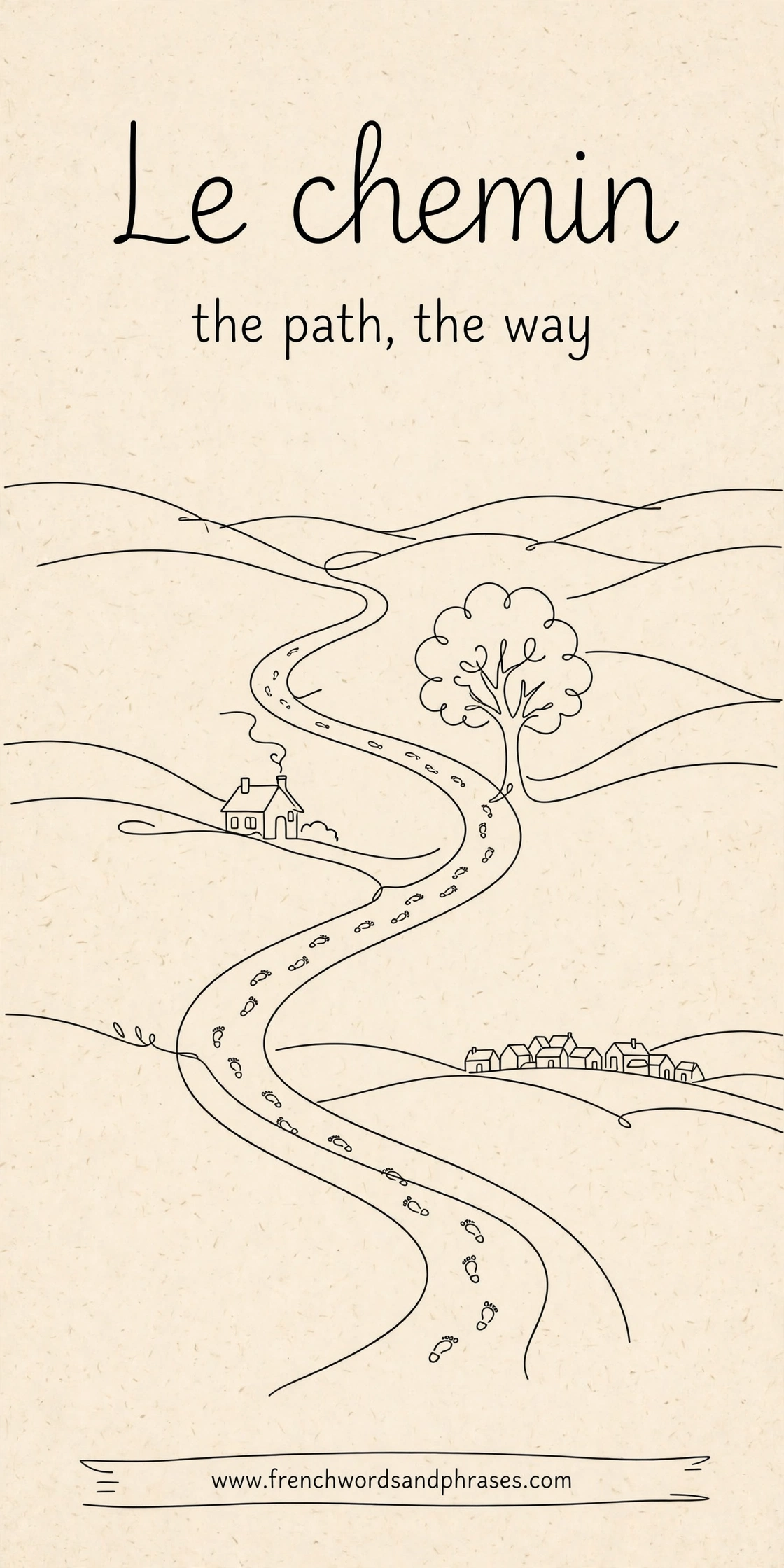
Le chemin means a path, a way.
It starts at the garden gate, crosses the field in a pale ribbon of dust, and disappears into the woods: le chemin, the path — the oldest piece of technology in France, a road too small for cars and exactly the right size for a life.
In this guide, you’ll learn what chemin means in English, how to use it with its articles, how to form its plural, and how it appears in everyday French. Explore French examples, English translations, and practice quizzes.
Understanding the French Noun Chemin
Chemin is a masculine French noun, learned with its article: le chemin, un chemin. It comes from a Gaulish word, camminus, a path or journey — one of the few everyday French words that predates Latin in France. Its big brother is la route, the road for cars; the chemin is walked, not driven.
It means a path, a way — a track for walkers, carts and bicycles: un chemin de terre, a dirt path, un chemin de campagne, a country lane, un chemin de fer, a railway (literally a path of iron). Figuratively it is the way through life or through a problem: le chemin de la réussite, the road to success, être sur le bon chemin, to be on the right track. The key verb is montrer le chemin, to show the way.
Gender: Masculine — le chemin
Definite article: le — le chemin (the path)
Indefinite article: un — un chemin (a path)
Plural: les chemins — regular, with a simple -s
Spelling note: from Gaulish camminus — a pre-Latin word for a journey
Famous compound: le chemin de fer — the railway, the path of iron
English equivalents: A path, a way, a track, a lane.
Ask for the way with quel est le chemin pour… ? or simply le chemin, s’il vous plaît ? To lose it is perdre son chemin; to be halfway is à mi-chemin, a phrase French also uses for compromises: à mi-chemin entre les deux, halfway between the two. Walkers follow les chemins de randonnée, the marked hiking trails.
Experience the Word
Chemin is the road reduced to human scale: no engines, no hurry, just feet, dust and the time to think.
Imagine the village path at dawn, the grass wet on both sides, a line of footprints ahead of you in the dew — somebody has already taken this chemin this morning, and the day feels less lonely for it.
You have not just named a track. You have named the shape of every journey — le chemin, the path that makes the going possible.
How to Use Chemin in French: Complete Guide
Let’s explore how chemin works in French, beginning with its articles — le chemin, un chemin, montrer le chemin.
Chemin with the Definite Article (Le, Les)
Used for a specific path — the one through the woods, the one home.
| Form | French |
|---|---|
| Masculine singular | le chemin |
| Plural | les chemins |
Example
Le chemin traverse la forêt.
The path crosses the forest.
Chemin with the Indefinite Article (Un, Des)
Used for a path in general — any track that leads somewhere.
| Form | French |
|---|---|
| Masculine singular | un chemin |
| Plural | des chemins |
Example
Un chemin étroit descend vers la rivière.
A narrow path goes down towards the river.
Chemin with Kinds of Path (De terre, de fer, de campagne…)
French names its paths by what they are made of and where they go.
| Kind | French |
|---|---|
| a dirt path | un chemin de terre |
| a country lane | un chemin de campagne |
| a railway | un chemin de fer |
| a hiking trail | un chemin de randonnée |
| a towpath | un chemin de halage |
Example
Le chemin de fer longe la côte depuis un siècle.
The railway has run along the coast for a century.
Quick Quiz 1
Complete the sentence:
______ chemin passe devant la maison. (the)
Reveal the answer
Le
Le chemin passe devant la maison.
The path passes in front of the house — chemin is masculine, so le.
The Plural of Chemin
Chemin takes a regular plural in -s — a whole network of paths.
| Number | French |
|---|---|
| Singular | le chemin |
| Plural | les chemins |
Example
Tous les chemins du village mènent à la place.
All the paths in the village lead to the square.
Chemin with Possessive Adjectives (Mon, Ton, Son…)
Possessives agree with the noun: chemin is masculine, so mon, ton, son in the singular.
| Owner | French |
|---|---|
| my | mon chemin |
| your (tu) | ton chemin |
| his / her | son chemin |
| our | notre chemin |
| your (vous) | votre chemin |
| their | leur chemin |
Example
Chacun suit son chemin, à son rythme.
Everyone follows their own path, at their own pace.
Quick Quiz 2
Complete the sentence:
J’ai perdu ______ chemin dans la forêt. (my)
Reveal the answer
mon
J’ai perdu mon chemin dans la forêt.
I lost my way in the forest — mon, because chemin is masculine.
Chemin with Demonstrative Adjectives (Ce, Ces)
Used to point: ce chemin, this path — usually the one on the map.
| Form | French |
|---|---|
| Masculine singular | ce chemin |
| Plural | ces chemins |
Example
Ce chemin est plus court, mais plus raide.
This path is shorter, but steeper.
Chemin with Adjectives
Adjectives agree with chemin — masculine singular: un chemin étroit, un long chemin.
| Adjective | With Chemin |
|---|---|
| étroit (narrow) | un chemin étroit |
| long (long) | un long chemin |
| raide (steep) | un chemin raide |
| boueux (muddy) | un chemin boueux |
| bon (right, good) | le bon chemin |
Example
Après la pluie, le chemin est boueux.
After the rain, the path is muddy.
Quick Quiz 3
Complete the sentence:
C’est un chemin très ______, les voitures ne passent pas. (narrow)
Reveal the answer
étroit
C’est un chemin très étroit, les voitures ne passent pas.
It is a very narrow path, cars cannot get through — étroit, masculine, to agree with chemin.
Everyday Expressions with Chemin
Walks, railways and life choices — the chemin phrases of daily life.
| Expression | In English |
|---|---|
| montrer le chemin | to show the way |
| perdre son chemin | to lose one’s way |
| à mi-chemin | halfway |
| être sur le bon chemin | to be on the right track |
| le chemin de fer | the railway |
Example
Tu es sur le bon chemin, continue.
You are on the right track, keep going.
Words from the Same Family as Chemin
Roads and walking — the words that travel with chemin.
| French | In English |
|---|---|
| la route | the road — for cars |
| un sentier | a trail, a footpath — smaller than a chemin |
| cheminer | to walk along, to make one’s way (the verb) |
| la randonnée | hiking, a hike |
| un raccourci | a shortcut |
Example
Ce sentier rejoint le chemin principal après le pont.
This trail joins the main path after the bridge.
Quick Quiz 4
What does à mi-chemin mean?
Reveal the answer
Halfway — halfway along the path, and halfway between two positions.
Nous sommes à mi-chemin du village.
We are halfway to the village.
Chemin in Everyday French: Real-Life Examples
Now that you know the word, let’s see how chemin appears in everyday French.
Example 1 — Asking the way
Pardon, le chemin pour la gare, s’il vous plaît ?
Excuse me, the way to the station, please?
Example 2 — On a walk
Suivons ce chemin, il descend vers le lac.
Let’s follow this path, it goes down to the lake.
Example 3 — Halfway
À mi-chemin, nous ferons une pause.
Halfway there, we will take a break.
Example 4 — Lost
Je crois que nous avons perdu notre chemin.
I think we have lost our way.
Example 5 — Encouragement
Tu es sur le bon chemin, ne t’arrête pas.
You are on the right track, don’t stop.
Example 6 — The railway
Le chemin de fer traverse la plaine.
The railway crosses the plain.
Beyond Translation: The Meaning of Chemin
Chemin is a survivor: it is not Latin but Gaulish, a word the Romans found in France and never replaced. Two thousand years later it still refuses to grow up into a road — the chemin stays at walking pace, and French philosophy has borrowed it for everything else: le chemin de la vie, the path of life; chacun son chemin, each to their own path. Even the railway, when it arrived, had to borrow the walker’s word: un chemin de fer, a path made of iron.
To say chemin is to choose the human scale — the way you travel on foot, at the speed of thought.
It evokes dust, dew, shortcuts and homecomings — every journey that matters taken one step at a time.
How to Remember the French Noun Chemin
Remember it this way: Chemin is the path — masculine: le chemin. Cars take la route; walkers take le chemin.
- Always masculine — le chemin, un chemin, mon chemin.
- The halfway phrase — à mi-chemin, halfway, in space and in arguments.
- The iron path — le chemin de fer is the railway.
The key idea is le chemin — the path, masculine; à mi-chemin = halfway.
Test Your Knowledge of Chemin
Let’s see how much you’ve learned. Try answering these questions before revealing the answers.
Question 1
Is chemin masculine or feminine?
Reveal the answer
Masculine — le chemin, un chemin.
Question 2
How do you say the railway in French?
Reveal the answer
Le chemin de fer — literally, the path of iron.
Question 3
Translate: We lost our way in the forest.
Reveal the answer
Nous avons perdu notre chemin dans la forêt.
Question 4
What is the difference between un chemin and une route?
Reveal the answer
The chemin is walked — a path or lane; the route is the road for cars.
Question 5
Complete the sentence:
______ chemins de randonnée sont bien indiqués. (the)
Reveal the answer
Les
Les chemins de randonnée sont bien indiqués.
The hiking trails are well signposted.
Your Final Challenge
Can You Use It?
How would you say this in French?
“Let’s follow this path, it goes down to the lake.”
Reveal the answer
Suivons ce chemin, il descend vers le lac.
Let’s follow this path, it goes down to the lake.
A little French. A little curiosity. A richer everyday life.
LEARN FRENCH ONE WORD AT A TIME