A French Word to Live By
How to Conjugate Concorder in French
/kɔ̃.kɔʁ.de/
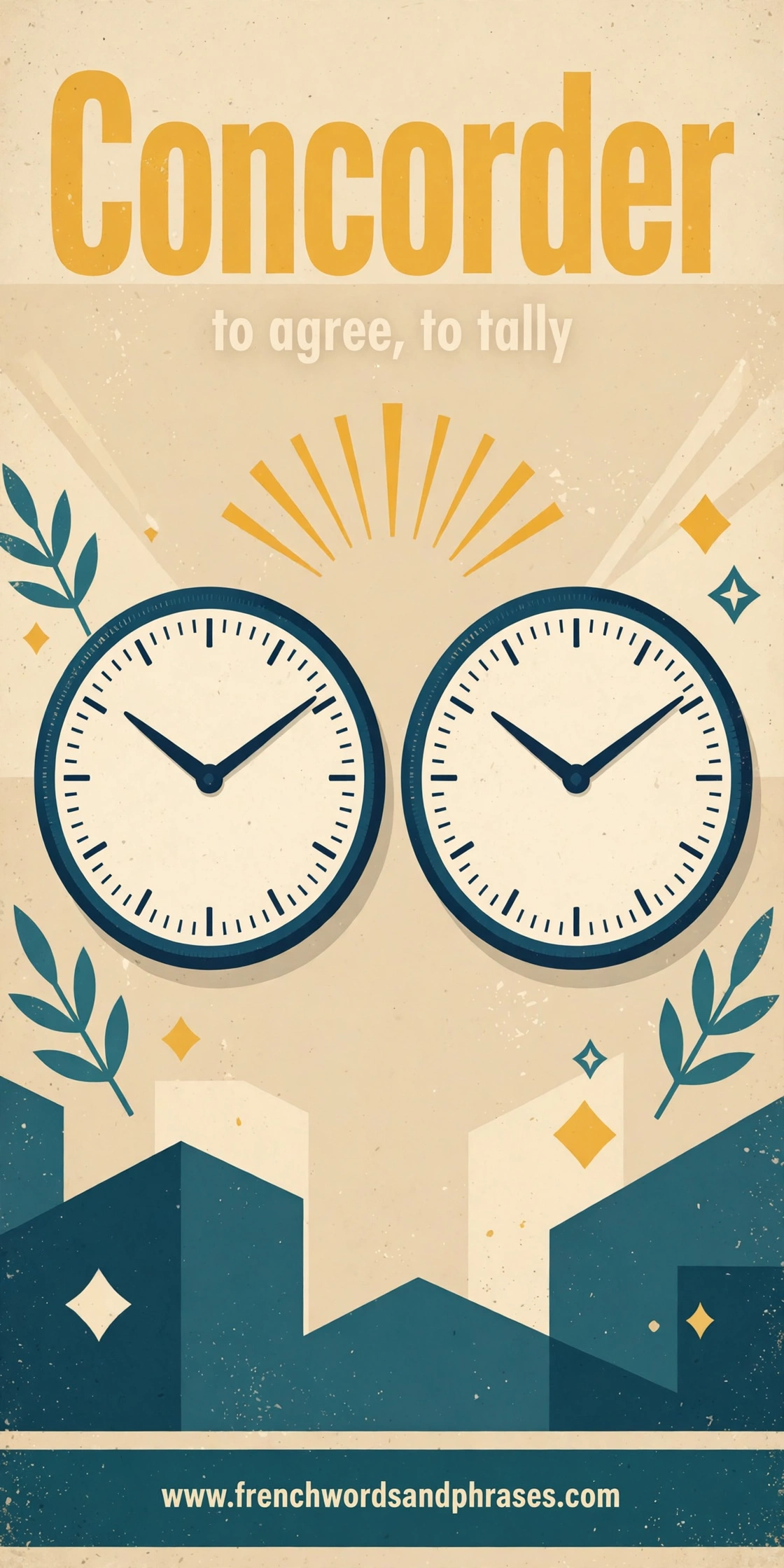
Concorder means to agree or to tally — for accounts, dates or testimonies to match one another exactly.
Two witnesses telling the same story in separate rooms, two columns of figures arriving at the same total, two calendars showing the same free weekend — concorder is the verb of things that line up: when separate accounts match, they concordent.
In this guide, you’ll learn how to conjugate concorder in all the major French tenses and moods. Explore complete conjugation tables, French examples, English translations, and practice quizzes.
Understanding the French Verb Concorder
Concorder is a regular French verb belonging to the first group of verbs, those ending in-er.
It means to agree, to tally. It is commonly used in accounting and auditing for figures that tally, in law and journalism for testimonies and versions that agree, and in everyday life for dates, stories and schedules that match — whenever two independent sources tell the same story, they concordent.
Verb classification: First group (-er)
Auxiliary verb: Avoir
Past participle: concordé
Present participle: concordant
English equivalents: To agree, to tally, to match, to be consistent; les comptes concordent — the accounts tally; les témoignages concordent — the testimonies agree; faire concorder — to make (things) tally, to reconcile; concorder avec — to agree with, to match.
One important detail: concorder is an intransitive verb in its core use — things concordent, all by themselves, and the subject is almost always plural or collective: les dates concordent, les versions concordent. To make things match you add faire: faire concorder les chiffres — to reconcile the figures. The verb is regular: je concorde, nous concordons, past participle concordé. Do not confuse it with accorder (to grant, to tune) or raccorder (to connect up).
Experience the Word
Concorder is the verb of the perfect match — the quiet click when two separate accounts turn out to be one and the same.
Imagine a detective interviewing two witnesses in different rooms. One says the man wore a red scarf and left at nine; the other, who has heard nothing, says exactly the same. Les témoignages concordent — and the detective sits up straight, because matching stories are either the truth or a conspiracy.
Neither witness copied the other. Their stories simply agreed — concordé, point by point, like two keys cut for one lock.
How to Conjugate Concorder: Complete French Conjugation Guide
Let’s explore every major conjugation of concorder, beginning with the indicative mood.
How to Conjugate Concorder in the Indicative Mood
The indicative mood is used to express facts, observations, actions, and events.
How to Conjugate Concorder in the Present Tense (Présent)
Used for actions happening now, habitual actions, and general truths.
| Subject | Conjugation |
|---|---|
| je | concorde |
| tu | concordes |
| il / elle | concorde |
| nous | concordons |
| vous | concordez |
| ils / elles | concordent |
Example
Les deux témoignages concordent sur tous les points essentiels.
The two testimonies agree on all the essential points.
Quick Quiz 1
Complete the sentence:
Les deux versions ______ sur ce point.
Reveal the answer
concordent
Les deux versions concordent sur ce point.
The two versions agree on this point.
How to Conjugate Concorder in the Passé Composé
Used for completed actions in the past. Concorder takes the auxiliary verb avoir.
| Subject | Conjugation |
|---|---|
| j’ | ai concordé |
| tu | as concordé |
| il / elle | a concordé |
| nous | avons concordé |
| vous | avez concordé |
| ils / elles | ont concordé |
Example
Après vérification, les comptes ont concordé au centime près.
After checking, the accounts tallied to the last cent.
How to Conjugate Concorder in the Imparfait (Imperfect Tense)
Used for habitual past actions, descriptions, and ongoing situations in the past.
| Subject | Conjugation |
|---|---|
| je | concordais |
| tu | concordais |
| il / elle | concordait |
| nous | concordions |
| vous | concordiez |
| ils / elles | concordaient |
Example
Ses paroles concordaient rarement avec ses actes.
His words rarely agreed with his actions.
Quick Quiz 2
Choose the correct form:
The accounts tallied.
Les comptes ______ au centime près. (ont concordé / sont concordés)
Reveal the answer
ont concordé
Les comptes ont concordé au centime près.
Concorder takes avoir.
How to Conjugate Concorder in the Plus-que-parfait
Used to describe an action that had already been completed before another past event.
| Subject | Conjugation |
|---|---|
| j’ | avais concordé |
| tu | avais concordé |
| il / elle | avait concordé |
| nous | avions concordé |
| vous | aviez concordé |
| ils / elles | avaient concordé |
Example
Les versions avaient concordé dès la première enquête.
The versions had agreed from the first investigation.
How to Conjugate Concorder in the Passé Simple
Primarily used in formal writing, literature, and historical narratives. It is rarely used in everyday conversation.
| Subject | Conjugation |
|---|---|
| je | concordai |
| tu | concordas |
| il / elle | concorda |
| nous | concordâmes |
| vous | concordâtes |
| ils / elles | concordèrent |
Example
Les chiffres concordèrent enfin après trois jours de calculs.
The figures finally tallied after three days of calculations.
How to Conjugate Concorder in the Passé Antérieur
A literary tense used to express an action completed immediately before another past action, generally in the passé simple.
| Subject | Conjugation |
|---|---|
| j’ | eus concordé |
| tu | eus concordé |
| il / elle | eut concordé |
| nous | eûmes concordé |
| vous | eûtes concordé |
| ils / elles | eurent concordé |
Example
Quand les rapports eurent concordé, le juge signa l’ordonnance.
When the reports had agreed, the judge signed the order.
How to Conjugate Concorder in the Future Tense (Futur Simple)
Used to describe actions that will take place in the future.
| Subject | Conjugation |
|---|---|
| je | concorderai |
| tu | concorderas |
| il / elle | concordera |
| nous | concorderons |
| vous | concorderez |
| ils / elles | concorderont |
Example
Si tu es honnête, ton récit concordera avec le sien.
If you are honest, your account will agree with his.
How to Conjugate Concorder in the Futur Antérieur (Future Perfect)
Used for an action that will have been completed before a particular point in the future.
| Subject | Conjugation |
|---|---|
| j’ | aurai concordé |
| tu | auras concordé |
| il / elle | aura concordé |
| nous | aurons concordé |
| vous | aurez concordé |
| ils / elles | auront concordé |
Example
Demain, les deux listes auront concordé ligne par ligne.
Tomorrow, the two lists will have tallied line by line.
How to Conjugate Concorder in the Near Future (Futur Proche)
Used to describe something that is going to happen soon. Formed with aller + infinitive.
| Subject | Conjugation |
|---|---|
| je | vais concorder |
| tu | vas concorder |
| il / elle | va concorder |
| nous | allons concorder |
| vous | allez concorder |
| ils / elles | vont concorder |
Example
Regarde bien : les dates vont concorder.
Look carefully: the dates are going to match.
How to Conjugate Concorder in the Conditional Mood
The conditional mood expresses what would happen under certain circumstances. It is also frequently used to make polite requests or express wishes.
How to Conjugate Concorder in the Present Conditional
| Subject | Conjugation |
|---|---|
| je | concorderais |
| tu | concorderais |
| il / elle | concorderait |
| nous | concorderions |
| vous | concorderiez |
| ils / elles | concorderaient |
Example
Sans cette erreur, tout concorderait parfaitement.
Without this mistake, everything would agree perfectly.
How to Conjugate Concorder in the Past Conditional
| Subject | Conjugation |
|---|---|
| j’ | aurais concordé |
| tu | aurais concordé |
| il / elle | aurait concordé |
| nous | aurions concordé |
| vous | auriez concordé |
| ils / elles | auraient concordé |
Example
Les témoins auraient concordé s’ils avaient vu la même chose.
The witnesses would have agreed if they had seen the same thing.
Concorder in the Literary Past Conditional Form
This less common literary form uses the imperfect subjunctive of avoir.
| Subject | Conjugation |
|---|---|
| j’ | eusse concordé |
| tu | eusses concordé |
| il / elle | eût concordé |
| nous | eussions concordé |
| vous | eussiez concordé |
| ils / elles | eussent concordé |
Example
Les preuves eussent concordé sans ce faux témoignage.
The evidence would have tallied without that false testimony.
How to Conjugate Concorder in the Subjunctive Mood
The subjunctive is used to express wishes, emotions, doubts, necessity, and uncertainty. It frequently follows expressions such as il faut que (it is necessary that) or bien que (although).
How to Conjugate Concorder in the Present Subjunctive
| Subject | Conjugation |
|---|---|
| que je | concorde |
| que tu | concordes |
| qu’il / qu’elle | concorde |
| que nous | concordions |
| que vous | concordiez |
| qu’ils / qu’elles | concordent |
Example
Il est essentiel que les dates concordent.
It is essential that the dates agree.
Quick Quiz 3
Complete the sentence using the subjunctive:
Il faut que vos témoignages ______.
Reveal the answer
concordent
Il faut que vos témoignages concordent.
Your testimonies must agree.
How to Conjugate Concorder in the Imperfect Subjunctive
A literary tense, rarely encountered in modern spoken French.
| Subject | Conjugation |
|---|---|
| que je | concordasse |
| que tu | concordasses |
| qu’il / qu’elle | concordât |
| que nous | concordassions |
| que vous | concordassiez |
| qu’ils / qu’elles | concordassent |
Example
Je voulais que les deux rapports concordassent exactement.
I wanted the two reports to agree exactly.
How to Conjugate Concorder in the Pluperfect Subjunctive
A literary construction used to express an action completed before another past action.
| Subject | Conjugation |
|---|---|
| que j’ | eusse concordé |
| que tu | eusses concordé |
| qu’il / qu’elle | eût concordé |
| que nous | eussions concordé |
| que vous | eussiez concordé |
| qu’ils / qu’elles | eussent concordé |
Example
On doutait que les chiffres eussent concordé un jour.
People doubted the figures had ever tallied.
How to Conjugate Concorder in the Past Subjunctive
| Subject | Conjugation |
|---|---|
| que j’ | aie concordé |
| que tu | aies concordé |
| qu’il / qu’elle | ait concordé |
| que nous | ayons concordé |
| que vous | ayez concordé |
| qu’ils / qu’elles | aient concordé |
Example
Je suis content que vos versions aient concordé.
I am glad your versions agreed.
How to Conjugate Concorder in the Imperative
The imperative is used to give commands, instructions, invitations, or suggestions. Subject pronouns are omitted.
How to Conjugate Concorder in the Present Imperative
| Person | Conjugation |
|---|---|
| (tu) | concorde |
| (nous) | concordons |
| (vous) | concordez |
Example
Fais concorder les chiffres avant la réunion !
Make the figures tally before the meeting!
Quick Quiz 4
How would you say Make the figures tally (tu form)?
Reveal the answer
Fais concorder les chiffres !
French Participles of Concorder
Participles are verb forms that can be used in compound tenses and other grammatical constructions.
Present Participle of Concorder
concordant
En concordant sur ce point, les experts ont rassuré le public.
By agreeing on this point, the experts reassured the public.
Past Participle of Concorder
concordé
Une fois concordés, les deux registres ont été archivés ensemble.
Once reconciled, the two registers were filed away together.
Concorder in Everyday French: Real-Life Examples
Now that you know the conjugations, let’s see how concorder appears in everyday French.
Example 1 — Present
Les témoignages concordent parfaitement.
The testimonies agree perfectly.
Example 2 — Passé composé
Les comptes ont concordé au centime près.
The accounts tallied to the last cent.
Example 3 — Imparfait
Ses paroles concordaient avec ses actes.
His words agreed with his actions.
Example 4 — Future
Ton récit concordera avec le sien.
Your account will agree with his.
Example 5 — Conditional
Tout concorderait sans cette erreur.
Everything would tally without this mistake.
Example 6 — Imperative
Fais concorder les deux listes !
Make the two lists tally!
Beyond Translation: The Meaning of Concorder
English keeps the same Latin root in concord and concordance — hearts beating together, cor, cordis — but everyday English lost the verb, while French concorder does daily duty in offices and courtrooms.
It is the verb auditors pray for.
When les comptes concordent, the books are clean; when les témoignages concordent, the story holds. Its opposite is just as useful: ça ne concorde pas — it does not add up — is the first sentence of every good investigation.
How to Remember the French Verb Concorder
Remember it this way: Concorder is about two witnesses, two rooms, exactly the same story.
- Think of two columns arriving at the same total: les comptes concordent.
- Things tally by themselves; to make them tally, say faire concorder.
- Regular -er: les dates concordent, nous concordons, past participle concordé.
The key idea is two witnesses, two rooms, exactly the same story.
Test Your Knowledge of Concorder
Let’s see how much you’ve learned. Try answering these questions before revealing the answers.
Question 1
How do you say The accounts tally in French?
Reveal the answer
Les comptes concordent.
Question 2
What construction means to make the figures tally?
Reveal the answer
Faire concorder — faire concorder les chiffres, to reconcile the figures.
Question 3
Translate: His words rarely agreed with his actions.
Reveal the answer
Ses paroles concordaient rarement avec ses actes.
Question 4
What is the past participle of concorder?
Reveal the answer
Concordé.
Question 5
Complete the sentence:
Il est essentiel que les dates ______.
Reveal the answer
concordent
Il est essentiel que les dates concordent.
It is essential that the dates agree.
Your Final Challenge
Can You Use It?
How would you say this in French?
When the figures tally and the witnesses tell the same story, the truth is not far away.
Reveal the answer
Quand les chiffres concordent et que les témoins racontent la même histoire, la vérité n’est plus très loin.
When the figures tally and the witnesses tell the same story, the truth is not far away.
A little French. A little curiosity. A richer everyday life.
LEARN FRENCH ONE WORD AT A TIME