A French Word to Live By
How to Conjugate Concocter in French
/kɔ̃.kɔk.te/
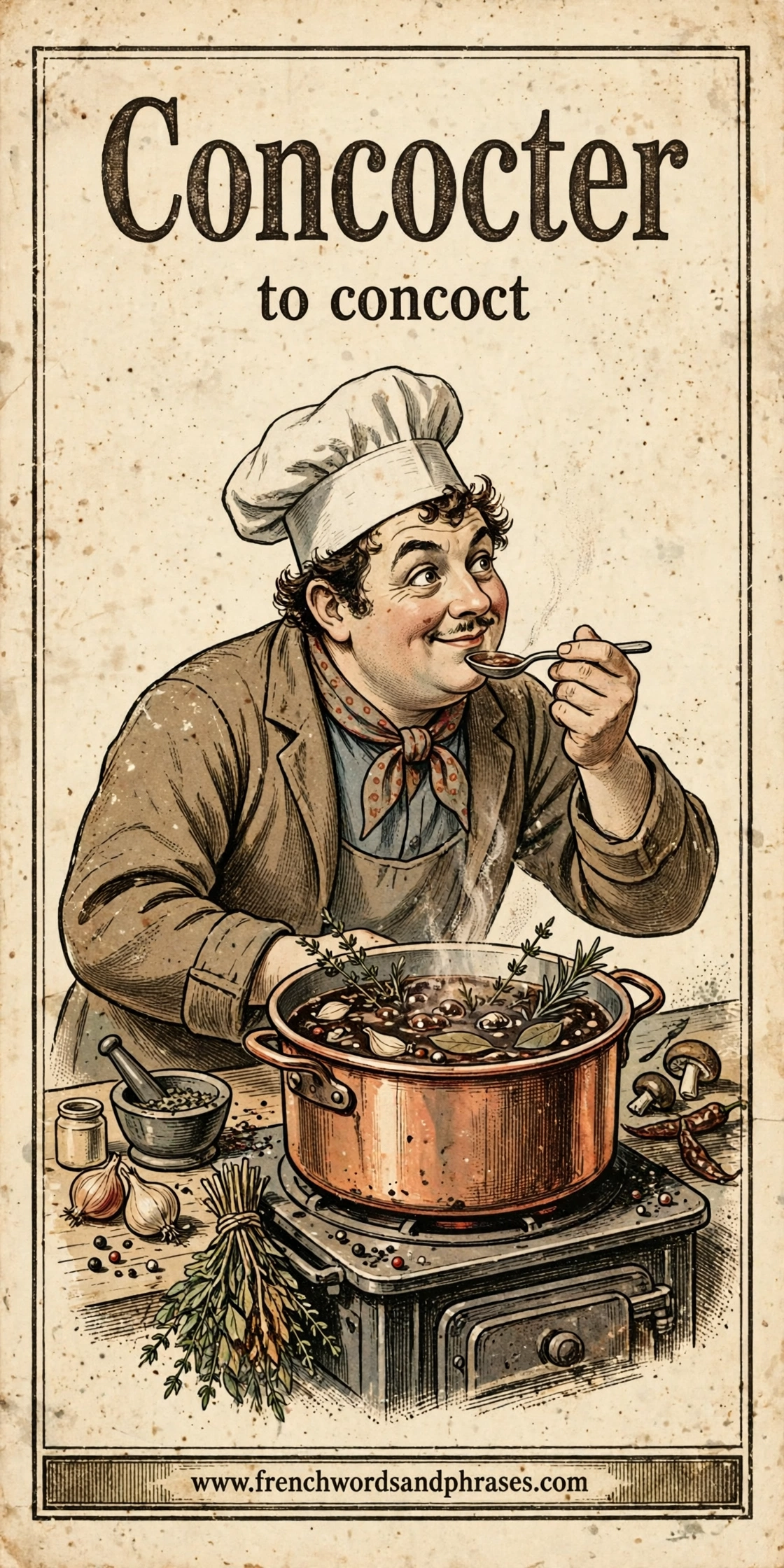
Concocter means to concoct — to cook up something with care and a touch of scheming, whether a dish, an excuse or a plan.
A grandmother stirring a pot whose recipe exists nowhere on paper, a schoolboy inventing a story for the headmaster, friends plotting a surprise party in whispers — concocter is the verb of cooking things up: part kitchen, part conspiracy, always made with care.
In this guide, you’ll learn how to conjugate concocter in all the major French tenses and moods. Explore complete conjugation tables, French examples, English translations, and practice quizzes.
Understanding the French Verb Concocter
Concocter is a regular French verb belonging to the first group of verbs, those ending in-er.
It means to concoct. It is commonly used for home cooking with a personal touch, and figuratively for excuses, stories, plans and schemes that someone has carefully put together — the tone ranges from tender (a meal made with love) to suspicious (a story too well prepared to be true).
Verb classification: First group (-er)
Auxiliary verb: Avoir
Past participle: concocté
Present participle: concoctant
English equivalents: To concoct, to cook up, to brew up; concocter un petit plat — to cook up a little dish; concocter un alibi, une excuse — to concoct an alibi, an excuse; concocter un plan, un projet — to hatch a plan, a project; concocter une surprise — to cook up a surprise.
One important detail: concocter is a perfectly regular -er verb — je concocte, nous concoctons, ils concoctent, past participle concocté — and its charm is in its choice of object. In the kitchen it is affectionate: concocter un petit plat suggests something made lovingly, off-recipe. Outside the kitchen it turns sly: concocter un alibi is to invent one, piece by piece, exactly as a cook assembles a dish. Whatever is concocté has been put together deliberately, ingredient by ingredient.
Experience the Word
Concocter is the verb of the loving plot — nothing concocté is improvised; it has been simmered, seasoned and kept secret until the right moment.
Imagine a small kitchen on a Sunday morning. Grandmother sends everyone out, closes the door, and for two hours the house fills with smells nobody can name. She is not following a recipe — elle concocte, tasting, adjusting, inventing, and the family will never extract the secret from her.
The dish was not found in any book. It was concocted — concocté, with patience, mischief and love.
How to Conjugate Concocter: Complete French Conjugation Guide
Let’s explore every major conjugation of concocter, beginning with the indicative mood.
How to Conjugate Concocter in the Indicative Mood
The indicative mood is used to express facts, observations, actions, and events.
How to Conjugate Concocter in the Present Tense (Présent)
Used for actions happening now, habitual actions, and general truths.
| Subject | Conjugation |
|---|---|
| je | concocte |
| tu | concoctes |
| il / elle | concocte |
| nous | concoctons |
| vous | concoctez |
| ils / elles | concoctent |
Example
Le dimanche, ma grand-mère concocte un petit plat mijoté dont elle garde le secret.
On Sundays, my grandmother concocts a little simmered dish whose recipe she keeps secret.
Quick Quiz 1
Complete the sentence:
Nous ______ une surprise pour son anniversaire.
Reveal the answer
concoctons
Nous concoctons une surprise pour son anniversaire.
We are cooking up a surprise for his birthday.
How to Conjugate Concocter in the Passé Composé
Used for completed actions in the past. Concocter takes the auxiliary verb avoir.
| Subject | Conjugation |
|---|---|
| j’ | ai concocté |
| tu | as concocté |
| il / elle | a concocté |
| nous | avons concocté |
| vous | avez concocté |
| ils / elles | ont concocté |
Example
Il a concocté un alibi compliqué pour expliquer son retard.
He concocted a complicated alibi to explain his lateness.
How to Conjugate Concocter in the Imparfait (Imperfect Tense)
Used for habitual past actions, descriptions, and ongoing situations in the past.
| Subject | Conjugation |
|---|---|
| je | concoctais |
| tu | concoctais |
| il / elle | concoctait |
| nous | concoctions |
| vous | concoctiez |
| ils / elles | concoctaient |
Example
En cuisine, elle concoctait toujours quelque chose de nouveau.
In the kitchen, she was always concocting something new.
Quick Quiz 2
Choose the correct form:
He concocted an alibi.
Il ______ un alibi. (a concocté / est concocté)
Reveal the answer
a concocté
Il a concocté un alibi.
Concocter takes avoir.
How to Conjugate Concocter in the Plus-que-parfait
Used to describe an action that had already been completed before another past event.
| Subject | Conjugation |
|---|---|
| j’ | avais concocté |
| tu | avais concocté |
| il / elle | avait concocté |
| nous | avions concocté |
| vous | aviez concocté |
| ils / elles | avaient concocté |
Example
Ils avaient concocté un plan pour surprendre leur mère.
They had concocted a plan to surprise their mother.
How to Conjugate Concocter in the Passé Simple
Primarily used in formal writing, literature, and historical narratives. It is rarely used in everyday conversation.
| Subject | Conjugation |
|---|---|
| je | concoctai |
| tu | concoctas |
| il / elle | concocta |
| nous | concoctâmes |
| vous | concoctâtes |
| ils / elles | concoctèrent |
Example
Le cuisinier concocta un menu digne d’un roi.
The cook concocted a menu fit for a king.
How to Conjugate Concocter in the Passé Antérieur
A literary tense used to express an action completed immediately before another past action, generally in the passé simple.
| Subject | Conjugation |
|---|---|
| j’ | eus concocté |
| tu | eus concocté |
| il / elle | eut concocté |
| nous | eûmes concocté |
| vous | eûtes concocté |
| ils / elles | eurent concocté |
Example
Quand il eut concocté son excuse, il frappa à la porte du directeur.
When he had concocted his excuse, he knocked on the manager’s door.
How to Conjugate Concocter in the Future Tense (Futur Simple)
Used to describe actions that will take place in the future.
| Subject | Conjugation |
|---|---|
| je | concocterai |
| tu | concocteras |
| il / elle | concoctera |
| nous | concocterons |
| vous | concocterez |
| ils / elles | concocteront |
Example
Demain, je concocterai un dîner spécial pour nos invités.
Tomorrow, I will concoct a special dinner for our guests.
How to Conjugate Concocter in the Futur Antérieur (Future Perfect)
Used for an action that will have been completed before a particular point in the future.
| Subject | Conjugation |
|---|---|
| j’ | aurai concocté |
| tu | auras concocté |
| il / elle | aura concocté |
| nous | aurons concocté |
| vous | aurez concocté |
| ils / elles | auront concocté |
Example
À midi, elle aura concocté trois desserts différents.
By noon, she will have concocted three different desserts.
How to Conjugate Concocter in the Near Future (Futur Proche)
Used to describe something that is going to happen soon. Formed with aller + infinitive.
| Subject | Conjugation |
|---|---|
| je | vais concocter |
| tu | vas concocter |
| il / elle | va concocter |
| nous | allons concocter |
| vous | allez concocter |
| ils / elles | vont concocter |
Example
Chut, ils vont concocter une surprise pour ton anniversaire.
Shh, they are going to concoct a surprise for your birthday.
How to Conjugate Concocter in the Conditional Mood
The conditional mood expresses what would happen under certain circumstances. It is also frequently used to make polite requests or express wishes.
How to Conjugate Concocter in the Present Conditional
| Subject | Conjugation |
|---|---|
| je | concocterais |
| tu | concocterais |
| il / elle | concocterait |
| nous | concocterions |
| vous | concocteriez |
| ils / elles | concocteraient |
Example
Sans recette, je concocterais n’importe quoi.
Without a recipe, I would concoct just anything.
How to Conjugate Concocter in the Past Conditional
| Subject | Conjugation |
|---|---|
| j’ | aurais concocté |
| tu | aurais concocté |
| il / elle | aurait concocté |
| nous | aurions concocté |
| vous | auriez concocté |
| ils / elles | auraient concocté |
Example
Elle aurait concocté une meilleure excuse avec plus de temps.
She would have concocted a better excuse with more time.
Concocter in the Literary Past Conditional Form
This less common literary form uses the imperfect subjunctive of avoir.
| Subject | Conjugation |
|---|---|
| j’ | eusse concocté |
| tu | eusses concocté |
| il / elle | eût concocté |
| nous | eussions concocté |
| vous | eussiez concocté |
| ils / elles | eussent concocté |
Example
Il eût concocté un stratagème plus fin s’il eût été plus calme.
He would have concocted a subtler scheme had he been calmer.
How to Conjugate Concocter in the Subjunctive Mood
The subjunctive is used to express wishes, emotions, doubts, necessity, and uncertainty. It frequently follows expressions such as il faut que (it is necessary that) or bien que (although).
How to Conjugate Concocter in the Present Subjunctive
| Subject | Conjugation |
|---|---|
| que je | concocte |
| que tu | concoctes |
| qu’il / qu’elle | concocte |
| que nous | concoctions |
| que vous | concoctiez |
| qu’ils / qu’elles | concoctent |
Example
Il faut que tu concoctes une excuse crédible.
You must concoct a believable excuse.
Quick Quiz 3
Complete the sentence using the subjunctive:
Il faut que vous ______ un plan avant demain.
Reveal the answer
concoctiez
Il faut que vous concoctiez un plan avant demain.
You must concoct a plan before tomorrow.
How to Conjugate Concocter in the Imperfect Subjunctive
A literary tense, rarely encountered in modern spoken French.
| Subject | Conjugation |
|---|---|
| que je | concoctasse |
| que tu | concoctasses |
| qu’il / qu’elle | concoctât |
| que nous | concoctassions |
| que vous | concoctassiez |
| qu’ils / qu’elles | concoctassent |
Example
Je doutais qu’il concoctât un repas aussi bon avec si peu d’ingrédients.
I doubted he could concoct such a good meal with so few ingredients.
How to Conjugate Concocter in the Pluperfect Subjunctive
A literary construction used to express an action completed before another past action.
| Subject | Conjugation |
|---|---|
| que j’ | eusse concocté |
| que tu | eusses concocté |
| qu’il / qu’elle | eût concocté |
| que nous | eussions concocté |
| que vous | eussiez concocté |
| qu’ils / qu’elles | eussent concocté |
Example
On racontait qu’ils eussent concocté le complot pendant des mois.
It was said they had concocted the plot over months.
How to Conjugate Concocter in the Past Subjunctive
| Subject | Conjugation |
|---|---|
| que j’ | aie concocté |
| que tu | aies concocté |
| qu’il / qu’elle | ait concocté |
| que nous | ayons concocté |
| que vous | ayez concocté |
| qu’ils / qu’elles | aient concocté |
Example
Je suis étonné qu’elle ait concocté ce menu en une heure.
I am amazed she concocted this menu in one hour.
How to Conjugate Concocter in the Imperative
The imperative is used to give commands, instructions, invitations, or suggestions. Subject pronouns are omitted.
How to Conjugate Concocter in the Present Imperative
| Person | Conjugation |
|---|---|
| (tu) | concocte |
| (nous) | concoctons |
| (vous) | concoctez |
Example
Concocte-nous un de tes petits plats, s’il te plaît !
Concoct one of your little dishes for us, please!
Quick Quiz 4
How would you say Concoct something good (tu form)?
Reveal the answer
Concocte quelque chose de bon !
French Participles of Concocter
Participles are verb forms that can be used in compound tenses and other grammatical constructions.
Present Participle of Concocter
concoctant
En concoctant des histoires, il a fini par y croire lui-même.
By concocting stories, he ended up believing them himself.
Past Participle of Concocter
concocté
Concocté avec soin, ce repas a régalé tout le monde.
Concocted with care, this meal delighted everyone.
Concocter in Everyday French: Real-Life Examples
Now that you know the conjugations, let’s see how concocter appears in everyday French.
Example 1 — Present
Elle concocte un petit plat mijoté.
She is concocting a little simmered dish.
Example 2 — Passé composé
Il a concocté un alibi invraisemblable.
He concocted an unlikely alibi.
Example 3 — Imparfait
Nous concoctions une surprise pour elle.
We were cooking up a surprise for her.
Example 4 — Future
Je concocterai un dîner spécial demain.
I will concoct a special dinner tomorrow.
Example 5 — Conditional
Tu concocterais une meilleure excuse que ça.
You would concoct a better excuse than that.
Example 6 — Imperative
Concocte quelque chose de bon pour ce soir !
Concoct something good for tonight!
Beyond Translation: The Meaning of Concocter
English concoct comes from the same Latin kitchen — concoquere, to cook together, to digest — and French concocter has kept the heat in the word.
Nothing concocté is raw or accidental.
A sauce, an alibi and a conspiracy are all cooked: assembled slowly, tasted, adjusted. That is why the verb so often carries a smile or a raised eyebrow — to say someone a concocté une histoire is to admire the cooking while doubting the ingredients.
How to Remember the French Verb Concocter
Remember it this way: Concocter is about the grandmother’s secret dish — and the schoolboy’s homemade alibi.
- Kitchen first: concocter un petit plat is cooking with love and no recipe book.
- Then the sly sense: concocter un alibi, un plan — to cook up an excuse or a scheme.
- Regular -er throughout: je concocte, nous concoctons, past participle concocté.
The key idea is the grandmother’s secret dish — and the schoolboy’s homemade alibi.
Test Your Knowledge of Concocter
Let’s see how much you’ve learned. Try answering these questions before revealing the answers.
Question 1
What two worlds does concocter move between?
Reveal the answer
The kitchen and the plot — concocter un petit plat (to cook up a dish) and concocter un alibi (to concoct an alibi).
Question 2
How do you say He concocted a complicated alibi in French?
Reveal the answer
Il a concocté un alibi compliqué.
Question 3
Translate: She is concocting a little dish.
Reveal the answer
Elle concocte un petit plat.
Question 4
What is the past participle of concocter?
Reveal the answer
Concocté.
Question 5
Complete the sentence:
Il faut que tu ______ une excuse crédible.
Reveal the answer
concoctes
Il faut que tu concoctes une excuse crédible.
You must concoct a believable excuse.
Your Final Challenge
Can You Use It?
How would you say this in French?
She is secretly concocting a festive meal, and the whole house can guess without seeing a thing.
Reveal the answer
Elle concocte en secret un repas de fête, et toute la maison devine sans rien voir.
She is secretly concocting a festive meal, and the whole house can guess without seeing a thing.
A little French. A little curiosity. A richer everyday life.
LEARN FRENCH ONE WORD AT A TIME