A French Word to Live By
How to Conjugate Commenter in French
/kɔ.mɑ̃.te/
Commenter means to comment — to give your reading of a text, a match, an event or a decision, out loud or in print.
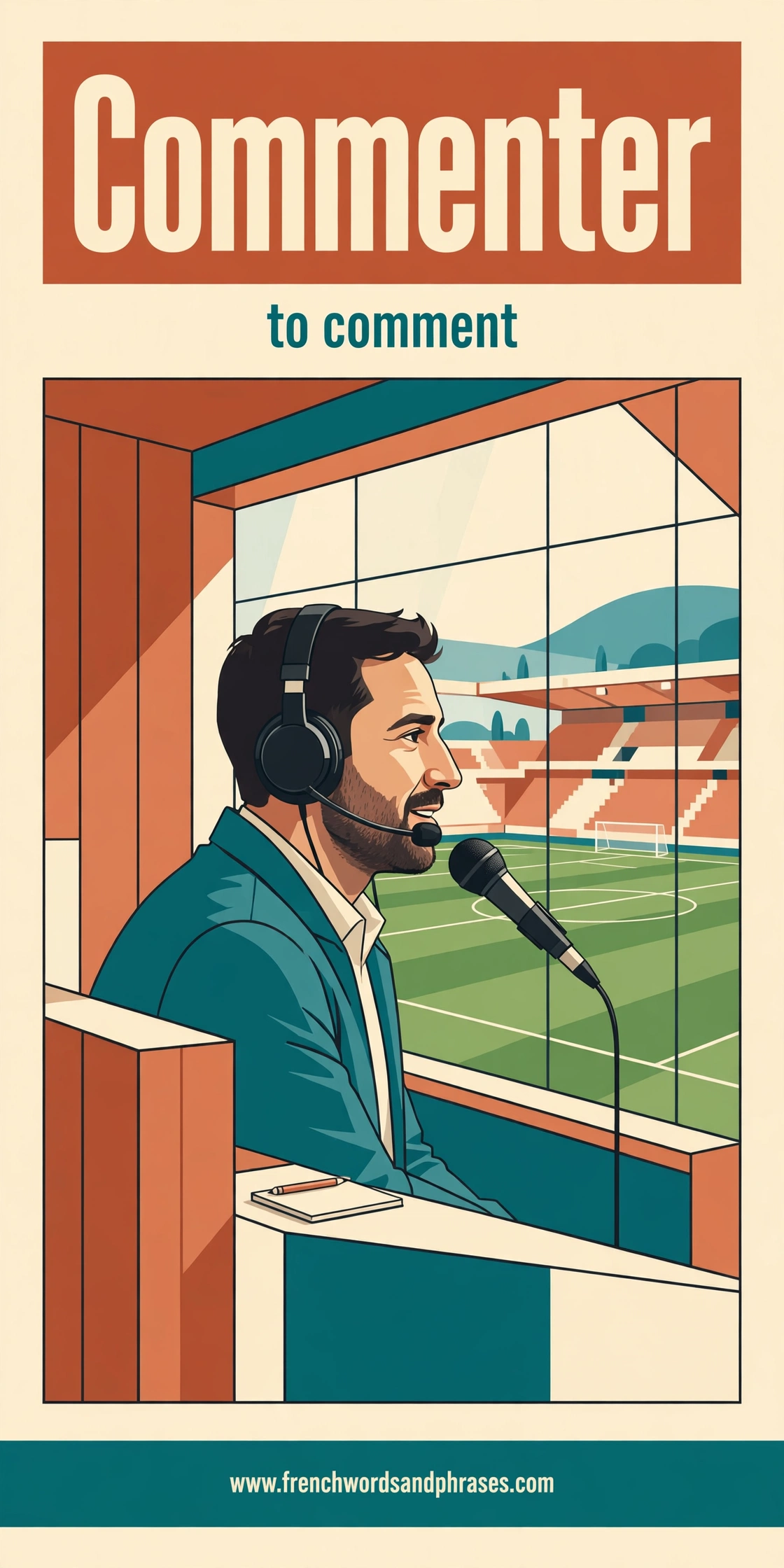
A commentator leaning into the microphone as the striker shoots, a teacher writing in the margin of an essay, a minister facing the cameras after a vote — commenter is the verb of the running commentary: watching something unfold and putting words on it as it happens.
In this guide, you’ll learn how to conjugate commenter in all the major French tenses and moods. Explore complete conjugation tables, French examples, English translations, and practice quizzes.
Understanding the French Verb Commenter
Commenter is a regular French verb belonging to the first group of verbs, those ending in-er.
It means to comment. It is used for sports commentary, for literary and legal commentary (commenter un arrêt, un texte de loi), and for officials reacting to news — le ministre n’a pas souhaité commenter, ‘the minister declined to comment’, is the standard formula of press conferences.
Verb classification: First group (-er)
Auxiliary verb: Avoir
Past participle: commenté
Present participle: commentant
English equivalents: To comment, to commentate, to provide commentary; commenter un match — to commentate on a match; commenter un texte — to write a commentary on a text; commenter l’actualité — to comment on current events; sans commentaire — no comment.
One important detail: commenter is a perfectly regular -er verb — je commente, nous commentons, past participle commenté — and its trap is not spelling but company. You commenter something directly: on commente un match, un texte, une décision, with no preposition before the thing commented on. The person who does it is un commentateur (a commentator or pundit), and the product is un commentaire — a commentary, but also, beware, the dreaded comment in the margin of a school report.
Experience the Word
Commenter is the verb of the voice-over — life happens in front of you, and you supply the words that tell everyone what it means.
Imagine the last minute of a cup final in a small French bar. The television commentator’s voice climbs as the ball crosses the box — il commente, he narrates, he interprets — and the whole room lives the match twice: once with their eyes, once through his words.
The players play the match. He comments it — il le commente — and makes it a story.
How to Conjugate Commenter: Complete French Conjugation Guide
Let’s explore every major conjugation of commenter, beginning with the indicative mood.
How to Conjugate Commenter in the Indicative Mood
The indicative mood is used to express facts, observations, actions, and events.
How to Conjugate Commenter in the Present Tense (Présent)
Used for actions happening now, habitual actions, and general truths.
| Subject | Conjugation |
|---|---|
| je | commente |
| tu | commentes |
| il / elle | commente |
| nous | commentons |
| vous | commentez |
| ils / elles | commentent |
Example
Elle commente le match en direct à la radio.
She is commentating on the match live on the radio.
Quick Quiz 1
Complete the sentence:
Nous ______ le match en direct.
Reveal the answer
commentons
Nous commentons le match en direct.
We are commentating on the match live.
How to Conjugate Commenter in the Passé Composé
Used for completed actions in the past. Commenter takes the auxiliary verb avoir.
| Subject | Conjugation |
|---|---|
| j’ | ai commenté |
| tu | as commenté |
| il / elle | a commenté |
| nous | avons commenté |
| vous | avez commenté |
| ils / elles | ont commenté |
Example
Le professeur a commenté chaque paragraphe de ma copie.
The teacher commented on every paragraph of my essay.
How to Conjugate Commenter in the Imparfait (Imperfect Tense)
Used for habitual past actions, descriptions, and ongoing situations in the past.
| Subject | Conjugation |
|---|---|
| je | commentais |
| tu | commentais |
| il / elle | commentait |
| nous | commentions |
| vous | commentiez |
| ils / elles | commentaient |
Example
Autrefois, il commentait les courses de chevaux pour la télévision.
In the old days, he used to commentate on horse racing for television.
Quick Quiz 2
Choose the correct form:
The teacher commented on my essay.
Le professeur ______ ma copie. (a commenté / est commenté)
Reveal the answer
a commenté
Le professeur a commenté ma copie.
Commenter takes avoir.
How to Conjugate Commenter in the Plus-que-parfait
Used to describe an action that had already been completed before another past event.
| Subject | Conjugation |
|---|---|
| j’ | avais commenté |
| tu | avais commenté |
| il / elle | avait commenté |
| nous | avions commenté |
| vous | aviez commenté |
| ils / elles | avaient commenté |
Example
Le journal avait déjà commenté la décision avant midi.
The newspaper had already commented on the decision before noon.
How to Conjugate Commenter in the Passé Simple
Primarily used in formal writing, literature, and historical narratives. It is rarely used in everyday conversation.
| Subject | Conjugation |
|---|---|
| je | commentai |
| tu | commentas |
| il / elle | commenta |
| nous | commentâmes |
| vous | commentâtes |
| ils / elles | commentèrent |
Example
Le chroniqueur commenta l’événement avec une ironie mordante.
The columnist commented on the event with biting irony.
How to Conjugate Commenter in the Passé Antérieur
A literary tense used to express an action completed immediately before another past action, generally in the passé simple.
| Subject | Conjugation |
|---|---|
| j’ | eus commenté |
| tu | eus commenté |
| il / elle | eut commenté |
| nous | eûmes commenté |
| vous | eûtes commenté |
| ils / elles | eurent commenté |
Example
Quand l’éditorialiste eut commenté le discours, le débat commença.
When the editorialist had commented on the speech, the debate began.
How to Conjugate Commenter in the Future Tense (Futur Simple)
Used to describe actions that will take place in the future.
| Subject | Conjugation |
|---|---|
| je | commenterai |
| tu | commenteras |
| il / elle | commentera |
| nous | commenterons |
| vous | commenterez |
| ils / elles | commenteront |
Example
Demain, elle commentera la finale pour des millions d’auditeurs.
Tomorrow, she will commentate on the final for millions of listeners.
How to Conjugate Commenter in the Futur Antérieur (Future Perfect)
Used for an action that will have been completed before a particular point in the future.
| Subject | Conjugation |
|---|---|
| j’ | aurai commenté |
| tu | auras commenté |
| il / elle | aura commenté |
| nous | aurons commenté |
| vous | aurez commenté |
| ils / elles | auront commenté |
Example
À la fin de l’émission, ils auront commenté tous les résultats.
By the end of the programme, they will have commented on all the results.
How to Conjugate Commenter in the Near Future (Futur Proche)
Used to describe something that is going to happen soon. Formed with aller + infinitive.
| Subject | Conjugation |
|---|---|
| je | vais commenter |
| tu | vas commenter |
| il / elle | va commenter |
| nous | allons commenter |
| vous | allez commenter |
| ils / elles | vont commenter |
Example
Le ministre va commenter les chiffres du chômage ce soir.
The minister is going to comment on the unemployment figures this evening.
How to Conjugate Commenter in the Conditional Mood
The conditional mood expresses what would happen under certain circumstances. It is also frequently used to make polite requests or express wishes.
How to Conjugate Commenter in the Present Conditional
| Subject | Conjugation |
|---|---|
| je | commenterais |
| tu | commenterais |
| il / elle | commenterait |
| nous | commenterions |
| vous | commenteriez |
| ils / elles | commenteraient |
Example
À sa place, je commenterais cette décision avec plus de prudence.
In his place, I would comment on this decision more cautiously.
How to Conjugate Commenter in the Past Conditional
| Subject | Conjugation |
|---|---|
| j’ | aurais commenté |
| tu | aurais commenté |
| il / elle | aurait commenté |
| nous | aurions commenté |
| vous | auriez commenté |
| ils / elles | auraient commenté |
Example
Elle aurait commenté le match si elle n’avait pas perdu sa voix.
She would have commentated on the match if she had not lost her voice.
Commenter in the Literary Past Conditional Form
This less common literary form uses the imperfect subjunctive of avoir.
| Subject | Conjugation |
|---|---|
| j’ | eusse commenté |
| tu | eusses commenté |
| il / elle | eût commenté |
| nous | eussions commenté |
| vous | eussiez commenté |
| ils / elles | eussent commenté |
Example
Il eût commenté le texte ligne par ligne, comme autrefois.
He would have commented on the text line by line, as in the old days.
How to Conjugate Commenter in the Subjunctive Mood
The subjunctive is used to express wishes, emotions, doubts, necessity, and uncertainty. It frequently follows expressions such as il faut que (it is necessary that) or bien que (although).
How to Conjugate Commenter in the Present Subjunctive
| Subject | Conjugation |
|---|---|
| que je | commente |
| que tu | commentes |
| qu’il / qu’elle | commente |
| que nous | commentions |
| que vous | commentiez |
| qu’ils / qu’elles | commentent |
Example
Il faut que tu commentes ce poème pour demain.
You must write a commentary on this poem for tomorrow.
Quick Quiz 3
Complete the sentence using the subjunctive:
Il faut que vous ______ cette décision.
Reveal the answer
commentiez
Il faut que vous commentiez cette décision.
You must comment on this decision.
How to Conjugate Commenter in the Imperfect Subjunctive
A literary tense, rarely encountered in modern spoken French.
| Subject | Conjugation |
|---|---|
| que je | commentasse |
| que tu | commentasses |
| qu’il / qu’elle | commentât |
| que nous | commentassions |
| que vous | commentassiez |
| qu’ils / qu’elles | commentassent |
Example
On ne s’attendait pas qu’il commentât le match avec tant de passion.
No one expected him to commentate on the match with so much passion.
How to Conjugate Commenter in the Pluperfect Subjunctive
A literary construction used to express an action completed before another past action.
| Subject | Conjugation |
|---|---|
| que j’ | eusse commenté |
| que tu | eusses commenté |
| qu’il / qu’elle | eût commenté |
| que nous | eussions commenté |
| que vous | eussiez commenté |
| qu’ils / qu’elles | eussent commenté |
Example
On craignait qu’elle eût commenté l’affaire avant le procès.
People feared she had commented on the case before the trial.
How to Conjugate Commenter in the Past Subjunctive
| Subject | Conjugation |
|---|---|
| que j’ | aie commenté |
| que tu | aies commenté |
| qu’il / qu’elle | ait commenté |
| que nous | ayons commenté |
| que vous | ayez commenté |
| qu’ils / qu’elles | aient commenté |
Example
Je suis content qu’il ait commenté mon article avec tant d’attention.
I am glad he commented on my article so attentively.
How to Conjugate Commenter in the Imperative
The imperative is used to give commands, instructions, invitations, or suggestions. Subject pronouns are omitted.
How to Conjugate Commenter in the Present Imperative
| Person | Conjugation |
|---|---|
| (tu) | commente |
| (nous) | commentons |
| (vous) | commentez |
Example
Commente ce texte en trois paragraphes, pas plus !
Comment on this text in three paragraphs, no more!
Quick Quiz 4
How would you say Comment on the news (tu form)?
Reveal the answer
Commente l’actualité !
French Participles of Commenter
Participles are verb forms that can be used in compound tenses and other grammatical constructions.
Present Participle of Commenter
commentant
En commentant le match, il a fait rire tout le studio.
While commentating on the match, he made the whole studio laugh.
Past Participle of Commenter
commenté
Commenté par des générations d’étudiants, ce poème est devenu un classique.
Commented on by generations of students, this poem has become a classic.
Commenter in Everyday French: Real-Life Examples
Now that you know the conjugations, let’s see how commenter appears in everyday French.
Example 1 — Present
Elle commente le match en direct.
She commentates on the match live.
Example 2 — Passé composé
Le professeur a commenté ma copie.
The teacher commented on my essay.
Example 3 — Imparfait
Il commentait les courses pour la télévision.
He used to commentate on the races for television.
Example 4 — Future
Le ministre commentera les résultats ce soir.
The minister will comment on the results this evening.
Example 5 — Conditional
Je commenterais avec plus de prudence.
I would comment more cautiously.
Example 6 — Imperative
Commente ce texte pour demain !
Comment on this text for tomorrow!
Beyond Translation: The Meaning of Commenter
English comment comes straight from Latin commentari, to devise, to note down — and French commenter still carries that scholarly weight alongside the stadium microphone.
To comment, in French, is a profession.
Un commentateur sportif is a national figure, un commentaire de texte is the classic school exercise, and sans commentaire — ‘no comment’ — is the most eloquent comment of all.
How to Remember the French Verb Commenter
Remember it this way: Commenter is about the voice over the match — watching life and supplying the words.
- No preposition before the thing: on commente un match, un texte, une décision.
- The family does the work: un commentateur commentates, un commentaire is the commentary.
- Regular -er: je commente, nous commentons, past participle commenté.
The key idea is the voice over the match — watching life and supplying the words.
Test Your Knowledge of Commenter
Let’s see how much you’ve learned. Try answering these questions before revealing the answers.
Question 1
Which noun does commenter produce for the person who commentates?
Reveal the answer
Un commentateur — a commentator; his product is un commentaire.
Question 2
How do you say She is commentating on the match live in French?
Reveal the answer
Elle commente le match en direct.
Question 3
Translate: The teacher commented on every paragraph.
Reveal the answer
Le professeur a commenté chaque paragraphe.
Question 4
What is the past participle of commenter?
Reveal the answer
Commenté.
Question 5
Complete the sentence:
Il faut que tu ______ ce poème pour demain.
Reveal the answer
commentes
Il faut que tu commentes ce poème pour demain.
You must write a commentary on this poem for tomorrow.
Your Final Challenge
Can You Use It?
How would you say this in French?
She commentates on the match, and suddenly the whole bar understands the game before even seeing it.
Reveal the answer
Elle commente le match, et soudain tout le bar comprend le jeu avant même de le voir.
She commentates on the match, and suddenly the whole bar understands the game before even seeing it.
A little French. A little curiosity. A richer everyday life.
LEARN FRENCH ONE WORD AT A TIME