A French Word to Live By
How to Conjugate Commémorer in French
/kɔ.me.mɔ.ʁe/
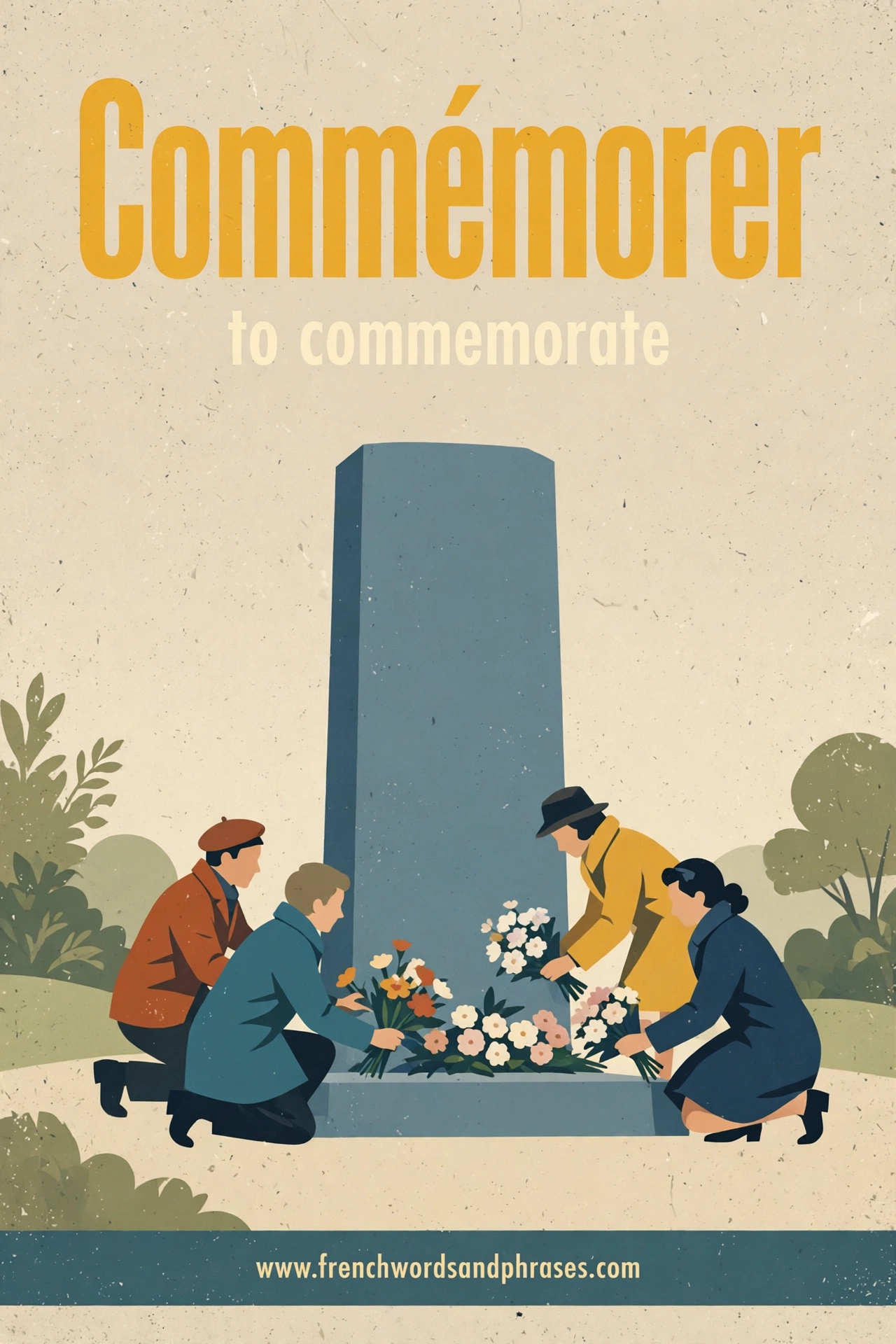
Commémorer means to commemorate — to remember a great event or a lost generation together, out loud, and on purpose.
A village silent at eleven o’clock on 11 November, wreaths laid at a stone of names, a nation pausing at a centenary — commémorer is the verb of public memory: the ceremony by which a community refuses to forget.
In this guide, you’ll learn how to conjugate commémorer in all the major French tenses and moods. Explore complete conjugation tables, French examples, English translations, and practice quizzes.
Understanding the French Verb Commémorer
Commémorer is a regular French verb belonging to the first group of verbs, those ending in-er.
It means to commemorate. It belongs to ceremonies, monuments and anniversaries: towns commémorent their dead, nations commémorent treaties, victories and liberations. It is more solemn than fêter (to celebrate) and more public than se souvenir (to remember privately): one commémore together, usually standing up, often in silence.
Verb classification: First group (-er)
Auxiliary verb: Avoir
Past participle: commémoré
Present participle: commémorant
English equivalents: To commemorate; commémorer un événement, un anniversaire — to commemorate an event, an anniversary; commémorer le souvenir de qqn — to commemorate the memory of someone; commémorer les victimes — to honour the memory of the victims; une cérémonie commémorative — a commemorative ceremony.
One important detail: commémorer keeps its é everywhere — je commémore, nous commémorons, je commémorerai — and never turns it into è. The reason is the syllable that follows: in célébrer (je célèbre) the é stands before a mute ending, but in commémorer the é is followed by the full vowel of -mo-, so it stays acute in every form. The verb is otherwise a regular -er with avoir, and the double m never changes: commémorons, commémoré, en commémorant.
Experience the Word
Commémorer is the verb of memory with its shoes polished — remembrance turned into a ceremony.
Imagine a small French village on a grey November morning. The mayor reads the names on the war memorial, one by one, as he does every year; the schoolchildren stand very still; a trumpet sounds. Le village commémore ses morts — the same names, the same silence, and somehow it is never routine.
The men named on the stone died a century ago. They are remembered — commémorés — because the village refuses to stop.
How to Conjugate Commémorer: Complete French Conjugation Guide
Let’s explore every major conjugation of commémorer, beginning with the indicative mood.
How to Conjugate Commémorer in the Indicative Mood
The indicative mood is used to express facts, observations, actions, and events.
How to Conjugate Commémorer in the Present Tense (Présent)
Used for actions happening now, habitual actions, and general truths.
| Subject | Conjugation |
|---|---|
| je | commémore |
| tu | commémores |
| il / elle | commémore |
| nous | commémorons |
| vous | commémorez |
| ils / elles | commémorent |
Example
Chaque année, le village commémore la fin de la guerre.
Every year, the village commemorates the end of the war.
Quick Quiz 1
Complete the sentence:
Nous ______ la fin de la guerre.
Reveal the answer
commémorons
Nous commémorons la fin de la guerre.
We are commemorating the end of the war.
How to Conjugate Commémorer in the Passé Composé
Used for completed actions in the past. Commémorer takes the auxiliary verb avoir.
| Subject | Conjugation |
|---|---|
| j’ | ai commémoré |
| tu | as commémoré |
| il / elle | a commémoré |
| nous | avons commémoré |
| vous | avez commémoré |
| ils / elles | ont commémoré |
Example
Nous avons commémoré le centenaire de sa naissance.
We commemorated the centenary of his birth.
How to Conjugate Commémorer in the Imparfait (Imperfect Tense)
Used for habitual past actions, descriptions, and ongoing situations in the past.
| Subject | Conjugation |
|---|---|
| je | commémorais |
| tu | commémorais |
| il / elle | commémorait |
| nous | commémorions |
| vous | commémoriez |
| ils / elles | commémoraient |
Example
La ville commémorait ses héros chaque 11 novembre.
The town used to commemorate its heroes every 11 November.
Quick Quiz 2
Choose the correct form:
The town commemorated its heroes.
La ville ______ ses héros. (a commémoré / est commémorée)
Reveal the answer
a commémoré
La ville a commémoré ses héros.
Commémorer takes avoir.
How to Conjugate Commémorer in the Plus-que-parfait
Used to describe an action that had already been completed before another past event.
| Subject | Conjugation |
|---|---|
| j’ | avais commémoré |
| tu | avais commémoré |
| il / elle | avait commémoré |
| nous | avions commémoré |
| vous | aviez commémoré |
| ils / elles | avaient commémoré |
Example
Ils avaient commémoré l’événement avec une plaque de marbre.
They had commemorated the event with a marble plaque.
How to Conjugate Commémorer in the Passé Simple
Primarily used in formal writing, literature, and historical narratives. It is rarely used in everyday conversation.
| Subject | Conjugation |
|---|---|
| je | commémorai |
| tu | commémoras |
| il / elle | commémora |
| nous | commémorâmes |
| vous | commémorâtes |
| ils / elles | commémorèrent |
Example
La nation commémora le jour de la victoire.
The nation commemorated Victory Day.
How to Conjugate Commémorer in the Passé Antérieur
A literary tense used to express an action completed immediately before another past action, generally in the passé simple.
| Subject | Conjugation |
|---|---|
| j’ | eus commémoré |
| tu | eus commémoré |
| il / elle | eut commémoré |
| nous | eûmes commémoré |
| vous | eûtes commémoré |
| ils / elles | eurent commémoré |
Example
Quand on eut commémoré les victimes, le silence retomba.
When the victims had been commemorated, silence fell again.
How to Conjugate Commémorer in the Future Tense (Futur Simple)
Used to describe actions that will take place in the future.
| Subject | Conjugation |
|---|---|
| je | commémorerai |
| tu | commémoreras |
| il / elle | commémorera |
| nous | commémorerons |
| vous | commémorerez |
| ils / elles | commémoreront |
Example
Demain, nous commémorerons la signature du traité.
Tomorrow, we will commemorate the signing of the treaty.
How to Conjugate Commémorer in the Futur Antérieur (Future Perfect)
Used for an action that will have been completed before a particular point in the future.
| Subject | Conjugation |
|---|---|
| j’ | aurai commémoré |
| tu | auras commémoré |
| il / elle | aura commémoré |
| nous | aurons commémoré |
| vous | aurez commémoré |
| ils / elles | auront commémoré |
Example
À la fin de la cérémonie, nous aurons commémoré tous les disparus.
By the end of the ceremony, we will have commemorated all the missing.
How to Conjugate Commémorer in the Near Future (Futur Proche)
Used to describe something that is going to happen soon. Formed with aller + infinitive.
| Subject | Conjugation |
|---|---|
| je | vais commémorer |
| tu | vas commémorer |
| il / elle | va commémorer |
| nous | allons commémorer |
| vous | allez commémorer |
| ils / elles | vont commémorer |
Example
Le pays va commémorer les quatre-vingts ans du Débarquement.
The country is going to commemorate the eightieth anniversary of D-Day.
How to Conjugate Commémorer in the Conditional Mood
The conditional mood expresses what would happen under certain circumstances. It is also frequently used to make polite requests or express wishes.
How to Conjugate Commémorer in the Present Conditional
| Subject | Conjugation |
|---|---|
| je | commémorerais |
| tu | commémorerais |
| il / elle | commémorerait |
| nous | commémorerions |
| vous | commémoreriez |
| ils / elles | commémoreraient |
Example
Sans la pluie, la foule commémorerait l’événement sur la place.
Without the rain, the crowd would commemorate the event in the square.
How to Conjugate Commémorer in the Past Conditional
| Subject | Conjugation |
|---|---|
| j’ | aurais commémoré |
| tu | aurais commémoré |
| il / elle | aurait commémoré |
| nous | aurions commémoré |
| vous | auriez commémoré |
| ils / elles | auraient commémoré |
Example
Ils auraient commémoré l’anniversaire avec plus d’éclat en temps de paix.
They would have commemorated the anniversary with more splendour in peacetime.
Commémorer in the Literary Past Conditional Form
This less common literary form uses the imperfect subjunctive of avoir.
| Subject | Conjugation |
|---|---|
| j’ | eusse commémoré |
| tu | eusses commémoré |
| il / elle | eût commémoré |
| nous | eussions commémoré |
| vous | eussiez commémoré |
| ils / elles | eussent commémoré |
Example
Le peuple eût commémoré ce jour à jamais.
The people would have commemorated this day forever.
How to Conjugate Commémorer in the Subjunctive Mood
The subjunctive is used to express wishes, emotions, doubts, necessity, and uncertainty. It frequently follows expressions such as il faut que (it is necessary that) or bien que (although).
How to Conjugate Commémorer in the Present Subjunctive
| Subject | Conjugation |
|---|---|
| que je | commémore |
| que tu | commémores |
| qu’il / qu’elle | commémore |
| que nous | commémorions |
| que vous | commémoriez |
| qu’ils / qu’elles | commémorent |
Example
Il est important que nous commémorions ces sacrifices.
It is important that we commemorate these sacrifices.
Quick Quiz 3
Complete the sentence using the subjunctive:
Il est important que nous ______ ces sacrifices.
Reveal the answer
commémorions
Il est important que nous commémorions ces sacrifices.
It is important that we commemorate these sacrifices.
How to Conjugate Commémorer in the Imperfect Subjunctive
A literary tense, rarely encountered in modern spoken French.
| Subject | Conjugation |
|---|---|
| que je | commémorasse |
| que tu | commémorasses |
| qu’il / qu’elle | commémorât |
| que nous | commémorassions |
| que vous | commémorassiez |
| qu’ils / qu’elles | commémorassent |
Example
Le maire souhaitait que la ville commémorât dignement ses morts.
The mayor wished the town to commemorate its dead with dignity.
How to Conjugate Commémorer in the Pluperfect Subjunctive
A literary construction used to express an action completed before another past action.
| Subject | Conjugation |
|---|---|
| que j’ | eusse commémoré |
| que tu | eusses commémoré |
| qu’il / qu’elle | eût commémoré |
| que nous | eussions commémoré |
| que vous | eussiez commémoré |
| qu’ils / qu’elles | eussent commémoré |
Example
On racontait que le village eût commémoré la bataille chaque année.
People said the village had commemorated the battle every year.
How to Conjugate Commémorer in the Past Subjunctive
| Subject | Conjugation |
|---|---|
| que j’ | aie commémoré |
| que tu | aies commémoré |
| qu’il / qu’elle | ait commémoré |
| que nous | ayons commémoré |
| que vous | ayez commémoré |
| qu’ils / qu’elles | aient commémoré |
Example
Je suis ému que tant de gens aient commémoré ce jour avec nous.
I am moved that so many people commemorated this day with us.
How to Conjugate Commémorer in the Imperative
The imperative is used to give commands, instructions, invitations, or suggestions. Subject pronouns are omitted.
How to Conjugate Commémorer in the Present Imperative
| Person | Conjugation |
|---|---|
| (tu) | commémore |
| (nous) | commémorons |
| (vous) | commémorez |
Example
Commémorons ensemble le souvenir de ceux qui sont tombés !
Let us commemorate together the memory of those who fell!
Quick Quiz 4
How would you say Commemorate this day (tu form)?
Reveal the answer
Commémore ce jour !
French Participles of Commémorer
Participles are verb forms that can be used in compound tenses and other grammatical constructions.
Present Participle of Commémorer
commémorant
En commémorant le passé, nous protégeons l’avenir.
By commemorating the past, we protect the future.
Past Participle of Commémorer
commémoré
Commémorée par tout un peuple, la victoire n’a jamais été oubliée.
Commemorated by a whole people, the victory has never been forgotten.
Commémorer in Everyday French: Real-Life Examples
Now that you know the conjugations, let’s see how commémorer appears in everyday French.
Example 1 — Present
Le village commémore ses morts.
The village commemorates its dead.
Example 2 — Passé composé
Nous avons commémoré le centenaire.
We commemorated the centenary.
Example 3 — Imparfait
La ville commémorait ses héros.
The town used to commemorate its heroes.
Example 4 — Future
Nous commémorerons la signature du traité.
We will commemorate the signing of the treaty.
Example 5 — Conditional
La foule commémorerait l’événement sur la place.
The crowd would commemorate the event in the square.
Example 6 — Imperative
Commémorons ce jour ensemble !
Let us commemorate this day together!
Beyond Translation: The Meaning of Commémorer
The word is Latin commemorare — to bring to mind together: com-, together, and memor, mindful.
Memory, in this verb, is a team sport.
English ‘commemorate’ is its exact twin, but French uses commémorer constantly — every town has its monument, every year its 11 novembre — where English often reaches for the plainer ‘remember’.
How to Remember the French Verb Commémorer
Remember it this way: Commémorer is about the village silent at the war memorial, refusing to forget.
- The é never changes: je commémore, nous commémorons, je commémorerai — the next syllable has a full vowel.
- Regular -er with avoir, double m throughout: commémoré, en commémorant.
- Solemn and public: towns commémorent their dead; fêter is for parties, commémorer for memorials.
The key idea is the village silent at the war memorial, refusing to forget.
Test Your Knowledge of Commémorer
Let’s see how much you’ve learned. Try answering these questions before revealing the answers.
Question 1
Why does the é of commémorer never become è?
Reveal the answer
Because the next syllable has a full vowel — je commémore, nous commémorons; unlike célébrer, the é never stands before a mute ending.
Question 2
How do you say The village commemorates its dead in French?
Reveal the answer
Le village commémore ses morts.
Question 3
Translate: We have commemorated the centenary of his birth.
Reveal the answer
Nous avons commémoré le centenaire de sa naissance.
Question 4
What is the past participle of commémorer?
Reveal the answer
Commémoré.
Question 5
Complete the sentence:
Il est important que nous ______ ces sacrifices.
Reveal the answer
commémorions
Il est important que nous commémorions ces sacrifices.
It is important that we commemorate these sacrifices.
Your Final Challenge
Can You Use It?
How would you say this in French?
To commemorate is not to look backwards: it is to promise not to forget.
Reveal the answer
Commémorer, ce n’est pas regarder en arrière : c’est promettre de ne pas oublier.
To commemorate is not to look backwards: it is to promise not to forget.
A little French. A little curiosity. A richer everyday life.
LEARN FRENCH ONE WORD AT A TIME