A French Word to Live By
Translate Cheville to English
/ʃə.vij/
La cheville means the ankle.
The hiker steps on a round stone, her ankle rolls with a crack of pain — elle s’est foulé la cheville — and the whole group stops to help her down the mountain.
In this guide, you’ll learn what cheville means in English, how to use it with its articles, how to form its plural, and how it appears in everyday French. Explore French examples, English translations, and practice quizzes.
Understanding the French Noun Cheville
Cheville is a feminine French noun, learned with its article: la cheville, une cheville. It names the ankle, the joint between leg and foot — but in French the same word also means a peg or a dowel, the little pin that holds furniture and arguments together.
It means the ankle — the supple joint that lets the foot flex, point and roll, and the part of the leg most often twisted: se fouler la cheville is to sprain your ankle. From the workshop sense of the word comes a glorious expression: la cheville ouvrière, the linchpin — the one person a whole organisation cannot do without.
Gender: Feminine
Definite article: la — la cheville (the ankle)
Indefinite article: une — une cheville (an ankle; also a peg, a dowel)
Plural: les chevilles
Two lives: The ankle of the body — and the peg or dowel of the workshop
English equivalents: The ankle. (In a workshop: a peg, a dowel, a pin.)
One important usage detail: French measures modesty with ankles — someone who a les chevilles qui enflent, whose ankles are swelling, is getting big-headed, too pleased with themselves to fit their shoes. And nobody is flattered to hear they n’arrivent pas à la cheville de someone — they don’t come up to their ankle, they can’t hold a candle to them.
Experience the Word
Cheville is the body’s most trusting joint. It balances the whole weight of you on a few centimetres of bone and ligament — and one bad stone can stop a journey.
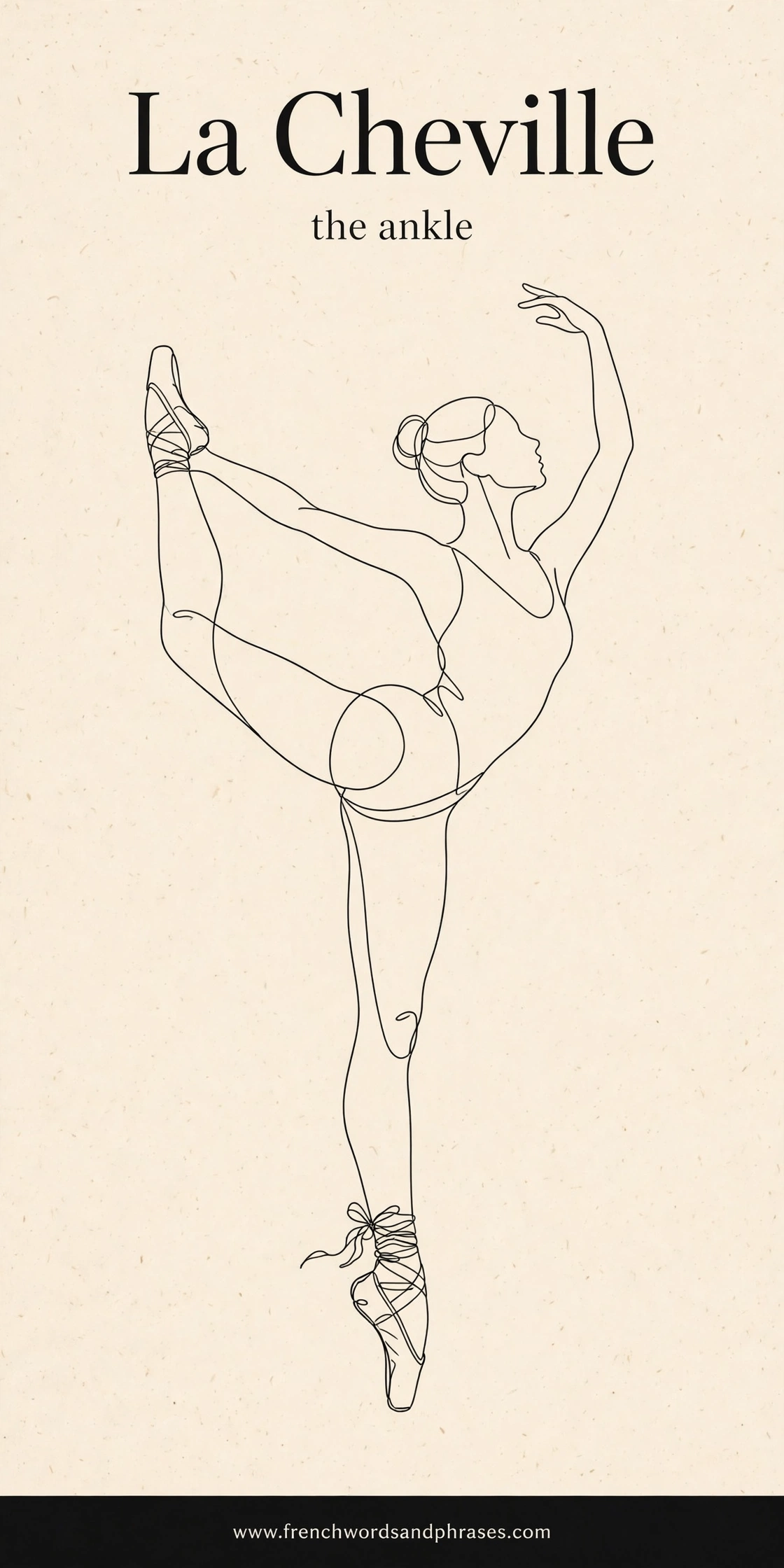
Imagine the dancer on pointe, chevilles like steel springs, or the hiker bandaging a foulure beside the mountain path.
You have not just twisted a joint. You have tested the pin that holds you together — la cheville, ankle and linchpin in one word.
How to Use Cheville in French: Complete Guide
Let’s explore how cheville works in French, beginning with its articles — then twist, swell and hold the whole workshop together.
Cheville with the Definite Article (La, Les)
Used for a specific ankle — the twisted one, the one in the bandage.
| Form | French |
|---|---|
| Feminine singular | la cheville |
| Plural | les chevilles |
Example
La cheville de la randonneuse est enflée après la chute.
The hiker’s ankle is swollen after the fall.
Cheville with the Indefinite Article (Une, Des)
Used for an ankle in general — une cheville, or a peg from the toolbox.
| Form | French |
|---|---|
| Feminine singular | une cheville |
| Plural | des chevilles |
Example
Il faut une cheville solide pour danser sur les pointes.
You need a strong ankle to dance on pointe.
Cheville with Quantities and Pairs
Ankles come in pairs and swell in comparisons — the quantities of the joint.
| Quantity | French |
|---|---|
| one ankle | une cheville |
| both ankles | les deux chevilles |
| a sprained ankle | une cheville foulée |
| ankle-deep water | de l’eau jusqu’aux chevilles |
| a pair of ankle socks | une paire de socquettes (aux chevilles) |
Example
Les enfants pataugent avec de l’eau jusqu’aux chevilles.
The children splash about with water up to their ankles.
Quick Quiz 1
Complete the sentence:
Elle s’est foulé ______ cheville en descendant l’escalier. (the)
Reveal the answer
la
Elle s’est foulé la cheville en descendant l’escalier.
She sprained her ankle coming down the stairs — la cheville, because cheville is feminine.
The Plural of Cheville
Cheville adds an -s in the plural — les chevilles, left and right.
| Number | French |
|---|---|
| Singular | la cheville |
| Plural | les chevilles |
Example
Les chevilles des danseuses sont fines et très fortes.
The dancers’ ankles are slim and very strong.
Cheville with Possessive Adjectives (Ma, Ta, Sa…)
Possessives agree with the noun: cheville is feminine, so it takes ma, ta, sa.
| Owner | French |
|---|---|
| my | ma cheville |
| your (tu) | ta cheville |
| his / her | sa cheville |
| our | notre cheville |
| your (vous) | votre cheville |
| their | leur cheville |
Example
Ma cheville droite est encore fragile depuis l’entorse.
My right ankle is still weak since the sprain.
Quick Quiz 2
Complete the sentence:
Depuis son succès, il a ______ chevilles qui enflent ! (the — in the expression for getting big-headed)
Reveal the answer
les
Depuis son succès, il a les chevilles qui enflent !
Since his success, he’s getting big-headed — literally, his ankles are swelling.
Cheville with Demonstrative Adjectives (Cette, Ces)
Used to point: cette cheville, ces chevilles.
| Form | French |
|---|---|
| Feminine singular | cette cheville |
| Plural | ces chevilles |
Example
Cette cheville doit rester bandée pendant dix jours.
This ankle must stay bandaged for ten days.
Cheville with Adjectives
Adjectives agree with cheville: fine, forte, foulée — feminine forms.
| Adjective | With Cheville |
|---|---|
| fine (slim) | une cheville fine |
| forte (strong) | une cheville forte |
| foulée (sprained) | une cheville foulée |
| enflée (swollen) | une cheville enflée |
| fragile (weak) | une cheville fragile |
Example
Après l’entorse, elle garde une cheville fragile.
After the sprain, she is left with a weak ankle.
Quick Quiz 3
Complete the sentence:
C’est une cheville très ______. (swollen)
Reveal the answer
enflée
C’est une cheville très enflée.
It’s a very swollen ankle — enflée, with the feminine -e.
Everyday Expressions with Cheville
Sprains, linchpins and swollen heads — the cheville phrases of daily life.
| Expression | In English |
|---|---|
| se fouler la cheville | to sprain one’s ankle |
| la cheville ouvrière | the linchpin, the key person |
| avoir les chevilles qui enflent | to be getting big-headed |
| ne pas arriver à la cheville de quelqu’un | to not hold a candle to someone |
| une entorse de la cheville | an ankle sprain |
| en cheville avec quelqu’un | in cahoots with someone (familiar) |
Example
Madame Berthe est la cheville ouvrière de toute l’association.
Madame Berthe is the linchpin of the whole association.
Words from the Same Family as Cheville
Pegs, pins and sprains — the words that travel with cheville.
| French | In English |
|---|---|
| cheviller | to peg, to pin together |
| la foulure | a sprain, a twist |
| l’entorse | a sprain |
| le pied | the foot |
| le mollet | the calf |
Example
Le menuisier cheville les deux planches avec soin.
The carpenter pegs the two boards together carefully.
Quick Quiz 4
What is la cheville ouvrière of an organisation?
Reveal the answer
Its linchpin — the key person who holds everything together, named after the worker’s peg.
Sans elle, la cheville ouvrière, le festival n’existerait pas.
Without her, the linchpin, the festival wouldn’t exist.
Cheville in Everyday French: Real-Life Examples
Now that you know the word, let’s see how cheville appears in everyday French.
Example 1 — On the path
Le randonneur s’est foulé la cheville sur un caillou.
The hiker sprained his ankle on a stone.
Example 2 — At the dance studio
Les danseuses échauffent leurs chevilles avant le cours.
The dancers warm up their ankles before class.
Example 3 — Big-headed
Depuis sa victoire, il a les chevilles qui enflent.
Since his victory, he’s been getting big-headed.
Example 4 — The key person
C’est elle, la cheville ouvrière de la fête du village.
She is the linchpin of the village festival.
Example 5 — Paddling
Les enfants ont de l’eau jusqu’aux chevilles et rient.
The children have water up to their ankles and are laughing.
Example 6 — Recovery
Sa cheville va mieux, elle recommence à marcher.
Her ankle is better, she is starting to walk again.
Beyond Translation: The Meaning of Cheville
Cheville comes from the Latin clavicula, a little key or pin — and French never forgot the workshop inside the word. The ankle is the body’s pin, the peg on which the leg turns; the carpenter’s cheville holds the chair together; and the person who holds an organisation together is its cheville ouvrière. One small word for every pin that keeps a structure — body, chair or festival — from falling apart.
To say cheville is to name the little pin on which big things turn.
It evokes the dancer’s spring, the hiker’s bandaged foulure, and the indispensable Madame Berthe of every village fête.
How to Remember the French Noun Cheville
Remember it this way: Cheville is the ankle — feminine, and also the carpenter’s peg: la cheville, la cheville ouvrière, the linchpin.
- You twist — se fouler la cheville, to sprain your ankle.
- You hold things together — la cheville ouvrière, the linchpin.
- You stay modest — swollen chevilles mean a big head.
The key idea is la cheville — the ankle, the peg, the linchpin.
Test Your Knowledge of Cheville
Let’s see how much you’ve learned. Try answering these questions before revealing the answers.
Question 1
Is cheville masculine or feminine?
Reveal the answer
Feminine — la cheville, une cheville.
Question 2
How do you say « the ankles » in French?
Reveal the answer
Les chevilles — cheville adds an -s in the plural.
Question 3
Translate: She sprained her ankle.
Reveal the answer
Elle s’est foulé la cheville.
Question 4
What does « avoir les chevilles qui enflent » mean?
Reveal the answer
To be getting big-headed — literally, to have swelling ankles.
Question 5
Complete the sentence:
______ cheville gauche est enflée. (My)
Reveal the answer
Ma
Ma cheville gauche est enflée.
My left ankle is swollen — ma, because cheville is feminine.
Your Final Challenge
Can You Use It?
How would you say this in French?
“The hiker sprains her ankle on the path.”
Reveal the answer
La randonneuse se foule la cheville sur le chemin.
The hiker sprains her ankle on the path.
A little French. A little curiosity. A richer everyday life.
LEARN FRENCH ONE WORD AT A TIME