A French Word to Live By
Translate Tibia to English
/ti.bja/
Le tibia means the shinbone.
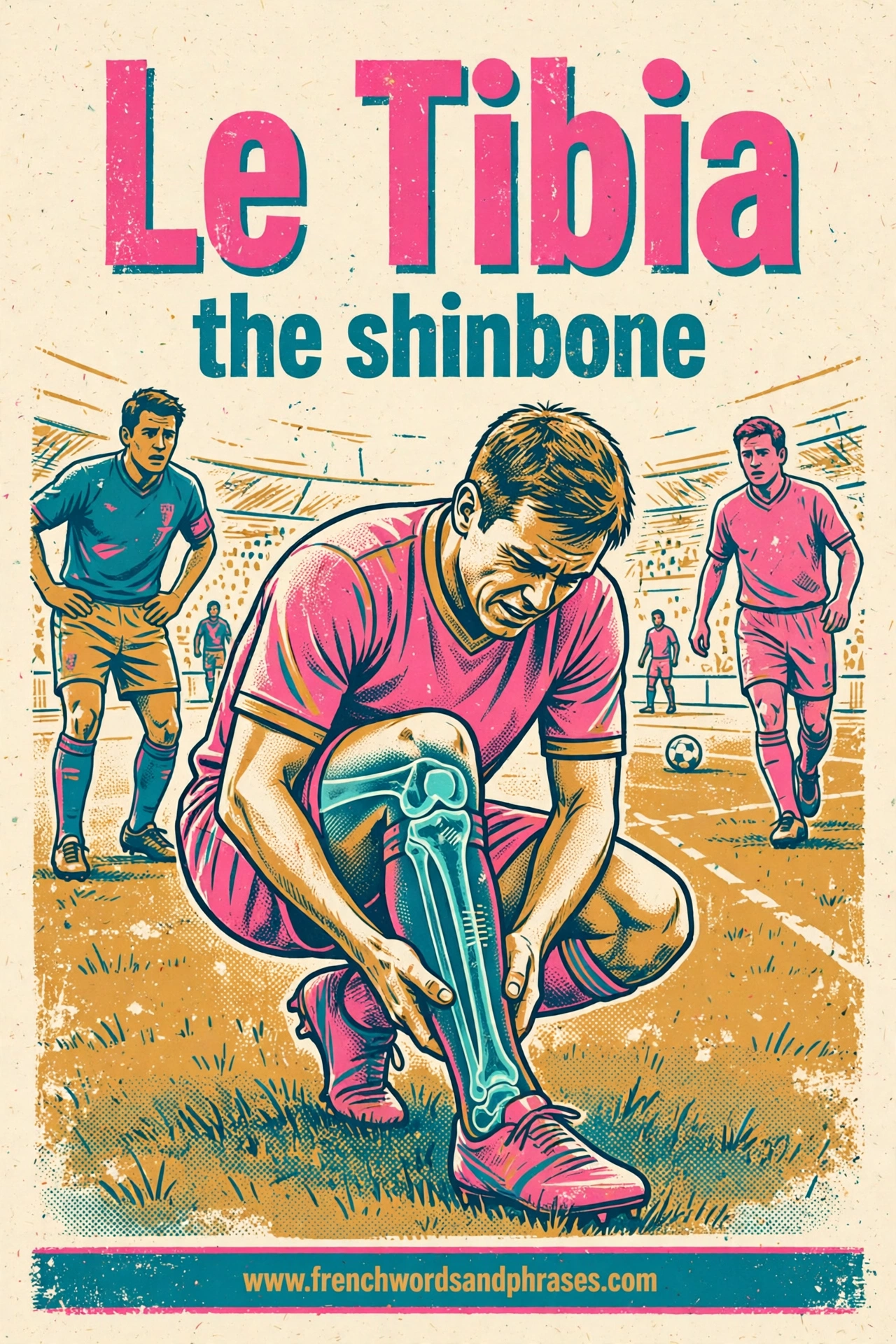
The young footballer takes a kick right on the shin, hops twice, rubs the bone with a grimace — un coup dans le tibia ! — and the whole bench winces with him.
In this guide, you’ll learn what tibia means in English, how to use it with its articles, how to form its plural, and how it appears in everyday French. Explore French examples, English translations, and practice quizzes.
Understanding the French Noun Tibia
Tibia is a masculine French noun, learned with its article: le tibia, un tibia. It is the great bone of the lower leg, the shinbone — and its name is pure Latin, unchanged in French and in the anatomy books of half the world.
It means the shinbone — the long, strong bone at the front of the lower leg, between le genou and la cheville. Its sharp front edge lies just under the skin, which is why a knock on the tibia hurts so much — and why footballers protect it with des protège-tibias (shin guards).
Gender: Masculine
Definite article: le — le tibia (the shinbone)
Indefinite article: un — un tibia (a shinbone)
Plural: les tibias
Where: The front of the lower leg, from le genou to la cheville
English equivalents: The shinbone; the tibia.
One important usage detail: in everyday French, le tibia names both the bone and the shin itself — « je me suis cogné le tibia » is what everyone says after meeting the coffee table. Footballers never forget the other half of the lesson: les protège-tibias are compulsory in a match.
Experience the Word
Tibia is the body’s exposed edge. Most bones hide under muscle; the tibia runs just beneath the skin, brave and unprotected, first to meet every table leg and tackle.
Imagine the shin guard slipped into the sock before the match, or the sharp breath everyone takes at a coup dans le tibia on a cold morning.
You have not just knocked your leg. You have rung the bone — le tibia, the shin that takes the hits.
How to Use Tibia in French: Complete Guide
Let’s explore how tibia works in French, beginning with its articles — then guard the shin and count the knocks.
Tibia with the Definite Article (Le, Les)
Used for a specific shinbone — the one that just met the table.
| Form | French |
|---|---|
| Masculine singular | le tibia |
| Plural | les tibias |
Example
Le tibia du joueur a reçu un coup violent.
The player’s shinbone took a violent knock.
Tibia with the Indefinite Article (Un, Des)
Used for a shinbone in general — un tibia, a shinbone like any other.
| Form | French |
|---|---|
| Masculine singular | un tibia |
| Plural | des tibias |
Example
Un tibia fracturé demande plusieurs semaines de repos.
A fractured shinbone needs several weeks of rest.
Tibia with Quantities and Protection
Shinbones come in pairs and are protected in pairs — the quantities of the football kit.
| Quantity | French |
|---|---|
| one shinbone | un tibia |
| both shinbones | les deux tibias |
| a pair of shin guards | une paire de protège-tibias |
| a knock on the shin | un coup sur le tibia |
| the length of the shinbone | la longueur du tibia |
Example
Il n’oublie jamais ses protège-tibias avant un match.
He never forgets his shin guards before a match.
Quick Quiz 1
Complete the sentence:
Elle s’est cogné ______ tibia contre la table basse. (the)
Reveal the answer
le
Elle s’est cogné le tibia contre la table basse.
She banged her shin on the coffee table — le tibia, because tibia is masculine.
The Plural of Tibia
Tibia adds an -s in the plural — les tibias, one in each leg.
| Number | French |
|---|---|
| Singular | le tibia |
| Plural | les tibias |
Example
Les tibias portent le poids du corps à chaque pas.
The shinbones carry the body’s weight with every step.
Tibia with Possessive Adjectives (Mon, Ton, Son…)
Possessives agree with the noun: tibia is masculine, so it takes mon, ton, son.
| Owner | French |
|---|---|
| my | mon tibia |
| your (tu) | ton tibia |
| his / her | son tibia |
| our | notre tibia |
| your (vous) | votre tibia |
| their | leur tibia |
Example
Mon tibia est couvert de bleus après le match.
My shin is covered in bruises after the match.
Quick Quiz 2
Complete the sentence:
______ tibias sont protégés par les protège-tibias. (Their)
Reveal the answer
Leurs
Leurs tibias sont protégés par les protège-tibias.
Their shinbones are protected by the shin guards — leurs tibias, plural.
Tibia with Demonstrative Adjectives (Ce, Ces)
Used to point: ce tibia, ces tibias.
| Form | French |
|---|---|
| Masculine singular | ce tibia |
| Plural | ces tibias |
Example
Ce tibia mettra six semaines à guérir.
This shinbone will take six weeks to heal.
Tibia with Adjectives
Adjectives agree with tibia: long, fracturé, douloureux — masculine forms.
| Adjective | With Tibia |
|---|---|
| long (long) | un tibia long |
| fracturé (fractured) | un tibia fracturé |
| douloureux (painful) | un tibia douloureux |
| solide (strong) | un tibia solide |
| gauche (left) | le tibia gauche |
Example
Le tibia gauche du défenseur est fracturé.
The defender’s left shinbone is fractured.
Quick Quiz 3
Complete the sentence:
C’est un tibia très ______. (painful — after the knock)
Reveal the answer
douloureux
C’est un tibia très douloureux.
It’s a very painful shin — douloureux, masculine form.
Everyday Expressions with Tibia
Knocks, guards and anatomy lessons — the tibia phrases of daily life.
| Expression | In English |
|---|---|
| se cogner le tibia | to bang one’s shin |
| un coup dans le tibia | a kick in the shin |
| les protège-tibias | shin guards, shin pads |
| se fracturer le tibia | to fracture one’s shinbone |
| le tibia et le péroné | the tibia and the fibula (the two bones of the lower leg) |
| la crête du tibia | the shin ridge, the front edge of the shinbone |
Example
Aïe ! Je me suis cogné le tibia contre le lit !
Ouch! I banged my shin on the bed!
Words from the Same Family as Tibia
Bones, guards and lower legs — the words that travel with tibia.
| French | In English |
|---|---|
| tibial | tibial, relating to the shinbone |
| le péroné | the fibula, the thinner bone beside the tibia |
| le protège-tibia | the shin guard |
| le mollet | the calf |
| l’os | the bone |
Example
Le tibia et le péroné forment le squelette de la jambe inférieure.
The tibia and the fibula form the skeleton of the lower leg.
Quick Quiz 4
What are les protège-tibias?
Reveal the answer
Shin guards — the protective pads footballers wear over the tibia.
Sans protège-tibias, le match est interdit aux enfants.
Without shin guards, children are not allowed to play the match.
Tibia in Everyday French: Real-Life Examples
Now that you know the word, let’s see how tibia appears in everyday French.
Example 1 — The coffee table
Il se cogne le tibia contre la table et grimace.
He bangs his shin on the table and grimaces.
Example 2 — Before the match
Les enfants mettent leurs protège-tibias dans les vestiaires.
The children put on their shin guards in the changing room.
Example 3 — Anatomy class
Le professeur montre le tibia sur le squelette du laboratoire.
The teacher points out the shinbone on the lab skeleton.
Example 4 — At the hospital
La radio montre un tibia fracturé net.
The X-ray shows a cleanly fractured shinbone.
Example 5 — Training
Ses tibias sont couverts de petits bleus après l’entraînement.
His shins are covered in little bruises after training.
Example 6 — The pair of bones
Le tibia porte le poids, le péroné stabilise la cheville.
The tibia carries the weight, the fibula stabilises the ankle.
Beyond Translation: The Meaning of Tibia
Tibia is a word with two lives: in Latin, tibia meant both the shinbone and a flute — because the first flutes were made from hollow shinbones, often of cranes or deer. The bone became the instrument, and the instrument kept the bone’s name for two thousand years. French inherited the anatomical half of the story, and every anatomy student in the world still learns the same word.
To say tibia is to name the bone that once made music.
It evokes the footballer’s wince, the shin guard in the sock, and the sharpest little pain in everyday life — the coffee table at midnight.
How to Remember the French Noun Tibia
Remember it this way: Tibia is the shinbone — masculine, pure Latin, the long bone at the front of the lower leg: le tibia, un tibia.
- You wince — se cogner le tibia, the coffee-table classic.
- You protect — les protège-tibias before every match.
- You pair it — le tibia et le péroné, the two bones of the shin.
The key idea is le tibia — the shinbone that once was a flute.
Test Your Knowledge of Tibia
Let’s see how much you’ve learned. Try answering these questions before revealing the answers.
Question 1
Is tibia masculine or feminine?
Reveal the answer
Masculine — le tibia, un tibia.
Question 2
How do you say « the shinbones » in French?
Reveal the answer
Les tibias — tibia adds an -s in the plural.
Question 3
Translate: He banged his shin.
Reveal the answer
Il s’est cogné le tibia.
Question 4
What is le péroné?
Reveal the answer
The fibula — the thinner bone that runs beside the tibia in the lower leg.
Question 5
Complete the sentence:
Elle protège ______ tibias avec des protège-tibias. (her)
Reveal the answer
ses
Elle protège ses tibias avec des protège-tibias.
She protects her shinbones with shin guards — ses tibias, plural.
Your Final Challenge
Can You Use It?
How would you say this in French?
“The footballer protects his shinbones with shin guards.”
Reveal the answer
Le footballeur protège ses tibias avec des protège-tibias.
The footballer protects his shinbones with shin guards.
A little French. A little curiosity. A richer everyday life.
LEARN FRENCH ONE WORD AT A TIME