A French Word to Live By
Translate Cheval to English
/ʃə.val/
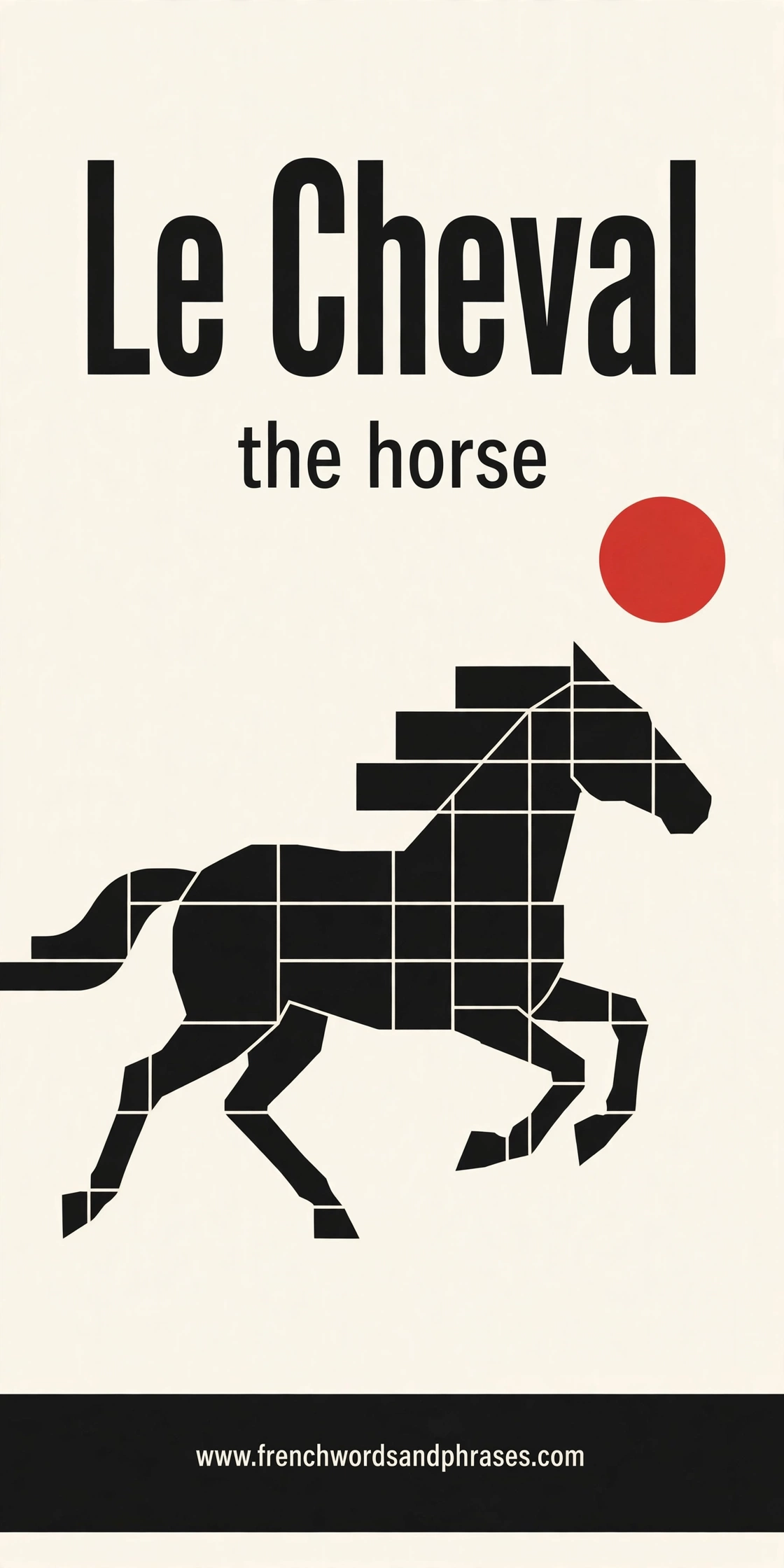
Le Cheval means the horse.
At the riding school, the children line up along the fence with carrots in their pockets. The big bay horse lowers his head over the rail, sniffs, and chooses — « Doucement, il adore les carottes, ce cheval. » Gentle hands, happy horse.
In this guide, you’ll learn what cheval means in English, how to use it with its articles, how to form its plural, and how it appears in everyday French. Explore French examples, English translations, and practice quizzes.
Understanding the French Noun Cheval
Cheval is a masculine French noun, learned with its article: le cheval, un cheval. It is the horse — the animal that carried French history on its back. Its plural is famously irregular: les chevaux. The idiom être à cheval sur les principes means to be strict about principles — sitting astride them like a rider who will not budge.
It means the horse — the riding, working and racing animal: un cheval de course, un cheval de trait. From the animal it reaches into engines (un moteur de cent chevaux — a hundred horsepower), chess (le cheval is not used; the knight is le cavalier), and a forest of idioms about strength, appetite and stubborn dignity.
Gender: Masculine — le cheval, un cheval
Plural: les chevaux — irregular plural in -aux
Definite article: le — le cheval (the horse)
Indefinite article: un — un cheval (a horse)
Key idiom: être à cheval sur les principes — to be strict about principles
English equivalents: The horse; horsepower (in engines, invariable in the plural phrase)
One important usage detail: to ride is monter à cheval — no article, and the phrase never changes. A female horse is une jument, a young one un poulain, and the rider is un cavalier. And watch the plural: chevaux with -aux, never chevals.
Experience the Word
Le cheval built France before the engine did: it ploughed the fields, pulled the coaches between étapes, and charged in every history painting in the Louvre. The Camargue still runs its white horses half-wild through the marshes.
The word survives everywhere in modern French: engines are measured in chevaux, a generous appetite is une faim de cheval, and a remedy too strong is un remède de cheval.
For learners, cheval is unforgettable once you meet its plural: chevaux is one of the great -al → -aux transformations, and it opens the door to the whole stable of horse idioms.
How to Use Cheval in French: Complete Guide
Let’s explore how cheval works in French, beginning with its articles — and gallop carefully around its irregular plural, les chevaux.
Cheval with the Definite Article (Le, Les)
Cheval is masculine: le in the singular; the plural noun itself changes to chevaux.
| Form | French | English |
|---|---|---|
| Masculine singular | le cheval | the horse |
| Plural | les chevaux | the horses |
| In a sentence | Le cheval galope dans le pré. | The horse is galloping in the meadow. |
Example
Le cheval blanc de la Camargue court dans les marais.
The white horse of the Camargue runs in the marshes.
Cheval with the Indefinite Article (Un, Des)
Use un for one horse, des for horses in general.
| Form | French | English |
|---|---|---|
| Masculine singular | un cheval | a horse |
| Plural | des chevaux | some horses |
| In a sentence | Il a acheté un cheval. | He bought a horse. |
Example
Un cheval bien dressé obéit à la voix.
A well-trained horse obeys the voice.
Cheval with Partitives and Quantities
Cheval is countable; quantities count the animals or measure their strength.
| Quantity | French | English |
|---|---|---|
| Three horses | trois chevaux | three horses |
| A herd of horses | un troupeau de chevaux | a herd of horses |
| Horsepower | cent chevaux | a hundred horsepower |
| Many horses | beaucoup de chevaux | many horses |
Example
Ce moteur développe deux cents chevaux.
This engine develops two hundred horsepower.
Quick Quiz 1
Complete the sentence:
______ cheval de mon voisin est très doux.
Reveal the answer
Le
Le cheval de mon voisin est très doux.
My neighbour’s horse is very gentle — cheval is masculine.
The Plural of Cheval
Careful — this is one of the famous ones: nouns in -al usually change to -aux. Le cheval, les chevaux.
| Number | French | English |
|---|---|---|
| Singular | le cheval | the horse |
| Plural | les chevaux | the horses |
| In a sentence | Les chevaux courent vite. | The horses run fast. |
Example
Les chevaux sauvages traversent la plaine au galop.
The wild horses cross the plain at a gallop.
Cheval with Possessive Adjectives (Mon, Ton, Son…)
Possessives agree with the noun: cheval is masculine, so mon, ton, son in the singular.
| Owner | French | English |
|---|---|---|
| My | mon cheval | my horse |
| Your | ton cheval | your horse |
| His / her | son cheval | his / her horse |
| Their (plural) | leurs chevaux | their horses |
Example
Elle brosse son cheval chaque matin avant l’entraînement.
She grooms her horse every morning before training.
Quick Quiz 2
What is the plural of le cheval?
Reveal the answer
Les chevaux — the -al ending becomes -aux. Never chevals!
Cheval with Demonstrative Adjectives (Ce, Ces)
For a masculine noun: ce in the singular, ces in the plural.
| Form | French | English |
|---|---|---|
| Singular | ce cheval | this horse |
| Plural | ces chevaux | these horses |
| In a sentence | Ce cheval est magnifique. | This horse is magnificent. |
Example
Ces chevaux appartiennent au centre équestre.
These horses belong to the riding centre.
Cheval with Adjectives: Agreement
Adjectives agree with cheval — and the plural adjective follows les chevaux.
| Adjective | French | English |
|---|---|---|
| White | un cheval blanc | a white horse |
| Wild | un cheval sauvage | a wild horse |
| Plural | des chevaux sauvages | wild horses |
| Old | un vieux cheval | an old horse |
Example
Les chevaux blancs de Camargue sont protégés.
The white horses of the Camargue are protected.
Quick Quiz 3
Translate: these horses
Reveal the answer
Ces chevaux — the plural of cheval is chevaux, and the demonstrative is ces.
Everyday Expressions with Cheval
Cheval canters through a whole stable of idioms.
| Expression | Meaning |
|---|---|
| être à cheval sur les principes | to be strict about principles, a stickler |
| monter à cheval | to ride a horse; to go riding |
| une faim de cheval | a ravenous appetite |
| un remède de cheval | a drastic remedy, strong medicine |
Example
Notre directrice est à cheval sur les principes : jamais de retard.
Our headmistress is a stickler for principles: never any lateness.
Words from the Same Family as Cheval
The stable family: riders, mares and foals.
| Word | Meaning |
|---|---|
| le cavalier | the rider; the knight (in chess) |
| la jument | the mare |
| le poulain | the foal |
| la chevalerie | chivalry; knighthood |
Example
Le cavalier guide sa jument vers l’obstacle.
The rider guides his mare towards the jump.
Quick Quiz 4
What does « être à cheval sur les principes » mean?
Reveal the answer
To be strict about principles — to sit astride the rules like a rider and not budge an inch from them.
Cheval in Everyday French: Real-Life Examples
Now that you know the word, let’s see how cheval appears in everyday French.
Example 1 — At the stable
Le cheval attend sa carotte près de la barrière.
The horse waits for its carrot by the fence.
Example 2 — Riding
Le samedi, les enfants montent à cheval.
On Saturdays, the children go horse riding.
Example 3 — Strict rules
Mon grand-père est à cheval sur les principes.
My grandfather is a stickler for principles.
Example 4 — Hungry
Après la randonnée, j’ai une faim de cheval !
After the hike, I’m as hungry as a horse!
Example 5 — Engines
Cette voiture a un moteur de cent cinquante chevaux.
This car has a hundred-and-fifty-horsepower engine.
Example 6 — In the fields
Les chevaux de trait tiraient autrefois la charrue.
Draught horses used to pull the plough.
Beyond Translation: The Meaning of Cheval
No animal stands closer to French history than the cheval: the mounted knight gave French la chevalerie and English the word chivalry itself. The horse has left the fields and the battlefield, but it has never left the language — it measures engines, appetites and remedies, and it still carries the strictest French speakers, seated firmly à cheval sur les principes.
How to Remember the French Noun Cheval
Remember it this way: Cheval is the horse — and its plural breaks into a gallop: les chevaux. Picture the rider sitting firm in the saddle, à cheval sur les principes, and the plural will stick.
- Masculine — le cheval, un cheval.
- Irregular plural — les chevaux, the -al becomes -aux.
- Riding is monter à cheval — no article, ever.
The key idea is le cheval, les chevaux — the horse and its galloping plural.
Test Your Knowledge of Cheval
Let’s see how much you’ve learned. Try answering these questions before revealing the answers.
Question 1
Is cheval masculine or feminine?
Reveal the answer
Masculine — le cheval, un cheval.
Question 2
What is the plural of cheval?
Reveal the answer
Chevaux — les chevaux, an -aux plural.
Question 3
How do you say to go horse riding?
Reveal the answer
Monter à cheval — the phrase takes no article.
Question 4
What does être à cheval sur les principes mean?
Reveal the answer
To be strict about principles — to be a stickler for the rules.
Question 5
Complete the sentence:
Les ______ de Camargue sont blancs.
Reveal the answer
chevaux
Les chevaux de Camargue sont blancs.
The horses of the Camargue are white.
Your Final Challenge
Can You Use It?
How would you say this in French?
“The horses gallop in the meadow.”
Reveal the answer
Les chevaux galopent dans le pré.
The horses gallop in the meadow.
A little French. A little curiosity. A richer everyday life.
LEARN FRENCH ONE WORD AT A TIME