A French Word to Live By
Translate Honneur to English
/ɔ.nœʁ/
L’Honneur means the honour.
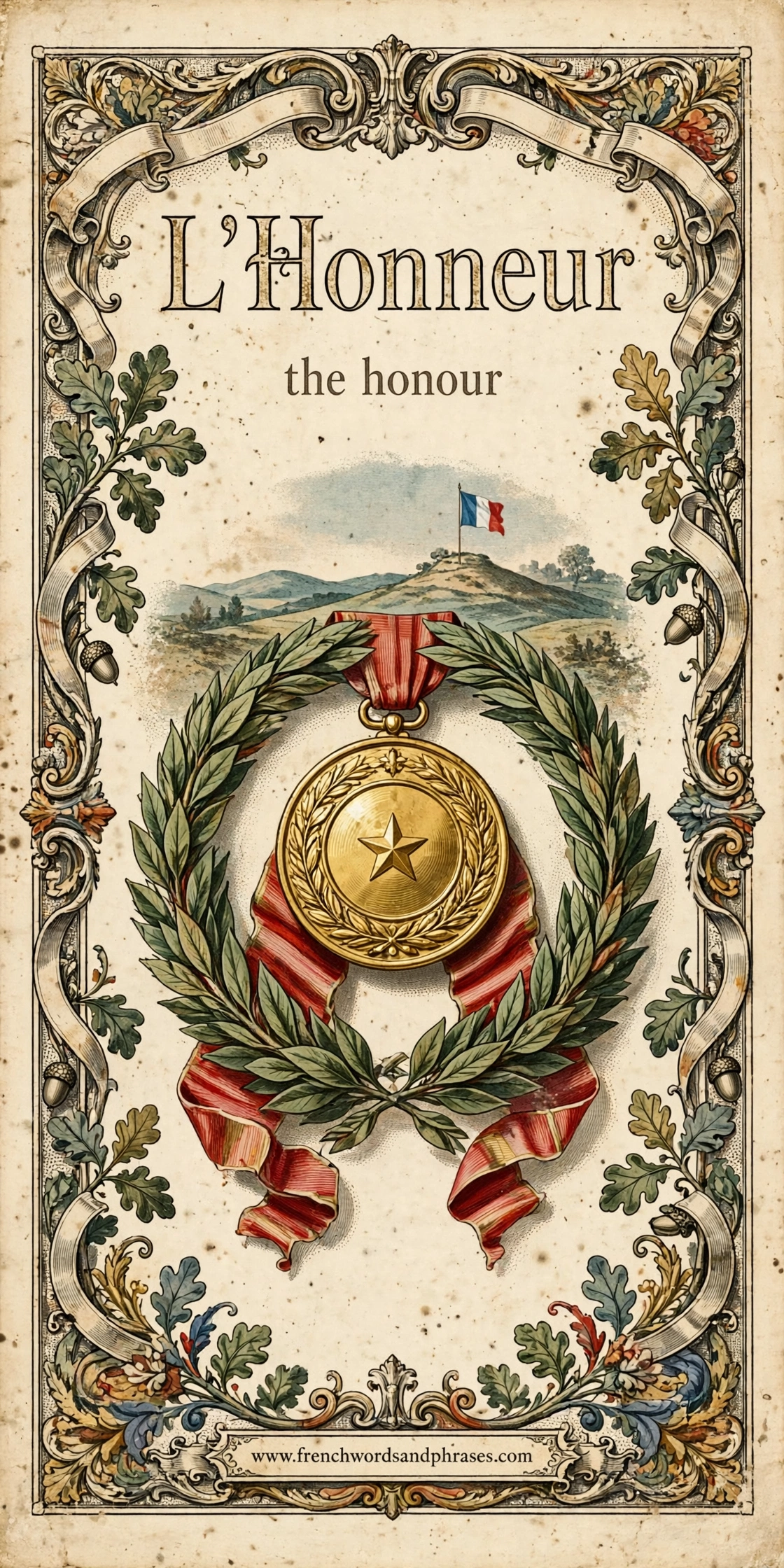
The village square is full: flags, a brass band, the mayor in his sash. An old schoolteacher steps forward, trembling, as the medal is pinned to her coat — « Pour cinquante ans au service des enfants, la commune vous fait cet honneur. »
In this guide, you’ll learn what honneur means in English, how to use it with its articles, how to form its plural, and how it appears in everyday French. Explore French examples, English translations, and practice quizzes.
Understanding the French Noun Honneur
Honneur is a masculine French noun, learned with its article: l’honneur, un honneur — the h is silent, so the article elides. It is honour: the respect a person has earned, the privilege of doing something, the good name a family defends. The phrase en tout bien tout honneur means with entirely honourable intentions — above board, with nothing improper meant.
It means the honour — first the inner quality, the sense of dignity that guides a person (un homme d’honneur keeps his word), then the public recognition of it: medals, titles, la Légion d’honneur. It also names a privilege: c’est un honneur de vous accueillir, it is an honour to welcome you. In the plural, les honneurs are the marks of distinction a ceremony bestows.
Gender: Masculine — l’honneur, un honneur (silent h, article elides)
Plural: les honneurs — marks of distinction, ceremonial honours
Definite article: l’ — l’honneur (the honour)
Indefinite article: un — un honneur (an honour, a privilege)
Key phrase: en tout bien tout honneur — with entirely honourable intentions
English equivalents: The honour; a privilege; distinction; a good name
One important usage detail: en tout bien tout honneur is the classic reassurance — it says an invitation, a compliment or a proposal is offered honourably, with respectable intentions only. You will also meet faire honneur à — to do credit to: ce plat fait honneur au chef. And the guest of honour at any French ceremony is l’invité d’honneur.
Experience the Word
L’honneur is a word with a straight back. It governed duels and declarations in old France, and it still governs the ceremony when a mayor pins a medal or a president awards the Légion d’honneur, the red ribbon every French schoolchild recognises.
Yet the word is warm as often as it is solemn: to be given the place of honour at table, to be invited en tout bien tout honneur, to do honour to a meal by finishing it — honneur threads through daily politeness.
For learners, honneur is a ceremony in a word: silent h, elided article, and a family of phrases that open the doors of formal French.
How to Use Honneur in French: Complete Guide
Let’s explore how honneur works in French, beginning with its articles — a masculine noun whose silent h makes the article elide to l’.
Honneur with the Definite Article (L’, Les)
Honneur starts with a silent h, so the definite article is l’ in the singular, les in the plural.
| Form | French | English |
|---|---|---|
| Masculine singular | l’honneur | the honour |
| Plural | les honneurs | the honours (distinctions) |
| In a sentence | L’honneur de la famille compte beaucoup. | The family’s honour matters a great deal. |
Example
Il a défendu l’honneur de son régiment.
He defended the honour of his regiment.
Honneur with the Indefinite Article (Un, Des)
Use un for one honour or privilege, des in the plural.
| Form | French | English |
|---|---|---|
| Masculine singular | un honneur | an honour; a privilege |
| Plural | des honneurs | honours, distinctions |
| In a sentence | C’est un honneur de vous recevoir. | It’s an honour to welcome you. |
Example
Quel honneur de chanter dans cette salle !
What an honour to sing in this hall!
Honneur with Partitives and Quantities
As an abstract quality, honneur takes de phrases; as distinctions, it is counted.
| Quantity | French | English |
|---|---|---|
| A great honour | un grand honneur | a great honour |
| Many honours | beaucoup d’honneurs | many distinctions |
| Too much honour | trop d’honneur | too much honour (polite protest) |
| The highest honour | le plus grand honneur | the highest honour |
Example
Vous me faites trop d’honneur, je n’ai fait que mon travail.
You do me too much honour, I only did my job.
Quick Quiz 1
Complete the sentence:
______ honneur de notre ville est en jeu.
Reveal the answer
L’
L’honneur de notre ville est en jeu.
Our town’s honour is at stake — honneur is masculine with a silent h, so the article elides to l’.
The Plural of Honneur
Honneur adds a regular -s — and les honneurs usually means the distinctions and ceremonies themselves.
| Number | French | English |
|---|---|---|
| Singular | l’honneur | the honour |
| Plural | les honneurs | the honours, the distinctions |
| In a sentence | Il a reçu les honneurs militaires. | He received military honours. |
Example
Les honneurs de la République vont aux plus méritants.
The honours of the Republic go to the most deserving.
Honneur with Possessive Adjectives (Mon, Ton, Son…)
Before the silent h, the possessives keep their masculine forms: mon, ton, son in the singular.
| Owner | French | English |
|---|---|---|
| My | mon honneur | my honour |
| Your | ton honneur | your honour |
| His / her | son honneur | his / her honour |
| Their (plural) | leurs honneurs | their distinctions |
Example
Elle a défendu son honneur avec courage.
She defended her honour with courage.
Quick Quiz 2
What is the plural of l’honneur?
Reveal the answer
Les honneurs — a regular -s plural, usually meaning the distinctions and ceremonial honours.
Honneur with Demonstrative Adjectives (Cet, Ces)
Before a masculine noun with a silent h, this is cet in the singular, ces in the plural.
| Form | French | English |
|---|---|---|
| Singular | cet honneur | this honour |
| Plural | ces honneurs | these honours |
| In a sentence | Cet honneur me touche profondément. | This honour touches me deeply. |
Example
Je n’oublierai jamais cet honneur inattendu.
I will never forget this unexpected honour.
Honneur with Adjectives: Agreement
Adjectives agree with honneur: masculine singular, -s in the plural.
| Adjective | French | English |
|---|---|---|
| Great | un grand honneur | a great honour |
| National | un honneur national | a national honour |
| Plural | de grands honneurs | great honours |
| Immense | un honneur immense | an immense honour |
Example
Recevoir cette médaille est un honneur immense pour elle.
Receiving this medal is an immense honour for her.
Quick Quiz 3
Translate: this honour
Reveal the answer
Cet honneur — honneur is masculine and begins with a silent h, so the demonstrative is cet, not ce.
Everyday Expressions with Honneur
Honneur graces ceremonies and dinner tables alike.
| Expression | Meaning |
|---|---|
| en tout bien tout honneur | with entirely honourable intentions |
| faire honneur à | to do credit to, to do justice to |
| un invité d’honneur | a guest of honour |
| la Légion d’honneur | France’s highest order of merit |
Example
Je vous invite à dîner, en tout bien tout honneur.
I invite you to dinner, with entirely honourable intentions.
Words from the Same Family as Honneur
The family of honneur is about respect earned and shown.
| Word | Meaning |
|---|---|
| honorer | to honour, to pay tribute to |
| honorable | honourable, respectable |
| les honoraires | professional fees (a doctor’s, a lawyer’s) |
| déshonorer | to dishonour, to disgrace |
Example
La ville honore ses champions avec une fête.
The town honours its champions with a celebration.
Quick Quiz 4
What does « en tout bien tout honneur » reassure the listener?
Reveal the answer
That the intentions are entirely honourable — an invitation or proposal made above board, with nothing improper meant.
Honneur in Everyday French: Real-Life Examples
Now that you know the word, let’s see how honneur appears in everyday French.
Example 1 — A ceremony
Le maire lui a remis une médaille d’honneur.
The mayor presented her with a medal of honour.
Example 2 — A welcome
C’est un honneur de vous avoir parmi nous.
It’s an honour to have you among us.
Example 3 — A dinner invitation
Je t’invite chez moi, en tout bien tout honneur.
I’m inviting you to my home, with entirely honourable intentions.
Example 4 — Doing justice
Les invités ont fait honneur au repas de grand-mère.
The guests did justice to grandmother’s meal.
Example 5 — A promise
Un homme d’honneur tient toujours sa parole.
A man of honour always keeps his word.
Example 6 — The guest
L’invité d’honneur a coupé le ruban rouge.
The guest of honour cut the red ribbon.
Beyond Translation: The Meaning of Honneur
Honneur is the spine of French ceremony: the Légion d’honneur founded by Napoleon, the garde d’honneur at the tomb of the unknown soldier, the place d’honneur at the table. But the phrase en tout bien tout honneur shows the word’s other, gentler duty — it is the classic formula that lets an invitation be offered and accepted with perfect propriety, a small verbal bow that has smoothed French social life for centuries.
How to Remember the French Noun Honneur
Remember it this way: Honneur begins with a silent h — the word itself is too dignified to make a sound at the start. L’honneur is respect earned, and en tout bien tout honneur is the promise that intentions are pure.
- Masculine with a silent h — l’honneur, un honneur; demonstrative cet honneur.
- Plural les honneurs = the distinctions, the medals, the ceremony.
- The reassurance formula: en tout bien tout honneur — entirely honourable intentions.
The key idea is l’honneur — respect earned and openly shown.
Test Your Knowledge of Honneur
Let’s see how much you’ve learned. Try answering these questions before revealing the answers.
Question 1
Is honneur masculine or feminine?
Reveal the answer
Masculine — l’honneur, un honneur, with a silent h.
Question 2
What does en tout bien tout honneur mean?
Reveal the answer
With entirely honourable intentions — above board, nothing improper meant.
Question 3
How do you say this honour?
Reveal the answer
Cet honneur — cet before a masculine noun starting with a silent h.
Question 4
What is la Légion d’honneur?
Reveal the answer
France’s highest order of merit — the famous red-ribbon decoration founded by Napoleon.
Question 5
Complete the sentence:
C’est ______ honneur de vous accueillir.
Reveal the answer
un
C’est un honneur de vous accueillir.
It is an honour to welcome you.
Your Final Challenge
Can You Use It?
How would you say this in French?
“It is an honour to welcome you.”
Reveal the answer
C’est un honneur de vous accueillir.
It is an honour to welcome you.
A little French. A little curiosity. A richer everyday life.
LEARN FRENCH ONE WORD AT A TIME