A French Word to Live By
How to Conjugate Chantourner in French
/ʃɑ̃.tuʁ.ne/
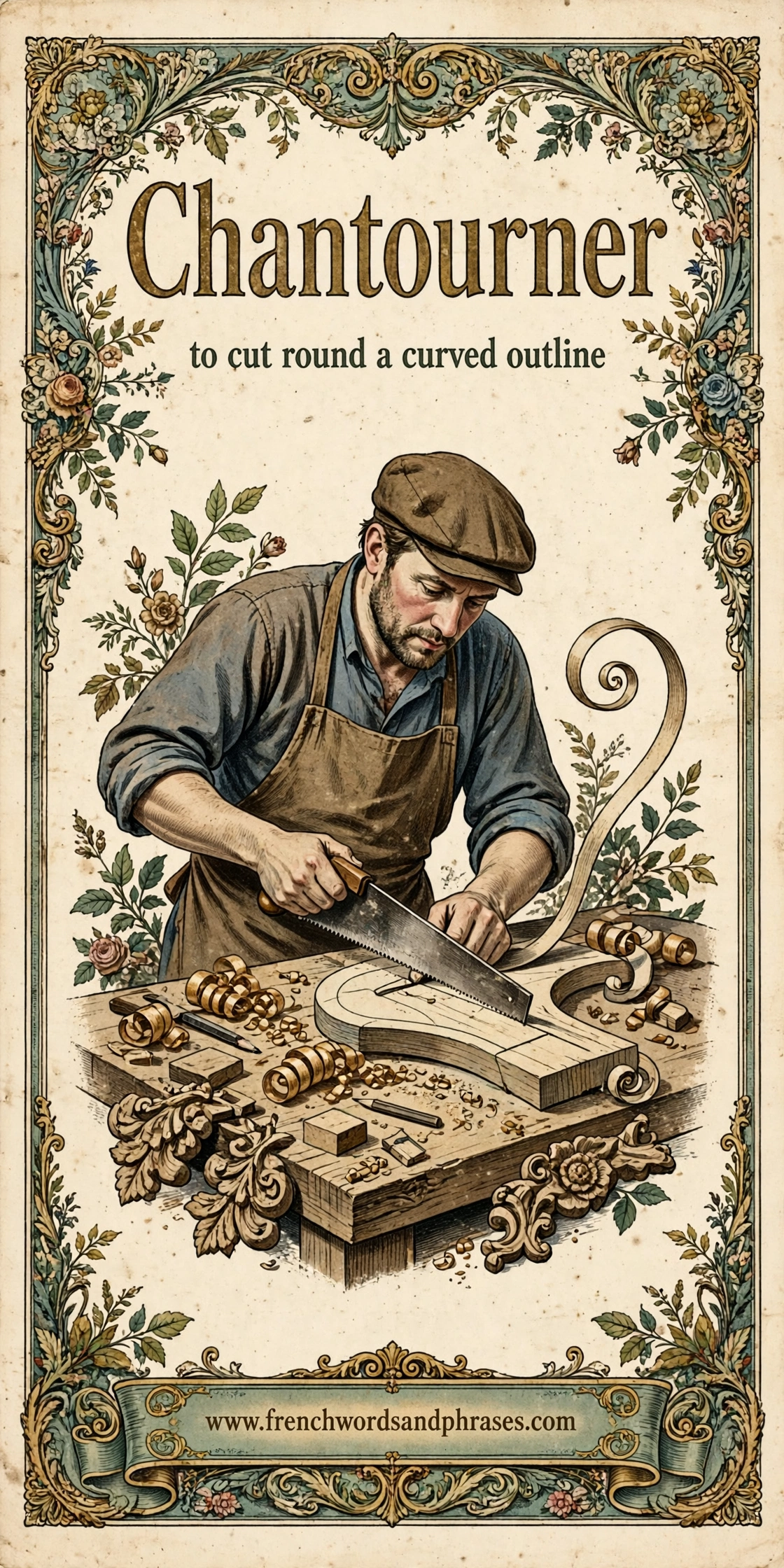
Chantourner means to cut round a curved outline — to saw wood along a drawn curve, the way chair backs, toy parts and decorative panels get their shapes.
In the carpentry workshop, a pencil line curves across a board like a river on a map. Chantourner is the sawyer’s verb for following that line exactly — cutting wood round a curved outline, slowly, so the curve comes out clean.
In this guide, you’ll learn how to conjugate chantourner in all the major French tenses and moods. Explore complete conjugation tables, French examples, English translations, and practice quizzes.
Understanding the French Verb Chantourner
Chantourner is a regular French verb belonging to the first group of verbs, those ending in-er.
It means to cut round a curved outline. It is commonly used in carpentry, cabinetmaking and model-making for cutting curved profiles in wood — chair backs, cabriole shapes, jigsaw puzzles, marquetry and fretwork — and occasionally for other materials cut along a drawn curve. It is a sober craftsman’s word: outside the workshop you will rarely hear it, but within it, nothing else will do.
Verb classification: First group (-er)
Auxiliary verb: Avoir
Past participle: chantourné
Present participle: chantournant
English equivalents: To cut round a curved outline, to fret-saw; chantourner une planche — to cut a board along a curve; une scie à chantourner — a fretsaw, a scroll saw; un chantourné — a decorative curved cut-out on furniture; chantourner à la scie sauteuse — to cut curves with a jigsaw.
One important detail: chantourner is a technical verb of the wood workshop, built on tourner, to turn — the saw turns and turns again to follow the curve. Its tool gives it away: une scie à chantourner is the fine fretsaw or scroll saw made for exactly this work. The cut-out shape it produces is itself a noun, un chantourné — the ornamental curved profile on the back of a chair or the apron of a table. The verb is perfectly regular: je chantourne, nous chantournons, past participle chantourné.
Experience the Word
Chantourner is the verb of the patient saw — straight lines are easy; the curve is where the craftsman shows.
Imagine the toymaker cutting a wooden horse from a plank of lime. The pencil outline bends through neck, back and tail; the fine blade follows, turning at every breath, and the waste wood falls away in curls until the horse stands free of the board.
He has not simply cut a board. He has chantourné — followed the curve faithfully, from first line to last.
How to Conjugate Chantourner: Complete French Conjugation Guide
Let’s explore every major conjugation of chantourner, beginning with the indicative mood.
How to Conjugate Chantourner in the Indicative Mood
The indicative mood is used to express facts, observations, actions, and events.
How to Conjugate Chantourner in the Present Tense (Présent)
Used for actions happening now, habitual actions, and general truths.
| Subject | Conjugation |
|---|---|
| je | chantourne |
| tu | chantournes |
| il / elle | chantourne |
| nous | chantournons |
| vous | chantournez |
| ils / elles | chantournent |
Example
Le menuisier chantourne le dossier de la chaise.
The joiner cuts the chair back along its curve.
Quick Quiz 1
Complete the sentence:
Nous ______ les pieds de la commode.
Reveal the answer
chantournons
Nous chantournons les pieds de la commode.
We are cutting the feet of the chest of drawers to their curved shape.
How to Conjugate Chantourner in the Passé Composé
Used for completed actions in the past. Chantourner takes the auxiliary verb avoir.
| Subject | Conjugation |
|---|---|
| j’ | ai chantourné |
| tu | as chantourné |
| il / elle | a chantourné |
| nous | avons chantourné |
| vous | avez chantourné |
| ils / elles | ont chantourné |
Example
Il a chantourné une belle courbe dans le chêne.
He cut a beautiful curve in the oak.
How to Conjugate Chantourner in the Imparfait (Imperfect Tense)
Used for habitual past actions, descriptions, and ongoing situations in the past.
| Subject | Conjugation |
|---|---|
| je | chantournais |
| tu | chantournais |
| il / elle | chantournait |
| nous | chantournions |
| vous | chantourniez |
| ils / elles | chantournaient |
Example
L’artisan chantournait les pièces du jouet en bois.
The craftsman used to cut out the pieces of the wooden toy along their curves.
Quick Quiz 2
Choose the correct form:
He cut a beautiful curve in the oak.
Il ______ une belle courbe dans le chêne. (a chantourné / est chantourné)
Reveal the answer
a chantourné
Il a chantourné une belle courbe dans le chêne.
Chantourner takes avoir.
How to Conjugate Chantourner in the Plus-que-parfait
Used to describe an action that had already been completed before another past event.
| Subject | Conjugation |
|---|---|
| j’ | avais chantourné |
| tu | avais chantourné |
| il / elle | avait chantourné |
| nous | avions chantourné |
| vous | aviez chantourné |
| ils / elles | avaient chantourné |
Example
Elle avait chantourné le plateau avant de le vernir.
She had cut the top to its curved outline before varnishing it.
How to Conjugate Chantourner in the Passé Simple
Primarily used in formal writing, literature, and historical narratives. It is rarely used in everyday conversation.
| Subject | Conjugation |
|---|---|
| je | chantournai |
| tu | chantournas |
| il / elle | chantourna |
| nous | chantournâmes |
| vous | chantournâtes |
| ils / elles | chantournèrent |
Example
L’ébéniste chantourna l’arcade du buffet d’une main sûre.
The cabinetmaker cut the curved arcade of the sideboard with a sure hand.
How to Conjugate Chantourner in the Passé Antérieur
A literary tense used to express an action completed immediately before another past action, generally in the passé simple.
| Subject | Conjugation |
|---|---|
| j’ | eus chantourné |
| tu | eus chantourné |
| il / elle | eut chantourné |
| nous | eûmes chantourné |
| vous | eûtes chantourné |
| ils / elles | eurent chantourné |
Example
Quand il eut chantourné la planche, il la ponça finement.
When he had cut the board along the curve, he sanded it smooth.
How to Conjugate Chantourner in the Future Tense (Futur Simple)
Used to describe actions that will take place in the future.
| Subject | Conjugation |
|---|---|
| je | chantournerai |
| tu | chantourneras |
| il / elle | chantournera |
| nous | chantournerons |
| vous | chantournerez |
| ils / elles | chantourneront |
Example
Demain, nous chantournerons les pieds de la commode.
Tomorrow, we will cut the feet of the chest of drawers to their curved shape.
How to Conjugate Chantourner in the Futur Antérieur (Future Perfect)
Used for an action that will have been completed before a particular point in the future.
| Subject | Conjugation |
|---|---|
| j’ | aurai chantourné |
| tu | auras chantourné |
| il / elle | aura chantourné |
| nous | aurons chantourné |
| vous | aurez chantourné |
| ils / elles | auront chantourné |
Example
À midi, il aura chantourné toutes les pièces du puzzle en bois.
By noon, he will have cut out all the pieces of the wooden puzzle.
How to Conjugate Chantourner in the Near Future (Futur Proche)
Used to describe something that is going to happen soon. Formed with aller + infinitive.
| Subject | Conjugation |
|---|---|
| je | vais chantourner |
| tu | vas chantourner |
| il / elle | va chantourner |
| nous | allons chantourner |
| vous | allez chantourner |
| ils / elles | vont chantourner |
Example
Je vais chantourner cette courbe avec la scie à chantourner.
I am going to cut this curve with the fretsaw.
How to Conjugate Chantourner in the Conditional Mood
The conditional mood expresses what would happen under certain circumstances. It is also frequently used to make polite requests or express wishes.
How to Conjugate Chantourner in the Present Conditional
| Subject | Conjugation |
|---|---|
| je | chantournerais |
| tu | chantournerais |
| il / elle | chantournerait |
| nous | chantournerions |
| vous | chantourneriez |
| ils / elles | chantourneraient |
Example
Avec une scie à chantourner, tu chantournerais plus précisément.
With a fretsaw, you would cut curves more precisely.
How to Conjugate Chantourner in the Past Conditional
| Subject | Conjugation |
|---|---|
| j’ | aurais chantourné |
| tu | aurais chantourné |
| il / elle | aurait chantourné |
| nous | aurions chantourné |
| vous | auriez chantourné |
| ils / elles | auraient chantourné |
Example
Il aurait chantourné le bord si le bois n’avait pas éclaté.
He would have cut the edge to the curve if the wood had not split.
Chantourner in the Literary Past Conditional Form
This less common literary form uses the imperfect subjunctive of avoir.
| Subject | Conjugation |
|---|---|
| j’ | eusse chantourné |
| tu | eusses chantourné |
| il / elle | eût chantourné |
| nous | eussions chantourné |
| vous | eussiez chantourné |
| ils / elles | eussent chantourné |
Example
L’ébéniste eût chantourné l’arcade d’une main sûre.
The cabinetmaker would have cut the arcade with a sure hand.
How to Conjugate Chantourner in the Subjunctive Mood
The subjunctive is used to express wishes, emotions, doubts, necessity, and uncertainty. It frequently follows expressions such as il faut que (it is necessary that) or bien que (although).
How to Conjugate Chantourner in the Present Subjunctive
| Subject | Conjugation |
|---|---|
| que je | chantourne |
| que tu | chantournes |
| qu’il / qu’elle | chantourne |
| que nous | chantournions |
| que vous | chantourniez |
| qu’ils / qu’elles | chantournent |
Example
Il faut que tu chantournes lentement pour suivre le trait.
You must cut slowly to follow the line.
Quick Quiz 3
Complete the sentence using the subjunctive:
Il faut que vous ______ lentement pour suivre le trait.
Reveal the answer
chantourniez
Il faut que vous chantourniez lentement pour suivre le trait.
You must cut slowly to follow the line.
How to Conjugate Chantourner in the Imperfect Subjunctive
A literary tense, rarely encountered in modern spoken French.
| Subject | Conjugation |
|---|---|
| que je | chantournasse |
| que tu | chantournasses |
| qu’il / qu’elle | chantournât |
| que nous | chantournassions |
| que vous | chantournassiez |
| qu’ils / qu’elles | chantournassent |
Example
Le maître voulait que l’apprenti chantournât sans dévier.
The master wanted the apprentice to cut the curve without wandering off the line.
How to Conjugate Chantourner in the Pluperfect Subjunctive
A literary construction used to express an action completed before another past action.
| Subject | Conjugation |
|---|---|
| que j’ | eusse chantourné |
| que tu | eusses chantourné |
| qu’il / qu’elle | eût chantourné |
| que nous | eussions chantourné |
| que vous | eussiez chantourné |
| qu’ils / qu’elles | eussent chantourné |
Example
On admirait qu’il eût chantourné ce motif compliqué.
People admired that he had cut out this complicated pattern.
How to Conjugate Chantourner in the Past Subjunctive
| Subject | Conjugation |
|---|---|
| que j’ | aie chantourné |
| que tu | aies chantourné |
| qu’il / qu’elle | ait chantourné |
| que nous | ayons chantourné |
| que vous | ayez chantourné |
| qu’ils / qu’elles | aient chantourné |
Example
Je suis fier qu’elle ait chantourné cette arabesque.
I am proud that she cut out this arabesque.
How to Conjugate Chantourner in the Imperative
The imperative is used to give commands, instructions, invitations, or suggestions. Subject pronouns are omitted.
How to Conjugate Chantourner in the Present Imperative
| Person | Conjugation |
|---|---|
| (tu) | chantourne |
| (nous) | chantournons |
| (vous) | chantournez |
Example
Chantourne en suivant le trait au crayon !
Cut along the curve, following the pencil line!
Quick Quiz 4
How would you say Cut along the curve (tu form)?
Reveal the answer
Chantourne en suivant le trait !
French Participles of Chantourner
Participles are verb forms that can be used in compound tenses and other grammatical constructions.
Present Participle of Chantourner
chantournant
En chantournant, il suit la courbe du bout des doigts.
Cutting the curve, he follows it with his fingertips.
Past Participle of Chantourner
chantourné
Chantournée à la main, la pièce épouse la forme du meuble.
Cut to its curve by hand, the piece fits the shape of the furniture.
Chantourner in Everyday French: Real-Life Examples
Now that you know the conjugations, let’s see how chantourner appears in everyday French.
Example 1 — Present
Le menuisier chantourne le dossier de la chaise.
The joiner cuts the chair back along its curve.
Example 2 — Passé composé
Il a chantourné une belle courbe dans le chêne.
He cut a beautiful curve in the oak.
Example 3 — Imparfait
L’artisan chantournait les pièces du jouet en bois.
The craftsman used to cut out the pieces of the wooden toy.
Example 4 — Future
Nous chantournerons les pieds de la commode.
We will cut the feet of the chest of drawers to their curved shape.
Example 5 — Conditional
Avec une scie à chantourner, tu chantournerais plus précisément.
With a fretsaw, you would cut curves more precisely.
Example 6 — Imperative
Chantourne en suivant le trait au crayon !
Cut along the curve, following the pencil line!
Beyond Translation: The Meaning of Chantourner
English does this work with two words — fret-sawing or scroll-cutting — where French keeps one workshop verb, chantourner, built on tourner: the blade keeps turning, and so does the word.
Every curved chair back in France was chantourné.
The noun survives in antique shops: un dossier chantourné, a chair back with a decorative curved cut-out, is the visible signature of the verb — proof that a saw once followed a pencil line with patience.
How to Remember the French Verb Chantourner
Remember it this way: Chantourner is about the fine saw following the pencil curve through the board.
- Tourner is inside it: chantourner is sawing that keeps turning, following a drawn curve in wood.
- Its tool names it: une scie à chantourner is the fretsaw or scroll saw.
- Regular -er: je chantourne, nous chantournons, past participle chantourné.
The key idea is the fine saw following the pencil curve through the board.
Test Your Knowledge of Chantourner
Let’s see how much you’ve learned. Try answering these questions before revealing the answers.
Question 1
What tool is named after chantourner?
Reveal the answer
La scie à chantourner — the fretsaw or scroll saw, made for cutting curves in wood.
Question 2
How do you say The joiner cuts the chair back along its curve in French?
Reveal the answer
Le menuisier chantourne le dossier de la chaise.
Question 3
Translate: You must cut slowly to follow the line.
Reveal the answer
Il faut que tu chantournes lentement pour suivre le trait.
Question 4
What is the past participle of chantourner?
Reveal the answer
Chantourné.
Question 5
Complete the sentence:
En ______, il suit la courbe du bout des doigts.
Reveal the answer
chantournant
En chantournant, il suit la courbe du bout des doigts.
Cutting the curve, he follows it with his fingertips.
Your Final Challenge
Can You Use It?
How would you say this in French?
He cuts the last curve, blows away the sawdust, and the wooden horse comes free of the board.
Reveal the answer
Il chantourne la dernière courbe, souffle la sciure, et le cheval de bois se détache de la planche.
He cuts the last curve, blows away the sawdust, and the wooden horse comes free of the board.
A little French. A little curiosity. A richer everyday life.
LEARN FRENCH ONE WORD AT A TIME