A French Word to Live By
How to Conjugate Chanceler in French
/ʃɑ̃.sə.le/
Chanceler means to totter, to stagger — to sway on unsteady legs, and, figuratively, to waver on the edge of collapse.
A drunk man weaving home under the streetlamps, a toddler taking her first steps, an old tower leaning a little more after every storm — chanceler is the verb of balance almost lost: swaying, reeling, and not quite falling.
In this guide, you’ll learn how to conjugate chanceler in all the major French tenses and moods. Explore complete conjugation tables, French examples, English translations, and practice quizzes.
Understanding the French Verb Chanceler
Chanceler is a regular French verb belonging to the first group of verbs, those ending in-er.
It means to totter, to stagger. It is commonly used of people unsteady on their feet — drunk, ill, wounded or overcome — of buildings and furniture about to topple, and figuratively of anything losing its firmness: un empire chancelle, sa détermination chancelle, la mémoire chancelle. It describes the sway before the fall, not the fall itself.
Verb classification: First group (-er)
Auxiliary verb: Avoir
Past participle: chancelé
Present participle: chancelant
English equivalents: To totter, to stagger, to reel; chanceler sous un coup — to reel from a blow; chanceler d’ivresse — to stagger drunkenly; faire chanceler un empire — to shake an empire; sa foi chancelle — his faith is wavering; une tour qui chancelle — a tottering tower.
One important detail: chanceler belongs to the appeler family of -eler verbs — the l doubles wherever the next syllable is mute: je chancelle, tu chancelles, il chancelle, ils chancellent, and through the whole future and conditional: je chancellerai, elle chancellerait. The l stays single where the ending is sounded: nous chancelons, vous chancelez, je chancelais, en chancelant, and in the infinitive and participle, chanceler, chancelé. Watch for the double l in the singular of the present — that is where learners slip.
Experience the Word
Chanceler is the verb of the almost-fall — the body negotiates with gravity, and gravity has not yet won.
Imagine the last drinker leaving the village café at midnight. He crosses the square in great slow curves, chancelant from lamp post to lamp post, hat in hand, dignity somehow intact — every step a small victory over the cobblestones.
He has not fallen once. He has chancelé — swayed, reeled, and stayed upright by miracle and habit.
How to Conjugate Chanceler: Complete French Conjugation Guide
Let’s explore every major conjugation of chanceler, beginning with the indicative mood.
How to Conjugate Chanceler in the Indicative Mood
The indicative mood is used to express facts, observations, actions, and events.
How to Conjugate Chanceler in the Present Tense (Présent)
Used for actions happening now, habitual actions, and general truths.
| Subject | Conjugation |
|---|---|
| je | chancelle |
| tu | chancelles |
| il / elle | chancelle |
| nous | chancelons |
| vous | chancelez |
| ils / elles | chancellent |
Example
L’ivrogne chancelle en sortant du café.
The drunk man totters as he leaves the café.
Quick Quiz 1
Complete the sentence:
Nous ______ à chaque pas sur le verglas.
Reveal the answer
chancelons
Nous chancelons à chaque pas sur le verglas.
We totter at every step on the ice — single l before a sounded ending.
How to Conjugate Chanceler in the Passé Composé
Used for completed actions in the past. Chanceler takes the auxiliary verb avoir.
| Subject | Conjugation |
|---|---|
| j’ | ai chancelé |
| tu | as chancelé |
| il / elle | a chancelé |
| nous | avons chancelé |
| vous | avez chancelé |
| ils / elles | ont chancelé |
Example
Elle a chancelé sous le poids de la valise.
She staggered under the weight of the suitcase.
How to Conjugate Chanceler in the Imparfait (Imperfect Tense)
Used for habitual past actions, descriptions, and ongoing situations in the past.
| Subject | Conjugation |
|---|---|
| je | chancelais |
| tu | chancelais |
| il / elle | chancelait |
| nous | chancelions |
| vous | chanceliez |
| ils / elles | chancelaient |
Example
Le vieillard chancelait à chaque pas sur le verglas.
The old man used to totter at every step on the ice.
Quick Quiz 2
Choose the correct form:
She staggered under the suitcase.
Elle ______ sous la valise. (a chancelé / est chancelée)
Reveal the answer
a chancelé
Elle a chancelé sous la valise.
Chanceler takes avoir.
How to Conjugate Chanceler in the Plus-que-parfait
Used to describe an action that had already been completed before another past event.
| Subject | Conjugation |
|---|---|
| j’ | avais chancelé |
| tu | avais chancelé |
| il / elle | avait chancelé |
| nous | avions chancelé |
| vous | aviez chancelé |
| ils / elles | avaient chancelé |
Example
Il avait chancelé plusieurs fois avant de tomber.
He had staggered several times before falling.
How to Conjugate Chanceler in the Passé Simple
Primarily used in formal writing, literature, and historical narratives. It is rarely used in everyday conversation.
| Subject | Conjugation |
|---|---|
| je | chancelai |
| tu | chancelas |
| il / elle | chancela |
| nous | chancelâmes |
| vous | chancelâtes |
| ils / elles | chancelèrent |
Example
Le soldat blessé chancela mais ne tomba pas.
The wounded soldier reeled but did not fall.
How to Conjugate Chanceler in the Passé Antérieur
A literary tense used to express an action completed immediately before another past action, generally in the passé simple.
| Subject | Conjugation |
|---|---|
| j’ | eus chancelé |
| tu | eus chancelé |
| il / elle | eut chancelé |
| nous | eûmes chancelé |
| vous | eûtes chancelé |
| ils / elles | eurent chancelé |
Example
Dès qu’il eut chancelé, ses amis le retinrent par le bras.
As soon as he had staggered, his friends caught him by the arm.
How to Conjugate Chanceler in the Future Tense (Futur Simple)
Used to describe actions that will take place in the future.
| Subject | Conjugation |
|---|---|
| je | chancellerai |
| tu | chancelleras |
| il / elle | chancellera |
| nous | chancellerons |
| vous | chancellerez |
| ils / elles | chancelleront |
Example
Si tu bois encore un verre, tu chancelleras sur le chemin du retour.
If you drink one more glass, you will stagger on the way home.
How to Conjugate Chanceler in the Futur Antérieur (Future Perfect)
Used for an action that will have been completed before a particular point in the future.
| Subject | Conjugation |
|---|---|
| j’ | aurai chancelé |
| tu | auras chancelé |
| il / elle | aura chancelé |
| nous | aurons chancelé |
| vous | aurez chancelé |
| ils / elles | auront chancelé |
Example
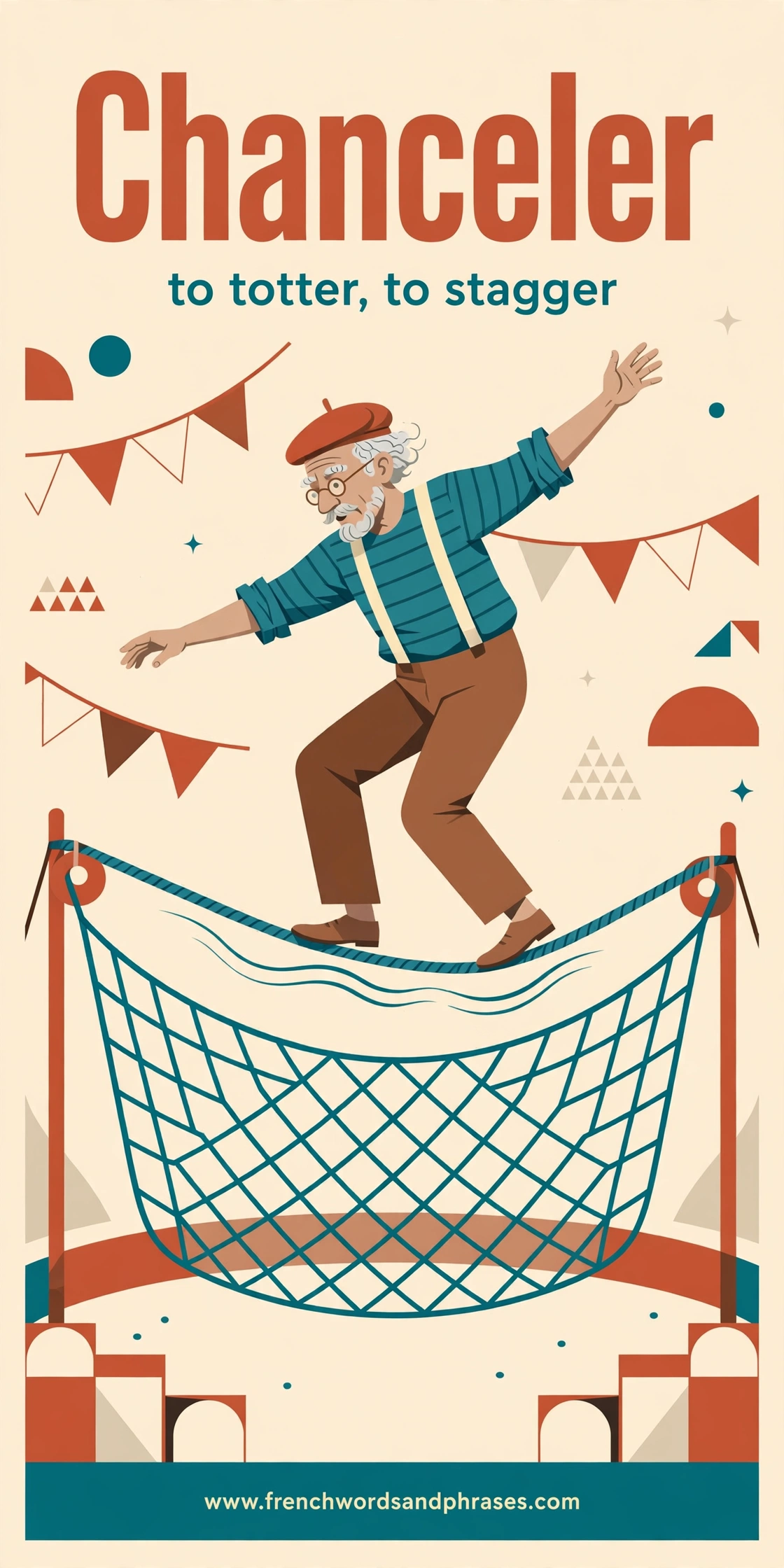
Le funambule aura chancelé cent fois avant la fin du spectacle.
The tightrope walker will have tottered a hundred times before the end of the show.
How to Conjugate Chanceler in the Near Future (Futur Proche)
Used to describe something that is going to happen soon. Formed with aller + infinitive.
| Subject | Conjugation |
|---|---|
| je | vais chanceler |
| tu | vas chanceler |
| il / elle | va chanceler |
| nous | allons chanceler |
| vous | allez chanceler |
| ils / elles | vont chanceler |
Example
Attention, la pile de livres va chanceler !
Careful, the pile of books is going to topple!
How to Conjugate Chanceler in the Conditional Mood
The conditional mood expresses what would happen under certain circumstances. It is also frequently used to make polite requests or express wishes.
How to Conjugate Chanceler in the Present Conditional
| Subject | Conjugation |
|---|---|
| je | chancellerais |
| tu | chancellerais |
| il / elle | chancellerait |
| nous | chancellerions |
| vous | chancelleriez |
| ils / elles | chancelleraient |
Example
Sans son bâton, le vieillard chancellerait à chaque pas.
Without his stick, the old man would totter at every step.
How to Conjugate Chanceler in the Past Conditional
| Subject | Conjugation |
|---|---|
| j’ | aurais chancelé |
| tu | aurais chancelé |
| il / elle | aurait chancelé |
| nous | aurions chancelé |
| vous | auriez chancelé |
| ils / elles | auraient chancelé |
Example
Il aurait chancelé sans le mur contre lequel il s’est appuyé.
He would have staggered without the wall he leaned against.
Chanceler in the Literary Past Conditional Form
This less common literary form uses the imperfect subjunctive of avoir.
| Subject | Conjugation |
|---|---|
| j’ | eusse chancelé |
| tu | eusses chancelé |
| il / elle | eût chancelé |
| nous | eussions chancelé |
| vous | eussiez chancelé |
| ils / elles | eussent chancelé |
Example
Il eût chancelé sous le coup sans le soutien de ses amis.
He would have reeled from the blow without his friends’ support.
How to Conjugate Chanceler in the Subjunctive Mood
The subjunctive is used to express wishes, emotions, doubts, necessity, and uncertainty. It frequently follows expressions such as il faut que (it is necessary that) or bien que (although).
How to Conjugate Chanceler in the Present Subjunctive
| Subject | Conjugation |
|---|---|
| que je | chancelle |
| que tu | chancelles |
| qu’il / qu’elle | chancelle |
| que nous | chancelions |
| que vous | chanceliez |
| qu’ils / qu’elles | chancellent |
Example
Je crains qu’elle chancelle en descendant l’escalier.
I am afraid she may totter coming down the stairs.
Quick Quiz 3
Complete the sentence using the subjunctive:
Je crains que tu ______ en descendant l’escalier.
Reveal the answer
chancelles
Je crains que tu chancelles en descendant l’escalier.
I am afraid you may totter coming down the stairs.
How to Conjugate Chanceler in the Imperfect Subjunctive
A literary tense, rarely encountered in modern spoken French.
| Subject | Conjugation |
|---|---|
| que je | chancelasse |
| que tu | chancelasses |
| qu’il / qu’elle | chancelât |
| que nous | chancelassions |
| que vous | chancelassiez |
| qu’ils / qu’elles | chancelassent |
Example
On craignait qu’il chancelât sous l’effet de la fièvre.
People feared he might reel under the effect of the fever.
How to Conjugate Chanceler in the Pluperfect Subjunctive
A literary construction used to express an action completed before another past action.
| Subject | Conjugation |
|---|---|
| que j’ | eusse chancelé |
| que tu | eusses chancelé |
| qu’il / qu’elle | eût chancelé |
| que nous | eussions chancelé |
| que vous | eussiez chancelé |
| qu’ils / qu’elles | eussent chancelé |
Example
On racontait qu’il eût chancelé devant l’ennemi sans reculer.
People said he had reeled before the enemy without retreating.
How to Conjugate Chanceler in the Past Subjunctive
| Subject | Conjugation |
|---|---|
| que j’ | aie chancelé |
| que tu | aies chancelé |
| qu’il / qu’elle | ait chancelé |
| que nous | ayons chancelé |
| que vous | ayez chancelé |
| qu’ils / qu’elles | aient chancelé |
Example
Je suis surpris qu’elle ait chancelé pour si peu.
I am surprised she staggered over so little.
How to Conjugate Chanceler in the Imperative
The imperative is used to give commands, instructions, invitations, or suggestions. Subject pronouns are omitted.
How to Conjugate Chanceler in the Present Imperative
| Person | Conjugation |
|---|---|
| (tu) | chancelle |
| (nous) | chancelons |
| (vous) | chancelez |
Example
Ne chancelle pas, tiens-toi au mur !
Don’t totter, hold on to the wall!
Quick Quiz 4
How would you say Don’t totter, hold on to the wall (tu form)?
Reveal the answer
Ne chancelle pas, tiens-toi au mur !
French Participles of Chanceler
Participles are verb forms that can be used in compound tenses and other grammatical constructions.
Present Participle of Chanceler
chancelant
En chancelant, il renversa la lampe.
Tottering, he knocked over the lamp.
Past Participle of Chanceler
chancelé
Tout chancelé par la nouvelle, il dut s’asseoir.
Quite shaken and reeling from the news, he had to sit down.
Chanceler in Everyday French: Real-Life Examples
Now that you know the conjugations, let’s see how chanceler appears in everyday French.
Example 1 — Present
L’ivrogne chancelle sous les réverbères.
The drunk man totters under the streetlamps.
Example 2 — Passé composé
Elle a chancelé sous le poids de la valise.
She staggered under the weight of the suitcase.
Example 3 — Imparfait
Le vieillard chancelait sur le verglas.
The old man used to totter on the ice.
Example 4 — Future
Sans bâton, tu chancelleras à chaque pas.
Without a stick, you will totter at every step.
Example 5 — Conditional
Il chancellerait sans le mur pour s’appuyer.
He would stagger without the wall to lean on.
Example 6 — Imperative
Ne chancelle pas, tiens-toi au mur !
Don’t totter, hold on to the wall!
Beyond Translation: The Meaning of Chanceler
English stagger and totter split the work that French gives to one verb — chanceler covers the drunkard’s walk, the toddler’s steps and the empire’s decline alike.
It is the verb of things that still stand, barely.
A government, a fortune, a faith can all chanceler — sway in the wind of events — and the word always leaves the ending open: recovery or collapse, the next sentence decides.
How to Remember the French Verb Chanceler
Remember it this way: Chanceler is about the drunkard swaying home — unsteady, but still on his feet.
- Appeler-type doubling: je chancelle with double l, but nous chancelons with a single l.
- The future doubles too: je chancellerai, elle chancellerait.
- Physical and figurative: a man chancelle on the ice, an empire chancelle before it falls.
The key idea is the drunkard swaying home — unsteady, but still on his feet.
Test Your Knowledge of Chanceler
Let’s see how much you’ve learned. Try answering these questions before revealing the answers.
Question 1
Why does je chancelle have two l’s but nous chancelons only one?
Reveal the answer
The -eler doubling rule — the l doubles before a mute syllable (je chancelle, ils chancellent, je chancellerai) and stays single where the ending is sounded (nous chancelons).
Question 2
How do you say The old man used to totter on the ice in French?
Reveal the answer
Le vieillard chancelait sur le verglas.
Question 3
Translate: She staggered under the weight of the suitcase.
Reveal the answer
Elle a chancelé sous le poids de la valise.
Question 4
What is the past participle of chanceler?
Reveal the answer
Chancelé.
Question 5
Complete the sentence:
Je crains qu’elle ______ en descendant l’escalier.
Reveal the answer
chancelle
Je crains qu’elle chancelle en descendant l’escalier.
I am afraid she may totter coming down the stairs.
Your Final Challenge
Can You Use It?
How would you say this in French?
He totters under the streetlamps, but he gets home on his feet, like every Saturday.
Reveal the answer
Il chancelle sous les réverbères, mais il rentre chez lui debout, comme chaque samedi.
He totters under the streetlamps, but he gets home on his feet, like every Saturday.
A little French. A little curiosity. A richer everyday life.
LEARN FRENCH ONE WORD AT A TIME