A French Word to Live By
How to Conjugate Champagniser in French
/ʃɑ̃.pa.ɲi.ze/
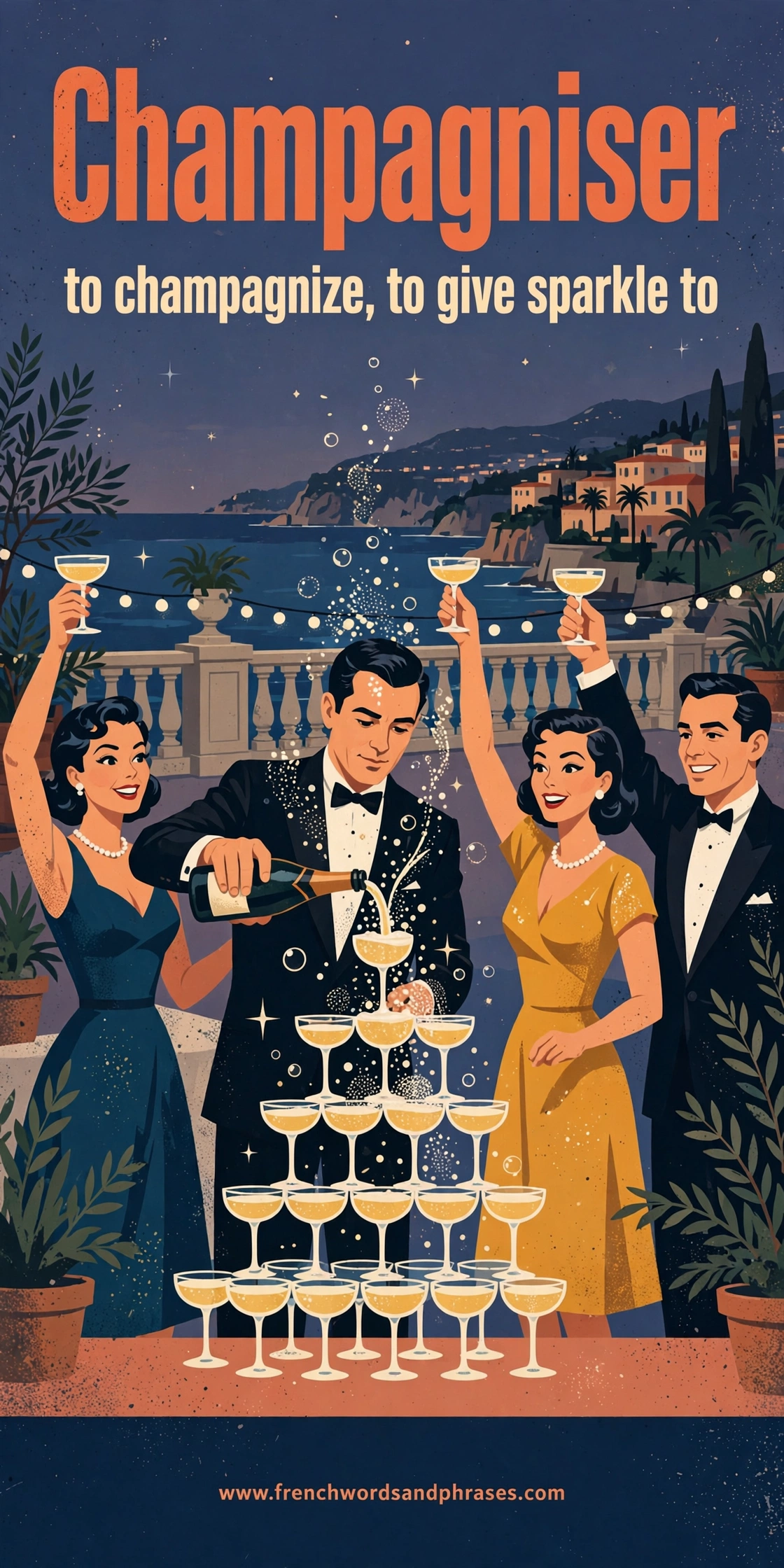
Champagniser means to champagnize, to give sparkle to — to put the fizz into a still wine, and by extension into anything that has gone flat.
Deep in a chalk cellar in Reims, rows of quiet bottles are slowly waking up: a second fermentation is filling them with bubbles. Champagniser is the winemaker’s verb for that transformation — making a still wine sparkling — and, figuratively, for giving sparkle to anything dull.
In this guide, you’ll learn how to conjugate champagniser in all the major French tenses and moods. Explore complete conjugation tables, French examples, English translations, and practice quizzes.
Understanding the French Verb Champagniser
Champagniser is a regular French verb belonging to the first group of verbs, those ending in-er.
It means to champagnize, to give sparkle to. It is commonly used in viticulture and the wine trade for the second fermentation that gives sparkling wine its mousse, and occasionally in a figurative sense — champagniser un texte, un discours — for livening something up and giving it sparkle, a usage borrowed from the literal bubbles.
Verb classification: First group (-er)
Auxiliary verb: Avoir
Past participle: champagnisé
Present participle: champagnisant
English equivalents: To champagnize, to make sparkling, to give sparkle to; champagniser un vin tranquille — to make a still wine sparkling; la champagnisation — the process of making wine sparkling; champagniser un discours — to give a speech sparkle; un vin champagnisé — a wine made sparkling by the champagne method.
One important detail: champagniser is built on Champagne, the region — and in the wine trade it is a precise technical term, not a loose compliment. To champagniser a wine is to subject a still wine to a second fermentation in the bottle, the méthode champenoise, so that it becomes effervescent. Only wines made in Champagne itself may legally be called champagne, but any producer may champagniser a wine. The verb is perfectly regular: je champagnise, nous champagnisons, past participle champagnisé.
Experience the Word
Champagniser is the verb of bottled patience — a flat, silent wine goes into the cellar, and months later it comes out dancing.
Imagine the cellar master turning each bottle a quarter-turn every day, the riddling racks, the yeast doing its slow invisible work. Nothing looks different from the corridor — yet inside every bottle, pressure is building, and a still wine is becoming a celebration.
The wine has not changed its nature. It has been champagnisé — given bubbles, given sparkle, given a reason to be opened.
How to Conjugate Champagniser: Complete French Conjugation Guide
Let’s explore every major conjugation of champagniser, beginning with the indicative mood.
How to Conjugate Champagniser in the Indicative Mood
The indicative mood is used to express facts, observations, actions, and events.
How to Conjugate Champagniser in the Present Tense (Présent)
Used for actions happening now, habitual actions, and general truths.
| Subject | Conjugation |
|---|---|
| je | champagnise |
| tu | champagnises |
| il / elle | champagnise |
| nous | champagnisons |
| vous | champagnisez |
| ils / elles | champagnisent |
Example
Ce domaine champagnise ses vins blancs depuis 1900.
This estate has been champagnizing its white wines since 1900.
Quick Quiz 1
Complete the sentence:
Nous ______ un vin de notre propre vigne.
Reveal the answer
champagnisons
Nous champagnisons un vin de notre propre vigne.
We are champagnizing a wine from our own vineyard.
How to Conjugate Champagniser in the Passé Composé
Used for completed actions in the past. Champagniser takes the auxiliary verb avoir.
| Subject | Conjugation |
|---|---|
| j’ | ai champagnisé |
| tu | as champagnisé |
| il / elle | a champagnisé |
| nous | avons champagnisé |
| vous | avez champagnisé |
| ils / elles | ont champagnisé |
Example
Ils ont champagnisé toute la récolte de l’année dernière.
They champagnized the whole of last year’s harvest.
How to Conjugate Champagniser in the Imparfait (Imperfect Tense)
Used for habitual past actions, descriptions, and ongoing situations in the past.
| Subject | Conjugation |
|---|---|
| je | champagnisais |
| tu | champagnisais |
| il / elle | champagnisait |
| nous | champagnisions |
| vous | champagnisiez |
| ils / elles | champagnisaient |
Example
Autrefois, on champagnisait le vin entièrement à la main.
In the old days, wine was champagnized entirely by hand.
Quick Quiz 2
Choose the correct form:
They champagnized the harvest.
Ils ______ toute la récolte. (ont champagnisé / sont champagnisés)
Reveal the answer
ont champagnisé
Ils ont champagnisé toute la récolte.
Champagniser takes avoir.
How to Conjugate Champagniser in the Plus-que-parfait
Used to describe an action that had already been completed before another past event.
| Subject | Conjugation |
|---|---|
| j’ | avais champagnisé |
| tu | avais champagnisé |
| il / elle | avait champagnisé |
| nous | avions champagnisé |
| vous | aviez champagnisé |
| ils / elles | avaient champagnisé |
Example
Le vigneron avait champagnisé le vin avant de le mettre en vente.
The winemaker had champagnized the wine before putting it on sale.
How to Conjugate Champagniser in the Passé Simple
Primarily used in formal writing, literature, and historical narratives. It is rarely used in everyday conversation.
| Subject | Conjugation |
|---|---|
| je | champagnisai |
| tu | champagnisas |
| il / elle | champagnisa |
| nous | champagnisâmes |
| vous | champagnisâtes |
| ils / elles | champagnisèrent |
Example
En 1850, la maison champagnisa son premier vin tranquille.
In 1850, the house champagnized its first still wine.
How to Conjugate Champagniser in the Passé Antérieur
A literary tense used to express an action completed immediately before another past action, generally in the passé simple.
| Subject | Conjugation |
|---|---|
| j’ | eus champagnisé |
| tu | eus champagnisé |
| il / elle | eut champagnisé |
| nous | eûmes champagnisé |
| vous | eûtes champagnisé |
| ils / elles | eurent champagnisé |
Example
Quand il eut champagnisé le vin, il le laissa reposer en cave.
When he had champagnized the wine, he left it to rest in the cellar.
How to Conjugate Champagniser in the Future Tense (Futur Simple)
Used to describe actions that will take place in the future.
| Subject | Conjugation |
|---|---|
| je | champagniserai |
| tu | champagniseras |
| il / elle | champagnisera |
| nous | champagniserons |
| vous | champagniserez |
| ils / elles | champagniseront |
Example
Cette année, nous champagniserons un vin de notre propre vigne.
This year, we will champagnize a wine from our own vineyard.
How to Conjugate Champagniser in the Futur Antérieur (Future Perfect)
Used for an action that will have been completed before a particular point in the future.
| Subject | Conjugation |
|---|---|
| j’ | aurai champagnisé |
| tu | auras champagnisé |
| il / elle | aura champagnisé |
| nous | aurons champagnisé |
| vous | aurez champagnisé |
| ils / elles | auront champagnisé |
Example
À Noël, ils auront champagnisé cinq mille bouteilles.
By Christmas, they will have champagnized five thousand bottles.
How to Conjugate Champagniser in the Near Future (Futur Proche)
Used to describe something that is going to happen soon. Formed with aller + infinitive.
| Subject | Conjugation |
|---|---|
| je | vais champagniser |
| tu | vas champagniser |
| il / elle | va champagniser |
| nous | allons champagniser |
| vous | allez champagniser |
| ils / elles | vont champagniser |
Example
Le caviste va champagniser cette cuvée pour les fêtes.
The cellarman is going to champagnize this vintage for the festive season.
How to Conjugate Champagniser in the Conditional Mood
The conditional mood expresses what would happen under certain circumstances. It is also frequently used to make polite requests or express wishes.
How to Conjugate Champagniser in the Present Conditional
| Subject | Conjugation |
|---|---|
| je | champagniserais |
| tu | champagniserais |
| il / elle | champagniserait |
| nous | champagniserions |
| vous | champagniseriez |
| ils / elles | champagniseraient |
Example
Le producteur champagniserait davantage si la demande augmentait.
The producer would champagnize more if demand increased.
How to Conjugate Champagniser in the Past Conditional
| Subject | Conjugation |
|---|---|
| j’ | aurais champagnisé |
| tu | aurais champagnisé |
| il / elle | aurait champagnisé |
| nous | aurions champagnisé |
| vous | auriez champagnisé |
| ils / elles | auraient champagnisé |
Example
Elle aurait champagnisé le vin si elle avait eu le matériel.
She would have champagnized the wine if she had had the equipment.
Champagniser in the Literary Past Conditional Form
This less common literary form uses the imperfect subjunctive of avoir.
| Subject | Conjugation |
|---|---|
| j’ | eusse champagnisé |
| tu | eusses champagnisé |
| il / elle | eût champagnisé |
| nous | eussions champagnisé |
| vous | eussiez champagnisé |
| ils / elles | eussent champagnisé |
Example
Le domaine eût champagnisé toute sa récolte, si la cave avait été prête.
The estate would have champagnized its whole harvest, if the cellar had been ready.
How to Conjugate Champagniser in the Subjunctive Mood
The subjunctive is used to express wishes, emotions, doubts, necessity, and uncertainty. It frequently follows expressions such as il faut que (it is necessary that) or bien que (although).
How to Conjugate Champagniser in the Present Subjunctive
| Subject | Conjugation |
|---|---|
| que je | champagnise |
| que tu | champagnises |
| qu’il / qu’elle | champagnise |
| que nous | champagnisions |
| que vous | champagnisiez |
| qu’ils / qu’elles | champagnisent |
Example
Il faut que l’on champagnise ce vin avant l’hiver.
This wine must be champagnized before winter.
Quick Quiz 3
Complete the sentence using the subjunctive:
Il faut que vous ______ ce vin avant l’hiver.
Reveal the answer
champagnisiez
Il faut que vous champagnisiez ce vin avant l’hiver.
You must champagnize this wine before winter.
How to Conjugate Champagniser in the Imperfect Subjunctive
A literary tense, rarely encountered in modern spoken French.
| Subject | Conjugation |
|---|---|
| que je | champagnisasse |
| que tu | champagnisasses |
| qu’il / qu’elle | champagnisât |
| que nous | champagnisassions |
| que vous | champagnisassiez |
| qu’ils / qu’elles | champagnisassent |
Example
On voulait qu’il champagnisât la cuvée avant décembre.
They wanted him to champagnize the vintage before December.
How to Conjugate Champagniser in the Pluperfect Subjunctive
A literary construction used to express an action completed before another past action.
| Subject | Conjugation |
|---|---|
| que j’ | eusse champagnisé |
| que tu | eusses champagnisé |
| qu’il / qu’elle | eût champagnisé |
| que nous | eussions champagnisé |
| que vous | eussiez champagnisé |
| qu’ils / qu’elles | eussent champagnisé |
Example
On admirait qu’il eût champagnisé ce vin en quelques mois seulement.
People admired that he had champagnized this wine in just a few months.
How to Conjugate Champagniser in the Past Subjunctive
| Subject | Conjugation |
|---|---|
| que j’ | aie champagnisé |
| que tu | aies champagnisé |
| qu’il / qu’elle | ait champagnisé |
| que nous | ayons champagnisé |
| que vous | ayez champagnisé |
| qu’ils / qu’elles | aient champagnisé |
Example
Je suis heureux qu’ils aient champagnisé notre vin.
I am glad they champagnized our wine.
How to Conjugate Champagniser in the Imperative
The imperative is used to give commands, instructions, invitations, or suggestions. Subject pronouns are omitted.
How to Conjugate Champagniser in the Present Imperative
| Person | Conjugation |
|---|---|
| (tu) | champagnise |
| (nous) | champagnisons |
| (vous) | champagnisez |
Example
Champagnisez ce vin avec soin, il le mérite !
Champagnize this wine with care, it deserves it!
Quick Quiz 4
How would you say Champagnize this wine with care (tu form)?
Reveal the answer
Champagnise ce vin avec soin !
French Participles of Champagniser
Participles are verb forms that can be used in compound tenses and other grammatical constructions.
Present Participle of Champagniser
champagnisant
En champagnisant le vin, on lui donne sa mousse délicate.
By champagnizing the wine, you give it its delicate sparkle.
Past Participle of Champagniser
champagnisé
Champagnisé selon la méthode traditionnelle, ce vin pétille finement.
Champagnized by the traditional method, this wine sparkles finely.
Champagniser in Everyday French: Real-Life Examples
Now that you know the conjugations, let’s see how champagniser appears in everyday French.
Example 1 — Present
Ce domaine champagnise ses vins blancs.
This estate champagnizes its white wines.
Example 2 — Passé composé
Ils ont champagnisé toute la récolte.
They champagnized the whole harvest.
Example 3 — Imparfait
Autrefois, on champagnisait le vin à la main.
In the old days, wine was champagnized by hand.
Example 4 — Future
Nous champagniserons un vin de notre vigne.
We will champagnize a wine from our vineyard.
Example 5 — Conditional
Il champagniserait davantage si la demande augmentait.
He would champagnize more if demand increased.
Example 6 — Imperative
Champagnisez ce vin avec soin !
Champagnize this wine with care!
Beyond Translation: The Meaning of Champagniser
English borrowed the noun but barely uses the verb; French champagniser is a working cellar term with a legal shadow — the wine may be champagnisé anywhere, but it may only be called champagne if it comes from Champagne.
Do not confuse it with chaptaliser.
Chaptaliser is adding sugar to the must to raise the alcohol; champagniser is the second fermentation that creates the bubbles. One sweetens, the other sparkles — and French keeps a separate verb for each.
How to Remember the French Verb Champagniser
Remember it this way: Champagniser is about the still wine that goes into the cellar and comes out sparkling.
- Built on Champagne: champagniser is what the méthode champenoise does — a second fermentation that puts bubbles into a still wine.
- Not chaptaliser: that is adding sugar; champagniser is adding sparkle.
- Regular -er: je champagnise, nous champagnisons, past participle champagnisé.
The key idea is the still wine that goes into the cellar and comes out sparkling.
Test Your Knowledge of Champagniser
Let’s see how much you’ve learned. Try answering these questions before revealing the answers.
Question 1
What does champagniser do to a wine?
Reveal the answer
It makes it sparkling — a second fermentation in the bottle gives the still wine its bubbles.
Question 2
How do you say They champagnized the whole harvest in French?
Reveal the answer
Ils ont champagnisé toute la récolte.
Question 3
Translate: This wine must be champagnized before winter.
Reveal the answer
Il faut que l’on champagnise ce vin avant l’hiver.
Question 4
What is the past participle of champagniser?
Reveal the answer
Champagnisé.
Question 5
Complete the sentence:
En ______ le vin, on lui donne sa mousse.
Reveal the answer
champagnisant
En champagnisant le vin, on lui donne sa mousse.
By champagnizing the wine, you give it its sparkle.
Your Final Challenge
Can You Use It?
How would you say this in French?
He champagnizes his wine in silence, and every bottle becomes a little celebration in waiting.
Reveal the answer
Il champagnise son vin en silence, et chaque bouteille devient une petite fête en attente.
He champagnizes his wine in silence, and every bottle becomes a little celebration in waiting.
A little French. A little curiosity. A richer everyday life.
LEARN FRENCH ONE WORD AT A TIME