A French Word to Live By
How to Conjugate Céder in French
/se.de/
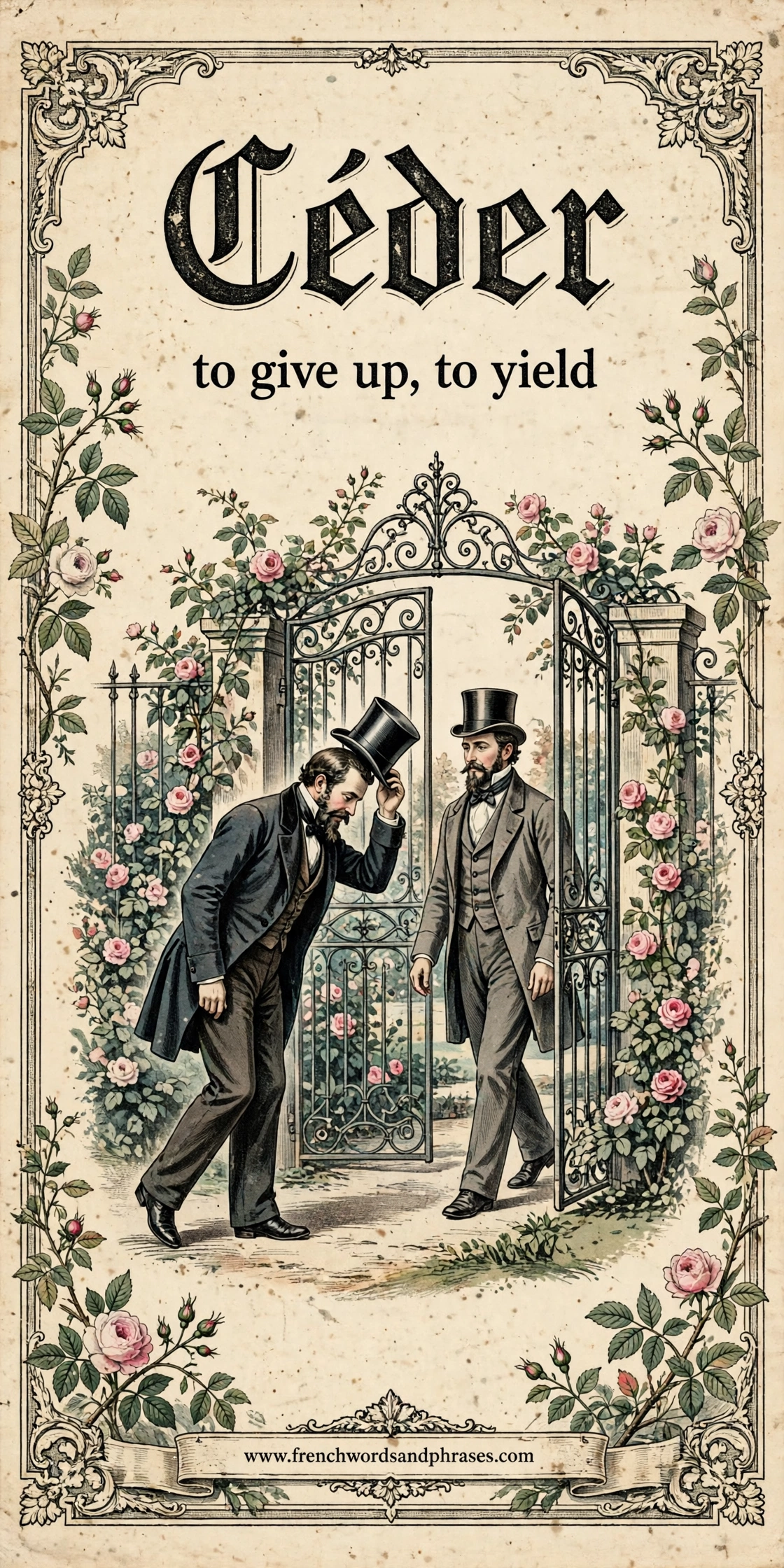
Céder means to give up, to yield — to stop resisting, hand over your place, your rights or the argument, and let the stronger pressure win.
A door giving slowly under a shoulder, a negotiator letting go of the last euro, ice cracking under a skater’s weight — céder is the verb of the moment resistance ends: people yield ground, and things give way, with the same word.
In this guide, you’ll learn how to conjugate céder in all the major French tenses and moods. Explore complete conjugation tables, French examples, English translations, and practice quizzes.
Understanding the French Verb Céder
Céder is a regular French verb belonging to the first group of verbs, those ending in-er.
It means to give up, to yield. It covers the whole scale of yielding: the courtesy of céder sa place in the bus, the diplomacy of céder sur un point in a negotiation, the legal transfer of céder un bail or des droits, and the physics of a door, a dam or a branch that cède under pressure.
Verb classification: First group (-er)
Auxiliary verb: Avoir
Past participle: cédé
Present participle: cédant
English equivalents: To give up, to yield, to give way; céder sa place — to give up one’s seat; céder à la tentation — to yield to temptation; céder le passage — to give way, to yield the right of way; céder un droit, un bien — to transfer a right, a property; la glace cède — the ice gives way.
One important detail: céder is the model of the grave-accent family — the é of the stem opens to è wherever the next syllable is mute: je cède, tu cèdes, il cède, ils cèdent, and in the subjunctive que je cède. The é survives wherever the ending is sounded: nous cédons, vous cédez, je cédais, en cédant, in the future and conditional — je céderai, je céderais — and in the participle cédé. Two constructions to master: céder quelque chose à quelqu’un (to hand something over) and céder à plus a noun (céder à la tentation, à la colère — to give in to it).
Experience the Word
Céder is the verb of the hinge moment — the exact second when holding on stops and giving way begins.
Imagine the last round of a negotiation in a hot little office. For six hours neither side has moved. Then the older man looks at the contract, breathes out, and says: je cède sur le prix. The room changes temperature — something that was locked has opened, and everyone can go home.
He has lost a little money and won the evening. He has yielded — cédé — and the yielding was the decision.
How to Conjugate Céder: Complete French Conjugation Guide
Let’s explore every major conjugation of céder, beginning with the indicative mood.
How to Conjugate Céder in the Indicative Mood
The indicative mood is used to express facts, observations, actions, and events.
How to Conjugate Céder in the Present Tense (Présent)
Used for actions happening now, habitual actions, and general truths.
| Subject | Conjugation |
|---|---|
| je | cède |
| tu | cèdes |
| il / elle | cède |
| nous | cédons |
| vous | cédez |
| ils / elles | cèdent |
Example
Je cède ma place à cette dame âgée.
I give up my seat to this elderly lady.
Quick Quiz 1
Complete the sentence:
Nous ______ notre place aux personnes âgées.
Reveal the answer
cédons
Nous cédons notre place aux personnes âgées.
We give up our seats to elderly people — nous keeps the é.
How to Conjugate Céder in the Passé Composé
Used for completed actions in the past. Céder takes the auxiliary verb avoir.
| Subject | Conjugation |
|---|---|
| j’ | ai cédé |
| tu | as cédé |
| il / elle | a cédé |
| nous | avons cédé |
| vous | avez cédé |
| ils / elles | ont cédé |
Example
Après des heures de débat, il a cédé sur le prix.
After hours of discussion, he gave way on the price.
How to Conjugate Céder in the Imparfait (Imperfect Tense)
Used for habitual past actions, descriptions, and ongoing situations in the past.
| Subject | Conjugation |
|---|---|
| je | cédais |
| tu | cédais |
| il / elle | cédait |
| nous | cédions |
| vous | cédiez |
| ils / elles | cédaient |
Example
La porte cédait lentement sous les coups d’épaule.
The door was slowly giving way under the blows of shoulders.
Quick Quiz 2
Choose the correct form:
He gave way on the price.
Il ______ sur le prix. (a cédé / est cédé)
Reveal the answer
a cédé
Il a cédé sur le prix.
Céder takes avoir.
How to Conjugate Céder in the Plus-que-parfait
Used to describe an action that had already been completed before another past event.
| Subject | Conjugation |
|---|---|
| j’ | avais cédé |
| tu | avais cédé |
| il / elle | avait cédé |
| nous | avions cédé |
| vous | aviez cédé |
| ils / elles | avaient cédé |
Example
Elle avait cédé sa part de la maison à son frère.
She had transferred her share of the house to her brother.
How to Conjugate Céder in the Passé Simple
Primarily used in formal writing, literature, and historical narratives. It is rarely used in everyday conversation.
| Subject | Conjugation |
|---|---|
| je | cédai |
| tu | cédas |
| il / elle | céda |
| nous | cédâmes |
| vous | cédâtes |
| ils / elles | cédèrent |
Example
Le barrage céda pendant la nuit, et l’eau envahit la plaine.
The dam gave way during the night, and the water flooded the plain.
How to Conjugate Céder in the Passé Antérieur
A literary tense used to express an action completed immediately before another past action, generally in the passé simple.
| Subject | Conjugation |
|---|---|
| j’ | eus cédé |
| tu | eus cédé |
| il / elle | eut cédé |
| nous | eûmes cédé |
| vous | eûtes cédé |
| ils / elles | eurent cédé |
Example
Quand la glace eut cédé sous ses pas, il tomba dans l’eau froide.
When the ice had given way beneath his steps, he fell into the cold water.
How to Conjugate Céder in the Future Tense (Futur Simple)
Used to describe actions that will take place in the future.
| Subject | Conjugation |
|---|---|
| je | cèderai |
| tu | cèderas |
| il / elle | cèdera |
| nous | cèderons |
| vous | cèderez |
| ils / elles | cèderont |
Example
Je ne céderai jamais sur ce point.
I will never give way on this point.
How to Conjugate Céder in the Futur Antérieur (Future Perfect)
Used for an action that will have been completed before a particular point in the future.
| Subject | Conjugation |
|---|---|
| j’ | aurai cédé |
| tu | auras cédé |
| il / elle | aura cédé |
| nous | aurons cédé |
| vous | aurez cédé |
| ils / elles | auront cédé |
Example
À la fin des négociations, chaque camp aura cédé quelque chose.
By the end of the talks, each side will have given up something.
How to Conjugate Céder in the Near Future (Futur Proche)
Used to describe something that is going to happen soon. Formed with aller + infinitive.
| Subject | Conjugation |
|---|---|
| je | vais céder |
| tu | vas céder |
| il / elle | va céder |
| nous | allons céder |
| vous | allez céder |
| ils / elles | vont céder |
Example
Attention, la branche va céder !
Careful, the branch is going to give way!
How to Conjugate Céder in the Conditional Mood
The conditional mood expresses what would happen under certain circumstances. It is also frequently used to make polite requests or express wishes.
How to Conjugate Céder in the Present Conditional
| Subject | Conjugation |
|---|---|
| je | cèderais |
| tu | cèderais |
| il / elle | cèderait |
| nous | cèderions |
| vous | cèderiez |
| ils / elles | cèderaient |
Example
À ta place, je céderais ma place sans discuter.
In your place, I would give up my seat without arguing.
How to Conjugate Céder in the Past Conditional
| Subject | Conjugation |
|---|---|
| j’ | aurais cédé |
| tu | aurais cédé |
| il / elle | aurait cédé |
| nous | aurions cédé |
| vous | auriez cédé |
| ils / elles | auraient cédé |
Example
Elle aurait cédé à la tentation sans le soutien de ses amis.
She would have yielded to temptation without her friends’ support.
Céder in the Literary Past Conditional Form
This less common literary form uses the imperfect subjunctive of avoir.
| Subject | Conjugation |
|---|---|
| j’ | eusse cédé |
| tu | eusses cédé |
| il / elle | eût cédé |
| nous | eussions cédé |
| vous | eussiez cédé |
| ils / elles | eussent cédé |
Example
Il eût cédé sa couronne plutôt que son honneur.
He would have given up his crown rather than his honour.
How to Conjugate Céder in the Subjunctive Mood
The subjunctive is used to express wishes, emotions, doubts, necessity, and uncertainty. It frequently follows expressions such as il faut que (it is necessary that) or bien que (although).
How to Conjugate Céder in the Present Subjunctive
| Subject | Conjugation |
|---|---|
| que je | cède |
| que tu | cèdes |
| qu’il / qu’elle | cède |
| que nous | cédions |
| que vous | cédiez |
| qu’ils / qu’elles | cèdent |
Example
Il faut que tu cèdes ta place aux personnes âgées.
You must give up your seat to elderly people.
Quick Quiz 3
Complete the sentence using the subjunctive:
Il faut que je ______ à la tentation moins souvent.
Reveal the answer
cède
Il faut que je cède à la tentation moins souvent.
I must give in to temptation less often.
How to Conjugate Céder in the Imperfect Subjunctive
A literary tense, rarely encountered in modern spoken French.
| Subject | Conjugation |
|---|---|
| que je | cédasse |
| que tu | cédasses |
| qu’il / qu’elle | cédât |
| que nous | cédassions |
| que vous | cédassiez |
| qu’ils / qu’elles | cédassent |
Example
Je doutais qu’il cédât un jour sur cette question.
I doubted he would ever give way on this question.
How to Conjugate Céder in the Pluperfect Subjunctive
A literary construction used to express an action completed before another past action.
| Subject | Conjugation |
|---|---|
| que j’ | eusse cédé |
| que tu | eusses cédé |
| qu’il / qu’elle | eût cédé |
| que nous | eussions cédé |
| que vous | eussiez cédé |
| qu’ils / qu’elles | eussent cédé |
Example
On craignait que le pont eût cédé sous le poids du camion.
People feared the bridge had given way under the weight of the lorry.
How to Conjugate Céder in the Past Subjunctive
| Subject | Conjugation |
|---|---|
| que j’ | aie cédé |
| que tu | aies cédé |
| qu’il / qu’elle | ait cédé |
| que nous | ayons cédé |
| que vous | ayez cédé |
| qu’ils / qu’elles | aient cédé |
Example
Je suis étonné qu’elle ait cédé si vite.
I am surprised she gave in so quickly.
How to Conjugate Céder in the Imperative
The imperative is used to give commands, instructions, invitations, or suggestions. Subject pronouns are omitted.
How to Conjugate Céder in the Present Imperative
| Person | Conjugation |
|---|---|
| (tu) | cède |
| (nous) | cédons |
| (vous) | cédez |
Example
Ne cède pas à la colère !
Do not give in to anger!
Quick Quiz 4
How would you say Do not give in to anger (tu form)?
Reveal the answer
Ne cède pas à la colère !
French Participles of Céder
Participles are verb forms that can be used in compound tenses and other grammatical constructions.
Present Participle of Céder
cédant
En cédant sur le prix, le vendeur a sauvé la vente.
By giving way on the price, the seller saved the sale.
Past Participle of Céder
cédé
Cédé à son fils, le commerce a pris un nouveau départ.
Transferred to his son, the business made a fresh start.
Céder in Everyday French: Real-Life Examples
Now that you know the conjugations, let’s see how céder appears in everyday French.
Example 1 — Present
Je cède ma place à cette dame.
I give up my seat to this lady.
Example 2 — Passé composé
Il a cédé sur le prix.
He gave way on the price.
Example 3 — Imparfait
La porte cédait lentement.
The door was slowly giving way.
Example 4 — Future
Je ne céderai jamais sur ce point.
I will never give way on this point.
Example 5 — Conditional
Je céderais ma place sans discuter.
I would give up my seat without arguing.
Example 6 — Imperative
Ne cède pas à la tentation !
Do not give in to temptation!
Beyond Translation: The Meaning of Céder
English cede, concede and cession are direct heirs — all from Latin cedere, to go, to step aside, to yield.
Céder is stepping aside, in every sense.
French stretches the one verb from road manners (céder le passage) to property law (céder un bail) to the dam that cède in the night — the person who yields and the thing that gives way perform the same act: they stop opposing the pressure.
How to Remember the French Verb Céder
Remember it this way: Céder is about the door giving slowly under the shoulder, the negotiator giving on the price.
- The grave rule: je cède, ils cèdent with è — but nous cédons, je céderai with é.
- Two constructions: céder quelque chose à quelqu’un, and céder à la tentation, à la colère.
- People yield and things give way with the same verb: le barrage cède, la glace cède.
The key idea is the door giving slowly under the shoulder, the negotiator giving on the price.
Test Your Knowledge of Céder
Let’s see how much you’ve learned. Try answering these questions before revealing the answers.
Question 1
Why is it je cède but nous cédons?
Reveal the answer
The grave-accent rule — é becomes è before a mute syllable (je cède), and stays é where the ending is sounded (nous cédons).
Question 2
How do you say I give up my seat to this elderly lady in French?
Reveal the answer
Je cède ma place à cette dame âgée.
Question 3
Translate: Careful, the branch is going to give way!
Reveal the answer
Attention, la branche va céder !
Question 4
What is the past participle of céder?
Reveal the answer
Cédé.
Question 5
Complete the sentence:
Il faut que tu ______ ta place aux personnes âgées.
Reveal the answer
cèdes
Il faut que tu cèdes ta place aux personnes âgées.
You must give up your seat to elderly people.
Your Final Challenge
Can You Use It?
How would you say this in French?
He gives up his seat, his price, sometimes his rights — but never his smile.
Reveal the answer
Il cède sa place, son prix, parfois son droit — mais jamais son sourire.
He gives up his seat, his price, sometimes his rights — but never his smile.
A little French. A little curiosity. A richer everyday life.
LEARN FRENCH ONE WORD AT A TIME