A French Word to Live By
How to Conjugate Caviarder in French
/ka.vjaʁ.de/
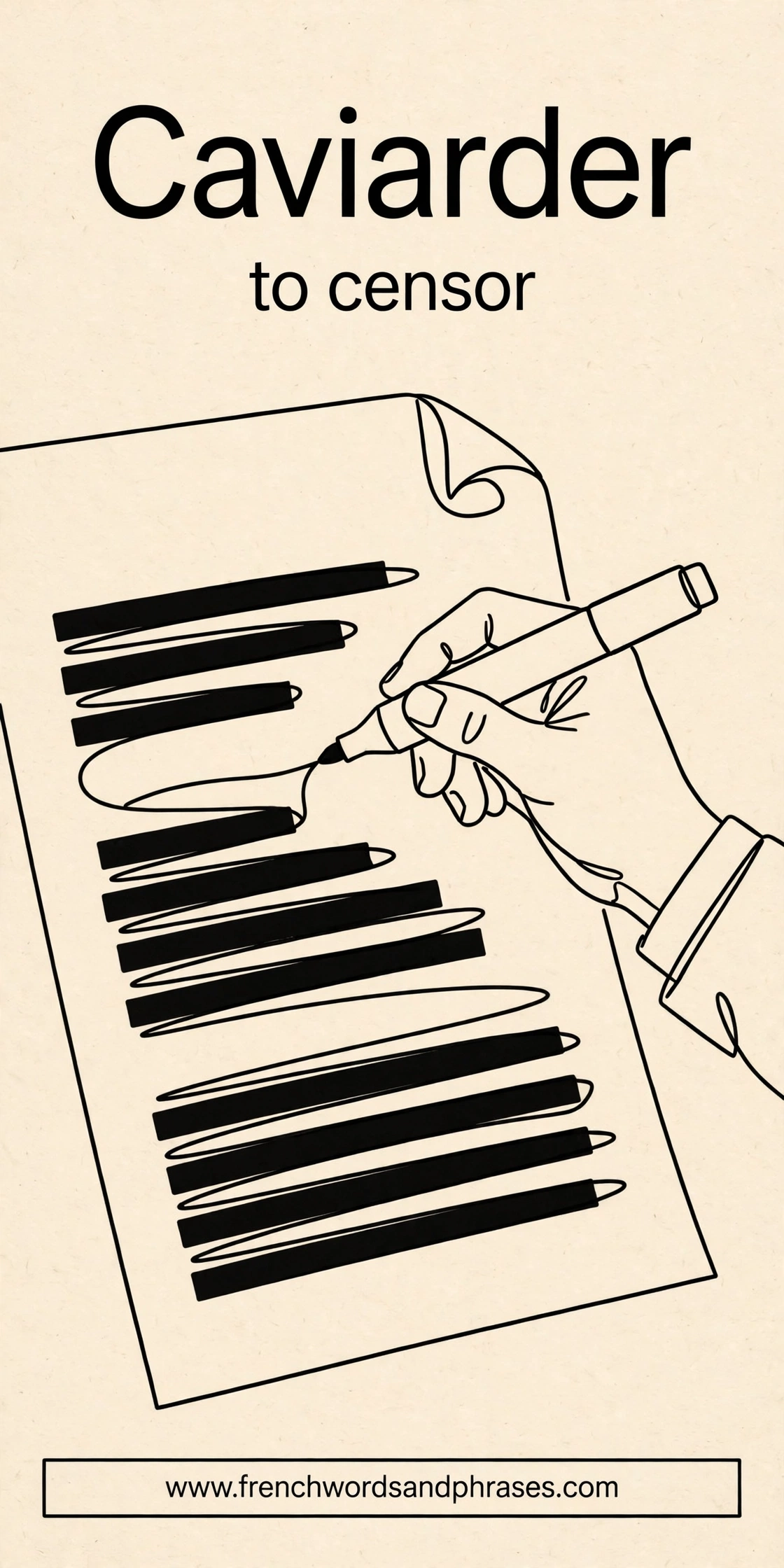
Caviarder means to censor — to black out the offending lines of a text with thick strokes of ink, until whole paragraphs disappear under the black.
A newspaper office under a watchful regime, a blue pencil — no, a pot of black ink — and an official working down the page line by line: caviarder is the journalists’ own slang for censorship, the text buried under black like caviar spread on toast.
In this guide, you’ll learn how to conjugate caviarder in all the major French tenses and moods. Explore complete conjugation tables, French examples, English translations, and practice quizzes.
Understanding the French Verb Caviarder
Caviarder is a regular French verb belonging to the first group of verbs, those ending in-er.
It means to censor. It evokes the great age of print censorship — war communiqués, occupation newspapers, the censored press of authoritarian regimes — and today it is used half-jokingly of any heavy-handed editing: an editor, a lawyer or a platform that blacks out the best lines of a text.
Verb classification: First group (-er)
Auxiliary verb: Avoir
Past participle: caviardé
Present participle: caviardant
English equivalents: To censor, to black out, to cut to ribbons; caviarder un article — to censor an article; caviarder un passage — to black out a passage; un article caviardé — a heavily censored article; la censure — censorship; le censeur — the censor.
One important detail: caviarder is familiar register — it is press slang, plain and simple, and it should be taught as such. The official, neutral verb is censurer; caviarder is what journalists say among themselves about copy butchered by the censor’s brush. The image is the blacked-out block itself, thick and dark like caviar on bread. The verb is regular: je caviarde, nous caviardons, past participle caviardé.
Experience the Word
Caviarder is censorship you can see — the black bar where a sentence used to be, louder than the sentence itself.
Imagine a journalist in a censored capital opening his own newspaper at breakfast. His article is there, his name is there — but the middle of the page is a black rectangle. The censor has caviardé every line that mattered, and every reader in the city will spend the morning guessing what the black is hiding.
The words are gone, the meaning survives as a silhouette. The article has been censored — caviardé — and the black itself has become the news.
How to Conjugate Caviarder: Complete French Conjugation Guide
Let’s explore every major conjugation of caviarder, beginning with the indicative mood.
How to Conjugate Caviarder in the Indicative Mood
The indicative mood is used to express facts, observations, actions, and events.
How to Conjugate Caviarder in the Present Tense (Présent)
Used for actions happening now, habitual actions, and general truths.
| Subject | Conjugation |
|---|---|
| je | caviarde |
| tu | caviardes |
| il / elle | caviarde |
| nous | caviardons |
| vous | caviardez |
| ils / elles | caviardent |
Example
Le régime caviarde tous les articles sur la manifestation.
The regime censors every article about the demonstration.
Quick Quiz 1
Complete the sentence:
Nous ______ les passages dangereux du rapport.
Reveal the answer
caviardons
Nous caviardons les passages dangereux du rapport.
We are censoring the dangerous passages of the report.
How to Conjugate Caviarder in the Passé Composé
Used for completed actions in the past. Caviarder takes the auxiliary verb avoir.
| Subject | Conjugation |
|---|---|
| j’ | ai caviardé |
| tu | as caviardé |
| il / elle | a caviardé |
| nous | avons caviardé |
| vous | avez caviardé |
| ils / elles | ont caviardé |
Example
Le censeur a caviardé la moitié de mon article.
The censor blacked out half of my article.
How to Conjugate Caviarder in the Imparfait (Imperfect Tense)
Used for habitual past actions, descriptions, and ongoing situations in the past.
| Subject | Conjugation |
|---|---|
| je | caviardais |
| tu | caviardais |
| il / elle | caviardait |
| nous | caviardions |
| vous | caviardiez |
| ils / elles | caviardaient |
Example
Pendant la guerre, on caviardait les lettres des soldats.
During the war, soldiers’ letters were censored.
Quick Quiz 2
Choose the correct form:
The censor blacked out the editorial.
Le censeur ______ l’éditorial. (a caviardé / est caviardé)
Reveal the answer
a caviardé
Le censeur a caviardé l’éditorial.
Caviarder takes avoir.
How to Conjugate Caviarder in the Plus-que-parfait
Used to describe an action that had already been completed before another past event.
| Subject | Conjugation |
|---|---|
| j’ | avais caviardé |
| tu | avais caviardé |
| il / elle | avait caviardé |
| nous | avions caviardé |
| vous | aviez caviardé |
| ils / elles | avaient caviardé |
Example
Elle avait caviardé le rapport avant de le transmettre.
She had censored the report before passing it on.
How to Conjugate Caviarder in the Passé Simple
Primarily used in formal writing, literature, and historical narratives. It is rarely used in everyday conversation.
| Subject | Conjugation |
|---|---|
| je | caviardai |
| tu | caviardas |
| il / elle | caviarda |
| nous | caviardâmes |
| vous | caviardâtes |
| ils / elles | caviardèrent |
Example
Le journal parut, mais la censure caviarda l’éditorial entier.
The newspaper appeared, but the censors blacked out the entire editorial.
How to Conjugate Caviarder in the Passé Antérieur
A literary tense used to express an action completed immediately before another past action, generally in the passé simple.
| Subject | Conjugation |
|---|---|
| j’ | eus caviardé |
| tu | eus caviardé |
| il / elle | eut caviardé |
| nous | eûmes caviardé |
| vous | eûtes caviardé |
| ils / elles | eurent caviardé |
Example
Quand le rédacteur eut caviardé les passages dangereux, l’article partit à l’imprimerie.
When the editor had cut the dangerous passages, the article went to the printers.
How to Conjugate Caviarder in the Future Tense (Futur Simple)
Used to describe actions that will take place in the future.
| Subject | Conjugation |
|---|---|
| je | caviarderai |
| tu | caviarderas |
| il / elle | caviardera |
| nous | caviarderons |
| vous | caviarderez |
| ils / elles | caviarderont |
Example
Si tu écris cela, ils caviarderont ton article.
If you write that, they will censor your article.
How to Conjugate Caviarder in the Futur Antérieur (Future Perfect)
Used for an action that will have been completed before a particular point in the future.
| Subject | Conjugation |
|---|---|
| j’ | aurai caviardé |
| tu | auras caviardé |
| il / elle | aura caviardé |
| nous | aurons caviardé |
| vous | aurez caviardé |
| ils / elles | auront caviardé |
Example
À la parution, la censure aura caviardé toutes les phrases sur le ministre.
By publication, the censors will have blacked out every sentence about the minister.
How to Conjugate Caviarder in the Near Future (Futur Proche)
Used to describe something that is going to happen soon. Formed with aller + infinitive.
| Subject | Conjugation |
|---|---|
| je | vais caviarder |
| tu | vas caviarder |
| il / elle | va caviarder |
| nous | allons caviarder |
| vous | allez caviarder |
| ils / elles | vont caviarder |
Example
Le directeur va caviarder ton papier, je te préviens.
The editor is going to butcher your piece, I am warning you.
How to Conjugate Caviarder in the Conditional Mood
The conditional mood expresses what would happen under certain circumstances. It is also frequently used to make polite requests or express wishes.
How to Conjugate Caviarder in the Present Conditional
| Subject | Conjugation |
|---|---|
| je | caviarderais |
| tu | caviarderais |
| il / elle | caviarderait |
| nous | caviarderions |
| vous | caviarderiez |
| ils / elles | caviarderaient |
Example
Un journal libre ne caviarderait jamais une opinion.
A free newspaper would never censor an opinion.
How to Conjugate Caviarder in the Past Conditional
| Subject | Conjugation |
|---|---|
| j’ | aurais caviardé |
| tu | aurais caviardé |
| il / elle | aurait caviardé |
| nous | aurions caviardé |
| vous | auriez caviardé |
| ils / elles | auraient caviardé |
Example
Ils auraient caviardé l’article entier sans la protestation des lecteurs.
They would have censored the whole article without the readers’ protest.
Caviarder in the Literary Past Conditional Form
This less common literary form uses the imperfect subjunctive of avoir.
| Subject | Conjugation |
|---|---|
| j’ | eusse caviardé |
| tu | eusses caviardé |
| il / elle | eût caviardé |
| nous | eussions caviardé |
| vous | eussiez caviardé |
| ils / elles | eussent caviardé |
Example
Le censeur eût caviardé jusqu’au titre, tant il craignait le scandale.
The censor would have blacked out even the title, so much did he fear scandal.
How to Conjugate Caviarder in the Subjunctive Mood
The subjunctive is used to express wishes, emotions, doubts, necessity, and uncertainty. It frequently follows expressions such as il faut que (it is necessary that) or bien que (although).
How to Conjugate Caviarder in the Present Subjunctive
| Subject | Conjugation |
|---|---|
| que je | caviarde |
| que tu | caviardes |
| qu’il / qu’elle | caviarde |
| que nous | caviardions |
| que vous | caviardiez |
| qu’ils / qu’elles | caviardent |
Example
Il ne faut pas que la peur caviarde nos phrases.
Fear must not censor our sentences.
Quick Quiz 3
Complete the sentence using the subjunctive:
Il ne faut pas que la peur ______ nos phrases.
Reveal the answer
caviarde
Il ne faut pas que la peur caviarde nos phrases.
Fear must not censor our sentences.
How to Conjugate Caviarder in the Imperfect Subjunctive
A literary tense, rarely encountered in modern spoken French.
| Subject | Conjugation |
|---|---|
| que je | caviardasse |
| que tu | caviardasses |
| qu’il / qu’elle | caviardât |
| que nous | caviardassions |
| que vous | caviardassiez |
| qu’ils / qu’elles | caviardassent |
Example
L’auteur craignait que l’éditeur ne caviardât son dernier chapitre.
The author feared the publisher might cut his last chapter to pieces.
How to Conjugate Caviarder in the Pluperfect Subjunctive
A literary construction used to express an action completed before another past action.
| Subject | Conjugation |
|---|---|
| que j’ | eusse caviardé |
| que tu | eusses caviardé |
| qu’il / qu’elle | eût caviardé |
| que nous | eussions caviardé |
| que vous | eussiez caviardé |
| qu’ils / qu’elles | eussent caviardé |
Example
On savait que la censure eût caviardé le manifeste avant sa diffusion.
It was known that the censors had blacked out the manifesto before its distribution.
How to Conjugate Caviarder in the Past Subjunctive
| Subject | Conjugation |
|---|---|
| que j’ | aie caviardé |
| que tu | aies caviardé |
| qu’il / qu’elle | ait caviardé |
| que nous | ayons caviardé |
| que vous | ayez caviardé |
| qu’ils / qu’elles | aient caviardé |
Example
Je suis furieux qu’ils aient caviardé mon interview.
I am furious they censored my interview.
How to Conjugate Caviarder in the Imperative
The imperative is used to give commands, instructions, invitations, or suggestions. Subject pronouns are omitted.
How to Conjugate Caviarder in the Present Imperative
| Person | Conjugation |
|---|---|
| (tu) | caviarde |
| (nous) | caviardons |
| (vous) | caviardez |
Example
Ne caviardez pas ce passage, il est essentiel !
Do not cut this passage, it is essential!
Quick Quiz 4
How would you say Do not cut this passage (tu form)?
Reveal the answer
Ne caviarde pas ce passage !
French Participles of Caviarder
Participles are verb forms that can be used in compound tenses and other grammatical constructions.
Present Participle of Caviarder
caviardant
En caviardant l’article, la censure l’a rendu plus célèbre.
By censoring the article, the censors made it more famous.
Past Participle of Caviarder
caviardé
Caviardé de partout, l’article ne disait plus rien.
Blacked out everywhere, the article no longer said anything.
Caviarder in Everyday French: Real-Life Examples
Now that you know the conjugations, let’s see how caviarder appears in everyday French.
Example 1 — Present
Le régime caviarde tous les articles gênants.
The regime censors every awkward article.
Example 2 — Passé composé
Le censeur a caviardé la moitié de mon article.
The censor blacked out half of my article.
Example 3 — Imparfait
Pendant la guerre, on caviardait les lettres des soldats.
During the war, soldiers’ letters were censored.
Example 4 — Future
Ils caviarderont ton article si tu écris cela.
They will censor your article if you write that.
Example 5 — Conditional
Un journal libre ne caviarderait jamais une opinion.
A free newspaper would never censor an opinion.
Example 6 — Imperative
Ne caviardez pas ce passage, il est essentiel !
Do not cut this passage, it is essential!
Beyond Translation: The Meaning of Caviarder
The word was born in the censored press of Tsarist Russia, where officials inked out forbidden passages in thick black blocks — and journalists, hungry and ironic, said the page looked spread with caviar.
Caviarder is censorship named by its victims.
The official vocabulary says censurer; the newsroom answers caviarder, and the joke carries the whole history of the black bar, from the Tsar’s inkpot to the redacted document of today.
How to Remember the French Verb Caviarder
Remember it this way: Caviarder is about the censor’s black ink spread over the page like caviar.
- Press slang, familiar register: the neutral word is censurer, the newsroom word is caviarder.
- Picture the censored page spread with black like caviar on toast — that is the whole etymology.
- Regular -er: je caviarde, nous caviardons, past participle caviardé.
The key idea is the censor’s black ink spread over the page like caviar.
Test Your Knowledge of Caviarder
Let’s see how much you’ve learned. Try answering these questions before revealing the answers.
Question 1
What is the difference between caviarder and censurer?
Reveal the answer
Register — censurer is the neutral, official word; caviarder is the familiar press slang for blacking out a text.
Question 2
How do you say The censor blacked out half of my article in French?
Reveal the answer
Le censeur a caviardé la moitié de mon article.
Question 3
Translate: During the war, soldiers’ letters were censored.
Reveal the answer
Pendant la guerre, on caviardait les lettres des soldats.
Question 4
What is the past participle of caviarder?
Reveal the answer
Caviardé.
Question 5
Complete the sentence:
Je suis furieux qu’ils ______ mon interview.
Reveal the answer
aient caviardé
Je suis furieux qu’ils aient caviardé mon interview.
I am furious they censored my interview.
Your Final Challenge
Can You Use It?
How would you say this in French?
They blacked out his article line by line, and every black line shouted louder than the text.
Reveal the answer
Ils ont caviardé son article ligne par ligne, et chaque ligne noire criait plus fort que le texte.
They blacked out his article line by line, and every black line shouted louder than the text.
A little French. A little curiosity. A richer everyday life.
LEARN FRENCH ONE WORD AT A TIME