A French Word to Live By
How to Conjugate Casemater in French
/kaz.ma.te/
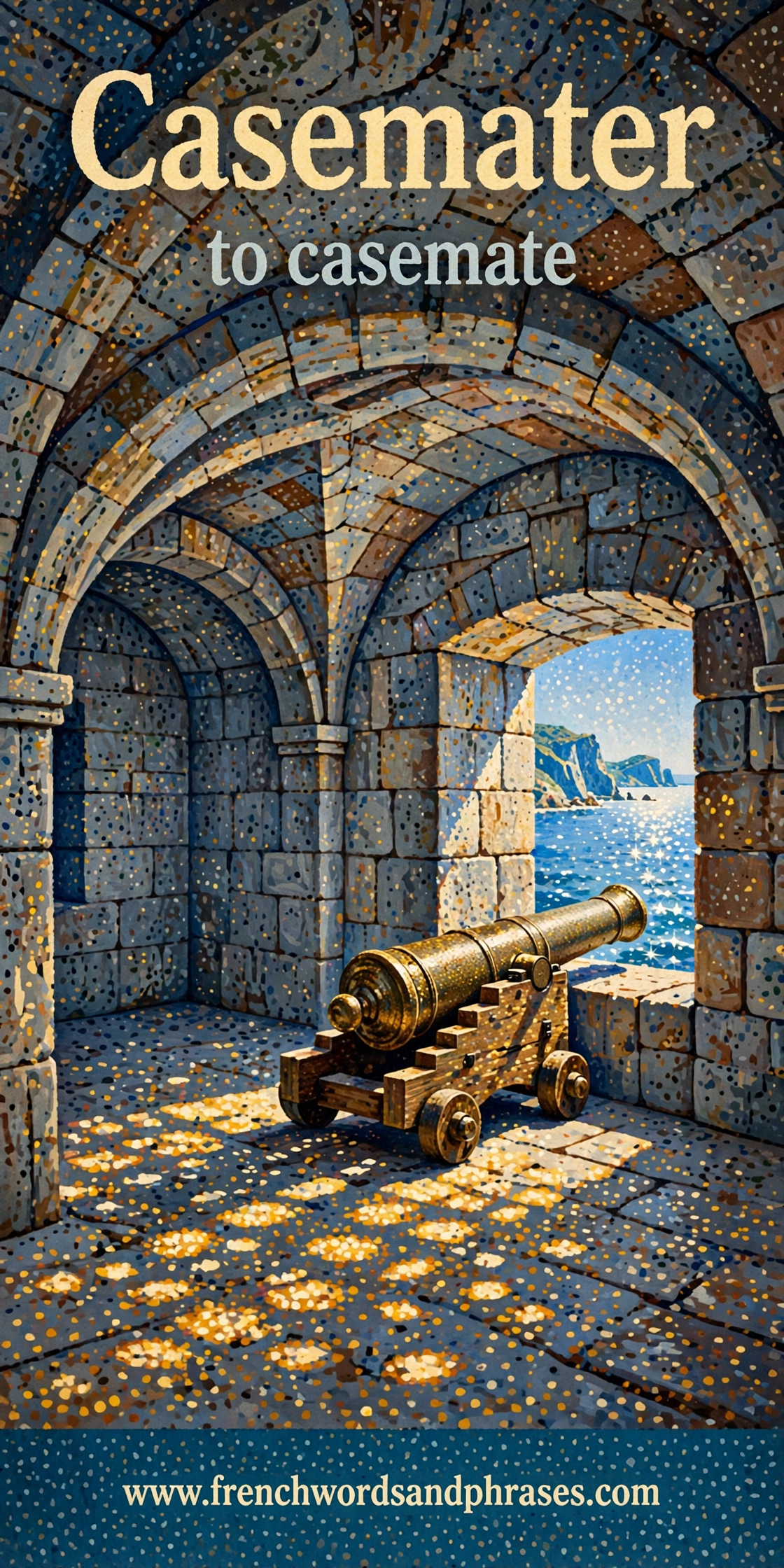
Casemater means to casemate — to shelter guns and soldiers inside a casemate, a vaulted, bombproof chamber in a fortification.
Along a frontier of concrete and steel, engineers sink their guns into vaulted chambers that no shell can reach. Casemater is the fortress-builder’s verb: to place artillery and men inside casemates, the bombproof rooms of a fort.
In this guide, you’ll learn how to conjugate casemater in all the major French tenses and moods. Explore complete conjugation tables, French examples, English translations, and practice quizzes.
Understanding the French Verb Casemater
Casemater is a regular French verb belonging to the first group of verbs, those ending in-er.
It means to casemate. It is a rare, technical verb of military engineering: engineers casemate guns, positions and whole forts, and historians use it for the great fortified lines of the seventeenth to twentieth centuries.
Verb classification: First group (-er)
Auxiliary verb: Avoir
Past participle: casematé
Present participle: casematant
English equivalents: To casemate, to place in a casemate; casemater des canons — to casemate guns; casemater une position — to protect a position with casemates; une casemate — a casemate, a bunker; un ouvrage casematé — a casemated work.
One important detail: casemater belongs to the vocabulary of fortification, and its noun does the everyday work — une casemate is the vaulted chamber itself, the ancestor of the modern bunker. The verb is a perfectly regular -er: je casemate, nous casematons, past participle casematé. You will meet it in histories of the Maginot Line and Vauban’s fortresses, rarely anywhere else.
Experience the Word
Casemater is the verb of war going underground — protection measured in metres of concrete and earth.
Imagine the engineers of the 1930s along France’s eastern border. Above ground, only grass and a steel turret; below, a small city of vaulted rooms where the guns sleep in their casemates, casematés, ready and invisible.
Nothing shows on the surface. Everything has been casematé — sunk, vaulted and hidden from the sky.
How to Conjugate Casemater: Complete French Conjugation Guide
Let’s explore every major conjugation of casemater, beginning with the indicative mood.
How to Conjugate Casemater in the Indicative Mood
The indicative mood is used to express facts, observations, actions, and events.
How to Conjugate Casemater in the Present Tense (Présent)
Used for actions happening now, habitual actions, and general truths.
| Subject | Conjugation |
|---|---|
| je | casemate |
| tu | casemates |
| il / elle | casemate |
| nous | casematons |
| vous | casematez |
| ils / elles | casematent |
Example
L’armée casemate ses canons le long de la frontière.
The army casemates its guns along the frontier.
Quick Quiz 1
Complete the sentence:
Nous ______ les batteries de la citadelle.
Reveal the answer
casematons
Nous casematons les batteries de la citadelle.
We are casemating the citadel’s batteries.
How to Conjugate Casemater in the Passé Composé
Used for completed actions in the past. Casemater takes the auxiliary verb avoir.
| Subject | Conjugation |
|---|---|
| j’ | ai casematé |
| tu | as casematé |
| il / elle | a casematé |
| nous | avons casematé |
| vous | avez casematé |
| ils / elles | ont casematé |
Example
Les ingénieurs ont casematé les pièces d’artillerie en deux ans.
The engineers casemated the artillery pieces in two years.
How to Conjugate Casemater in the Imparfait (Imperfect Tense)
Used for habitual past actions, descriptions, and ongoing situations in the past.
| Subject | Conjugation |
|---|---|
| je | casematais |
| tu | casematais |
| il / elle | casematait |
| nous | casemations |
| vous | casematiez |
| ils / elles | casemataient |
Example
Vauban casematait les bastions de ses forteresses.
Vauban used to casemate the bastions of his fortresses.
Quick Quiz 2
Choose the correct form:
The engineers casemated the fort.
Les ingénieurs ______ le fort. (ont casematé / sont casematés)
Reveal the answer
ont casematé
Les ingénieurs ont casematé le fort.
Casemater takes avoir.
How to Conjugate Casemater in the Plus-que-parfait
Used to describe an action that had already been completed before another past event.
| Subject | Conjugation |
|---|---|
| j’ | avais casematé |
| tu | avais casematé |
| il / elle | avait casematé |
| nous | avions casematé |
| vous | aviez casematé |
| ils / elles | avaient casematé |
Example
On avait casematé la position avant l’hiver.
The position had been casemated before the winter.
How to Conjugate Casemater in the Passé Simple
Primarily used in formal writing, literature, and historical narratives. It is rarely used in everyday conversation.
| Subject | Conjugation |
|---|---|
| je | casematai |
| tu | casematas |
| il / elle | casemata |
| nous | casematâmes |
| vous | casematâtes |
| ils / elles | casematèrent |
Example
Le génie casemata les canons de la citadelle en une saison.
The engineers casemated the citadel’s guns in one season.
How to Conjugate Casemater in the Passé Antérieur
A literary tense used to express an action completed immediately before another past action, generally in the passé simple.
| Subject | Conjugation |
|---|---|
| j’ | eus casematé |
| tu | eus casematé |
| il / elle | eut casematé |
| nous | eûmes casematé |
| vous | eûtes casematé |
| ils / elles | eurent casematé |
Example
Quand ils eurent casematé le fort, ils le camouflèrent.
When they had casemated the fort, they camouflaged it.
How to Conjugate Casemater in the Future Tense (Futur Simple)
Used to describe actions that will take place in the future.
| Subject | Conjugation |
|---|---|
| je | casematerai |
| tu | casemateras |
| il / elle | casematera |
| nous | casematerons |
| vous | casematerez |
| ils / elles | casemateront |
Example
L’an prochain, on casematera les nouvelles batteries côtières.
Next year, the new coastal batteries will be casemated.
How to Conjugate Casemater in the Futur Antérieur (Future Perfect)
Used for an action that will have been completed before a particular point in the future.
| Subject | Conjugation |
|---|---|
| j’ | aurai casematé |
| tu | auras casematé |
| il / elle | aura casematé |
| nous | aurons casematé |
| vous | aurez casematé |
| ils / elles | auront casematé |
Example
À la fin des travaux, ils auront casematé tout le secteur.
By the end of the works, they will have casemated the whole sector.
How to Conjugate Casemater in the Near Future (Futur Proche)
Used to describe something that is going to happen soon. Formed with aller + infinitive.
| Subject | Conjugation |
|---|---|
| je | vais casemater |
| tu | vas casemater |
| il / elle | va casemater |
| nous | allons casemater |
| vous | allez casemater |
| ils / elles | vont casemater |
Example
Le génie va casemater cette batterie avant l’automne.
The engineers are going to casemate this battery before autumn.
How to Conjugate Casemater in the Conditional Mood
The conditional mood expresses what would happen under certain circumstances. It is also frequently used to make polite requests or express wishes.
How to Conjugate Casemater in the Present Conditional
| Subject | Conjugation |
|---|---|
| je | casematerais |
| tu | casematerais |
| il / elle | casematerait |
| nous | casematerions |
| vous | casemateriez |
| ils / elles | casemateraient |
Example
Avec plus de béton, on casematerait aussi les dépôts de munitions.
With more concrete, the ammunition stores would be casemated too.
How to Conjugate Casemater in the Past Conditional
| Subject | Conjugation |
|---|---|
| j’ | aurais casematé |
| tu | aurais casematé |
| il / elle | aurait casematé |
| nous | aurions casematé |
| vous | auriez casematé |
| ils / elles | auraient casematé |
Example
Ils auraient casematé le fort si le temps l’avait permis.
They would have casemated the fort if time had allowed.
Casemater in the Literary Past Conditional Form
This less common literary form uses the imperfect subjunctive of avoir.
| Subject | Conjugation |
|---|---|
| j’ | eusse casematé |
| tu | eusses casematé |
| il / elle | eût casematé |
| nous | eussions casematé |
| vous | eussiez casematé |
| ils / elles | eussent casematé |
Example
Vauban eût casematé la place entière en une campagne.
Vauban would have casemated the entire stronghold in one campaign.
How to Conjugate Casemater in the Subjunctive Mood
The subjunctive is used to express wishes, emotions, doubts, necessity, and uncertainty. It frequently follows expressions such as il faut que (it is necessary that) or bien que (although).
How to Conjugate Casemater in the Present Subjunctive
| Subject | Conjugation |
|---|---|
| que je | casemate |
| que tu | casemates |
| qu’il / qu’elle | casemate |
| que nous | casemations |
| que vous | casematiez |
| qu’ils / qu’elles | casematent |
Example
Le plan exige que le génie casemate les canons avant mars.
The plan requires the engineers to casemate the guns before March.
Quick Quiz 3
Complete the sentence using the subjunctive:
Il faut que vous ______ les canons avant mars.
Reveal the answer
casematiez
Il faut que vous casematiez les canons avant mars.
You must casemate the guns before March.
How to Conjugate Casemater in the Imperfect Subjunctive
A literary tense, rarely encountered in modern spoken French.
| Subject | Conjugation |
|---|---|
| que je | casematasse |
| que tu | casematasses |
| qu’il / qu’elle | casematât |
| que nous | casematassions |
| que vous | casematassiez |
| qu’ils / qu’elles | casematassent |
Example
L’état-major voulait qu’on casematât toutes les batteries.
The general staff wanted all the batteries casemated.
How to Conjugate Casemater in the Pluperfect Subjunctive
A literary construction used to express an action completed before another past action.
| Subject | Conjugation |
|---|---|
| que j’ | eusse casematé |
| que tu | eusses casematé |
| qu’il / qu’elle | eût casematé |
| que nous | eussions casematé |
| que vous | eussiez casematé |
| qu’ils / qu’elles | eussent casematé |
Example
On disait qu’ils eussent casematé la frontière entière.
People said they had casemated the entire frontier.
How to Conjugate Casemater in the Past Subjunctive
| Subject | Conjugation |
|---|---|
| que j’ | aie casematé |
| que tu | aies casematé |
| qu’il / qu’elle | ait casematé |
| que nous | ayons casematé |
| que vous | ayez casematé |
| qu’ils / qu’elles | aient casematé |
Example
Il est rare qu’on ait casematé si vite un ouvrage entier.
It is rare for a whole work to have been casemated so quickly.
How to Conjugate Casemater in the Imperative
The imperative is used to give commands, instructions, invitations, or suggestions. Subject pronouns are omitted.
How to Conjugate Casemater in the Present Imperative
| Person | Conjugation |
|---|---|
| (tu) | casemate |
| (nous) | casematons |
| (vous) | casematez |
Example
Casematez les canons avant l’arrivée de l’inspection !
Casemate the guns before the inspection arrives!
Quick Quiz 4
How would you say Casemate the guns (tu form)?
Reveal the answer
Casemate les canons !
French Participles of Casemater
Participles are verb forms that can be used in compound tenses and other grammatical constructions.
Present Participle of Casemater
casematant
En casematant les batteries, le génie les rend invisibles.
By casemating the batteries, the engineers make them invisible.
Past Participle of Casemater
casematé
Casematé sous trois mètres de béton, le canon attend.
Casemated under three metres of concrete, the gun waits.
Casemater in Everyday French: Real-Life Examples
Now that you know the conjugations, let’s see how casemater appears in everyday French.
Example 1 — Present
L’armée casemate ses canons dans le béton.
The army casemates its guns in concrete.
Example 2 — Passé composé
Les ingénieurs ont casematé les batteries.
The engineers casemated the batteries.
Example 3 — Imparfait
Vauban casematait les bastions de ses forteresses.
Vauban used to casemate the bastions of his fortresses.
Example 4 — Future
On casematera les nouvelles batteries côtières.
The new coastal batteries will be casemated.
Example 5 — Conditional
Avec plus de béton, on casematerait aussi les dépôts.
With more concrete, the stores would be casemated too.
Example 6 — Imperative
Casematez les canons avant l’inspection !
Casemate the guns before the inspection!
Beyond Translation: The Meaning of Casemater
English military history uses the same noun, casemate, for the vaulted chamber in a fort or a warship — French casemater simply turns that chamber into an action.
To casemate is to give a gun a stone room of its own.
From Vauban’s citadels to the Maginot Line, the casemate was France’s answer to ever-heavier artillery: if the shells grow stronger, the rooms grow deeper.
How to Remember the French Verb Casemater
Remember it this way: Casemater is about guns sleeping in vaulted rooms under metres of concrete.
- Une casemate is the bombproof vaulted room; casemater is to put guns and men inside one.
- A word of fortresses and military history — Vauban and the Maginot Line are its home ground.
- Regular -er: je casemate, nous casematons, past participle casematé.
The key idea is guns sleeping in vaulted rooms under metres of concrete.
Test Your Knowledge of Casemater
Let’s see how much you’ve learned. Try answering these questions before revealing the answers.
Question 1
What is une casemate?
Reveal the answer
A vaulted, bombproof chamber in a fortification, sheltering guns or soldiers — casemater is to place them inside one.
Question 2
How do you say The army casemates its guns along the frontier in French?
Reveal the answer
L’armée casemate ses canons le long de la frontière.
Question 3
Translate: The engineers casemated the batteries.
Reveal the answer
Les ingénieurs ont casematé les batteries.
Question 4
What is the past participle of casemater?
Reveal the answer
Casematé.
Question 5
Complete the sentence:
Le plan exige que le génie ______ les canons avant mars.
Reveal the answer
casemate
Le plan exige que le génie casemate les canons avant mars.
The plan requires the engineers to casemate the guns before March.
Your Final Challenge
Can You Use It?
How would you say this in French?
They casemate the guns under the concrete, and the frontier falls silent.
Reveal the answer
Ils casematent les canons sous le béton, et la frontière se tait.
They casemate the guns under the concrete, and the frontier falls silent.
A little French. A little curiosity. A richer everyday life.
LEARN FRENCH ONE WORD AT A TIME