
A French Word to Live By
How to Conjugate Capoter in French
/ka.pɔ.te/
Capoter means to capsize, to overturn, to fail — a boat rolling over, a car ending on its roof, and, in familiar speech, a plan or a business going belly-up.
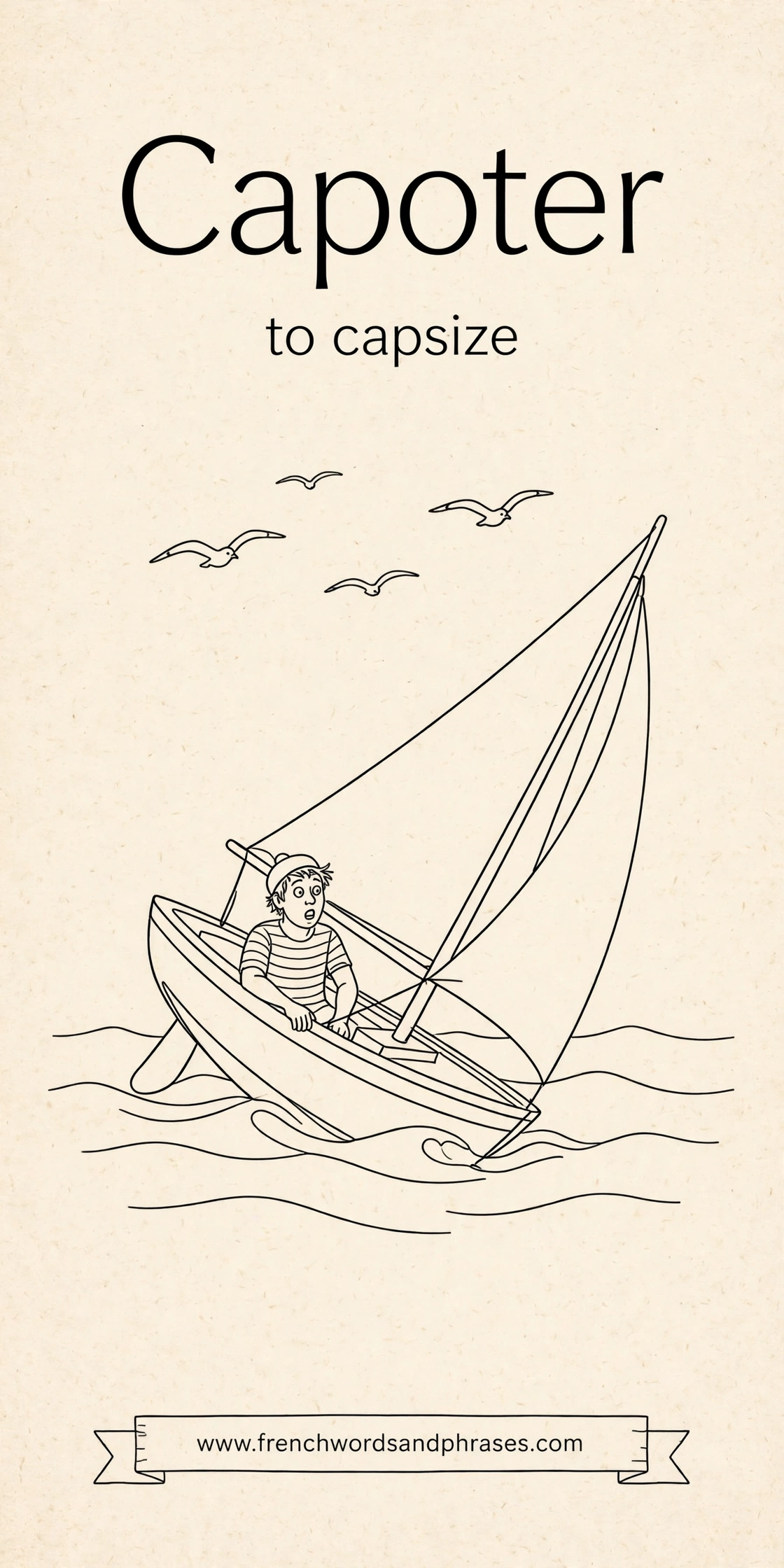
A dinghy caught by a gust and flipping in a flash, a project that looked solid until the day it folded — capoter is the verb of the sudden roll-over: one moment upright and sailing, the next moment upside down.
In this guide, you’ll learn how to conjugate capoter in all the major French tenses and moods. Explore complete conjugation tables, French examples, English translations, and practice quizzes.
Understanding the French Verb Capoter
Capoter is a regular French verb belonging to the first group of verbs, those ending in-er.
It means to capsize, to overturn, to fail. In Quebec French, capoter has a lively extra life: it can mean to go crazy with excitement or delight — capoter sur quelque chose, to be crazy about something. In European French, keep to the roll-over senses: capsize for boats, overturn for vehicles, collapse for plans.
Verb classification: First group (-er)
Auxiliary verb: Avoir
Past participle: capoté
Present participle: capotant
English equivalents: To capsize, to overturn, to fail; le bateau capote — the boat capsizes; faire capoter un projet — to sink a project; le projet a capoté — the project fell through; en amour, il capote toujours — in love, it always falls apart on him.
One important detail: capoter is a perfectly regular -er verb — le bateau capote, nous capotons, ils capotent, past participle capoté. Its home ground is the water: boats capotent. On land, cars capotent when they roll onto the roof, and in familiar French everything from negotiations to love affairs can capoter — fail suddenly and completely. The causative phrase is worth learning whole: faire capoter un accord, faire capoter un mariage, to sink a deal, to wreck a marriage.
Experience the Word
Capoter is the verb of the flash roll-over — upright, upright, and then suddenly the sky is under your feet.
Imagine a small sailing dinghy on a lake in July. A gust hits the sail sideways, the boat heels, heels further — et capote d’un coup, leaving two laughing swimmers clinging to the hull and a picnic basket floating away.
It took one second. The boat has capsized — elle a capoté, keel to the sun.
How to Conjugate Capoter: Complete French Conjugation Guide
Let’s explore every major conjugation of capoter, beginning with the indicative mood.
How to Conjugate Capoter in the Indicative Mood
The indicative mood is used to express facts, observations, actions, and events.
How to Conjugate Capoter in the Present Tense (Présent)
Used for actions happening now, habitual actions, and general truths.
| Subject | Conjugation |
|---|---|
| je | capote |
| tu | capotes |
| il / elle | capote |
| nous | capotons |
| vous | capotez |
| ils / elles | capotent |
Example
Le petit voilier capote sous la rafale.
The little sailing boat capsizes under the gust.
Quick Quiz 1
Complete the sentence:
Nous redressons le bateau avant qu’il ne ______.
Reveal the answer
capote
Nous redressons le bateau avant qu’il ne capote.
We right the boat before it capsizes.
How to Conjugate Capoter in the Passé Composé
Used for completed actions in the past. Capoter takes the auxiliary verb avoir.
| Subject | Conjugation |
|---|---|
| j’ | ai capoté |
| tu | as capoté |
| il / elle | a capoté |
| nous | avons capoté |
| vous | avez capoté |
| ils / elles | ont capoté |
Example
Le projet a capoté au dernier moment.
The project fell through at the last moment.
How to Conjugate Capoter in the Imparfait (Imperfect Tense)
Used for habitual past actions, descriptions, and ongoing situations in the past.
| Subject | Conjugation |
|---|---|
| je | capotais |
| tu | capotais |
| il / elle | capotait |
| nous | capotions |
| vous | capotiez |
| ils / elles | capotaient |
Example
Chaque été, un bateau capotait près de la jetée.
Every summer, a boat used to capsize near the jetty.
Quick Quiz 2
Choose the correct form:
The project fell through.
Le projet ______ au dernier moment. (a capoté / est capoté)
Reveal the answer
a capoté
Le projet a capoté au dernier moment.
Capoter takes avoir.
How to Conjugate Capoter in the Plus-que-parfait
Used to describe an action that had already been completed before another past event.
| Subject | Conjugation |
|---|---|
| j’ | avais capoté |
| tu | avais capoté |
| il / elle | avait capoté |
| nous | avions capoté |
| vous | aviez capoté |
| ils / elles | avaient capoté |
Example
La barque avait capoté avant l’arrivée des secours.
The rowing boat had capsized before help arrived.
How to Conjugate Capoter in the Passé Simple
Primarily used in formal writing, literature, and historical narratives. It is rarely used in everyday conversation.
| Subject | Conjugation |
|---|---|
| je | capotai |
| tu | capotas |
| il / elle | capota |
| nous | capotâmes |
| vous | capotâtes |
| ils / elles | capotèrent |
Example
La chaloupe capota dans la houle et disparut.
The launch capsized in the swell and disappeared.
How to Conjugate Capoter in the Passé Antérieur
A literary tense used to express an action completed immediately before another past action, generally in the passé simple.
| Subject | Conjugation |
|---|---|
| j’ | eus capoté |
| tu | eus capoté |
| il / elle | eut capoté |
| nous | eûmes capoté |
| vous | eûtes capoté |
| ils / elles | eurent capoté |
Example
Quand le canot eut capoté, les pêcheurs nagèrent vers la rive.
When the dinghy had capsized, the fishermen swam for the shore.
How to Conjugate Capoter in the Future Tense (Futur Simple)
Used to describe actions that will take place in the future.
| Subject | Conjugation |
|---|---|
| je | capoterai |
| tu | capoteras |
| il / elle | capotera |
| nous | capoterons |
| vous | capoterez |
| ils / elles | capoteront |
Example
Si le vent monte encore, le bateau capotera.
If the wind rises further, the boat will capsize.
How to Conjugate Capoter in the Futur Antérieur (Future Perfect)
Used for an action that will have been completed before a particular point in the future.
| Subject | Conjugation |
|---|---|
| j’ | aurai capoté |
| tu | auras capoté |
| il / elle | aura capoté |
| nous | aurons capoté |
| vous | aurez capoté |
| ils / elles | auront capoté |
Example
Sans lest, le voilier aura capoté avant la bouée.
Without ballast, the sailing boat will have capsized before the buoy.
How to Conjugate Capoter in the Near Future (Futur Proche)
Used to describe something that is going to happen soon. Formed with aller + infinitive.
| Subject | Conjugation |
|---|---|
| je | vais capoter |
| tu | vas capoter |
| il / elle | va capoter |
| nous | allons capoter |
| vous | allez capoter |
| ils / elles | vont capoter |
Example
Attention, la barque va capoter !
Careful, the boat is going to capsize!
How to Conjugate Capoter in the Conditional Mood
The conditional mood expresses what would happen under certain circumstances. It is also frequently used to make polite requests or express wishes.
How to Conjugate Capoter in the Present Conditional
| Subject | Conjugation |
|---|---|
| je | capoterais |
| tu | capoterais |
| il / elle | capoterait |
| nous | capoterions |
| vous | capoteriez |
| ils / elles | capoteraient |
Example
Avec une telle rafale, même un gros bateau capoterait.
In such a gust, even a big boat would capsize.
How to Conjugate Capoter in the Past Conditional
| Subject | Conjugation |
|---|---|
| j’ | aurais capoté |
| tu | aurais capoté |
| il / elle | aurait capoté |
| nous | aurions capoté |
| vous | auriez capoté |
| ils / elles | auraient capoté |
Example
Le projet aurait capoté sans ton intervention.
The project would have fallen through without your intervention.
Capoter in the Literary Past Conditional Form
This less common literary form uses the imperfect subjunctive of avoir.
| Subject | Conjugation |
|---|---|
| j’ | eusse capoté |
| tu | eusses capoté |
| il / elle | eût capoté |
| nous | eussions capoté |
| vous | eussiez capoté |
| ils / elles | eussent capoté |
Example
La nef eût capoté sous le poids des voiles.
The ship would have capsized under the weight of the sails.
How to Conjugate Capoter in the Subjunctive Mood
The subjunctive is used to express wishes, emotions, doubts, necessity, and uncertainty. It frequently follows expressions such as il faut que (it is necessary that) or bien que (although).
How to Conjugate Capoter in the Present Subjunctive
| Subject | Conjugation |
|---|---|
| que je | capote |
| que tu | capotes |
| qu’il / qu’elle | capote |
| que nous | capotions |
| que vous | capotiez |
| qu’ils / qu’elles | capotent |
Example
Je crains que le canot ne capote dans les rapides.
I fear the dinghy may capsize in the rapids.
Quick Quiz 3
Complete the sentence using the subjunctive:
Je crains que vous ne fassiez ______ les négociations.
Reveal the answer
capoter
Je crains que vous ne fassiez capoter les négociations.
I fear you may sink the negotiations.
How to Conjugate Capoter in the Imperfect Subjunctive
A literary tense, rarely encountered in modern spoken French.
| Subject | Conjugation |
|---|---|
| que je | capotasse |
| que tu | capotasses |
| qu’il / qu’elle | capotât |
| que nous | capotassions |
| que vous | capotassiez |
| qu’ils / qu’elles | capotassent |
Example
Tout le monde craignait que le projet capotât.
Everyone feared the project might fall through.
How to Conjugate Capoter in the Pluperfect Subjunctive
A literary construction used to express an action completed before another past action.
| Subject | Conjugation |
|---|---|
| que j’ | eusse capoté |
| que tu | eusses capoté |
| qu’il / qu’elle | eût capoté |
| que nous | eussions capoté |
| que vous | eussiez capoté |
| qu’ils / qu’elles | eussent capoté |
Example
On racontait que le navire eût capoté près des rochers.
People said the ship had capsized near the rocks.
How to Conjugate Capoter in the Past Subjunctive
| Subject | Conjugation |
|---|---|
| que j’ | aie capoté |
| que tu | aies capoté |
| qu’il / qu’elle | ait capoté |
| que nous | ayons capoté |
| que vous | ayez capoté |
| qu’ils / qu’elles | aient capoté |
Example
Je suis désolé que les négociations aient capoté.
I am sorry the negotiations fell through.
How to Conjugate Capoter in the Imperative
The imperative is used to give commands, instructions, invitations, or suggestions. Subject pronouns are omitted.
How to Conjugate Capoter in the Present Imperative
| Person | Conjugation |
|---|---|
| (tu) | capote |
| (nous) | capotons |
| (vous) | capotez |
Example
Ne capote pas, tiens bon la barre !
Do not capsize, hold the helm steady!
Quick Quiz 4
How would you say Do not capsize (tu form, to the sailor)?
Reveal the answer
Ne capote pas !
French Participles of Capoter
Participles are verb forms that can be used in compound tenses and other grammatical constructions.
Present Participle of Capoter
capotant
En capotant, le voilier a perdu son mât.
In capsizing, the sailing boat lost its mast.
Past Participle of Capoter
capoté
Le bateau a capoté, mais l’équipage est sain et sauf.
The boat capsized, but the crew is safe and sound.
Capoter in Everyday French: Real-Life Examples
Now that you know the conjugations, let’s see how capoter appears in everyday French.
Example 1 — Present
Le petit voilier capote sous la rafale.
The little sailing boat capsizes under the gust.
Example 2 — Passé composé
Le projet a capoté au dernier moment.
The project fell through at the last moment.
Example 3 — Imparfait
Un bateau capotait chaque été près de la jetée.
A boat used to capsize every summer near the jetty.
Example 4 — Future
Le bateau capotera si le vent monte encore.
The boat will capsize if the wind rises further.
Example 5 — Conditional
Même un gros bateau capoterait dans une telle rafale.
Even a big boat would capsize in such a gust.
Example 6 — Imperative
Ne capote pas, tiens bon la barre !
Do not capsize, hold the helm steady!
Beyond Translation: The Meaning of Capoter
English capsize stops at the water’s edge; French capoter keeps rolling — boats, cars, businesses, weddings.
Anything that ends upside down can capoter.
The word comes from the sea (the same family as la cape and capéer), and its land career is pure metaphor: a deal that capote has gone keel-up exactly like a dinghy in a gust.
How to Remember the French Verb Capoter
Remember it this way: Capoter is about the dinghy flipping in one gust, keel to the sun.
- Three roll-overs, one verb: boats capsize, cars overturn, projects fall through.
- Learn the causative whole: faire capoter un projet — to sink a project.
- Regular -er: je capote, nous capotons, past participle capoté.
The key idea is the dinghy flipping in one gust, keel to the sun.
Test Your Knowledge of Capoter
Let’s see how much you’ve learned. Try answering these questions before revealing the answers.
Question 1
How do you say to sink a project in French, using capoter?
Reveal the answer
Faire capoter un projet — the causative: to make a project capsize.
Question 2
How do you say The boat capsizes in French?
Reveal the answer
Le bateau capote.
Question 3
Translate: The project fell through at the last moment.
Reveal the answer
Le projet a capoté au dernier moment.
Question 4
What is the past participle of capoter?
Reveal the answer
Capoté.
Question 5
Complete the sentence:
Je crains que le canot ne ______ dans les rapides.
Reveal the answer
capote
Je crains que le canot ne capote dans les rapides.
I fear the dinghy may capsize in the rapids.
Your Final Challenge
Can You Use It?
How would you say this in French?
The little boat capsized under the gust, but the children are already laughing as they set it afloat again.
Reveal the answer
Le petit bateau a capoté sous la rafale, mais les enfants rient déjà en le remettant à flot.
The little boat capsized under the gust, but the children are already laughing as they set it afloat again.
A little French. A little curiosity. A richer everyday life.
LEARN FRENCH ONE WORD AT A TIME




