
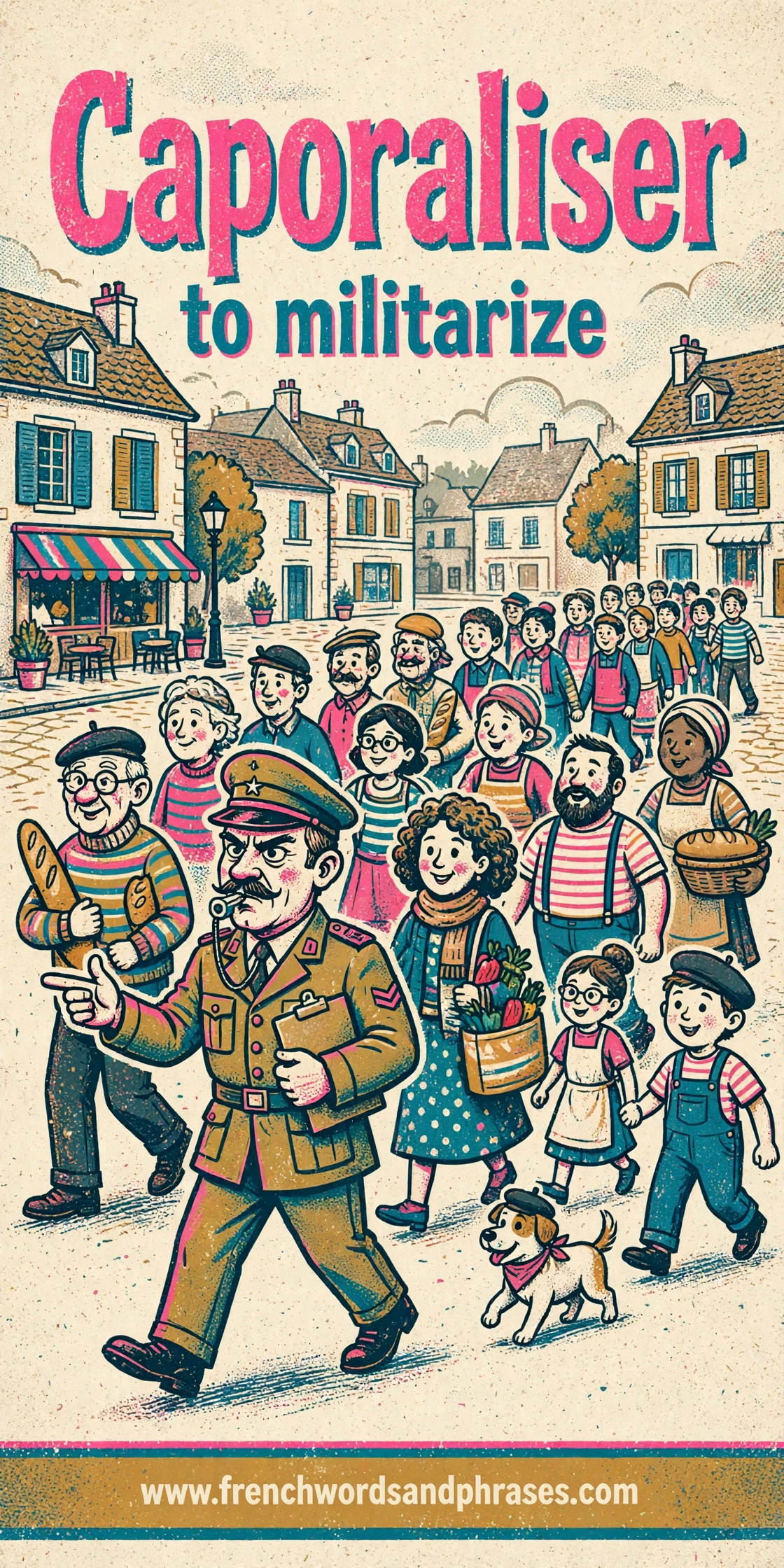
A French Word to Live By
How to Conjugate Caporaliser in French
/ka.pɔ.ʁa.li.ze/
Caporaliser means to militarize — to put an organisation, a school or a whole society under military discipline, run by ranks, orders and the corporal’s stick.
A factory run like a barracks, a youth movement marching in step, a minister who answers every question with an order — caporaliser is the verb of civilian life squeezed into uniform: hierarchy, drill and obedience, imposed from above.
In this guide, you’ll learn how to conjugate caporaliser in all the major French tenses and moods. Explore complete conjugation tables, French examples, English translations, and practice quizzes.
Understanding the French Verb Caporaliser
Caporaliser is a regular French verb belonging to the first group of verbs, those ending in-er.
It means to militarize. It belongs to political and historical prose — caporaliser l’Allemagne, caporaliser la jeunesse — where the charge is not just having an army, but organising civilian life itself on military lines: ranks, uniforms, drill and unquestioning obedience.
Verb classification: First group (-er)
Auxiliary verb: Avoir
Past participle: caporalisé
Present participle: caporalisant
English equivalents: To militarize, to run on military lines; caporaliser un pays — to militarize a country; caporaliser l’enseignement — to put education under military discipline; caporaliser les esprits — to regiment people’s minds; un régime qui caporalise la société — a regime that militarizes society.
One important detail: caporaliser is built on le caporal, the corporal — the lowest non-commissioned rank, famous in French political writing as the symbol of petty, bullying authority. The verb is a term of criticism, used by journalists and historians, almost never as praise: to caporaliser a society is to accuse its rulers of loving the parade ground too much. The conjugation is perfectly regular: je caporalise, nous caporalisons, ils caporalisent, past participle caporalisé.
Experience the Word
Caporaliser is the verb of the barracks swallowing the street — when the corporal’s whistle replaces the citizen’s voice.
Imagine a country where the new regime closes the debating societies and opens drill halls, where schoolchildren march to class in columns and factory workers wear numbered uniforms — le gouvernement caporalise le pays entier, one institution at a time.
Nobody declared war. Society has simply been militarized — caporalisée, drilled into step.
How to Conjugate Caporaliser: Complete French Conjugation Guide
Let’s explore every major conjugation of caporaliser, beginning with the indicative mood.
How to Conjugate Caporaliser in the Indicative Mood
The indicative mood is used to express facts, observations, actions, and events.
How to Conjugate Caporaliser in the Present Tense (Présent)
Used for actions happening now, habitual actions, and general truths.
| Subject | Conjugation |
|---|---|
| je | caporalise |
| tu | caporalises |
| il / elle | caporalise |
| nous | caporalisons |
| vous | caporalisez |
| ils / elles | caporalisent |
Example
Ce régime caporalise la société entière.
This regime is militarizing the whole of society.
Quick Quiz 1
Complete the sentence:
Nous refusons que l’on ______ nos écoles.
Reveal the answer
caporalise
Nous refusons que l’on caporalise nos écoles.
We refuse to let our schools be militarized.
How to Conjugate Caporaliser in the Passé Composé
Used for completed actions in the past. Caporaliser takes the auxiliary verb avoir.
| Subject | Conjugation |
|---|---|
| j’ | ai caporalisé |
| tu | as caporalisé |
| il / elle | a caporalisé |
| nous | avons caporalisé |
| vous | avez caporalisé |
| ils / elles | ont caporalisé |
Example
Le dictateur a caporalisé l’administration en deux ans.
The dictator militarized the administration in two years.
How to Conjugate Caporaliser in the Imparfait (Imperfect Tense)
Used for habitual past actions, descriptions, and ongoing situations in the past.
| Subject | Conjugation |
|---|---|
| je | caporalisais |
| tu | caporalisais |
| il / elle | caporalisait |
| nous | caporalisions |
| vous | caporalisiez |
| ils / elles | caporalisaient |
Example
Autrefois, cet État caporalisait même les écoles.
In the old days, that state used to militarize even the schools.
Quick Quiz 2
Choose the correct form:
The dictator militarized the administration.
Le dictateur ______ l’administration. (a caporalisé / est caporalisé)
Reveal the answer
a caporalisé
Le dictateur a caporalisé l’administration.
Caporaliser takes avoir.
How to Conjugate Caporaliser in the Plus-que-parfait
Used to describe an action that had already been completed before another past event.
| Subject | Conjugation |
|---|---|
| j’ | avais caporalisé |
| tu | avais caporalisé |
| il / elle | avait caporalisé |
| nous | avions caporalisé |
| vous | aviez caporalisé |
| ils / elles | avaient caporalisé |
Example
Ils avaient caporalisé la jeunesse avant la guerre.
They had militarized the youth before the war.
How to Conjugate Caporaliser in the Passé Simple
Primarily used in formal writing, literature, and historical narratives. It is rarely used in everyday conversation.
| Subject | Conjugation |
|---|---|
| je | caporalisai |
| tu | caporalisas |
| il / elle | caporalisa |
| nous | caporalisâmes |
| vous | caporalisâtes |
| ils / elles | caporalisèrent |
Example
Le nouveau pouvoir caporalisa le pays en quelques mois.
The new power militarized the country in a few months.
How to Conjugate Caporaliser in the Passé Antérieur
A literary tense used to express an action completed immediately before another past action, generally in the passé simple.
| Subject | Conjugation |
|---|---|
| j’ | eus caporalisé |
| tu | eus caporalisé |
| il / elle | eut caporalisé |
| nous | eûmes caporalisé |
| vous | eûtes caporalisé |
| ils / elles | eurent caporalisé |
Example
Quand le régime eut caporalisé la presse, plus personne n’osa écrire.
When the regime had militarized the press, nobody dared write any more.
How to Conjugate Caporaliser in the Future Tense (Futur Simple)
Used to describe actions that will take place in the future.
| Subject | Conjugation |
|---|---|
| je | caporaliserai |
| tu | caporaliseras |
| il / elle | caporalisera |
| nous | caporaliserons |
| vous | caporaliserez |
| ils / elles | caporaliseront |
Example
Si nous ne réagissons pas, ils caporaliseront toutes les institutions.
If we do not react, they will militarize every institution.
How to Conjugate Caporaliser in the Futur Antérieur (Future Perfect)
Used for an action that will have been completed before a particular point in the future.
| Subject | Conjugation |
|---|---|
| j’ | aurai caporalisé |
| tu | auras caporalisé |
| il / elle | aura caporalisé |
| nous | aurons caporalisé |
| vous | aurez caporalisé |
| ils / elles | auront caporalisé |
Example
En dix ans, le régime aura caporalisé l’ensemble du pays.
In ten years, the regime will have militarized the whole country.
How to Conjugate Caporaliser in the Near Future (Futur Proche)
Used to describe something that is going to happen soon. Formed with aller + infinitive.
| Subject | Conjugation |
|---|---|
| je | vais caporaliser |
| tu | vas caporaliser |
| il / elle | va caporaliser |
| nous | allons caporaliser |
| vous | allez caporaliser |
| ils / elles | vont caporaliser |
Example
Le gouvernement va caporaliser l’enseignement, disent les journaux.
The government is going to militarize education, say the newspapers.
How to Conjugate Caporaliser in the Conditional Mood
The conditional mood expresses what would happen under certain circumstances. It is also frequently used to make polite requests or express wishes.
How to Conjugate Caporaliser in the Present Conditional
| Subject | Conjugation |
|---|---|
| je | caporaliserais |
| tu | caporaliserais |
| il / elle | caporaliserait |
| nous | caporaliserions |
| vous | caporaliseriez |
| ils / elles | caporaliseraient |
Example
Un tel ministre caporaliserait même les bibliothèques.
Such a minister would militarize even the libraries.
How to Conjugate Caporaliser in the Past Conditional
| Subject | Conjugation |
|---|---|
| j’ | aurais caporalisé |
| tu | aurais caporalisé |
| il / elle | aurait caporalisé |
| nous | aurions caporalisé |
| vous | auriez caporalisé |
| ils / elles | auraient caporalisé |
Example
Il aurait caporalisé l’usine si les syndicats n’avaient pas protesté.
He would have militarized the factory if the unions had not protested.
Caporaliser in the Literary Past Conditional Form
This less common literary form uses the imperfect subjunctive of avoir.
| Subject | Conjugation |
|---|---|
| j’ | eusse caporalisé |
| tu | eusses caporalisé |
| il / elle | eût caporalisé |
| nous | eussions caporalisé |
| vous | eussiez caporalisé |
| ils / elles | eussent caporalisé |
Example
Le tyran eût caporalisé jusqu’aux écoles de village.
The tyrant would have militarized even the village schools.
How to Conjugate Caporaliser in the Subjunctive Mood
The subjunctive is used to express wishes, emotions, doubts, necessity, and uncertainty. It frequently follows expressions such as il faut que (it is necessary that) or bien que (although).
How to Conjugate Caporaliser in the Present Subjunctive
| Subject | Conjugation |
|---|---|
| que je | caporalise |
| que tu | caporalises |
| qu’il / qu’elle | caporalise |
| que nous | caporalisions |
| que vous | caporalisiez |
| qu’ils / qu’elles | caporalisent |
Example
Il est dangereux qu’un régime caporalise les esprits.
It is dangerous for a regime to regiment people’s minds.
Quick Quiz 3
Complete the sentence using the subjunctive:
Il est dangereux que vous ______ les esprits des jeunes.
Reveal the answer
caporalisiez
Il est dangereux que vous caporalisiez les esprits des jeunes.
It is dangerous for you to regiment young minds.
How to Conjugate Caporaliser in the Imperfect Subjunctive
A literary tense, rarely encountered in modern spoken French.
| Subject | Conjugation |
|---|---|
| que je | caporalisasse |
| que tu | caporalisasses |
| qu’il / qu’elle | caporalisât |
| que nous | caporalisassions |
| que vous | caporalisassiez |
| qu’ils / qu’elles | caporalisassent |
Example
Les historiens décrivent un État qui caporalisât tout.
Historians describe a state that militarized everything.
How to Conjugate Caporaliser in the Pluperfect Subjunctive
A literary construction used to express an action completed before another past action.
| Subject | Conjugation |
|---|---|
| que j’ | eusse caporalisé |
| que tu | eusses caporalisé |
| qu’il / qu’elle | eût caporalisé |
| que nous | eussions caporalisé |
| que vous | eussiez caporalisé |
| qu’ils / qu’elles | eussent caporalisé |
Example
On craignait que le pouvoir eût caporalisé la justice.
People feared the government had militarized the courts.
How to Conjugate Caporaliser in the Past Subjunctive
| que j’ | aie caporalisé |
| que tu | aies caporalisé |
| qu’il / qu’elle | ait caporalisé |
| que nous | ayons caporalisé |
| que vous | ayez caporalisé |
| qu’ils / qu’elles | aient caporalisé |
Example
Je regrette que le pays ait caporalisé son administration.
I regret that the country militarized its administration.
How to Conjugate Caporaliser in the Imperative
The imperative is used to give commands, instructions, invitations, or suggestions. Subject pronouns are omitted.
How to Conjugate Caporaliser in the Present Imperative
| Person | Conjugation |
|---|---|
| (tu) | caporalise |
| (nous) | caporalisons |
| (vous) | caporalisez |
Example
Ne caporalise pas ton entreprise, écoute tes employés !
Do not run your company like a barracks, listen to your employees!
Quick Quiz 4
How would you say Do not run your firm like a barracks (tu form)?
Reveal the answer
Ne caporalise pas ton entreprise !
French Participles of Caporaliser
Participles are verb forms that can be used in compound tenses and other grammatical constructions.
Present Participle of Caporaliser
caporalisant
En caporalisant les écoles, le régime préparait des soldats, pas des citoyens.
By militarizing the schools, the regime was preparing soldiers, not citizens.
Past Participle of Caporaliser
caporalisé
Caporalisée dès l’enfance, cette génération ne connaissait que l’obéissance.
Militarized from childhood, that generation knew only obedience.
Caporaliser in Everyday French: Real-Life Examples
Now that you know the conjugations, let’s see how caporaliser appears in everyday French.
Example 1 — Present
Ce régime caporalise la société entière.
This regime is militarizing the whole of society.
Example 2 — Passé composé
Le dictateur a caporalisé l’administration.
The dictator militarized the administration.
Example 3 — Imparfait
Cet État caporalisait même les écoles.
That state used to militarize even the schools.
Example 4 — Future
Ils caporaliseront toutes les institutions.
They will militarize every institution.
Example 5 — Conditional
Un tel ministre caporaliserait même les bibliothèques.
Such a minister would militarize even the libraries.
Example 6 — Imperative
Ne caporalise pas ton entreprise !
Do not run your company like a barracks!
Beyond Translation: The Meaning of Caporaliser
English militarize is neutral; French caporaliser sneers — the caporal is no general but the pettiest rank of all, the little corporal with the big stick.
The insult is built into the etymology.
French political language has used le caporal for two centuries as shorthand for bullying small authority — so a pays caporalisé is not just armed, it is being bullied into step by corporals.
How to Remember the French Verb Caporaliser
Remember it this way: Caporaliser is about schoolchildren marching to class in columns, whistled into step.
- Le caporal, the corporal, is inside the word — petty military authority is the point.
- A word of criticism in political prose: regimes caporalisent; democracies complain about it.
- Regular -er: je caporalise, nous caporalisons, past participle caporalisé.
The key idea is schoolchildren marching to class in columns, whistled into step.
Test Your Knowledge of Caporaliser
Let’s see how much you’ve learned. Try answering these questions before revealing the answers.
Question 1
Why is caporaliser a word of criticism rather than praise?
Reveal the answer
Because of le caporal — the petty, bullying corporal inside it: to caporaliser is to impose barracks discipline on civilian life.
Question 2
How do you say This regime is militarizing society in French?
Reveal the answer
Ce régime caporalise la société.
Question 3
Translate: The dictator militarized the administration in two years.
Reveal the answer
Le dictateur a caporalisé l’administration en deux ans.
Question 4
What is the past participle of caporaliser?
Reveal the answer
Caporalisé.
Question 5
Complete the sentence:
Il est dangereux qu’un régime ______ les esprits.
Reveal the answer
caporalise
Il est dangereux qu’un régime caporalise les esprits.
It is dangerous for a regime to regiment people’s minds.
Your Final Challenge
Can You Use It?
How would you say this in French?
A country that is militarized learns to march in step, but unlearns how to think aloud.
Reveal the answer
Un pays que l’on caporalise apprend à marcher au pas, mais il désapprend à penser tout haut.
A country that is militarized learns to march in step, but unlearns how to think aloud.
A little French. A little curiosity. A richer everyday life.
LEARN FRENCH ONE WORD AT A TIME




