
A French Word to Live By
How to Conjugate Capituler in French
/ka.pi.ty.le/
Capituler means to capitulate, to surrender — to lay down resistance at last, whether it is a garrison opening its gates or a parent giving in to a child’s pleading.
A fortress firing its last shot before the white flag rises, a father finally agreeing to the puppy after a month of siege — capituler is the verb of the moment resistance ends: terms accepted, arms laid down, the struggle honourably over.
In this guide, you’ll learn how to conjugate capituler in all the major French tenses and moods. Explore complete conjugation tables, French examples, English translations, and practice quizzes.
Understanding the French Verb Capituler
Capituler is a regular French verb belonging to the first group of verbs, those ending in-er.
It means to capitulate, to surrender. It is the word of treaties and sieges — la capitulation de la garnison — and, by playful extension, of any long resistance that finally crumbles: parents capitulent devant les supplications, negotiators capitulent after weeks of talks. It implies a struggle that was real before it ended.
Verb classification: First group (-er)
Auxiliary verb: Avoir
Past participle: capitulé
Present participle: capitulant
English equivalents: To capitulate, to surrender, to give in; capituler devant l’ennemi — to surrender to the enemy; capituler sans conditions — to surrender unconditionally; capituler devant les faits — to yield to the facts; faire capituler quelqu’un — to make someone give in.
One important detail: capituler is a perfectly regular -er verb — je capitule, nous capitulons, ils capitulent, past participle capitulé — and it usually stands alone or with devant: capituler devant l’ennemi, capituler devant l’évidence. Do not confuse it with se rendre, which is the plain everyday verb for surrendering; capituler is the formal, historical word, and its noun is la capitulation.
Experience the Word
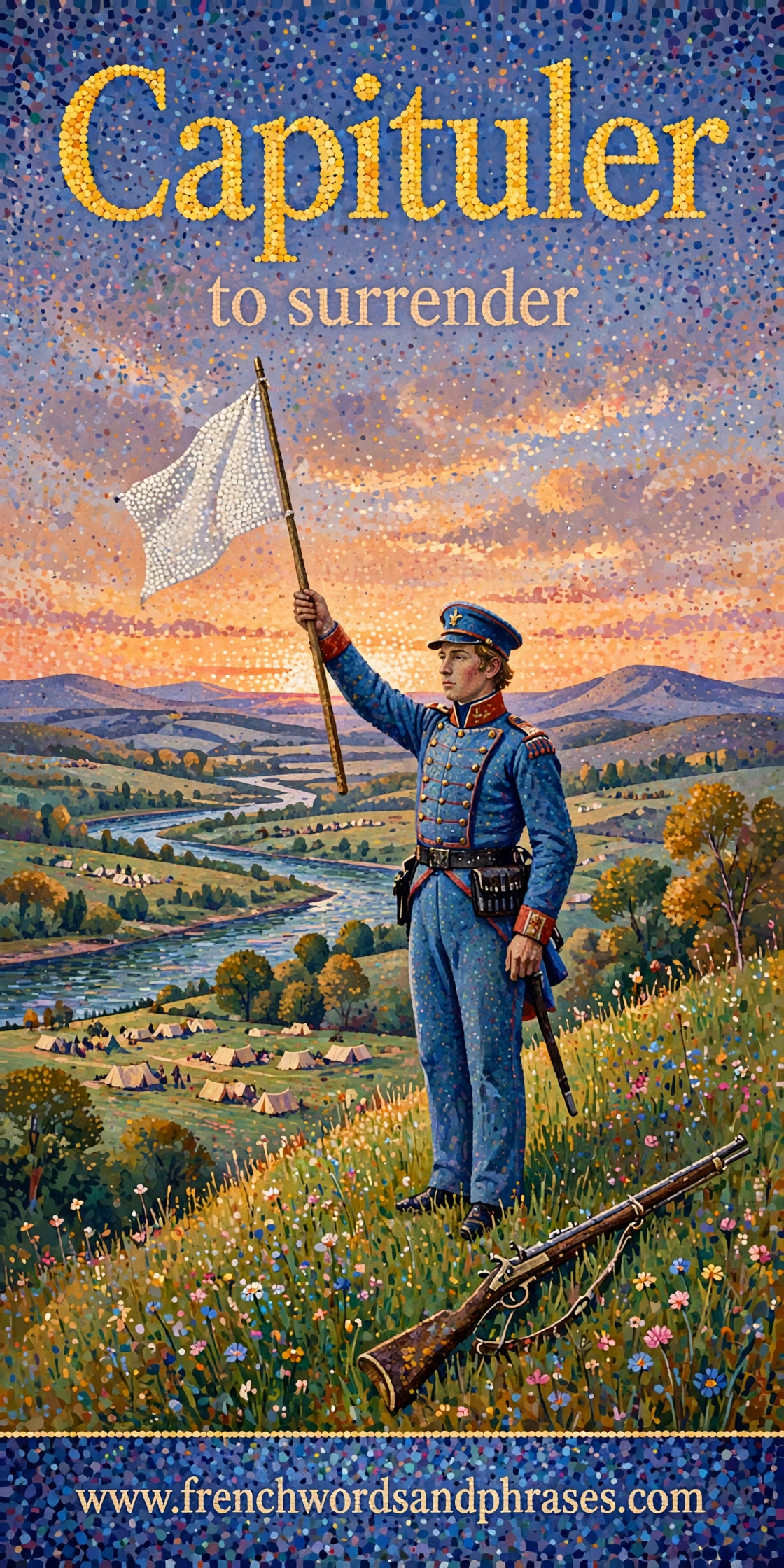
Capituler is the verb of the white flag — not the first retreat, but the final, formal end of resistance.
Imagine a besieged town in winter. The bread is gone, the powder is wet, the walls are breached — at dawn the mayor walks out with a white cloth on a pole: la ville capitule, and the gates open in silence.
The fight was long and brave. Now it is over — capitulé, signed, and entered into history.
How to Conjugate Capituler: Complete French Conjugation Guide
Let’s explore every major conjugation of capituler, beginning with the indicative mood.
How to Conjugate Capituler in the Indicative Mood
The indicative mood is used to express facts, observations, actions, and events.
How to Conjugate Capituler in the Present Tense (Présent)
Used for actions happening now, habitual actions, and general truths.
| Subject | Conjugation |
|---|---|
| je | capitule |
| tu | capitules |
| il / elle | capitule |
| nous | capitulons |
| vous | capitulez |
| ils / elles | capitulent |
Example
La garnison capitule après trois mois de siège.
The garrison surrenders after three months of siege.
Quick Quiz 1
Complete the sentence:
Nous ne ______ jamais devant la menace.
Reveal the answer
capitulons
Nous ne capitulons jamais devant la menace.
We never surrender to the threat.
How to Conjugate Capituler in the Passé Composé
Used for completed actions in the past. Capituler takes the auxiliary verb avoir.
| Subject | Conjugation |
|---|---|
| j’ | ai capitulé |
| tu | as capitulé |
| il / elle | a capitulé |
| nous | avons capitulé |
| vous | avez capitulé |
| ils / elles | ont capitulé |
Example
Le général a capitulé sans conditions.
The general surrendered unconditionally.
How to Conjugate Capituler in the Imparfait (Imperfect Tense)
Used for habitual past actions, descriptions, and ongoing situations in the past.
| Subject | Conjugation |
|---|---|
| je | capitulais |
| tu | capitulais |
| il / elle | capitulait |
| nous | capitulions |
| vous | capituliez |
| ils / elles | capitulaient |
Example
Les défenseurs ne capitulaient jamais avant l’aube.
The defenders never surrendered before dawn.
Quick Quiz 2
Choose the correct form:
The general surrendered unconditionally.
Le général ______ sans conditions. (a capitulé / est capitulé)
Reveal the answer
a capitulé
Le général a capitulé sans conditions.
Capituler takes avoir.
How to Conjugate Capituler in the Plus-que-parfait
Used to describe an action that had already been completed before another past event.
| Subject | Conjugation |
|---|---|
| j’ | avais capitulé |
| tu | avais capitulé |
| il / elle | avait capitulé |
| nous | avions capitulé |
| vous | aviez capitulé |
| ils / elles | avaient capitulé |
Example
La ville avait capitulé avant l’arrivée des secours.
The town had capitulated before help arrived.
How to Conjugate Capituler in the Passé Simple
Primarily used in formal writing, literature, and historical narratives. It is rarely used in everyday conversation.
| Subject | Conjugation |
|---|---|
| je | capitulai |
| tu | capitulas |
| il / elle | capitula |
| nous | capitulâmes |
| vous | capitulâtes |
| ils / elles | capitulèrent |
Example
Après un long siège, la forteresse capitula.
After a long siege, the fortress capitulated.
How to Conjugate Capituler in the Passé Antérieur
A literary tense used to express an action completed immediately before another past action, generally in the passé simple.
| Subject | Conjugation |
|---|---|
| j’ | eus capitulé |
| tu | eus capitulé |
| il / elle | eut capitulé |
| nous | eûmes capitulé |
| vous | eûtes capitulé |
| ils / elles | eurent capitulé |
Example
Quand l’armée eut capitulé, les cloches se turent.
When the army had surrendered, the bells fell silent.
How to Conjugate Capituler in the Future Tense (Futur Simple)
Used to describe actions that will take place in the future.
| Subject | Conjugation |
|---|---|
| je | capitulerai |
| tu | capituleras |
| il / elle | capitulera |
| nous | capitulerons |
| vous | capitulerez |
| ils / elles | capituleront |
Example
Ils ne capituleront jamais devant la menace.
They will never surrender to the threat.
How to Conjugate Capituler in the Futur Antérieur (Future Perfect)
Used for an action that will have been completed before a particular point in the future.
| Subject | Conjugation |
|---|---|
| j’ | aurai capitulé |
| tu | auras capitulé |
| il / elle | aura capitulé |
| nous | aurons capitulé |
| vous | aurez capitulé |
| ils / elles | auront capitulé |
Example
À la fin du mois, la direction aura capitulé devant les grévistes.
By the end of the month, the management will have given in to the strikers.
How to Conjugate Capituler in the Near Future (Futur Proche)
Used to describe something that is going to happen soon. Formed with aller + infinitive.
| Subject | Conjugation |
|---|---|
| je | vais capituler |
| tu | vas capituler |
| il / elle | va capituler |
| nous | allons capituler |
| vous | allez capituler |
| ils / elles | vont capituler |
Example
Le gouvernement va capituler devant la pression de la rue.
The government is going to give in to pressure from the street.
How to Conjugate Capituler in the Conditional Mood
The conditional mood expresses what would happen under certain circumstances. It is also frequently used to make polite requests or express wishes.
How to Conjugate Capituler in the Present Conditional
| Subject | Conjugation |
|---|---|
| je | capitulerais |
| tu | capitulerais |
| il / elle | capitulerait |
| nous | capitulerions |
| vous | capituleriez |
| ils / elles | capituleraient |
Example
Sans vivres, même les plus braves capituleraient.
Without food, even the bravest would surrender.
How to Conjugate Capituler in the Past Conditional
| Subject | Conjugation |
|---|---|
| j’ | aurais capitulé |
| tu | aurais capitulé |
| il / elle | aurait capitulé |
| nous | aurions capitulé |
| vous | auriez capitulé |
| ils / elles | auraient capitulé |
Example
Il aurait capitulé plus tôt si on lui avait offert des conditions honorables.
He would have surrendered sooner if he had been offered honourable terms.
Capituler in the Literary Past Conditional Form
This less common literary form uses the imperfect subjunctive of avoir.
| Subject | Conjugation |
|---|---|
| j’ | eusse capitulé |
| tu | eusses capitulé |
| il / elle | eût capitulé |
| nous | eussions capitulé |
| vous | eussiez capitulé |
| ils / elles | eussent capitulé |
Example
La citadelle eût capitulé avant l’hiver.
The citadel would have capitulated before winter.
How to Conjugate Capituler in the Subjunctive Mood
The subjunctive is used to express wishes, emotions, doubts, necessity, and uncertainty. It frequently follows expressions such as il faut que (it is necessary that) or bien que (although).
How to Conjugate Capituler in the Present Subjunctive
| Subject | Conjugation |
|---|---|
| que je | capitule |
| que tu | capitules |
| qu’il / qu’elle | capitule |
| que nous | capitulions |
| que vous | capituliez |
| qu’ils / qu’elles | capitulent |
Example
Il est impossible que nos soldats capitulent.
It is impossible for our soldiers to surrender.
Quick Quiz 3
Complete the sentence using the subjunctive:
Il est impossible que vous ______ si vite.
Reveal the answer
capituliez
Il est impossible que vous capituliez si vite.
It is impossible for you to give in so quickly.
How to Conjugate Capituler in the Imperfect Subjunctive
A literary tense, rarely encountered in modern spoken French.
| Subject | Conjugation |
|---|---|
| que je | capitulasse |
| que tu | capitulasses |
| qu’il / qu’elle | capitulât |
| que nous | capitulassions |
| que vous | capitulassiez |
| qu’ils / qu’elles | capitulassent |
Example
Le roi refusait que la ville capitulât sans combattre.
The king refused to let the town surrender without a fight.
How to Conjugate Capituler in the Pluperfect Subjunctive
A literary construction used to express an action completed before another past action.
| Subject | Conjugation |
|---|---|
| que j’ | eusse capitulé |
| que tu | eusses capitulé |
| qu’il / qu’elle | eût capitulé |
| que nous | eussions capitulé |
| que vous | eussiez capitulé |
| qu’ils / qu’elles | eussent capitulé |
Example
Les chroniques disent que la garnison eût capitulé faute de pain.
The chronicles say the garrison had surrendered for lack of bread.
How to Conjugate Capituler in the Past Subjunctive
| Subject | Conjugation |
|---|---|
| que j’ | aie capitulé |
| que tu | aies capitulé |
| qu’il / qu’elle | ait capitulé |
| que nous | ayons capitulé |
| que vous | ayez capitulé |
| qu’ils / qu’elles | aient capitulé |
Example
Je suis étonné que le directeur ait capitulé si vite.
I am surprised the director gave in so quickly.
How to Conjugate Capituler in the Imperative
The imperative is used to give commands, instructions, invitations, or suggestions. Subject pronouns are omitted.
How to Conjugate Capituler in the Present Imperative
| Person | Conjugation |
|---|---|
| (tu) | capitule |
| (nous) | capitulons |
| (vous) | capitulez |
Example
Ne capitule jamais devant la peur !
Never surrender to fear!
Quick Quiz 4
How would you say Never surrender to fear (tu form)?
Reveal the answer
Ne capitule jamais devant la peur !
French Participles of Capituler
Participles are verb forms that can be used in compound tenses and other grammatical constructions.
Present Participle of Capituler
capitulant
En capitulant trop tôt, il a tout perdu.
By surrendering too soon, he lost everything.
Past Participle of Capituler
capitulé
La ville a capitulé, mais ses habitants gardent la tête haute.
The town surrendered, but its people keep their heads high.
Capituler in Everyday French: Real-Life Examples
Now that you know the conjugations, let’s see how capituler appears in everyday French.
Example 1 — Present
La garnison capitule après trois mois de siège.
The garrison surrenders after three months of siege.
Example 2 — Passé composé
Le général a capitulé sans conditions.
The general surrendered unconditionally.
Example 3 — Imparfait
Les défenseurs ne capitulaient jamais.
The defenders never used to surrender.
Example 4 — Future
Ils ne capituleront jamais devant la menace.
They will never surrender to the threat.
Example 5 — Conditional
Sans vivres, les plus braves capituleraient.
Without food, the bravest would surrender.
Example 6 — Imperative
Ne capitule jamais devant la peur !
Never surrender to fear!
Beyond Translation: The Meaning of Capituler
English capitulate is the same word — and both hide a surprise: Latin capitula are little heads, chapters. To capitulate was first to draw up terms under headings.
A capitulation is a document before it is a defeat.
That is why capituler still smells of parchment and signatures, while everyday surrender is se rendre — the white flag in capituler always comes with clauses attached.
How to Remember the French Verb Capituler
Remember it this way: Capituler is about the mayor walking out at dawn with a white cloth on a pole.
- Devant is its partner preposition: capituler devant l’ennemi, devant les faits.
- Formal and historical — everyday French says se rendre for plain surrendering.
- Regular -er: je capitule, nous capitulons, past participle capitulé.
The key idea is the mayor walking out at dawn with a white cloth on a pole.
Test Your Knowledge of Capituler
Let’s see how much you’ve learned. Try answering these questions before revealing the answers.
Question 1
Which everyday verb usually replaces capituler for plain surrendering?
Reveal the answer
Se rendre — capituler is the formal, historical word, the one of treaties and sieges.
Question 2
How do you say The garrison surrenders in French?
Reveal the answer
La garnison capitule.
Question 3
Translate: The general surrendered unconditionally.
Reveal the answer
Le général a capitulé sans conditions.
Question 4
What is the past participle of capituler?
Reveal the answer
Capitulé.
Question 5
Complete the sentence:
Il est impossible que nos soldats ______.
Reveal the answer
capitulent
Il est impossible que nos soldats capitulent.
It is impossible for our soldiers to surrender.
Your Final Challenge
Can You Use It?
How would you say this in French?
The old fortress never surrendered to armies, only to time, stone by stone.
Reveal the answer
La vieille forteresse n’a jamais capitulé devant les armées, seulement devant le temps, pierre par pierre.
The old fortress never surrendered to armies, only to time, stone by stone.
A little French. A little curiosity. A richer everyday life.
LEARN FRENCH ONE WORD AT A TIME




