
A French Word to Live By
How to Conjugate Capitonner in French
/ka.pi.tɔ.ne/
Capitonner means to pad, to upholster — to cover furniture with soft stuffing held in place by buttons sunk deep into the fabric, giving that quilted, dimpled finish.
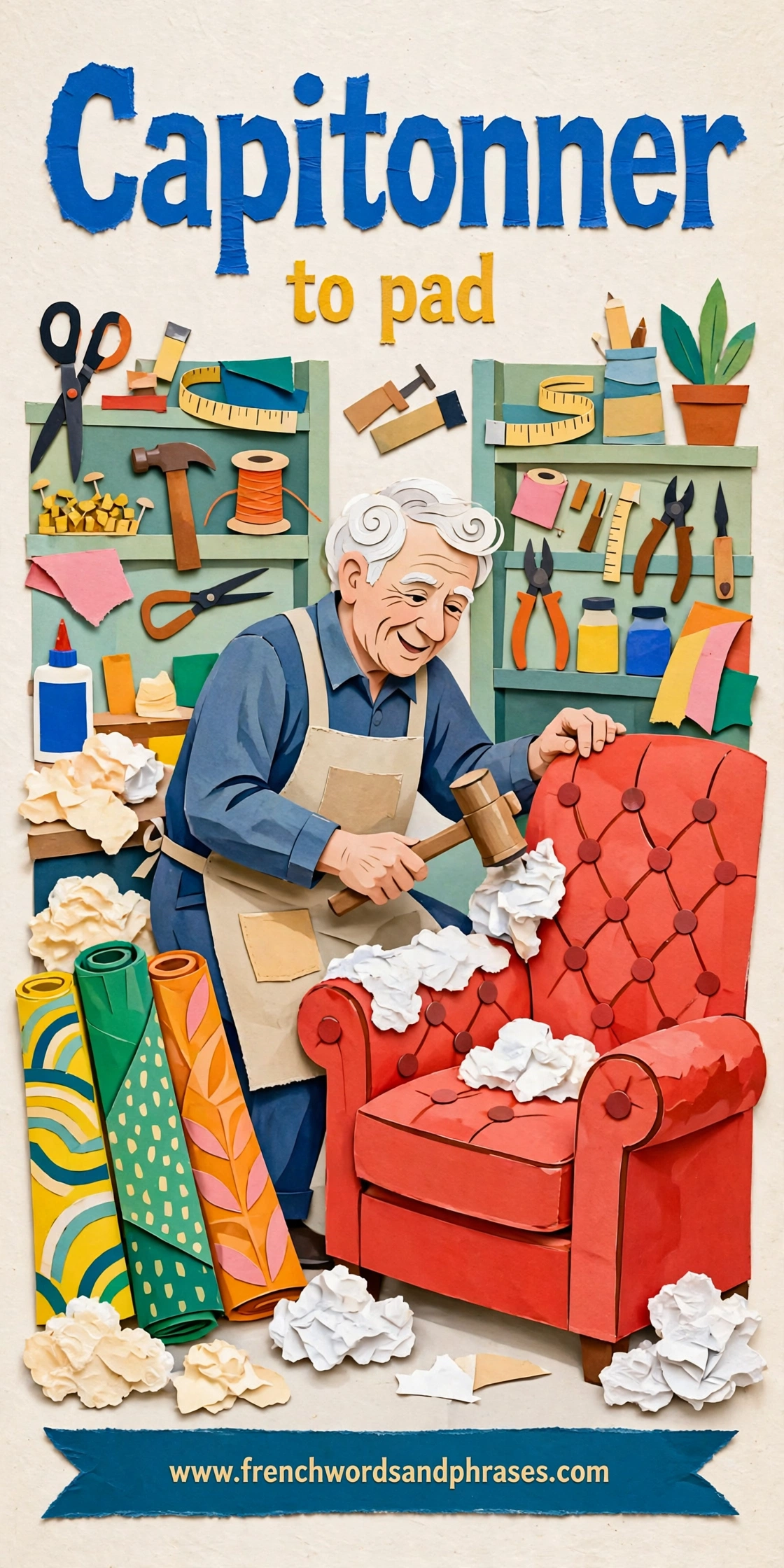
A craftsman in a quiet workshop, pulling a long needle through velvet and wadding, sinking button after button until the chair back dimples like a chocolate bar — capitonner is the upholsterer’s verb: softness, stitched into pattern.
In this guide, you’ll learn how to conjugate capitonner in all the major French tenses and moods. Explore complete conjugation tables, French examples, English translations, and practice quizzes.
Understanding the French Verb Capitonner
Capitonner is a regular French verb belonging to the first group of verbs, those ending in-er.
It means to pad, to upholster. It is the technical word of the upholstery trade (le capitonnage is the craft itself), used of armchairs, headboards, doors and carriage interiors — anywhere softness is quilted down with buttons. Outside the trade you meet the adjective far more often than the verb.
Verb classification: First group (-er)
Auxiliary verb: Avoir
Past participle: capitonné
Present participle: capitonnant
English equivalents: To pad, to upholster, to button (upholstery); capitonner un fauteuil — to upholster an armchair; capitonner une porte — to pad a door; un dossier capitonné — a buttoned back; du cuir capitonné — padded, quilted leather.
One important detail: capitonner is built on le capiton, the silk floss and wadding used for stuffing — and its adjective capitonné has escaped the workshop into everyday French: une porte capitonnée (a padded door, for silence), un fauteuil capitonné. The verb itself is perfectly regular: je capitonne, nous capitonnons, ils capitonnent, past participle capitonné.
Experience the Word
Capitonner is the verb of the dimpled chair — every button a small anchor holding the softness in place.
Imagine an old Paris workshop smelling of leather and horsehair. The upholsterer stretches crimson velvet over the chair back, drives his long needle through, and pulls each button down into the wadding — il capitonne le fauteuil — until the whole back blooms into deep, soft diamonds.
The chair was hard wood an hour ago. Now it is padded — capitonné, buttoned and plump as a cushion.
How to Conjugate Capitonner: Complete French Conjugation Guide
Let’s explore every major conjugation of capitonner, beginning with the indicative mood.
How to Conjugate Capitonner in the Indicative Mood
The indicative mood is used to express facts, observations, actions, and events.
How to Conjugate Capitonner in the Present Tense (Présent)
Used for actions happening now, habitual actions, and general truths.
| Subject | Conjugation |
|---|---|
| je | capitonne |
| tu | capitonnes |
| il / elle | capitonne |
| nous | capitonnons |
| vous | capitonnez |
| ils / elles | capitonnent |
Example
Le tapissier capitonne le dossier du fauteuil avec soin.
The upholsterer pads the back of the armchair with care.
Quick Quiz 1
Complete the sentence:
Nous ______ les banquettes du restaurant.
Reveal the answer
capitonnons
Nous capitonnons les banquettes du restaurant.
We are upholstering the restaurant’s banquettes.
How to Conjugate Capitonner in the Passé Composé
Used for completed actions in the past. Capitonner takes the auxiliary verb avoir.
| Subject | Conjugation |
|---|---|
| j’ | ai capitonné |
| tu | as capitonné |
| il / elle | a capitonné |
| nous | avons capitonné |
| vous | avez capitonné |
| ils / elles | ont capitonné |
Example
Ils ont capitonné les portes du studio pour le silence.
They padded the studio doors for silence.
How to Conjugate Capitonner in the Imparfait (Imperfect Tense)
Used for habitual past actions, descriptions, and ongoing situations in the past.
| Subject | Conjugation |
|---|---|
| je | capitonnais |
| tu | capitonnais |
| il / elle | capitonnait |
| nous | capitonnions |
| vous | capitonniez |
| ils / elles | capitonnaient |
Example
Autrefois, on capitonnait les sièges des voitures à chevaux.
In the old days, they used to pad the seats of horse-drawn carriages.
Quick Quiz 2
Choose the correct form:
They padded the studio doors.
Ils ______ les portes du studio. (ont capitonné / sont capitonné)
Reveal the answer
ont capitonné
Ils ont capitonné les portes du studio.
Capitonner takes avoir.
How to Conjugate Capitonner in the Plus-que-parfait
Used to describe an action that had already been completed before another past event.
| Subject | Conjugation |
|---|---|
| j’ | avais capitonné |
| tu | avais capitonné |
| il / elle | avait capitonné |
| nous | avions capitonné |
| vous | aviez capitonné |
| ils / elles | avaient capitonné |
Example
Elle avait capitonné la tête de lit avant l’arrivée des invités.
She had upholstered the headboard before the guests arrived.
How to Conjugate Capitonner in the Passé Simple
Primarily used in formal writing, literature, and historical narratives. It is rarely used in everyday conversation.
| Subject | Conjugation |
|---|---|
| je | capitonnai |
| tu | capitonnas |
| il / elle | capitonna |
| nous | capitonnâmes |
| vous | capitonnâtes |
| ils / elles | capitonnèrent |
Example
L’artisan capitonna six fauteuils pour le salon de la duchesse.
The craftsman upholstered six armchairs for the duchess’s drawing room.
How to Conjugate Capitonner in the Passé Antérieur
A literary tense used to express an action completed immediately before another past action, generally in the passé simple.
| Subject | Conjugation |
|---|---|
| j’ | eus capitonné |
| tu | eus capitonné |
| il / elle | eut capitonné |
| nous | eûmes capitonné |
| vous | eûtes capitonné |
| ils / elles | eurent capitonné |
Example
Quand il eut capitonné le dernier siège, l’atelier ferma ses portes.
When he had padded the last seat, the workshop closed its doors.
How to Conjugate Capitonner in the Future Tense (Futur Simple)
Used to describe actions that will take place in the future.
| Subject | Conjugation |
|---|---|
| je | capitonnerai |
| tu | capitonneras |
| il / elle | capitonnera |
| nous | capitonnerons |
| vous | capitonnerez |
| ils / elles | capitonneront |
Example
Nous capitonnerons les banquettes du restaurant ce printemps.
We will upholster the restaurant’s banquettes this spring.
How to Conjugate Capitonner in the Futur Antérieur (Future Perfect)
Used for an action that will have been completed before a particular point in the future.
| Subject | Conjugation |
|---|---|
| j’ | aurai capitonné |
| tu | auras capitonné |
| il / elle | aura capitonné |
| nous | aurons capitonné |
| vous | aurez capitonné |
| ils / elles | auront capitonné |
Example
À Noël, ils auront capitonné tout le salon.
By Christmas, they will have upholstered the whole sitting room.
How to Conjugate Capitonner in the Near Future (Futur Proche)
Used to describe something that is going to happen soon. Formed with aller + infinitive.
| Subject | Conjugation |
|---|---|
| je | vais capitonner |
| tu | vas capitonner |
| il / elle | va capitonner |
| nous | allons capitonner |
| vous | allez capitonner |
| ils / elles | vont capitonner |
Example
Le tapissier va capitonner ce vieux fauteuil en cuir vert.
The upholsterer is going to pad this old armchair in green leather.
How to Conjugate Capitonner in the Conditional Mood
The conditional mood expresses what would happen under certain circumstances. It is also frequently used to make polite requests or express wishes.
How to Conjugate Capitonner in the Present Conditional
| Subject | Conjugation |
|---|---|
| je | capitonnerais |
| tu | capitonnerais |
| il / elle | capitonnerait |
| nous | capitonnerions |
| vous | capitonneriez |
| ils / elles | capitonneraient |
Example
Avec un tissu plus épais, on capitonnerait plus facilement.
With a thicker fabric, they would pad more easily.
How to Conjugate Capitonner in the Past Conditional
| Subject | Conjugation |
|---|---|
| j’ | aurais capitonné |
| tu | aurais capitonné |
| il / elle | aurait capitonné |
| nous | aurions capitonné |
| vous | auriez capitonné |
| ils / elles | auraient capitonné |
Example
Elle aurait capitonné la porte si le bruit l’avait gênée.
She would have padded the door if the noise had bothered her.
Capitonner in the Literary Past Conditional Form
This less common literary form uses the imperfect subjunctive of avoir.
| Subject | Conjugation |
|---|---|
| j’ | eusse capitonné |
| tu | eusses capitonné |
| il / elle | eût capitonné |
| nous | eussions capitonné |
| vous | eussiez capitonné |
| ils / elles | eussent capitonné |
Example
L’artisan eût capitonné les sièges de velours cramoisi.
The craftsman would have upholstered the seats in crimson velvet.
How to Conjugate Capitonner in the Subjunctive Mood
The subjunctive is used to express wishes, emotions, doubts, necessity, and uncertainty. It frequently follows expressions such as il faut que (it is necessary that) or bien que (although).
How to Conjugate Capitonner in the Present Subjunctive
| Subject | Conjugation |
|---|---|
| que je | capitonne |
| que tu | capitonnes |
| qu’il / qu’elle | capitonne |
| que nous | capitonnions |
| que vous | capitonniez |
| qu’ils / qu’elles | capitonnent |
Example
Il faut que le tapissier capitonne les dossiers avant vendredi.
The upholsterer must pad the backs before Friday.
Quick Quiz 3
Complete the sentence using the subjunctive:
Il faut que vous ______ la tête de lit.
Reveal the answer
capitonniez
Il faut que vous capitonniez la tête de lit.
You must upholster the headboard.
How to Conjugate Capitonner in the Imperfect Subjunctive
A literary tense, rarely encountered in modern spoken French.
| Subject | Conjugation |
|---|---|
| que je | capitonnasse |
| que tu | capitonnasses |
| qu’il / qu’elle | capitonnât |
| que nous | capitonnassions |
| que vous | capitonnassiez |
| qu’ils / qu’elles | capitonnassent |
Example
La cliente souhaitait qu’on capitonnât les fauteuils en cuir.
The client wished the armchairs to be padded in leather.
How to Conjugate Capitonner in the Pluperfect Subjunctive
A literary construction used to express an action completed before another past action.
| Subject | Conjugation |
|---|---|
| que j’ | eusse capitonné |
| que tu | eusses capitonné |
| qu’il / qu’elle | eût capitonné |
| que nous | eussions capitonné |
| que vous | eussiez capitonné |
| qu’ils / qu’elles | eussent capitonné |
Example
On racontait que l’atelier eût capitonné les sièges du palais.
People said the workshop had upholstered the palace seats.
How to Conjugate Capitonner in the Past Subjunctive
| Subject | Conjugation |
|---|---|
| que j’ | aie capitonné |
| que tu | aies capitonné |
| qu’il / qu’elle | ait capitonné |
| que nous | ayons capitonné |
| que vous | ayez capitonné |
| qu’ils / qu’elles | aient capitonné |
Example
Je suis ravi que vous ayez capitonné la tête de lit.
I am delighted that you upholstered the headboard.
How to Conjugate Capitonner in the Imperative
The imperative is used to give commands, instructions, invitations, or suggestions. Subject pronouns are omitted.
How to Conjugate Capitonner in the Present Imperative
| Person | Conjugation |
|---|---|
| (tu) | capitonne |
| (nous) | capitonnons |
| (vous) | capitonnez |
Example
Capitonne ce dossier bien profondément !
Pad this back nice and deep!
Quick Quiz 4
How would you say Pad this back (tu form)?
Reveal the answer
Capitonne ce dossier !
French Participles of Capitonner
Participles are verb forms that can be used in compound tenses and other grammatical constructions.
Present Participle of Capitonner
capitonnant
En capitonnant les sièges, il écoutait la radio.
While padding the seats, he listened to the radio.
Past Participle of Capitonner
capitonné
Capitonné de cuir rouge, le fauteuil trône près de la cheminée.
Padded in red leather, the armchair sits in state by the fireplace.
Capitonner in Everyday French: Real-Life Examples
Now that you know the conjugations, let’s see how capitonner appears in everyday French.
Example 1 — Present
Le tapissier capitonne le dossier du fauteuil.
The upholsterer pads the back of the armchair.
Example 2 — Passé composé
Ils ont capitonné les portes du studio.
They padded the studio doors.
Example 3 — Imparfait
On capitonnait les sièges des voitures à chevaux.
They used to pad the seats of horse-drawn carriages.
Example 4 — Future
Nous capitonnerons les banquettes ce printemps.
We will upholster the banquettes this spring.
Example 5 — Conditional
On capitonnerait plus facilement avec un tissu épais.
They would pad more easily with a thick fabric.
Example 6 — Imperative
Capitonne ce dossier profondément !
Pad this back deeply!
Beyond Translation: The Meaning of Capitonner
English upholsterers say deep-buttoning or tufting; French capitonner names the whole operation after the stuffing itself, le capiton.
The adjective has moved into the language of comfort.
A salon capitonné, a porte capitonnée — the word itself feels soft, and French hotels advertise capitonné the way menus advertise homemade.
How to Remember the French Verb Capitonner
Remember it this way: Capitonner is about buttons sunk into crimson velvet, diamond by diamond.
- Le capiton is the wadding — capitonner is stitching softness down with buttons.
- The adjective capitonné is the everyday word: une porte capitonnée, un fauteuil capitonné.
- Regular -er: je capitonne, nous capitonnons, past participle capitonné.
The key idea is buttons sunk into crimson velvet, diamond by diamond.
Test Your Knowledge of Capitonner
Let’s see how much you’ve learned. Try answering these questions before revealing the answers.
Question 1
What is capitonnage in the upholstery trade?
Reveal the answer
The craft of padding — stuffing furniture and buttoning the fabric down into a quilted, dimpled finish.
Question 2
How do you say The upholsterer pads the armchair in French?
Reveal the answer
Le tapissier capitonne le fauteuil.
Question 3
Translate: They padded the studio doors for silence.
Reveal the answer
Ils ont capitonné les portes du studio pour le silence.
Question 4
What is the past participle of capitonner?
Reveal the answer
Capitonné.
Question 5
Complete the sentence:
Il faut que le tapissier ______ les dossiers avant vendredi.
Reveal the answer
capitonne
Il faut que le tapissier capitonne les dossiers avant vendredi.
The upholsterer must pad the backs before Friday.
Your Final Challenge
Can You Use It?
How would you say this in French?
Padded in dark velvet, the old armchair keeps the shape of all the readers who have fallen asleep in it.
Reveal the answer
Capitonné de velours sombre, le vieux fauteuil garde la forme de tous les lecteurs qui s’y sont endormis.
Padded in dark velvet, the old armchair keeps the shape of all the readers who have fallen asleep in it.
A little French. A little curiosity. A richer everyday life.
LEARN FRENCH ONE WORD AT A TIME




