
A French Word to Live By
How to Conjugate Capeler in French
/ka.pə.le/
Capeler means to rig — in the sailor’s sense: to fit and fasten ropes, gear or a harness securely at the top of a mast or over a point, so that everything holds fast.
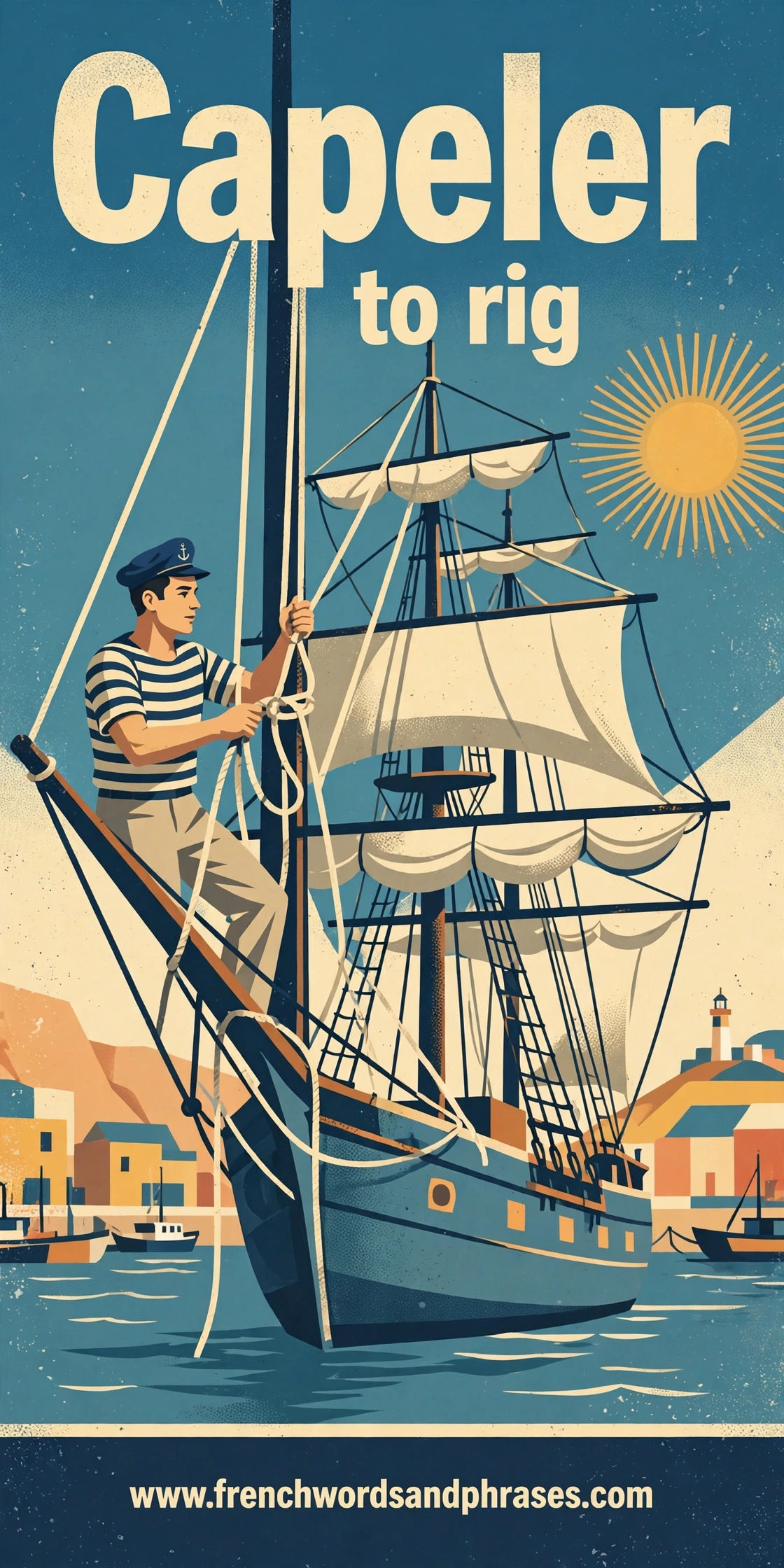
A sailor high in the rigging, passing a rope over the masthead and making it fast against the pull of the sea — capeler is the rigger’s verb: to fit gear on, snugly and securely, where the strain will come.
In this guide, you’ll learn how to conjugate capeler in all the major French tenses and moods. Explore complete conjugation tables, French examples, English translations, and practice quizzes.
Understanding the French Verb Capeler
Capeler is a regular French verb belonging to the first group of verbs, those ending in-er.
It means to rig. It is a specialist word of the rigging loft and the stable: sailors capeler the gear at a masthead, and horsemen capeler a harness onto a horse. In both worlds it means the same gesture — fitting something on so that it sits tight and will not slip under strain.
Verb classification: First group (-er)
Auxiliary verb: Avoir
Past participle: capelé
Present participle: capelant
English equivalents: To rig, to fit on securely (nautical); capeler un mât — to rig a masthead fitting; capeler un cordage — to make a rope fast over a point; capeler un harnais — to put on a harness; tout est capelé — everything is rigged and fast.
One important detail: capeler belongs to the appeler family of spelling — the single l of the infinitive doubles before a mute e. So the present runs je capelle, tu capelles, il capelle, ils capellent, while nous and vous keep one l: nous capelons, vous capelez. The doubling also runs through the whole future and conditional: je capellerai, je capellerais, and through the subjunctive singular and third plural: qu’il capelle, qu’ils capellent. The tu imperative doubles too: capelle ! — but the infinitive, the imperfect and the past participle keep the single l: capeler, je capelais, capelé.
Experience the Word
Capeler is the verb of the secure fit — gear passed over a point and made fast, checked once, trusted completely.
Imagine the top of a tall ship’s mast at dawn. The rigger sits astride the masthead, hauls the rope up hand over hand, and capelle le cordage — fits it over the cap — with the calm of a man whose knots will be tested by the whole Atlantic.
One l in the infinitive, two wherever the strain falls. The gear is rigged — capelé, doubled and fast.
How to Conjugate Capeler: Complete French Conjugation Guide
Let’s explore every major conjugation of capeler, beginning with the indicative mood.
How to Conjugate Capeler in the Indicative Mood
The indicative mood is used to express facts, observations, actions, and events.
How to Conjugate Capeler in the Present Tense (Présent)
Used for actions happening now, habitual actions, and general truths.
| Subject | Conjugation |
|---|---|
| je | capelle |
| tu | capelles |
| il / elle | capelle |
| nous | capelons |
| vous | capelez |
| ils / elles | capellent |
Example
Le gabier capelle le cordage au sommet du mât.
The topman rigs the rope at the top of the mast.
Quick Quiz 1
Complete the sentence:
Nous ______ les haubans avec soin.
Reveal the answer
capelons
Nous capelons les haubans avec soin.
We rig the shrouds with care — nous keeps the single l.
How to Conjugate Capeler in the Passé Composé
Used for completed actions in the past. Capeler takes the auxiliary verb avoir.
| Subject | Conjugation |
|---|---|
| j’ | ai capelé |
| tu | as capelé |
| il / elle | a capelé |
| nous | avons capelé |
| vous | avez capelé |
| ils / elles | ont capelé |
Example
Ils ont capelé tout le gréement avant le départ.
They rigged all the gear before departure.
How to Conjugate Capeler in the Imparfait (Imperfect Tense)
Used for habitual past actions, descriptions, and ongoing situations in the past.
| Subject | Conjugation |
|---|---|
| je | capelais |
| tu | capelais |
| il / elle | capelait |
| nous | capelions |
| vous | capeliez |
| ils / elles | capelaient |
Example
Le marin capelait les haubans avec un soin extrême.
The sailor used to rig the shrouds with extreme care.
Quick Quiz 2
Choose the correct form:
They rigged all the gear.
Ils ______ tout le gréement. (ont capelé / sont capelé)
Reveal the answer
ont capelé
Ils ont capelé tout le gréement.
Capeler takes avoir.
How to Conjugate Capeler in the Plus-que-parfait
Used to describe an action that had already been completed before another past event.
| Subject | Conjugation |
|---|---|
| j’ | avais capelé |
| tu | avais capelé |
| il / elle | avait capelé |
| nous | avions capelé |
| vous | aviez capelé |
| ils / elles | avaient capelé |
Example
On avait capelé le harnais avant d’atteler le cheval.
They had fitted on the harness before hitching up the horse.
How to Conjugate Capeler in the Passé Simple
Primarily used in formal writing, literature, and historical narratives. It is rarely used in everyday conversation.
| Subject | Conjugation |
|---|---|
| je | capelai |
| tu | capelas |
| il / elle | capela |
| nous | capelâmes |
| vous | capelâtes |
| ils / elles | capelèrent |
Example
Le maître d’équipage capela les cordages en une heure.
The boatswain rigged the ropes within an hour.
How to Conjugate Capeler in the Passé Antérieur
A literary tense used to express an action completed immediately before another past action, generally in the passé simple.
| Subject | Conjugation |
|---|---|
| j’ | eus capelé |
| tu | eus capelé |
| il / elle | eut capelé |
| nous | eûmes capelé |
| vous | eûtes capelé |
| ils / elles | eurent capelé |
Example
Quand il eut capelé le dernier cordage, le navire appareilla.
When he had rigged the last rope, the ship set sail.
How to Conjugate Capeler in the Future Tense (Futur Simple)
Used to describe actions that will take place in the future.
| Subject | Conjugation |
|---|---|
| je | capellerai |
| tu | capelleras |
| il / elle | capellera |
| nous | capellerons |
| vous | capellerez |
| ils / elles | capelleront |
Example
Demain, l’équipe capellera le nouveau mât.
Tomorrow, the crew will rig the new mast.
How to Conjugate Capeler in the Futur Antérieur (Future Perfect)
Used for an action that will have been completed before a particular point in the future.
| Subject | Conjugation |
|---|---|
| j’ | aurai capelé |
| tu | auras capelé |
| il / elle | aura capelé |
| nous | aurons capelé |
| vous | aurez capelé |
| ils / elles | auront capelé |
Example
À midi, ils auront capelé tout le gréement dormant.
By noon, they will have rigged all the standing rigging.
How to Conjugate Capeler in the Near Future (Futur Proche)
Used to describe something that is going to happen soon. Formed with aller + infinitive.
| Subject | Conjugation |
|---|---|
| je | vais capeler |
| tu | vas capeler |
| il / elle | va capeler |
| nous | allons capeler |
| vous | allez capeler |
| ils / elles | vont capeler |
Example
Le gabier va capeler le cordage avant la manœuvre.
The topman is going to rig the rope before the manoeuvre.
How to Conjugate Capeler in the Conditional Mood
The conditional mood expresses what would happen under certain circumstances. It is also frequently used to make polite requests or express wishes.
How to Conjugate Capeler in the Present Conditional
| Subject | Conjugation |
|---|---|
| je | capellerais |
| tu | capellerais |
| il / elle | capellerait |
| nous | capellerions |
| vous | capelleriez |
| ils / elles | capelleraient |
Example
Avec de meilleurs cordages, on capellerait plus vite.
With better ropes, they would rig faster.
How to Conjugate Capeler in the Past Conditional
| Subject | Conjugation |
|---|---|
| j’ | aurais capelé |
| tu | aurais capelé |
| il / elle | aurait capelé |
| nous | aurions capelé |
| vous | auriez capelé |
| ils / elles | auraient capelé |
Example
Il aurait capelé le harnais si le cheval avait été calme.
He would have fitted on the harness if the horse had been calm.
Capeler in the Literary Past Conditional Form
This less common literary form uses the imperfect subjunctive of avoir.
| Subject | Conjugation |
|---|---|
| j’ | eusse capelé |
| tu | eusses capelé |
| il / elle | eût capelé |
| nous | eussions capelé |
| vous | eussiez capelé |
| ils / elles | eussent capelé |
Example
Le gabier eût capelé le mât avant la tempête.
The topman would have rigged the mast before the storm.
How to Conjugate Capeler in the Subjunctive Mood
The subjunctive is used to express wishes, emotions, doubts, necessity, and uncertainty. It frequently follows expressions such as il faut que (it is necessary that) or bien que (although).
How to Conjugate Capeler in the Present Subjunctive
| Subject | Conjugation |
|---|---|
| que je | capelle |
| que tu | capelles |
| qu’il / qu’elle | capelle |
| que nous | capelions |
| que vous | capeliez |
| qu’ils / qu’elles | capellent |
Example
Il faut que tu capelles ce cordage solidement.
You must rig this rope securely.
Quick Quiz 3
Complete the sentence using the subjunctive:
Il faut que les gabiers ______ le mât avant la nuit.
Reveal the answer
capellent
Il faut que les gabiers capellent le mât avant la nuit.
The third plural subjunctive doubles the l: capellent.
How to Conjugate Capeler in the Imperfect Subjunctive
A literary tense, rarely encountered in modern spoken French.
| Subject | Conjugation |
|---|---|
| que je | capelasse |
| que tu | capelasses |
| qu’il / qu’elle | capelât |
| que nous | capelassions |
| que vous | capelassiez |
| qu’ils / qu’elles | capelassent |
Example
Le capitaine exigeait que l’on capelât tout avant la nuit.
The captain required everything to be rigged before nightfall.
How to Conjugate Capeler in the Pluperfect Subjunctive
A literary construction used to express an action completed before another past action.
| Subject | Conjugation |
|---|---|
| que j’ | eusse capelé |
| que tu | eusses capelé |
| qu’il / qu’elle | eût capelé |
| que nous | eussions capelé |
| que vous | eussiez capelé |
| qu’ils / qu’elles | eussent capelé |
Example
On racontait qu’il eût capelé le gréement à lui seul.
People said he had rigged the whole gear single-handed.
How to Conjugate Capeler in the Past Subjunctive
| Subject | Conjugation |
|---|---|
| que j’ | aie capelé |
| que tu | aies capelé |
| qu’il / qu’elle | ait capelé |
| que nous | ayons capelé |
| que vous | ayez capelé |
| qu’ils / qu’elles | aient capelé |
Example
Je suis content que vous ayez capelé le mât à temps.
I am glad you rigged the mast in time.
How to Conjugate Capeler in the Imperative
The imperative is used to give commands, instructions, invitations, or suggestions. Subject pronouns are omitted.
How to Conjugate Capeler in the Present Imperative
| Person | Conjugation |
|---|---|
| (tu) | capelle |
| (nous) | capelons |
| (vous) | capelez |
Example
Capelle ce cordage, et vérifie le nœud !
Rig this rope, and check the knot!
Quick Quiz 4
How would you say Rig this rope (tu form)?
Reveal the answer
Capelle ce cordage !
French Participles of Capeler
Participles are verb forms that can be used in compound tenses and other grammatical constructions.
Present Participle of Capeler
capelant
En capelant les haubans, il chantait un air de marin.
While rigging the shrouds, he sang a sailor’s song.
Past Participle of Capeler
capelé
Capelé avec soin, le gréement a tenu toute la traversée.
Carefully rigged, the gear held for the whole crossing.
Capeler in Everyday French: Real-Life Examples
Now that you know the conjugations, let’s see how capeler appears in everyday French.
Example 1 — Present
Le gabier capelle le cordage au sommet du mât.
The topman rigs the rope at the top of the mast.
Example 2 — Passé composé
Ils ont capelé tout le gréement avant le départ.
They rigged all the gear before departure.
Example 3 — Imparfait
Le marin capelait les haubans avec soin.
The sailor used to rig the shrouds with care.
Example 4 — Future
L’équipe capellera le nouveau mât demain.
The crew will rig the new mast tomorrow.
Example 5 — Conditional
On capellerait plus vite avec de meilleurs cordages.
They would rig faster with better ropes.
Example 6 — Imperative
Capelle ce cordage solidement !
Rig this rope securely!
Beyond Translation: The Meaning of Capeler
English to rig is broad — ships, elections and games can all be rigged; French capeler stays honest and nautical, from the cap, the head of the mast, where the gear is fitted.
It belongs to the appeler spelling family.
Like appeler and cacheter, it doubles its consonant exactly where the following e falls silent — je capelle, je capellerai — a small orthographic swell that every French schoolchild learns to ride.
How to Remember the French Verb Capeler
Remember it this way: Capeler is about the rigger at the masthead, doubling the l where the strain falls.
- Appeler-type doubling: je capelle with two l’s, but nous capelons with one.
- The doubling runs through future and conditional too: je capellerai, je capellerais.
- Think of the masthead cap: capeler is fitting the gear on at the top, fast and secure.
The key idea is the rigger at the masthead, doubling the l where the strain falls.
Test Your Knowledge of Capeler
Let’s see how much you’ve learned. Try answering these questions before revealing the answers.
Question 1
Why does je capelle have two l’s but nous capelons only one?
Reveal the answer
The appeler-type rule — the l doubles before a mute e (present singular and third plural, future, conditional, tu imperative); nous/vous forms keep the single l.
Question 2
How do you say The topman rigs the rope in French?
Reveal the answer
Le gabier capelle le cordage.
Question 3
Translate: They rigged all the gear before departure.
Reveal the answer
Ils ont capelé tout le gréement avant le départ.
Question 4
What is the past participle of capeler?
Reveal the answer
Capelé — with a single l.
Question 5
Complete the sentence:
Il faut que tu ______ ce cordage solidement.
Reveal the answer
capelles
Il faut que tu capelles ce cordage solidement.
You must rig this rope securely.
Your Final Challenge
Can You Use It?
How would you say this in French?
The old topman rigs his rope slowly, as one signs a piece of work that the whole sea will come to inspect.
Reveal the answer
Le vieux gabier capelle son cordage lentement, comme on signe un travail que la mer entière viendra vérifier.
The old topman rigs his rope slowly, as one signs a piece of work that the whole sea will come to inspect.
A little French. A little curiosity. A richer everyday life.
LEARN FRENCH ONE WORD AT A TIME




