
A French Word to Live By
How to Conjugate Capéer in French
/ka.pe.e/
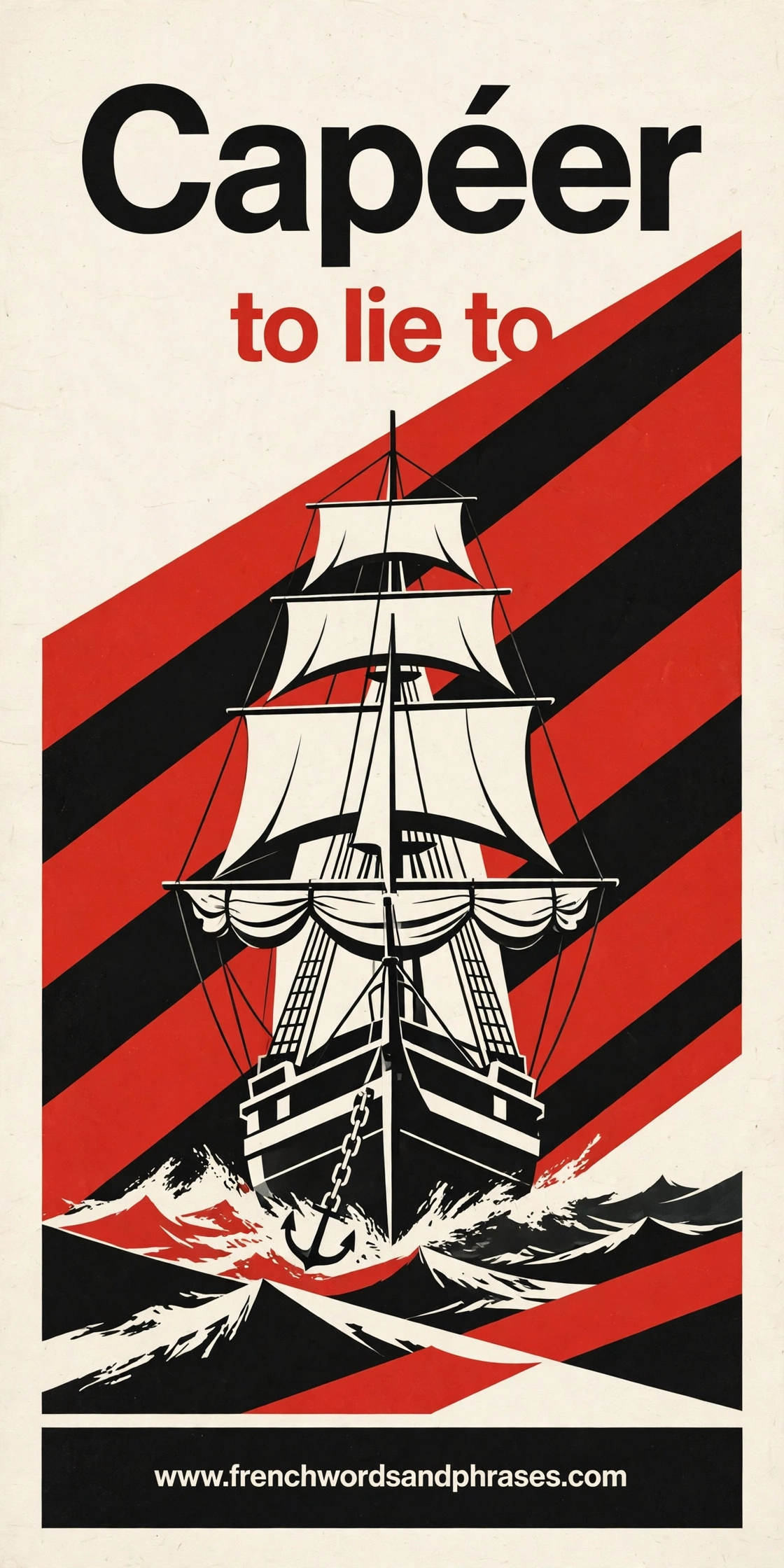
Capéer means to lie to — the sailor’s manoeuvre of holding a ship nearly stopped, sails trimmed against the wind, riding out heavy weather.
A sailing ship in a rising gale, sails backed, barely moving yet holding her ground against the sea — capéer is the old nautical verb for that patient, stubborn wait: the ship lies to, and the storm does its worst around her.
In this guide, you’ll learn how to conjugate capéer in all the major French tenses and moods. Explore complete conjugation tables, French examples, English translations, and practice quizzes.
Understanding the French Verb Capéer
Capéer is a regular French verb belonging to the first group of verbs, those ending in-er.
It means to lie to (nautical). It belongs to the age of sail and to classic sea literature; modern sailors more often say mettre à la cape or être à la cape. The subject is almost always the ship herself, sometimes her captain by extension, and the setting is always the same: too much wind to sail, too much sea to run.
Verb classification: First group (-er)
Auxiliary verb: Avoir
Past participle: capéé
Present participle: capéant
English equivalents: To lie to, to heave to (nautical); capéer dans la tempête — to lie to in the storm; le navire capée sous voilure réduite — the ship lies to under reduced sail; capéer en attendant le jour — to lie to while waiting for daylight; mettre à la cape — to heave to (the noun phrase cousin).
One important detail: capéer is a sea word and nothing to do with lying in the fibbing sense — English to lie to is itself the nautical term for a ship held almost stationary in heavy weather. The verb is built on la cape, the storm position (mettre à la cape). It conjugates as a perfectly regular -er verb: le navire capée, nous capéons, ils capéent, past participle capéé — note the double é where stem meets ending, as in créer: je capée, capéé.
Experience the Word
Capéer is the verb of the ship that refuses both to advance and to flee — she faces the storm and waits it out.
Imagine a three-masted ship caught by a night gale off Brittany. The captain orders the sails backed and the helm lashed down; le navire capée, rolling heavily but holding, while the waves break white around her and the crew waits for dawn.
She is going nowhere, on purpose. The ship lies to — elle capée — and patience itself becomes the seamanship.
How to Conjugate Capéer: Complete French Conjugation Guide
Let’s explore every major conjugation of capéer, beginning with the indicative mood.
How to Conjugate Capéer in the Indicative Mood
The indicative mood is used to express facts, observations, actions, and events.
How to Conjugate Capéer in the Present Tense (Présent)
Used for actions happening now, habitual actions, and general truths.
| Subject | Conjugation |
|---|---|
| je | capée |
| tu | capées |
| il / elle | capée |
| nous | capéons |
| vous | capéez |
| ils / elles | capéent |
Example
Le navire capée au large en attendant que le vent tombe.
The ship lies to offshore, waiting for the wind to drop.
Quick Quiz 1
Complete the sentence:
Nous ______ au large en attendant le jour. (said of our ship)
Reveal the answer
capéons
Nous capéons au large en attendant le jour.
We are lying to offshore, waiting for daylight.
How to Conjugate Capéer in the Passé Composé
Used for completed actions in the past. Capéer takes the auxiliary verb avoir.
| Subject | Conjugation |
|---|---|
| j’ | ai capéé |
| tu | as capéé |
| il / elle | a capéé |
| nous | avons capéé |
| vous | avez capéé |
| ils / elles | ont capéé |
Example
Le brick a capéé toute la nuit dans le coup de vent.
The brig lay to all night in the gale.
How to Conjugate Capéer in the Imparfait (Imperfect Tense)
Used for habitual past actions, descriptions, and ongoing situations in the past.
| Subject | Conjugation |
|---|---|
| je | capéais |
| tu | capéais |
| il / elle | capéait |
| nous | capéions |
| vous | capéiez |
| ils / elles | capéaient |
Example
Le vieux voilier capéait dès que la mer devenait mauvaise.
The old sailing ship used to lie to as soon as the sea turned rough.
Quick Quiz 2
Choose the correct form:
The brig lay to all night.
Le brick ______ toute la nuit. (a capéé / est capéé)
Reveal the answer
a capéé
Le brick a capéé toute la nuit.
Capéer takes avoir.
How to Conjugate Capéer in the Plus-que-parfait
Used to describe an action that had already been completed before another past event.
| Subject | Conjugation |
|---|---|
| j’ | avais capéé |
| tu | avais capéé |
| il / elle | avait capéé |
| nous | avions capéé |
| vous | aviez capéé |
| ils / elles | avaient capéé |
Example
La frégate avait capéé deux jours avant de reprendre sa route.
The frigate had lain to for two days before resuming her course.
How to Conjugate Capéer in the Passé Simple
Primarily used in formal writing, literature, and historical narratives. It is rarely used in everyday conversation.
| Subject | Conjugation |
|---|---|
| je | capéai |
| tu | capéas |
| il / elle | capéa |
| nous | capéâmes |
| vous | capéâtes |
| ils / elles | capéèrent |
Example
Le navire capéa sous la tempête jusqu’au matin.
The ship lay to under the storm until morning.
How to Conjugate Capéer in the Passé Antérieur
A literary tense used to express an action completed immediately before another past action, generally in the passé simple.
| Subject | Conjugation |
|---|---|
| j’ | eus capéé |
| tu | eus capéé |
| il / elle | eut capéé |
| nous | eûmes capéé |
| vous | eûtes capéé |
| ils / elles | eurent capéé |
Example
Quand le vent eut molli, le navire, qui avait capéé toute la nuit, remit à la voile.
When the wind had dropped, the ship, which had lain to all night, set sail again.
How to Conjugate Capéer in the Future Tense (Futur Simple)
Used to describe actions that will take place in the future.
| Subject | Conjugation |
|---|---|
| je | capéerai |
| tu | capéeras |
| il / elle | capéera |
| nous | capéerons |
| vous | capéerez |
| ils / elles | capéeront |
Example
Si la tempête se lève, le voilier capéera au large des côtes.
If the storm rises, the sailing ship will lie to off the coast.
How to Conjugate Capéer in the Futur Antérieur (Future Perfect)
Used for an action that will have been completed before a particular point in the future.
| Subject | Conjugation |
|---|---|
| j’ | aurai capéé |
| tu | auras capéé |
| il / elle | aura capéé |
| nous | aurons capéé |
| vous | aurez capéé |
| ils / elles | auront capéé |
Example
À l’aube, le navire aura capéé huit heures dans la houle.
By dawn, the ship will have lain to for eight hours in the swell.
How to Conjugate Capéer in the Near Future (Futur Proche)
Used to describe something that is going to happen soon. Formed with aller + infinitive.
| Subject | Conjugation |
|---|---|
| je | vais capéer |
| tu | vas capéer |
| il / elle | va capéer |
| nous | allons capéer |
| vous | allez capéer |
| ils / elles | vont capéer |
Example
Le vent monte, le navire va capéer sous voilure réduite.
The wind is rising, the ship is going to lie to under reduced sail.
How to Conjugate Capéer in the Conditional Mood
The conditional mood expresses what would happen under certain circumstances. It is also frequently used to make polite requests or express wishes.
How to Conjugate Capéer in the Present Conditional
| Subject | Conjugation |
|---|---|
| je | capéerais |
| tu | capéerais |
| il / elle | capéerait |
| nous | capéerions |
| vous | capéeriez |
| ils / elles | capéeraient |
Example
Avec une mer pareille, même un paquebot capéerait.
In such a sea, even a liner would lie to.
How to Conjugate Capéer in the Past Conditional
| Subject | Conjugation |
|---|---|
| j’ | aurais capéé |
| tu | aurais capéé |
| il / elle | aurait capéé |
| nous | aurions capéé |
| vous | auriez capéé |
| ils / elles | auraient capéé |
Example
Le capitaine aurait capéé plus tôt si le vent avait tourné.
The captain would have lain to earlier if the wind had shifted.
Capéer in the Literary Past Conditional Form
This less common literary form uses the imperfect subjunctive of avoir.
| Subject | Conjugation |
|---|---|
| j’ | eusse capéé |
| tu | eusses capéé |
| il / elle | eût capéé |
| nous | eussions capéé |
| vous | eussiez capéé |
| ils / elles | eussent capéé |
Example
Le navire eût capéé jusqu’à la fin du grain.
The ship would have lain to until the end of the squall.
How to Conjugate Capéer in the Subjunctive Mood
The subjunctive is used to express wishes, emotions, doubts, necessity, and uncertainty. It frequently follows expressions such as il faut que (it is necessary that) or bien que (although).
How to Conjugate Capéer in the Present Subjunctive
| Subject | Conjugation |
|---|---|
| que je | capée |
| que tu | capées |
| qu’il / qu’elle | capée |
| que nous | capéions |
| que vous | capéiez |
| qu’ils / qu’elles | capéent |
Example
Il est prudent que le voilier capée avant la nuit.
It is wise for the sailing ship to lie to before nightfall.
Quick Quiz 3
Complete the sentence using the subjunctive:
Le capitaine ordonne que les navires ______ au large.
Reveal the answer
capéent
Le capitaine ordonne que les navires capéent au large.
The captain orders the ships to lie to offshore.
How to Conjugate Capéer in the Imperfect Subjunctive
A literary tense, rarely encountered in modern spoken French.
| Subject | Conjugation |
|---|---|
| que je | capéasse |
| que tu | capéasses |
| qu’il / qu’elle | capéât |
| que nous | capéassions |
| que vous | capéassiez |
| qu’ils / qu’elles | capéassent |
Example
Le capitaine ordonna que le navire capéât au large.
The captain ordered the ship to lie to offshore.
How to Conjugate Capéer in the Pluperfect Subjunctive
A literary construction used to express an action completed before another past action.
| Subject | Conjugation |
|---|---|
| que j’ | eusse capéé |
| que tu | eusses capéé |
| qu’il / qu’elle | eût capéé |
| que nous | eussions capéé |
| que vous | eussiez capéé |
| qu’ils / qu’elles | eussent capéé |
Example
Les récits racontent que la frégate eût capéé trois jours entiers.
The accounts tell that the frigate had lain to for three whole days.
How to Conjugate Capéer in the Past Subjunctive
| Subject | Conjugation |
|---|---|
| que j’ | aie capéé |
| que tu | aies capéé |
| qu’il / qu’elle | ait capéé |
| que nous | ayons capéé |
| que vous | ayez capéé |
| qu’ils / qu’elles | aient capéé |
Example
Je suis soulagé que le navire ait capéé au lieu de fuir la tempête.
I am relieved the ship lay to instead of running from the storm.
How to Conjugate Capéer in the Imperative
The imperative is used to give commands, instructions, invitations, or suggestions. Subject pronouns are omitted.
How to Conjugate Capéer in the Present Imperative
| Person | Conjugation |
|---|---|
| (tu) | capée |
| (nous) | capéons |
| (vous) | capéez |
Example
Capée au large et attends le jour, vieux navire !
Lie to offshore and wait for daylight, old ship!
Quick Quiz 4
How would you say Lie to and wait for daylight (tu form, to the ship)?
Reveal the answer
Capée et attends le jour !
French Participles of Capéer
Participles are verb forms that can be used in compound tenses and other grammatical constructions.
Present Participle of Capéer
capéant
En capéant, le voilier perdait à peine un mille par heure.
While lying to, the sailing ship lost barely a mile an hour.
Past Participle of Capéer
capéé
Après avoir capéé toute la nuit, l’équipage reprit la mer au matin.
After lying to all night, the crew put back to sea in the morning.
Capéer in Everyday French: Real-Life Examples
Now that you know the conjugations, let’s see how capéer appears in everyday French.
Example 1 — Present
Le navire capée en attendant que le vent tombe.
The ship lies to, waiting for the wind to drop.
Example 2 — Passé composé
Le brick a capéé toute la nuit.
The brig lay to all night.
Example 3 — Imparfait
Le voilier capéait dès que la mer grossissait.
The sailing ship used to lie to whenever the sea rose.
Example 4 — Future
Le navire capéera au large si la tempête se lève.
The ship will lie to offshore if the storm rises.
Example 5 — Conditional
Même un paquebot capéerait dans une telle mer.
Even a liner would lie to in such a sea.
Example 6 — Imperative
Capée au large et attends le jour !
Lie to offshore and wait for daylight!
Beyond Translation: The Meaning of Capéer
English sailors say to lie to or to heave to; French capéer comes from la cape, the storm trim of sails — the same cape that gives mettre à la cape.
It is a verb of dignified immobility.
In an age that praises speed, capéer honours the opposite skill: knowing when the bravest seamanship is simply to stop, face the weather, and out-wait it.
How to Remember the French Verb Capéer
Remember it this way: Capéer is about the ship facing the gale, sails backed, waiting for dawn.
- A sea word only: to lie to is what a ship does in heavy weather — nothing to do with telling lies.
- Built on la cape, the storm position; the common modern phrase is mettre à la cape.
- Regular -er with double é at the joins: je capée, capéé — exactly like créer.
The key idea is the ship facing the gale, sails backed, waiting for dawn.
Test Your Knowledge of Capéer
Let’s see how much you’ve learned. Try answering these questions before revealing the answers.
Question 1
What does it mean when a ship capée?
Reveal the answer
She lies to — held almost stationary, sails trimmed against the wind, riding out heavy weather.
Question 2
How do you say The ship lies to offshore in French?
Reveal the answer
Le navire capée au large.
Question 3
Translate: The brig lay to all night in the gale.
Reveal the answer
Le brick a capéé toute la nuit dans le coup de vent.
Question 4
What is the past participle of capéer?
Reveal the answer
Capéé.
Question 5
Complete the sentence:
Il est prudent que le voilier ______ avant la nuit.
Reveal the answer
capée
Il est prudent que le voilier capée avant la nuit.
It is wise for the sailing ship to lie to before nightfall.
Your Final Challenge
Can You Use It?
How would you say this in French?
The old ship lies to in the black night, patient as a beast that has known the sea for a hundred years.
Reveal the answer
Le vieux navire capée dans la nuit noire, patient comme une bête qui connaît la mer depuis cent ans.
The old ship lies to in the black night, patient as a beast that has known the sea for a hundred years.
A little French. A little curiosity. A richer everyday life.
LEARN FRENCH ONE WORD AT A TIME




