
A French Word to Live By
How to Conjugate Canoter in French
/ka.nɔ.te/
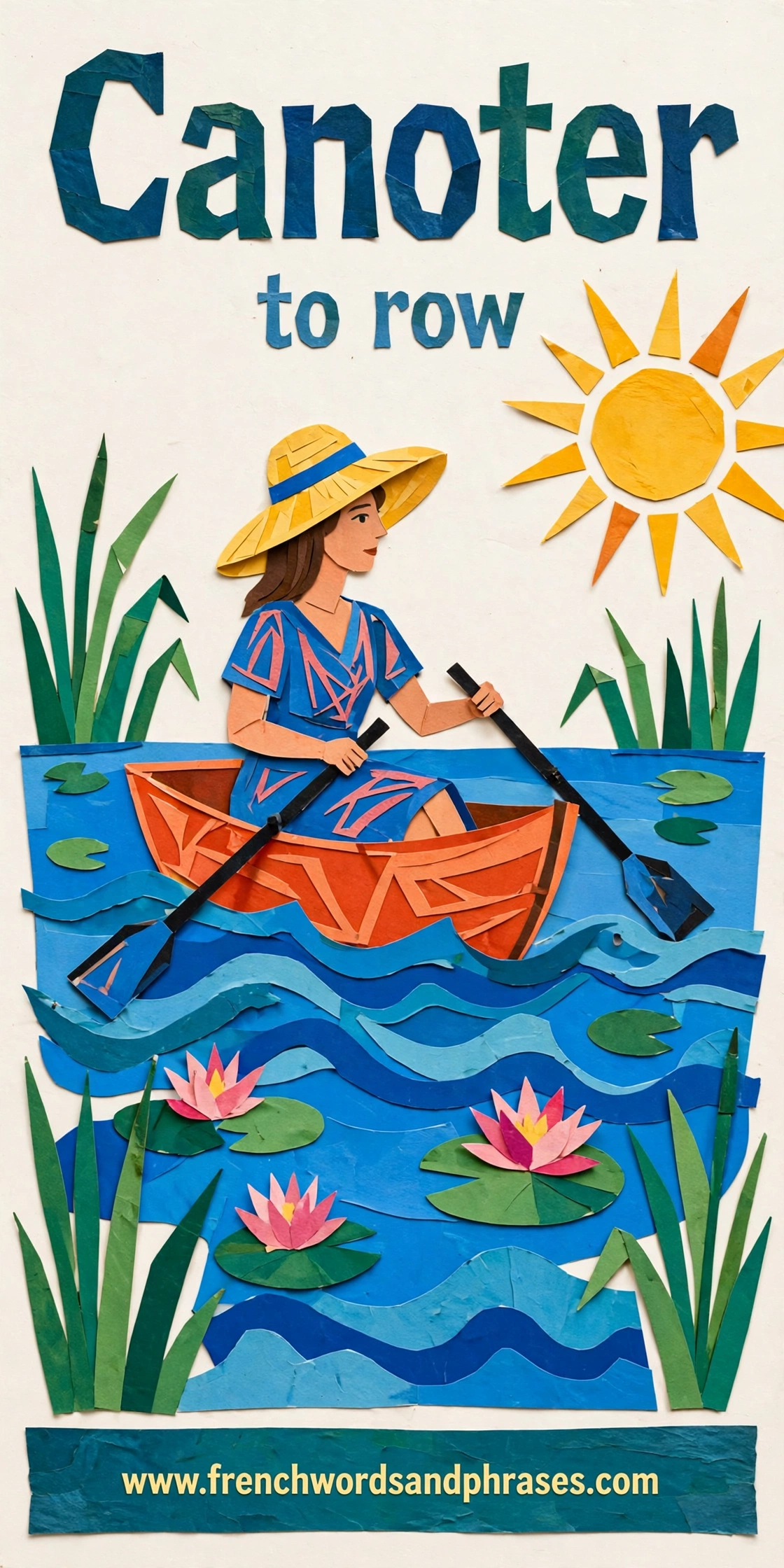
Canoter means to boat, to row — to go out on the water in a small boat for the pleasure of it, paddling or rowing gently along a river or across a lake.
A Sunday morning on a slow river, willows trailing in the water, a couple in a green rowing boat with a picnic basket — canoter is the verb of leisure on the water: no destination, no hurry, just the soft knock of oars and the boat sliding through reflections.
In this guide, you’ll learn how to conjugate canoter in all the major French tenses and moods. Explore complete conjugation tables, French examples, English translations, and practice quizzes.
Understanding the French Verb Canoter
Canoter is a regular French verb belonging to the first group of verbs, those ending in-er.
It means to boat, to row. It evokes the gentle boating of rivers and park lakes — the Marne, the Bois de Boulogne — rather than the sea or serious rowing. Expect it in novels, songs and holiday talk; for sport rowing French says ramer or faire de l’aviron.
Verb classification: First group (-er)
Auxiliary verb: Avoir
Past participle: canoté
Present participle: canotant
English equivalents: To go boating, to row about; canoter sur un lac — to boat on a lake; canoter sur la rivière — to row on the river; faire du canotage — to go boating; un canot — a small boat, a dinghy; canoter en amoureux — to go boating as a couple.
One important detail: canoter is built on le canot, the small boat — and unlike ramer (to row, the effort and the sport), canoter is about the outing, not the exercise: one canote pour le plaisir, with a hat, a book and nowhere to be. It is perfectly regular: je canote, nous canotons, ils canotent, past participle canoté. The activity as a noun is le canotage — faire du canotage is the classic Sunday of the Parisian suburbs painted by Renoir.
Experience the Word
Canoter is the verb of the unhurried boat — the journey is the picnic, and the picnic is the point.
Imagine the banks of the Marne on a June Sunday in 1880. A young couple rents a green canot; she trails her hand in the water, he rows in slow strokes under the willows — ils canotent, ils rient, et le déjeuner les attend dans l’herbe, exactly as Renoir painted them.
They are going nowhere at all. They are simply boating — ils canotent, and the afternoon is perfect.
How to Conjugate Canoter: Complete French Conjugation Guide
Let’s explore every major conjugation of canoter, beginning with the indicative mood.
How to Conjugate Canoter in the Indicative Mood
The indicative mood is used to express facts, observations, actions, and events.
How to Conjugate Canoter in the Present Tense (Présent)
Used for actions happening now, habitual actions, and general truths.
| Subject | Conjugation |
|---|---|
| je | canote |
| tu | canotes |
| il / elle | canote |
| nous | canotons |
| vous | canotez |
| ils / elles | canotent |
Example
Le dimanche, ils canotent sur le lac du parc.
On Sundays, they go boating on the park lake.
Quick Quiz 1
Complete the sentence:
Nous ______ sur le lac chaque dimanche.
Reveal the answer
canotons
Nous canotons sur le lac chaque dimanche.
We go boating on the lake every Sunday.
How to Conjugate Canoter in the Passé Composé
Used for completed actions in the past. Canoter takes the auxiliary verb avoir.
| Subject | Conjugation |
|---|---|
| j’ | ai canoté |
| tu | as canoté |
| il / elle | a canoté |
| nous | avons canoté |
| vous | avez canoté |
| ils / elles | ont canoté |
Example
Nous avons canoté toute la matinée sur la rivière.
We boated all morning on the river.
How to Conjugate Canoter in the Imparfait (Imperfect Tense)
Used for habitual past actions, descriptions, and ongoing situations in the past.
| Subject | Conjugation |
|---|---|
| je | canotais |
| tu | canotais |
| il / elle | canotait |
| nous | canotions |
| vous | canotiez |
| ils / elles | canotaient |
Example
Autrefois, les amoureux canotaient le long de la Marne.
In the old days, lovers used to go boating along the Marne.
Quick Quiz 2
Choose the correct form:
We boated all morning.
Nous ______ toute la matinée. (avons canoté / sommes canotés)
Reveal the answer
avons canoté
Nous avons canoté toute la matinée.
Canoter takes avoir.
How to Conjugate Canoter in the Plus-que-parfait
Used to describe an action that had already been completed before another past event.
| Subject | Conjugation |
|---|---|
| j’ | avais canoté |
| tu | avais canoté |
| il / elle | avait canoté |
| nous | avions canoté |
| vous | aviez canoté |
| ils / elles | avaient canoté |
Example
Elle avait canoté avant de découvrir la voile.
She had been a pleasure-boater before discovering sailing.
How to Conjugate Canoter in the Passé Simple
Primarily used in formal writing, literature, and historical narratives. It is rarely used in everyday conversation.
| Subject | Conjugation |
|---|---|
| je | canotai |
| tu | canotas |
| il / elle | canota |
| nous | canotâmes |
| vous | canotâtes |
| ils / elles | canotèrent |
Example
Ce jour-là, ils canotèrent jusqu’à l’île aux cygnes.
That day, they rowed as far as swan island.
How to Conjugate Canoter in the Passé Antérieur
A literary tense used to express an action completed immediately before another past action, generally in the passé simple.
| Subject | Conjugation |
|---|---|
| j’ | eus canoté |
| tu | eus canoté |
| il / elle | eut canoté |
| nous | eûmes canoté |
| vous | eûtes canoté |
| ils / elles | eurent canoté |
Example
Quand ils eurent canoté deux heures, ils accostèrent pour déjeuner.
When they had boated for two hours, they landed for lunch.
How to Conjugate Canoter in the Future Tense (Futur Simple)
Used to describe actions that will take place in the future.
| Subject | Conjugation |
|---|---|
| je | canoterai |
| tu | canoteras |
| il / elle | canotera |
| nous | canoterons |
| vous | canoterez |
| ils / elles | canoteront |
Example
Demain, nous canoterons sur le lac si le vent tombe.
Tomorrow, we will go boating on the lake if the wind drops.
How to Conjugate Canoter in the Futur Antérieur (Future Perfect)
Used for an action that will have been completed before a particular point in the future.
| Subject | Conjugation |
|---|---|
| j’ | aurai canoté |
| tu | auras canoté |
| il / elle | aura canoté |
| nous | aurons canoté |
| vous | aurez canoté |
| ils / elles | auront canoté |
Example
À midi, ils auront canoté autour de toute l’île.
By noon, they will have rowed all around the island.
How to Conjugate Canoter in the Near Future (Futur Proche)
Used to describe something that is going to happen soon. Formed with aller + infinitive.
| Subject | Conjugation |
|---|---|
| je | vais canoter |
| tu | vas canoter |
| il / elle | va canoter |
| nous | allons canoter |
| vous | allez canoter |
| ils / elles | vont canoter |
Example
Regarde ce soleil, on va canoter cet après-midi !
Look at this sun, we are going boating this afternoon!
How to Conjugate Canoter in the Conditional Mood
The conditional mood expresses what would happen under certain circumstances. It is also frequently used to make polite requests or express wishes.
How to Conjugate Canoter in the Present Conditional
| Subject | Conjugation |
|---|---|
| je | canoterais |
| tu | canoterais |
| il / elle | canoterait |
| nous | canoterions |
| vous | canoteriez |
| ils / elles | canoteraient |
Example
Avec un bateau plus léger, nous canoterions plus loin.
With a lighter boat, we would row further.
How to Conjugate Canoter in the Past Conditional
| Subject | Conjugation |
|---|---|
| j’ | aurais canoté |
| tu | aurais canoté |
| il / elle | aurait canoté |
| nous | aurions canoté |
| vous | auriez canoté |
| ils / elles | auraient canoté |
Example
Ils auraient canoté volontiers si la pluie n’était pas venue.
They would gladly have gone boating if the rain had not come.
Canoter in the Literary Past Conditional Form
This less common literary form uses the imperfect subjunctive of avoir.
| Subject | Conjugation |
|---|---|
| j’ | eusse canoté |
| tu | eusses canoté |
| il / elle | eût canoté |
| nous | eussions canoté |
| vous | eussiez canoté |
| ils / elles | eussent canoté |
Example
Le poète eût canoté sur l’étang jusqu’au crépuscule.
The poet would have boated on the pond until dusk.
How to Conjugate Canoter in the Subjunctive Mood
The subjunctive is used to express wishes, emotions, doubts, necessity, and uncertainty. It frequently follows expressions such as il faut que (it is necessary that) or bien que (although).
How to Conjugate Canoter in the Present Subjunctive
| Subject | Conjugation |
|---|---|
| que je | canote |
| que tu | canotes |
| qu’il / qu’elle | canote |
| que nous | canotions |
| que vous | canotiez |
| qu’ils / qu’elles | canotent |
Example
Je propose que l’on canote après le déjeuner.
I suggest we go boating after lunch.
Quick Quiz 3
Complete the sentence using the subjunctive:
Je propose que vous ______ après le déjeuner.
Reveal the answer
canotiez
Je propose que vous canotiez après le déjeuner.
I suggest you go boating after lunch.
How to Conjugate Canoter in the Imperfect Subjunctive
A literary tense, rarely encountered in modern spoken French.
| Subject | Conjugation |
|---|---|
| que je | canotasse |
| que tu | canotasses |
| qu’il / qu’elle | canotât |
| que nous | canotassions |
| que vous | canotassiez |
| qu’ils / qu’elles | canotassent |
Example
Je rêvais qu’ils canotassent ensemble sur la rivière.
I dreamed that they were boating together on the river.
How to Conjugate Canoter in the Pluperfect Subjunctive
A literary construction used to express an action completed before another past action.
| Subject | Conjugation |
|---|---|
| que j’ | eusse canoté |
| que tu | eusses canoté |
| qu’il / qu’elle | eût canoté |
| que nous | eussions canoté |
| que vous | eussiez canoté |
| qu’ils / qu’elles | eussent canoté |
Example
On racontait que le roi eût canoté incognito sur le lac.
People said the king had gone boating incognito on the lake.
How to Conjugate Canoter in the Past Subjunctive
| Subject | Conjugation |
|---|---|
| que j’ | aie canoté |
| que tu | aies canoté |
| qu’il / qu’elle | ait canoté |
| que nous | ayons canoté |
| que vous | ayez canoté |
| qu’ils / qu’elles | aient canoté |
Example
Je suis ravi que vous ayez canoté sous ce beau soleil.
I am delighted you went boating in this lovely sunshine.
How to Conjugate Canoter in the Imperative
The imperative is used to give commands, instructions, invitations, or suggestions. Subject pronouns are omitted.
How to Conjugate Canoter in the Present Imperative
| Person | Conjugation |
|---|---|
| (tu) | canote |
| (nous) | canotons |
| (vous) | canotez |
Example
Canotons jusqu’à l’île, le pique-nique nous y attend !
Let us row to the island, the picnic is waiting for us there!
Quick Quiz 4
How would you say Let us row to the island (nous form)?
Reveal the answer
Canotons jusqu’à l’île !
French Participles of Canoter
Participles are verb forms that can be used in compound tenses and other grammatical constructions.
Present Participle of Canoter
canotant
En canotant doucement, elle a aperçu un héron.
While boating gently, she caught sight of a heron.
Past Participle of Canoter
canoté
Canoté par beau temps, ce lac est un vrai paradis.
Boated on in fine weather, this lake is a true paradise.
Canoter in Everyday French: Real-Life Examples
Now that you know the conjugations, let’s see how canoter appears in everyday French.
Example 1 — Present
Ils canotent sur le lac du parc le dimanche.
They go boating on the park lake on Sundays.
Example 2 — Passé composé
Nous avons canoté toute la matinée.
We boated all morning.
Example 3 — Imparfait
Les amoureux canotaient le long de la Marne.
Lovers used to go boating along the Marne.
Example 4 — Future
Nous canoterons sur le lac demain.
We will go boating on the lake tomorrow.
Example 5 — Conditional
Nous canoterions plus loin avec un bateau léger.
We would row further with a light boat.
Example 6 — Imperative
Canotons jusqu’à l’île !
Let us row to the island!
Beyond Translation: The Meaning of Canoter
English canoe and French canot are distant cousins from the Caribbean word for a dugout boat — but French canoter stayed home on the river.
It is the verb of Renoir’s Sundays.
The Déjeuner des canotiers — Luncheon of the Boating Party — takes its very name from these canotiers, the straw-hatted boaters of the Marne: when French says canoter, it still smells faintly of grass, white wine and 1880.
How to Remember the French Verb Canoter
Remember it this way: Canoter is about Renoir’s boaters drifting under the willows.
- Le canot is the little boat: canoter is to take it out for pleasure, not for sport.
- Ramer is the rowing itself; canoter is the outing — hat, picnic and all.
- Regular -er: je canote, nous canotons, past participle canoté; the activity is le canotage.
The key idea is Renoir’s boaters drifting under the willows.
Test Your Knowledge of Canoter
Let’s see how much you’ve learned. Try answering these questions before revealing the answers.
Question 1
What is the difference between canoter and ramer?
Reveal the answer
Ramer is the physical rowing; canoter is the pleasure outing in a small boat — the whole Sunday, not just the strokes.
Question 2
How do you say We boated all morning in French?
Reveal the answer
Nous avons canoté toute la matinée.
Question 3
Translate: On Sundays, they go boating on the lake.
Reveal the answer
Le dimanche, ils canotent sur le lac.
Question 4
What is the past participle of canoter?
Reveal the answer
Canoté.
Question 5
Complete the sentence:
Je propose que l’on ______ après le déjeuner.
Reveal the answer
canote
Je propose que l’on canote après le déjeuner.
I suggest we go boating after lunch.
Your Final Challenge
Can You Use It?
How would you say this in French?
They go boating under the willows, with no goal and no watch, and the river lends them its finest mirror.
Reveal the answer
Ils canotent sous les saules, sans but et sans montre, et la rivière leur prête son plus beau miroir.
They go boating under the willows, with no goal and no watch, and the river lends them its finest mirror.
A little French. A little curiosity. A richer everyday life.
LEARN FRENCH ONE WORD AT A TIME




