A French Word to Live By
How to Conjugate Canonner in French
/ka.nɔ.ne/
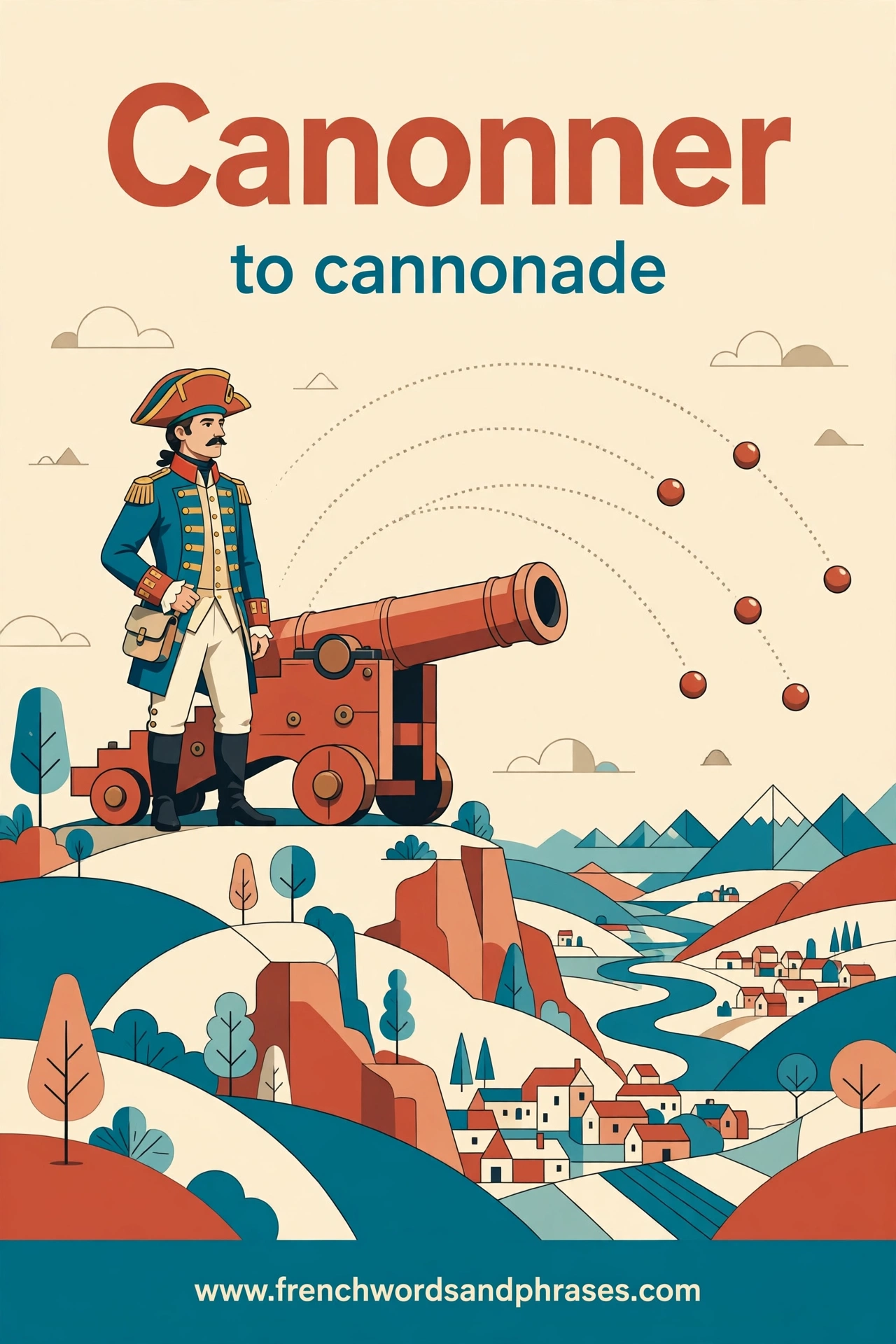
Canonner means to cannonade, to batter — to pound a place or an army with cannon fire, shell after shell, until the walls shake and the dust never settles.
A fortress town under bombardment at dawn, its church tower disappearing into smoke — canonner is the heavy verb of old warfare: rows of great guns firing together, and a target battered without pause until it yields or falls silent.
In this guide, you’ll learn how to conjugate canonner in all the major French tenses and moods. Explore complete conjugation tables, French examples, English translations, and practice quizzes.
Understanding the French Verb Canonner
Canonner is a regular French verb belonging to the first group of verbs, those ending in-er.
It means to cannonade, to batter. It belongs to the history of sieges and naval battles — the age of Vauban’s fortresses and wooden warships — and survives in history books, war reporting and metaphor: a striker who canonne the goal, a journalist canonnée de questions, where the shells are shots or questions fired without pause.
Verb classification: First group (-er)
Auxiliary verb: Avoir
Past participle: canonné
Present participle: canonnant
English equivalents: To cannonade, to bombard, to batter with artillery; canonner une forteresse — to cannonade a fortress; canonner les remparts — to batter the ramparts; se faire canonner — to come under cannon fire; une canonnade — a cannonade, a bombardment.
One important detail: canonner is built on le canon — this time it IS the battlefield cannon, the great gun, and the verb is its voice. It is perfectly regular: je canonne, nous canonnons, ils canonnent, past participle canonné. The bombardment itself is a noun of its own: une canonnade, and a ship’s gunner is un canonnier. Do not confuse the verb with canoniser, which belongs to the Church’s other canon — the list of saints.
Experience the Word
Canonner is the verb of the siege — not one shot but a hundred, fired as one long sentence of thunder.
Imagine a walled town in 1673, seen from the besiegers’ hill at sunrise. Fifty cannon open fire together; the church bells answer nothing, the ramparts vanish into their own dust — l’armée canonne la ville depuis l’aube, and by noon a breach is opening in the wall like a slow wound.
This is not marksmanship. It is battering — canonner, to pound a place until the place itself gives up.
How to Conjugate Canonner: Complete French Conjugation Guide
Let’s explore every major conjugation of canonner, beginning with the indicative mood.
How to Conjugate Canonner in the Indicative Mood
The indicative mood is used to express facts, observations, actions, and events.
How to Conjugate Canonner in the Present Tense (Présent)
Used for actions happening now, habitual actions, and general truths.
| Subject | Conjugation |
|---|---|
| je | canonne |
| tu | canonnes |
| il / elle | canonne |
| nous | canonnons |
| vous | canonnez |
| ils / elles | canonnent |
Example
L’artillerie canonne la forteresse depuis l’aube.
The artillery has been cannonading the fortress since dawn.
Quick Quiz 1
Complete the sentence:
Nous ______ la citadelle depuis l’aube.
Reveal the answer
canonnons
Nous canonnons la citadelle depuis l’aube.
We have been cannonading the citadel since dawn.
How to Conjugate Canonner in the Passé Composé
Used for completed actions in the past. Canonner takes the auxiliary verb avoir.
| Subject | Conjugation |
|---|---|
| j’ | ai canonné |
| tu | as canonné |
| il / elle | a canonné |
| nous | avons canonné |
| vous | avez canonné |
| ils / elles | ont canonné |
Example
Les navires ont canonné le port pendant trois heures.
The ships cannonaded the harbour for three hours.
How to Conjugate Canonner in the Imparfait (Imperfect Tense)
Used for habitual past actions, descriptions, and ongoing situations in the past.
| Subject | Conjugation |
|---|---|
| je | canonnais |
| tu | canonnais |
| il / elle | canonnait |
| nous | canonnions |
| vous | canonniez |
| ils / elles | canonnaient |
Example
Chaque matin, les assiégeants canonnaient les remparts.
Every morning, the besiegers battered the ramparts.
Quick Quiz 2
Choose the correct form:
The ships cannonaded the harbour.
Les navires ______ le port. (ont canonné / sont canonnés)
Reveal the answer
ont canonné
Les navires ont canonné le port.
Canonner takes avoir.
How to Conjugate Canonner in the Plus-que-parfait
Used to describe an action that had already been completed before another past event.
| Subject | Conjugation |
|---|---|
| j’ | avais canonné |
| tu | avais canonné |
| il / elle | avait canonné |
| nous | avions canonné |
| vous | aviez canonné |
| ils / elles | avaient canonné |
Example
Ils avaient canonné la ville avant de donner l’assaut.
They had cannonaded the town before launching the assault.
How to Conjugate Canonner in the Passé Simple
Primarily used in formal writing, literature, and historical narratives. It is rarely used in everyday conversation.
| Subject | Conjugation |
|---|---|
| je | canonnai |
| tu | canonnas |
| il / elle | canonna |
| nous | canonnâmes |
| vous | canonnâtes |
| ils / elles | canonnèrent |
Example
La flotte canonna le fort jusqu’au coucher du soleil.
The fleet cannonaded the fort until sunset.
How to Conjugate Canonner in the Passé Antérieur
A literary tense used to express an action completed immediately before another past action, generally in the passé simple.
| Subject | Conjugation |
|---|---|
| j’ | eus canonné |
| tu | eus canonné |
| il / elle | eut canonné |
| nous | eûmes canonné |
| vous | eûtes canonné |
| ils / elles | eurent canonné |
Example
Quand les canons eurent canonné la tour, elle s’effondra.
When the guns had battered the tower, it collapsed.
How to Conjugate Canonner in the Future Tense (Futur Simple)
Used to describe actions that will take place in the future.
| Subject | Conjugation |
|---|---|
| je | canonnerai |
| tu | canonneras |
| il / elle | canonnera |
| nous | canonnerons |
| vous | canonnerez |
| ils / elles | canonneront |
Example
Demain, les batteries canonneront la citadelle.
Tomorrow, the batteries will cannonade the citadel.
How to Conjugate Canonner in the Futur Antérieur (Future Perfect)
Used for an action that will have been completed before a particular point in the future.
| Subject | Conjugation |
|---|---|
| j’ | aurai canonné |
| tu | auras canonné |
| il / elle | aura canonné |
| nous | aurons canonné |
| vous | aurez canonné |
| ils / elles | auront canonné |
Example
À midi, l’artillerie aura canonné toutes les positions ennemies.
By noon, the artillery will have cannonaded all the enemy positions.
How to Conjugate Canonner in the Near Future (Futur Proche)
Used to describe something that is going to happen soon. Formed with aller + infinitive.
| Subject | Conjugation |
|---|---|
| je | vais canonner |
| tu | vas canonner |
| il / elle | va canonner |
| nous | allons canonner |
| vous | allez canonner |
| ils / elles | vont canonner |
Example
Le général va canonner le pont pour arrêter l’ennemi.
The general is going to cannonade the bridge to stop the enemy.
How to Conjugate Canonner in the Conditional Mood
The conditional mood expresses what would happen under certain circumstances. It is also frequently used to make polite requests or express wishes.
How to Conjugate Canonner in the Present Conditional
| Subject | Conjugation |
|---|---|
| je | canonnerais |
| tu | canonnerais |
| il / elle | canonnerait |
| nous | canonnerions |
| vous | canonneriez |
| ils / elles | canonneraient |
Example
Avec plus de poudre, ils canonneraient la ville jour et nuit.
With more powder, they would cannonade the town day and night.
How to Conjugate Canonner in the Past Conditional
| Subject | Conjugation |
|---|---|
| j’ | aurais canonné |
| tu | aurais canonné |
| il / elle | aurait canonné |
| nous | aurions canonné |
| vous | auriez canonné |
| ils / elles | auraient canonné |
Example
La flotte aurait canonné le port si le vent l’avait permis.
The fleet would have cannonaded the harbour if the wind had allowed it.
Canonner in the Literary Past Conditional Form
This less common literary form uses the imperfect subjunctive of avoir.
| Subject | Conjugation |
|---|---|
| j’ | eusse canonné |
| tu | eusses canonné |
| il / elle | eût canonné |
| nous | eussions canonné |
| vous | eussiez canonné |
| ils / elles | eussent canonné |
Example
Les assiégeants eussent canonné la place jusqu’à sa chute.
The besiegers would have cannonaded the stronghold until it fell.
How to Conjugate Canonner in the Subjunctive Mood
The subjunctive is used to express wishes, emotions, doubts, necessity, and uncertainty. It frequently follows expressions such as il faut que (it is necessary that) or bien que (although).
How to Conjugate Canonner in the Present Subjunctive
| Subject | Conjugation |
|---|---|
| que je | canonne |
| que tu | canonnes |
| qu’il / qu’elle | canonne |
| que nous | canonnions |
| que vous | canonniez |
| qu’ils / qu’elles | canonnent |
Example
Le roi ordonne que l’on canonne la citadelle dès demain.
The king orders the citadel to be cannonaded from tomorrow.
Quick Quiz 3
Complete the sentence using the subjunctive:
Le roi ordonne que vous ______ la citadelle dès demain.
Reveal the answer
canonniez
Le roi ordonne que vous canonniez la citadelle dès demain.
The king orders you to cannonade the citadel from tomorrow.
How to Conjugate Canonner in the Imperfect Subjunctive
A literary tense, rarely encountered in modern spoken French.
| Subject | Conjugation |
|---|---|
| que je | canonnasse |
| que tu | canonnasses |
| qu’il / qu’elle | canonnât |
| que nous | canonnassions |
| que vous | canonnassiez |
| qu’ils / qu’elles | canonnassent |
Example
Il fallait que l’artillerie canonnât les remparts sans relâche.
The artillery had to batter the ramparts without respite.
How to Conjugate Canonner in the Pluperfect Subjunctive
A literary construction used to express an action completed before another past action.
| Subject | Conjugation |
|---|---|
| que j’ | eusse canonné |
| que tu | eusses canonné |
| qu’il / qu’elle | eût canonné |
| que nous | eussions canonné |
| que vous | eussiez canonné |
| qu’ils / qu’elles | eussent canonné |
Example
On racontait que les navires eussent canonné le port toute la nuit.
People said the ships had cannonaded the harbour all night.
How to Conjugate Canonner in the Past Subjunctive
| Subject | Conjugation |
|---|---|
| que j’ | aie canonné |
| que tu | aies canonné |
| qu’il / qu’elle | ait canonné |
| que nous | ayons canonné |
| que vous | ayez canonné |
| qu’ils / qu’elles | aient canonné |
Example
Il est triste que l’on ait canonné une si belle ville.
It is sad that such a beautiful town was cannonaded.
How to Conjugate Canonner in the Imperative
The imperative is used to give commands, instructions, invitations, or suggestions. Subject pronouns are omitted.
How to Conjugate Canonner in the Present Imperative
| Person | Conjugation |
|---|---|
| (tu) | canonne |
| (nous) | canonnons |
| (vous) | canonnez |
Example
Canonnons les remparts, pas les maisons !
Let us batter the ramparts, not the houses!
Quick Quiz 4
How would you say Let us batter the ramparts (nous form)?
Reveal the answer
Canonnons les remparts !
French Participles of Canonner
Participles are verb forms that can be used in compound tenses and other grammatical constructions.
Present Participle of Canonner
canonnant
En canonnant le fort, les navires ont épuisé leur poudre.
By cannonading the fort, the ships used up their powder.
Past Participle of Canonner
canonné
Canonnée pendant dix jours, la ville finit par se rendre.
Cannonaded for ten days, the town finally surrendered.
Canonner in Everyday French: Real-Life Examples
Now that you know the conjugations, let’s see how canonner appears in everyday French.
Example 1 — Present
L’artillerie canonne la forteresse.
The artillery is cannonading the fortress.
Example 2 — Passé composé
Les navires ont canonné le port pendant trois heures.
The ships cannonaded the harbour for three hours.
Example 3 — Imparfait
Les assiégeants canonnaient les remparts chaque matin.
The besiegers battered the ramparts every morning.
Example 4 — Future
Les batteries canonneront la citadelle demain.
The batteries will cannonade the citadel tomorrow.
Example 5 — Conditional
Ils canonneraient la ville jour et nuit.
They would cannonade the town day and night.
Example 6 — Imperative
Canonnons les remparts !
Let us batter the ramparts!
Beyond Translation: The Meaning of Canonner
English cannonade was borrowed from French canonnade — and the verb canonner is its engine.
French built a whole family on the great gun.
Le canon fires, le canonnier serves it, la canonnade is the storm of its fire, and canonner is the storm at work — a reminder that in the age of sieges, artillery was not a weapon among others but the weather itself.
How to Remember the French Verb Canonner
Remember it this way: Canonner is about fifty cannon battering the fortress walls at dawn.
- Le canon is the great gun: canonner is to be its voice — to pound with cannon fire.
- The storm itself is une canonnade; the gunner is un canonnier.
- Regular -er with double n: je canonne, nous canonnons, past participle canonné.
The key idea is fifty cannon battering the fortress walls at dawn.
Test Your Knowledge of Canonner
Let’s see how much you’ve learned. Try answering these questions before revealing the answers.
Question 1
What is a cannonade called in French?
Reveal the answer
Une canonnade — the storm of cannon fire; the verb is canonner.
Question 2
How do you say The ships cannonaded the harbour in French?
Reveal the answer
Les navires ont canonné le port.
Question 3
Translate: The artillery is cannonading the fortress.
Reveal the answer
L’artillerie canonne la forteresse.
Question 4
What is the past participle of canonner?
Reveal the answer
Cannoné.
Question 5
Complete the sentence:
Il fallait que l’artillerie ______ les remparts sans relâche.
Reveal the answer
canonnât
Il fallait que l’artillerie canonnât les remparts sans relâche.
The artillery had to batter the ramparts without respite.
Your Final Challenge
Can You Use It?
How would you say this in French?
For ten days they cannonaded the town, and on the tenth day the bells rang out peace over the ruins.
Reveal the answer
Pendant dix jours ils ont canonné la ville, et le dixième jour, les cloches ont sonné la paix sur les ruines.
For ten days they cannonaded the town, and on the tenth day the bells rang out peace over the ruins.
A little French. A little curiosity. A richer everyday life.
LEARN FRENCH ONE WORD AT A TIME