
A French Word to Live By
How to Conjugate Cambrer in French
/kɑ̃.bʁe/
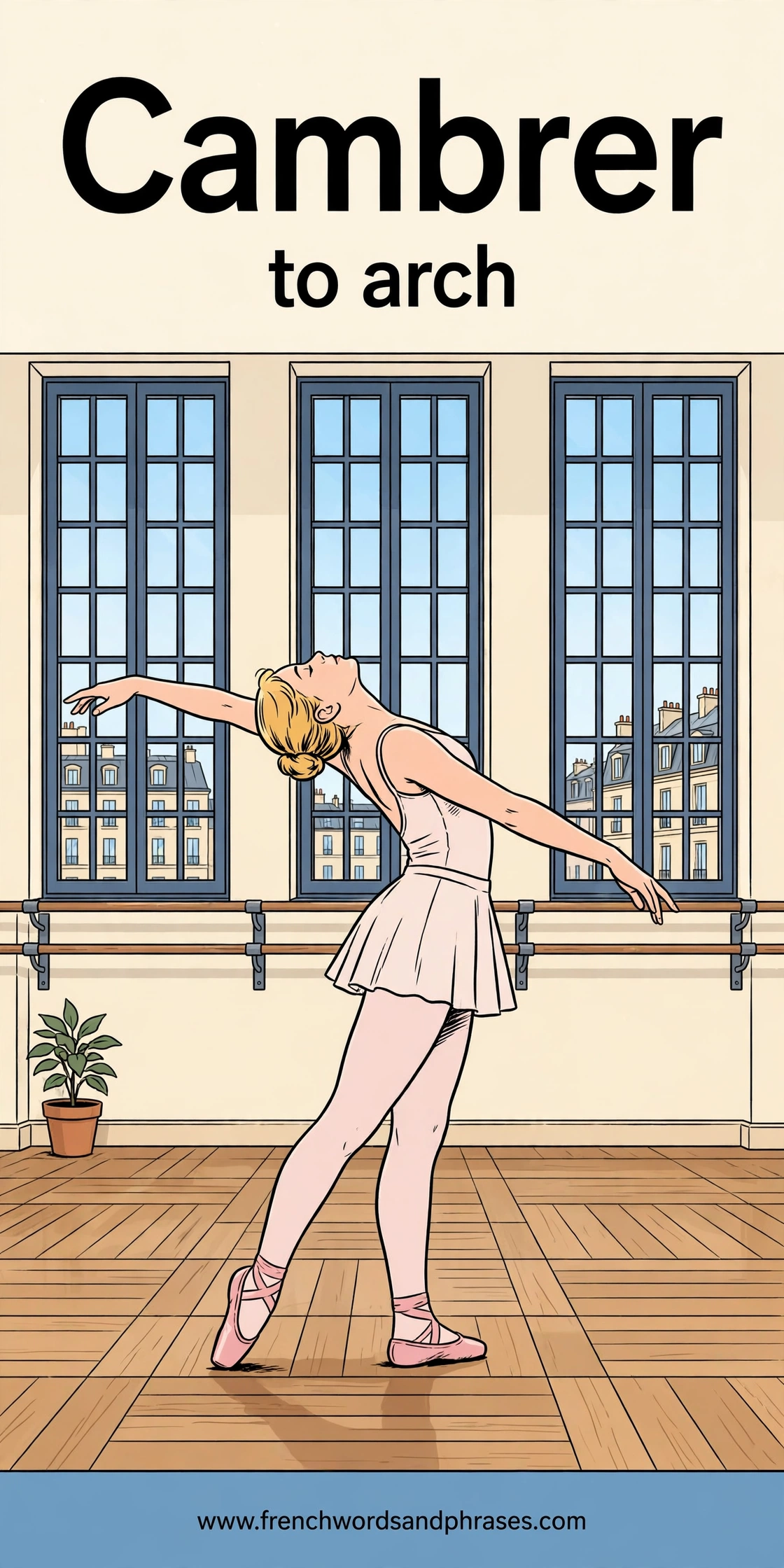
Cambrer means to bend, to arch, to curve — to give something a graceful bend: a back arched, a piece of wood curved, a waist bent backwards.
A dancer arching her back at the barre, a craftsman bending a strip of wood over steam — cambrer is the verb of the deliberate curve, the bend put into a body or a material on purpose.
In this guide, you’ll learn how to conjugate cambrer in all the major French tenses and moods. Explore complete conjugation tables, French examples, English translations, and practice quizzes.
Understanding the French Verb Cambrer
Cambrer is a regular French verb belonging to the first group of verbs, those ending in-er.
It means to bend, to arch, to curve. Cambrer is about curves with shape and intention — the arch of a dancer’s back, the bend steamed into chair wood, the curve of a shoe. It is more elegant and deliberate than plier (to bend, to fold) or courber (to bow, to curve under weight).
Verb classification: First group (-er)
Auxiliary verb: Avoir
Past participle: cambré
Present participle: cambrant
English equivalents: To bend, to arch, to curve; cambrer le dos — to arch one’s back; cambrer les reins — to arch the small of the back; cambrer une planche — to bend a board; cambrer le bois — to curve wood; un pied cambré — a highly arched foot.
One important detail: cambrer is a plain regular -er verb — je cambre, nous cambrons, ils cambrent, past participle cambré — but keep the senses apart: used transitively, you cambrer something (le dos, les reins, une planche); for a person drawing themselves up proudly, French switches to the reflexive se cambrer. The adjective cambré describes anything naturally arched: un pied cambré, une taille cambrée.
Experience the Word
Cambrer is the verb of the beautiful bend — the curve a body or a craftsman makes on purpose.
Imagine a ballet studio at nine in the morning. At the barre, twenty dancers rise, breathe, and cambrent le dos in one slow wave — chests open, heads back — before folding forward again like closing flowers.
Nobody has been bent by force. They have arched — cambré, deliberately, with the whole body in agreement.
How to Conjugate Cambrer: Complete French Conjugation Guide
Let’s explore every major conjugation of cambrer, beginning with the indicative mood.
How to Conjugate Cambrer in the Indicative Mood
The indicative mood is used to express facts, observations, actions, and events.
How to Conjugate Cambrer in the Present Tense (Présent)
Used for actions happening now, habitual actions, and general truths.
| Subject | Conjugation |
|---|---|
| je | cambre |
| tu | cambres |
| il / elle | cambre |
| nous | cambrons |
| vous | cambrez |
| ils / elles | cambrent |
Example
La danseuse cambre le dos avec grâce.
The dancer arches her back gracefully.
Quick Quiz 1
Complete the sentence:
Nous ______ le dos à la barre, chaque matin.
Reveal the answer
cambrons
Nous cambrons le dos à la barre, chaque matin.
We arch our backs at the barre every morning.
How to Conjugate Cambrer in the Passé Composé
Used for completed actions in the past. Cambrer takes the auxiliary verb avoir.
| Subject | Conjugation |
|---|---|
| j’ | ai cambré |
| tu | as cambré |
| il / elle | a cambré |
| nous | avons cambré |
| vous | avez cambré |
| ils / elles | ont cambré |
Example
L’ébéniste a cambré la planche à la vapeur.
The cabinetmaker bent the board with steam.
How to Conjugate Cambrer in the Imparfait (Imperfect Tense)
Used for habitual past actions, descriptions, and ongoing situations in the past.
| Subject | Conjugation |
|---|---|
| je | cambrais |
| tu | cambrais |
| il / elle | cambrait |
| nous | cambrions |
| vous | cambriez |
| ils / elles | cambraient |
Example
Le gymnaste cambrait les reins avant chaque saut.
The gymnast used to arch the small of his back before each jump.
Quick Quiz 2
Choose the correct form:
The wood keeps its shape.
Le bois, ______ à la vapeur, garde sa forme. (cambré / cambrons)
Reveal the answer
cambré
Le bois, cambré à la vapeur, garde sa forme.
Here cambré is the past participle used as an adjective.
How to Conjugate Cambrer in the Plus-que-parfait
Used to describe an action that had already been completed before another past event.
| Subject | Conjugation |
|---|---|
| j’ | avais cambré |
| tu | avais cambré |
| il / elle | avait cambré |
| nous | avions cambré |
| vous | aviez cambré |
| ils / elles | avaient cambré |
Example
Elle avait cambré le dos juste avant la photo.
She had arched her back just before the photo.
How to Conjugate Cambrer in the Passé Simple
Primarily used in formal writing, literature, and historical narratives. It is rarely used in everyday conversation.
| Subject | Conjugation |
|---|---|
| je | cambrai |
| tu | cambras |
| il / elle | cambra |
| nous | cambrâmes |
| vous | cambrâtes |
| ils / elles | cambrèrent |
Example
La danseuse cambra le dos et releva la tête.
The dancer arched her back and raised her head.
How to Conjugate Cambrer in the Passé Antérieur
A literary tense used to express an action completed immediately before another past action, generally in the passé simple.
| Subject | Conjugation |
|---|---|
| j’ | eus cambré |
| tu | eus cambré |
| il / elle | eut cambré |
| nous | eûmes cambré |
| vous | eûtes cambré |
| ils / elles | eurent cambré |
Example
Quand il eut cambré le bois, il le laissa sécher.
When he had bent the wood, he left it to dry.
How to Conjugate Cambrer in the Future Tense (Futur Simple)
Used to describe actions that will take place in the future.
| Subject | Conjugation |
|---|---|
| je | cambrerai |
| tu | cambreras |
| il / elle | cambrera |
| nous | cambrerons |
| vous | cambrerez |
| ils / elles | cambreront |
Example
Demain, l’artisan cambrera les pieds de la chaise.
Tomorrow, the craftsman will bend the chair legs.
How to Conjugate Cambrer in the Futur Antérieur (Future Perfect)
Used for an action that will have been completed before a particular point in the future.
| Subject | Conjugation |
|---|---|
| j’ | aurai cambré |
| tu | auras cambré |
| il / elle | aura cambré |
| nous | aurons cambré |
| vous | aurez cambré |
| ils / elles | auront cambré |
Example
À la fin du cours, vous aurez cambré le dos dix fois.
By the end of the class, you will have arched your backs ten times.
How to Conjugate Cambrer in the Near Future (Futur Proche)
Used to describe something that is going to happen soon. Formed with aller + infinitive.
| Subject | Conjugation |
|---|---|
| je | vais cambrer |
| tu | vas cambrer |
| il / elle | va cambrer |
| nous | allons cambrer |
| vous | allez cambrer |
| ils / elles | vont cambrer |
Example
Elle va cambrer les reins pour la photo.
She is going to arch the small of her back for the photo.
How to Conjugate Cambrer in the Conditional Mood
The conditional mood expresses what would happen under certain circumstances. It is also frequently used to make polite requests or express wishes.
How to Conjugate Cambrer in the Present Conditional
| Subject | Conjugation |
|---|---|
| je | cambrerais |
| tu | cambrerais |
| il / elle | cambrerait |
| nous | cambrerions |
| vous | cambreriez |
| ils / elles | cambreraient |
Example
Un bon danseur cambrerait le dos sans effort.
A good dancer would arch his back effortlessly.
How to Conjugate Cambrer in the Past Conditional
| Subject | Conjugation |
|---|---|
| j’ | aurais cambré |
| tu | aurais cambré |
| il / elle | aurait cambré |
| nous | aurions cambré |
| vous | auriez cambré |
| ils / elles | auraient cambré |
Example
Tu aurais cambré la planche si tu avais eu de la vapeur.
You would have bent the board if you had had steam.
Cambrer in the Literary Past Conditional Form
This less common literary form uses the imperfect subjunctive of avoir.
| Subject | Conjugation |
|---|---|
| j’ | eusse cambré |
| tu | eusses cambré |
| il / elle | eût cambré |
| nous | eussions cambré |
| vous | eussiez cambré |
| ils / elles | eussent cambré |
Example
Elle eût cambré le dos avec plus de grâce encore.
She would have arched her back with even more grace.
How to Conjugate Cambrer in the Subjunctive Mood
The subjunctive is used to express wishes, emotions, doubts, necessity, and uncertainty. It frequently follows expressions such as il faut que (it is necessary that) or bien que (although).
How to Conjugate Cambrer in the Present Subjunctive
| Subject | Conjugation |
|---|---|
| que je | cambre |
| que tu | cambres |
| qu’il / qu’elle | cambre |
| que nous | cambrions |
| que vous | cambriez |
| qu’ils / qu’elles | cambrent |
Example
Il faut que tu cambres le dos doucement.
You must arch your back gently.
Quick Quiz 3
Complete the sentence using the subjunctive:
Il faut que vous ______ les reins sans forcer.
Reveal the answer
cambriez
Il faut que vous cambriez les reins sans forcer.
You must arch the small of your backs without forcing.
How to Conjugate Cambrer in the Imperfect Subjunctive
A literary tense, rarely encountered in modern spoken French.
| Subject | Conjugation |
|---|---|
| que je | cambrasse |
| que tu | cambrasses |
| qu’il / qu’elle | cambrât |
| que nous | cambrassions |
| que vous | cambrassiez |
| qu’ils / qu’elles | cambrassent |
Example
Le professeur demandait que l’élève cambrât les reins.
The teacher asked the pupil to arch the small of his back.
How to Conjugate Cambrer in the Pluperfect Subjunctive
A literary construction used to express an action completed before another past action.
| Subject | Conjugation |
|---|---|
| que j’ | eusse cambré |
| que tu | eusses cambré |
| qu’il / qu’elle | eût cambré |
| que nous | eussions cambré |
| que vous | eussiez cambré |
| qu’ils / qu’elles | eussent cambré |
Example
On admira qu’elle eût cambré le dos si souplement.
People admired that she had arched her back so supplely.
How to Conjugate Cambrer in the Past Subjunctive
| Subject | Conjugation |
|---|---|
| que j’ | aie cambré |
| que tu | aies cambré |
| qu’il / qu’elle | ait cambré |
| que nous | ayons cambré |
| que vous | ayez cambré |
| qu’ils / qu’elles | aient cambré |
Example
Je suis content que tu aies cambré le bois sans le casser.
I am glad you bent the wood without breaking it.
How to Conjugate Cambrer in the Imperative
The imperative is used to give commands, instructions, invitations, or suggestions. Subject pronouns are omitted.
How to Conjugate Cambrer in the Present Imperative
| Person | Conjugation |
|---|---|
| (tu) | cambre |
| (nous) | cambrons |
| (vous) | cambrez |
Example
Cambre le dos, mais sans forcer !
Arch your back, but without forcing it!
Quick Quiz 4
How would you say Arch your back gently (tu form)?
Reveal the answer
Cambre le dos doucement !
French Participles of Cambrer
Participles are verb forms that can be used in compound tenses and other grammatical constructions.
Present Participle of Cambrer
cambrant
En cambrant les reins, elle garde l’équilibre.
By arching the small of her back, she keeps her balance.
Past Participle of Cambrer
cambré
Cambré à la vapeur, le bois garde sa forme.
Bent with steam, the wood keeps its shape.
Cambrer in Everyday French: Real-Life Examples
Now that you know the conjugations, let’s see how cambrer appears in everyday French.
Example 1 — Present
La danseuse cambre le dos.
The dancer arches her back.
Example 2 — Passé composé
L’ébéniste a cambré la planche.
The cabinetmaker bent the board.
Example 3 — Imparfait
Le gymnaste cambrait les reins.
The gymnast used to arch the small of his back.
Example 4 — Future
L’artisan cambrera les pieds de la chaise.
The craftsman will bend the chair legs.
Example 5 — Conditional
Un danseur cambrerait le dos sans effort.
A dancer would arch his back effortlessly.
Example 6 — Imperative
Cambre le dos doucement !
Arch your back gently!
Beyond Translation: The Meaning of Cambrer
English to arch and to camber are both cousins — a cambered road curves for drainage, and French cambrer covers that whole family of deliberate curves, from dance studios to workshops.
It is the curve as craftsmanship.
What is cambré — a back, a waist, a shoe, a chair leg — has been given its bend by design, and the adjective is a compliment: un pied cambré is a beautifully arched foot.
How to Remember the French Verb Cambrer
Remember it this way: Cambrer is about a dancer’s back arching at the barre.
- Transitive cambrer bends something: cambrer le dos, cambrer une planche.
- For a person standing tall and proud, switch to the reflexive se cambrer.
- Plain regular -er: je cambre, nous cambrons, past participle cambré.
The key idea is a dancer’s back arching at the barre.
Test Your Knowledge of Cambrer
Let’s see how much you’ve learned. Try answering these questions before revealing the answers.
Question 1
What is the difference between cambrer le dos and se cambrer?
Reveal the answer
Cambrer le dos is transitive — to arch the back; se cambrer is the whole person drawing themselves up.
Question 2
How do you say The dancer arches her back in French?
Reveal the answer
La danseuse cambre le dos.
Question 3
Translate: The cabinetmaker bent the board with steam.
Reveal the answer
L’ébéniste a cambré la planche à la vapeur.
Question 4
What is the past participle of cambrer?
Reveal the answer
Cambré.
Question 5
Complete the sentence:
Il faut que tu ______ le dos doucement.
Reveal the answer
cambres
Il faut que tu cambres le dos doucement.
You must arch your back gently.
Your Final Challenge
Can You Use It?
How would you say this in French?
The dancer arched her back one last time, and the whole hall held its breath.
Reveal the answer
La danseuse cambra le dos une dernière fois, et la salle entière retint son souffle.
The dancer arched her back one last time, and the whole hall held its breath.
A little French. A little curiosity. A richer everyday life.
LEARN FRENCH ONE WORD AT A TIME




