
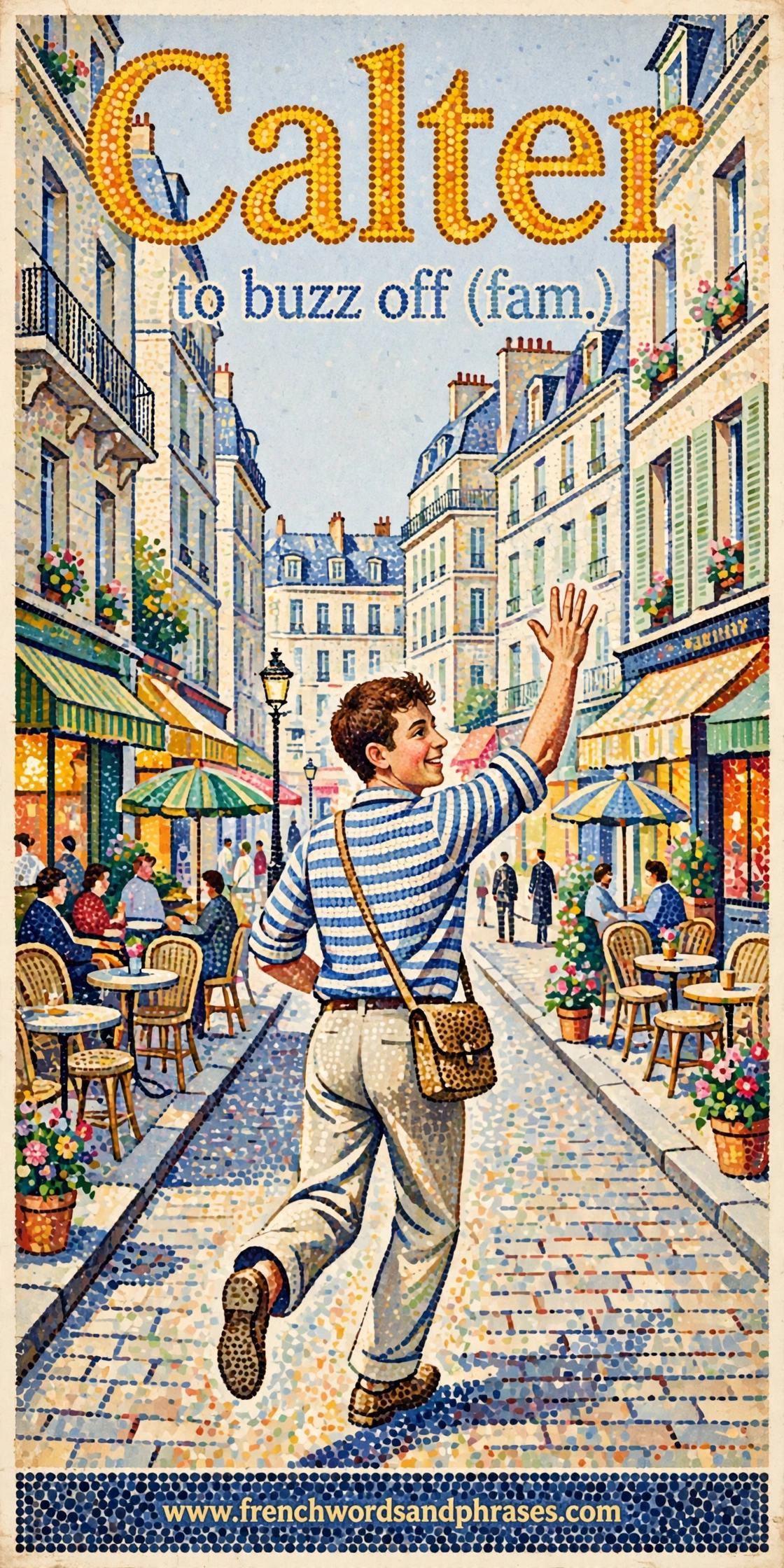
A French Word to Live By
How to Conjugate Calter in French
/kal.te/
Calter means to buzz off (fam.) — to leave in a hurry, to clear out fast, in familiar French slang.
The police whistle blows at the end of the street, the teacher’s footsteps echo in the corridor — calter is the familiar verb of the quick getaway: gone before anyone can ask questions.
In this guide, you’ll learn how to conjugate calter in all the major French tenses and moods. Explore complete conjugation tables, French examples, English translations, and practice quizzes.
Understanding the French Verb Calter
Calter is a regular French verb belonging to the first group of verbs, those ending in-er.
It means to buzz off (fam.). Calter always suggests speed and a whiff of mischief — nobody calte from a place they are happy to stay in. It is the verb of kids scattering when a window breaks and of friends slipping away from a boring party before the speeches.
Verb classification: First group (-er)
Auxiliary verb: Avoir
Past participle: calté
Present participle: caltant
English equivalents: To buzz off, to clear out, to scarper (fam.); calter en vitesse — to clear out fast; allez, on calte ! — come on, let’s buzz off!; ils ont calté dès qu’ils ont vu les gendarmes — they scarpered as soon as they saw the police; se calter is also heard for the same idea.
One important detail: calter is familier — slang. In the street and among friends it is perfect; in a formal letter or an exam essay, use partir, s’en aller or filer instead. The conjugation itself is a plain regular -er: je calte, nous caltons, ils caltent, past participle calté. You will also hear the reflexive twin se calter with exactly the same meaning.
Experience the Word
Calter is the verb of the hasty exit — one whistle, one look, and the street is empty.
Imagine three schoolboys who have just rung every doorbell in the street. A window opens, a voice shouts, a dog barks — et ils caltent, three pairs of legs vanishing round the corner before the first door even opens.
Nothing was stolen and no one was caught. They had simply buzzed off — calté, at the first sound, like startled sparrows.
How to Conjugate Calter: Complete French Conjugation Guide
Let’s explore every major conjugation of calter, beginning with the indicative mood.
How to Conjugate Calter in the Indicative Mood
The indicative mood is used to express facts, observations, actions, and events.
How to Conjugate Calter in the Present Tense (Présent)
Used for actions happening now, habitual actions, and general truths.
| Subject | Conjugation |
|---|---|
| je | calte |
| tu | caltes |
| il / elle | calte |
| nous | caltons |
| vous | caltez |
| ils / elles | caltent |
Example
Dès que le gardien arrive, les enfants caltent en riant.
As soon as the caretaker arrives, the children buzz off laughing.
Quick Quiz 1
Complete the sentence:
Nous ______ par le jardin, vite !
Reveal the answer
caltons
Nous caltons par le jardin, vite !
We are clearing out through the garden, quick!
How to Conjugate Calter in the Passé Composé
Used for completed actions in the past. Calter takes the auxiliary verb avoir.
| Subject | Conjugation |
|---|---|
| j’ | ai calté |
| tu | as calté |
| il / elle | a calté |
| nous | avons calté |
| vous | avez calté |
| ils / elles | ont calté |
Example
Ils ont calté dès qu’ils ont entendu la sirène.
They scarpered as soon as they heard the siren.
How to Conjugate Calter in the Imparfait (Imperfect Tense)
Used for habitual past actions, descriptions, and ongoing situations in the past.
| Subject | Conjugation |
|---|---|
| je | caltais |
| tu | caltais |
| il / elle | caltait |
| nous | caltions |
| vous | caltiez |
| ils / elles | caltaient |
Example
À la moindre alerte, la bande caltait par la ruelle.
At the slightest alarm, the gang would clear out down the alley.
Quick Quiz 2
Choose the correct form:
They scarpered before the police arrived.
Ils ______ avant l’arrivée des gendarmes. (ont calté / sont caltés)
Reveal the answer
ont calté
Ils ont calté avant l’arrivée des gendarmes.
Calter takes avoir.
How to Conjugate Calter in the Plus-que-parfait
Used to describe an action that had already been completed before another past event.
| Subject | Conjugation |
|---|---|
| j’ | avais calté |
| tu | avais calté |
| il / elle | avait calté |
| nous | avions calté |
| vous | aviez calté |
| ils / elles | avaient calté |
Example
Les voleurs avaient calté avant l’arrivée des gendarmes.
The thieves had buzzed off before the police arrived.
How to Conjugate Calter in the Passé Simple
Primarily used in formal writing, literature, and historical narratives. It is rarely used in everyday conversation.
| Subject | Conjugation |
|---|---|
| je | caltai |
| tu | caltas |
| il / elle | calta |
| nous | caltâmes |
| vous | caltâtes |
| ils / elles | caltèrent |
Example
Au premier coup de sifflet, tout le groupe calta.
At the first whistle, the whole group scarpered.
How to Conjugate Calter in the Passé Antérieur
A literary tense used to express an action completed immediately before another past action, generally in the passé simple.
| Subject | Conjugation |
|---|---|
| j’ | eus calté |
| tu | eus calté |
| il / elle | eut calté |
| nous | eûmes calté |
| vous | eûtes calté |
| ils / elles | eurent calté |
Example
Quand ils eurent calté, la rue redevint silencieuse.
When they had cleared out, the street fell silent again.
How to Conjugate Calter in the Future Tense (Futur Simple)
Used to describe actions that will take place in the future.
| Subject | Conjugation |
|---|---|
| je | calterai |
| tu | calteras |
| il / elle | caltera |
| nous | calterons |
| vous | calterez |
| ils / elles | calteront |
Example
Si le gardien revient, nous calterons par le jardin.
If the caretaker comes back, we shall buzz off through the garden.
How to Conjugate Calter in the Futur Antérieur (Future Perfect)
Used for an action that will have been completed before a particular point in the future.
| Subject | Conjugation |
|---|---|
| j’ | aurai calté |
| tu | auras calté |
| il / elle | aura calté |
| nous | aurons calté |
| vous | aurez calté |
| ils / elles | auront calté |
Example
À ton retour, ils auront déjà calté.
By the time you get back, they will already have buzzed off.
How to Conjugate Calter in the Near Future (Futur Proche)
Used to describe something that is going to happen soon. Formed with aller + infinitive.
| Subject | Conjugation |
|---|---|
| je | vais calter |
| tu | vas calter |
| il / elle | va calter |
| nous | allons calter |
| vous | allez calter |
| ils / elles | vont calter |
Example
Allez, on va calter avant qu’il pleuve.
Come on, we are going to clear out before it rains.
How to Conjugate Calter in the Conditional Mood
The conditional mood expresses what would happen under certain circumstances. It is also frequently used to make polite requests or express wishes.
How to Conjugate Calter in the Present Conditional
| Subject | Conjugation |
|---|---|
| je | calterais |
| tu | calterais |
| il / elle | calterait |
| nous | calterions |
| vous | calteriez |
| ils / elles | calteraient |
Example
À ta place, je calterais avant les discours.
If I were you, I would buzz off before the speeches.
How to Conjugate Calter in the Past Conditional
| Subject | Conjugation |
|---|---|
| j’ | aurais calté |
| tu | aurais calté |
| il / elle | aurait calté |
| nous | aurions calté |
| vous | auriez calté |
| ils / elles | auraient calté |
Example
Vous auriez calté si vous aviez vu le gardien.
You would have scarpered if you had seen the caretaker.
Calter in the Literary Past Conditional Form
This less common literary form uses the imperfect subjunctive of avoir.
| Subject | Conjugation |
|---|---|
| j’ | eusse calté |
| tu | eusses calté |
| il / elle | eût calté |
| nous | eussions calté |
| vous | eussiez calté |
| ils / elles | eussent calté |
Example
Ils eussent calté au premier bruit, selon les témoins.
They would have buzzed off at the first sound, according to the witnesses.
How to Conjugate Calter in the Subjunctive Mood
The subjunctive is used to express wishes, emotions, doubts, necessity, and uncertainty. It frequently follows expressions such as il faut que (it is necessary that) or bien que (although).
How to Conjugate Calter in the Present Subjunctive
| Subject | Conjugation |
|---|---|
| que je | calte |
| que tu | caltes |
| qu’il / qu’elle | calte |
| que nous | caltions |
| que vous | caltiez |
| qu’ils / qu’elles | caltent |
Example
Il faut que vous caltiez avant la fermeture.
You must clear out before closing time.
Quick Quiz 3
Complete the sentence using the subjunctive:
Il faut que tu ______ avant les discours.
Reveal the answer
caltes
Il faut que tu caltes avant les discours.
You must buzz off before the speeches.
How to Conjugate Calter in the Imperfect Subjunctive
A literary tense, rarely encountered in modern spoken French.
| Subject | Conjugation |
|---|---|
| que je | caltasse |
| que tu | caltasses |
| qu’il / qu’elle | caltât |
| que nous | caltassions |
| que vous | caltassiez |
| qu’ils / qu’elles | caltassent |
Example
Il valait mieux qu’ils caltassent avant l’arrivée du directeur.
It was better for them to buzz off before the headmaster arrived.
How to Conjugate Calter in the Pluperfect Subjunctive
A literary construction used to express an action completed before another past action.
| Subject | Conjugation |
|---|---|
| que j’ | eusse calté |
| que tu | eusses calté |
| qu’il / qu’elle | eût calté |
| que nous | eussions calté |
| que vous | eussiez calté |
| qu’ils / qu’elles | eussent calté |
Example
On disait qu’ils eussent calté dès le premier coup de sifflet.
People said they had scarpered at the very first whistle.
How to Conjugate Calter in the Past Subjunctive
| Subject | Conjugation |
|---|---|
| que j’ | aie calté |
| que tu | aies calté |
| qu’il / qu’elle | ait calté |
| que nous | ayons calté |
| que vous | ayez calté |
| qu’ils / qu’elles | aient calté |
Example
Je suis content que vous ayez calté à temps.
I am glad you cleared out in time.
How to Conjugate Calter in the Imperative
The imperative is used to give commands, instructions, invitations, or suggestions. Subject pronouns are omitted.
How to Conjugate Calter in the Present Imperative
| Person | Conjugation |
|---|---|
| (tu) | calte |
| (nous) | caltons |
| (vous) | caltez |
Example
Caltez, les gars, voilà le gardien !
Buzz off, lads, here comes the caretaker!
Quick Quiz 4
How would you say Buzz off, here comes the caretaker (tu form)?
Reveal the answer
Calte, voilà le gardien !
French Participles of Calter
Participles are verb forms that can be used in compound tenses and other grammatical constructions.
Present Participle of Calter
caltant
En caltant par la ruelle, ils ont évité le gardien.
By clearing out down the alley, they avoided the caretaker.
Past Participle of Calter
calté
Calté en deux minutes, le groupe n’a laissé aucune trace.
Gone in two minutes, the group left no trace.
Calter in Everyday French: Real-Life Examples
Now that you know the conjugations, let’s see how calter appears in everyday French.
Example 1 — Present
Les enfants caltent dès qu’ils voient le gardien.
The children buzz off as soon as they see the caretaker.
Example 2 — Passé composé
Ils ont calté avant l’arrivée des gendarmes.
They scarpered before the police arrived.
Example 3 — Imparfait
La bande caltait par la ruelle.
The gang would clear out down the alley.
Example 4 — Future
Nous calterons par le jardin.
We shall buzz off through the garden.
Example 5 — Conditional
Je calterais avant les discours.
I would buzz off before the speeches.
Example 6 — Imperative
Caltez, voilà le gardien !
Buzz off, here comes the caretaker!
Beyond Translation: The Meaning of Calter
English to buzz off and to scarper are the right cousins — calter is unmistakably slang, the word of playgrounds, barracks and street corners.
It belongs to spoken French.
You will hear calter in films, songs and schoolyards far more than you will read it; and if someone whispers allez, on calte !, the correct response is not to ask where — it is to run.
How to Remember the French Verb Calter
Remember it this way: Calter is about three schoolboys vanishing round the corner.
- Familier register: perfect with friends, out of place in formal writing — use partir or filer there.
- Plain regular -er underneath the slang: je calte, nous caltons, past participle calté.
- It always smells of haste and mischief — a getaway, not a departure.
The key idea is three schoolboys vanishing round the corner.
Test Your Knowledge of Calter
Let’s see how much you’ve learned. Try answering these questions before revealing the answers.
Question 1
What register is calter, and what should you write in a formal letter instead?
Reveal the answer
Familier (slang) — in formal writing use partir, s’en aller or filer.
Question 2
How do you say They scarpered as soon as they heard the siren in French?
Reveal the answer
Ils ont calté dès qu’ils ont entendu la sirène.
Question 3
Translate: Come on, let’s buzz off before it rains!
Reveal the answer
Allez, on va calter avant qu’il pleuve.
Question 4
What is the past participle of calter?
Reveal the answer
Calté.
Question 5
Complete the sentence:
Il faut que vous ______ avant la fermeture.
Reveal the answer
caltiez
Il faut que vous caltiez avant la fermeture.
You must clear out before closing time.
Your Final Challenge
Can You Use It?
How would you say this in French?
At the first whistle, the gang buzzed off so fast that the street seemed never to have been lived in.
Reveal the answer
Au premier coup de sifflet, la bande calta si vite que la rue sembla n’avoir jamais été habitée.
At the first whistle, the gang buzzed off so fast that the street seemed never to have been lived in.
A little French. A little curiosity. A richer everyday life.
LEARN FRENCH ONE WORD AT A TIME




