
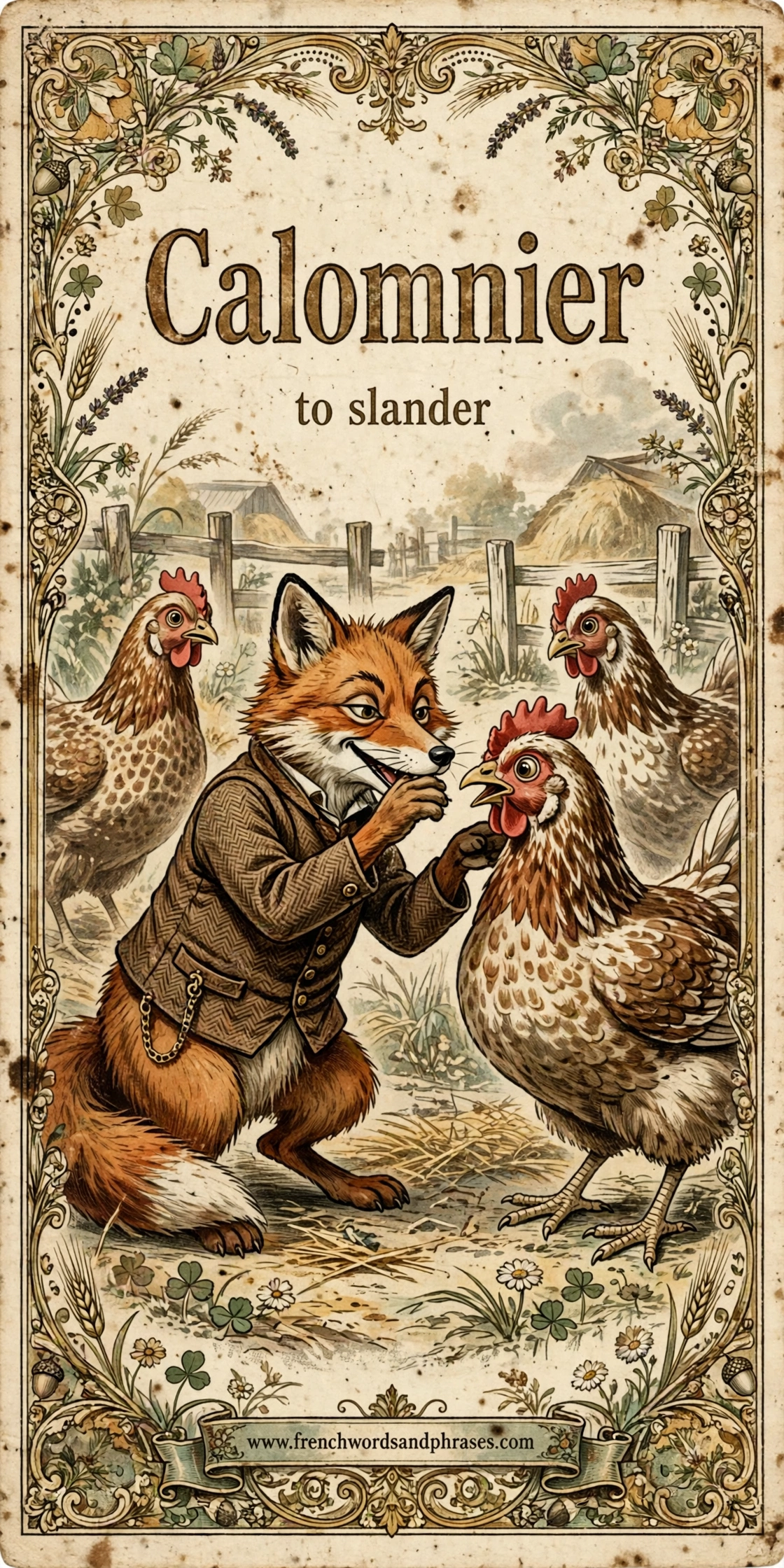
A French Word to Live By
How to Conjugate Calomnier in French
/ka.lɔm.nje/
Calomnier means to slander, to libel — to spread lies about someone in order to blacken their name and destroy their reputation.
An anonymous letter, a whisper repeated in every office corridor, a rival’s name dragged through the mud — calomnier is the verb of the deliberate lie told to ruin someone’s reputation.
In this guide, you’ll learn how to conjugate calomnier in all the major French tenses and moods. Explore complete conjugation tables, French examples, English translations, and practice quizzes.
Understanding the French Verb Calomnier
Calomnier is a regular French verb belonging to the first group of verbs, those ending in-er.
It means to slander, to libel. Calomnier always involves falsehood told with intent to harm: for spoken lies it matches English slander, in print it is libel. It is stronger and more deliberate than médire (to speak ill of), and the person attacked is innocent by definition — that injustice is built into the word.
Verb classification: First group (-er)
Auxiliary verb: Avoir
Past participle: calomnié
Present participle: calomniant
English equivalents: To slander, to libel, to defame; calomnier un rival — to slander a rival; calomnier quelqu’un dans la presse — to libel someone in the press; être calomnié par ses ennemis — to be slandered by one’s enemies; calomnier sans preuves — to defame without proof.
One important detail: calomnier is an -ier verb, so the stem ends in i and the imperfect and subjunctive nous/vous forms show a double i: nous calomniions, vous calomniiez — that doubled i is correct, not a typo. In the present the i merges with the ending: je calomnie, nous calomnions. The noun from the same family is famous: la calomnie, slander — Calomniez, calomniez, il en restera toujours quelque chose, slander away, something will always stick.
Experience the Word
Calomnier is the verb of the poisoned reputation — lies told on purpose, by someone who knows they are lies.
Imagine a gifted schoolteacher passed over for promotion. A colleague, smiling, lets fall a few invented details — money missing, favourites helped — and repeats them until the whole staff room believes them. Il calomnie, quietly, and the mud sticks.
No proof has ever been produced. She has simply been slandered — calomniée, by whispers that no denial can quite wash away.
How to Conjugate Calomnier: Complete French Conjugation Guide
Let’s explore every major conjugation of calomnier, beginning with the indicative mood.
How to Conjugate Calomnier in the Indicative Mood
The indicative mood is used to express facts, observations, actions, and events.
How to Conjugate Calomnier in the Present Tense (Présent)
Used for actions happening now, habitual actions, and general truths.
| Subject | Conjugation |
|---|---|
| je | calomnie |
| tu | calomnies |
| il / elle | calomnie |
| nous | calomnions |
| vous | calomniez |
| ils / elles | calomnient |
Example
Les jaloux calomnient ceux qui réussissent mieux qu’eux.
Jealous people slander those who do better than them.
Quick Quiz 1
Complete the sentence:
Nous ne ______ jamais nos rivaux.
Reveal the answer
calomnions
Nous ne calomnions jamais nos rivaux.
We never slander our rivals.
How to Conjugate Calomnier in the Passé Composé
Used for completed actions in the past. Calomnier takes the auxiliary verb avoir.
| Subject | Conjugation |
|---|---|
| j’ | ai calomnié |
| tu | as calomnié |
| il / elle | a calomnié |
| nous | avons calomnié |
| vous | avez calomnié |
| ils / elles | ont calomnié |
Example
Ses ennemis l’ont calomnié dans tous les journaux.
His enemies libelled him in all the newspapers.
How to Conjugate Calomnier in the Imparfait (Imperfect Tense)
Used for habitual past actions, descriptions, and ongoing situations in the past.
| Subject | Conjugation |
|---|---|
| je | calomniais |
| tu | calomniais |
| il / elle | calomniait |
| nous | calomniions |
| vous | calomniiez |
| ils / elles | calomniaient |
Example
Autrefois, on calomniait les artistes incompris.
In the old days, misunderstood artists were slandered.
Quick Quiz 2
Choose the correct form:
She was slandered by her enemies.
Elle ______ par ses ennemis. (a été calomniée / a calomnié)
Reveal the answer
a été calomniée
Elle a été calomniée par ses ennemis.
In the passive, the participle agrees: calomniée.
How to Conjugate Calomnier in the Plus-que-parfait
Used to describe an action that had already been completed before another past event.
| Subject | Conjugation |
|---|---|
| j’ | avais calomnié |
| tu | avais calomnié |
| il / elle | avait calomnié |
| nous | avions calomnié |
| vous | aviez calomnié |
| ils / elles | avaient calomnié |
Example
Le ministre avait calomnié son rival avant les élections.
The minister had slandered his rival before the elections.
How to Conjugate Calomnier in the Passé Simple
Primarily used in formal writing, literature, and historical narratives. It is rarely used in everyday conversation.
| Subject | Conjugation |
|---|---|
| je | calomniai |
| tu | calomnias |
| il / elle | calomnia |
| nous | calomniâmes |
| vous | calomniâtes |
| ils / elles | calomnièrent |
Example
Le pamphlet calomnia le maire pendant des semaines.
The pamphlet libelled the mayor for weeks.
How to Conjugate Calomnier in the Passé Antérieur
A literary tense used to express an action completed immediately before another past action, generally in the passé simple.
| Subject | Conjugation |
|---|---|
| j’ | eus calomnié |
| tu | eus calomnié |
| il / elle | eut calomnié |
| nous | eûmes calomnié |
| vous | eûtes calomnié |
| ils / elles | eurent calomnié |
Example
Quand il eut calomnié son associé, plus personne ne lui fit confiance.
When he had slandered his partner, nobody trusted him any more.
How to Conjugate Calomnier in the Future Tense (Futur Simple)
Used to describe actions that will take place in the future.
| Subject | Conjugation |
|---|---|
| je | calomnierai |
| tu | calomnieras |
| il / elle | calomniera |
| nous | calomnierons |
| vous | calomnierez |
| ils / elles | calomnieront |
Example
Ils te calomnieront dès que tu auras du succès.
They will slander you as soon as you are successful.
How to Conjugate Calomnier in the Futur Antérieur (Future Perfect)
Used for an action that will have been completed before a particular point in the future.
| Subject | Conjugation |
|---|---|
| j’ | aurai calomnié |
| tu | auras calomnié |
| il / elle | aura calomnié |
| nous | aurons calomnié |
| vous | aurez calomnié |
| ils / elles | auront calomnié |
Example
À la fin du procès, on aura calomnié tout le monde.
By the end of the trial, everyone will have been slandered.
How to Conjugate Calomnier in the Near Future (Futur Proche)
Used to describe something that is going to happen soon. Formed with aller + infinitive.
| Subject | Conjugation |
|---|---|
| je | vais calomnier |
| tu | vas calomnier |
| il / elle | va calomnier |
| nous | allons calomnier |
| vous | allez calomnier |
| ils / elles | vont calomnier |
Example
Attention, ce journal va calomnier le candidat.
Careful, that newspaper is going to libel the candidate.
How to Conjugate Calomnier in the Conditional Mood
The conditional mood expresses what would happen under certain circumstances. It is also frequently used to make polite requests or express wishes.
How to Conjugate Calomnier in the Present Conditional
| Subject | Conjugation |
|---|---|
| je | calomnierais |
| tu | calomnierais |
| il / elle | calomnierait |
| nous | calomnierions |
| vous | calomnieriez |
| ils / elles | calomnieraient |
Example
Sans preuves, aucun journaliste sérieux ne le calomnierait.
Without proof, no serious journalist would libel him.
How to Conjugate Calomnier in the Past Conditional
| Subject | Conjugation |
|---|---|
| j’ | aurais calomnié |
| tu | aurais calomnié |
| il / elle | aurait calomnié |
| nous | aurions calomnié |
| vous | auriez calomnié |
| ils / elles | auraient calomnié |
Example
Tu l’aurais calomnié si tu avais répété ces rumeurs.
You would have slandered him if you had repeated those rumours.
Calomnier in the Literary Past Conditional Form
This less common literary form uses the imperfect subjunctive of avoir.
| Subject | Conjugation |
|---|---|
| j’ | eusse calomnié |
| tu | eusses calomnié |
| il / elle | eût calomnié |
| nous | eussions calomnié |
| vous | eussiez calomnié |
| ils / elles | eussent calomnié |
Example
Il eût calomnié son frère pour hériter seul.
He would have slandered his own brother to inherit alone.
How to Conjugate Calomnier in the Subjunctive Mood
The subjunctive is used to express wishes, emotions, doubts, necessity, and uncertainty. It frequently follows expressions such as il faut que (it is necessary that) or bien que (although).
How to Conjugate Calomnier in the Present Subjunctive
| Subject | Conjugation |
|---|---|
| que je | calomnie |
| que tu | calomnies |
| qu’il / qu’elle | calomnie |
| que nous | calomniions |
| que vous | calomniiez |
| qu’ils / qu’elles | calomnient |
Example
Je ne veux pas que vous calomniiez vos collègues.
I do not want you to slander your colleagues.
Quick Quiz 3
Complete the sentence using the subjunctive:
Je ne veux pas que tu ______ ton frère.
Reveal the answer
calomnies
Je ne veux pas que tu calomnies ton frère.
I do not want you to slander your brother.
How to Conjugate Calomnier in the Imperfect Subjunctive
A literary tense, rarely encountered in modern spoken French.
| Subject | Conjugation |
|---|---|
| que je | calomniasse |
| que tu | calomniasses |
| qu’il / qu’elle | calomniât |
| que nous | calomniassions |
| que vous | calomniassiez |
| qu’ils / qu’elles | calomniassent |
Example
Il était honteux qu’on calomniât un homme innocent.
It was shameful that an innocent man should be slandered.
How to Conjugate Calomnier in the Pluperfect Subjunctive
A literary construction used to express an action completed before another past action.
| Subject | Conjugation |
|---|---|
| que j’ | eusse calomnié |
| que tu | eusses calomnié |
| qu’il / qu’elle | eût calomnié |
| que nous | eussions calomnié |
| que vous | eussiez calomnié |
| qu’ils / qu’elles | eussent calomnié |
Example
On disait qu’il eût calomnié son meilleur ami.
People said he had slandered his best friend.
How to Conjugate Calomnier in the Past Subjunctive
| Subject | Conjugation |
|---|---|
| que j’ | aie calomnié |
| que tu | aies calomnié |
| qu’il / qu’elle | ait calomnié |
| que nous | ayons calomnié |
| que vous | ayez calomnié |
| qu’ils / qu’elles | aient calomnié |
Example
Je suis indigné qu’on ait calomnié cette femme honnête.
I am outraged that this honest woman has been slandered.
How to Conjugate Calomnier in the Imperative
The imperative is used to give commands, instructions, invitations, or suggestions. Subject pronouns are omitted.
How to Conjugate Calomnier in the Present Imperative
| Person | Conjugation |
|---|---|
| (tu) | calomnie |
| (nous) | calomnions |
| (vous) | calomniez |
Example
Ne calomniez jamais un absent, il ne peut pas se défendre !
Never slander someone who is absent, they cannot defend themselves!
Quick Quiz 4
How would you say Do not slander your colleagues (tu form)?
Reveal the answer
Ne calomnie pas tes collègues !
French Participles of Calomnier
Participles are verb forms that can be used in compound tenses and other grammatical constructions.
Present Participle of Calomnier
calomniant
En calomniant son rival, il a perdu l’estime de tous.
By slandering his rival, he lost everyone’s respect.
Past Participle of Calomnier
calomnié
Calomnié par la presse, l’acteur a fini par porter plainte.
Libelled by the press, the actor ended up filing a complaint.
Calomnier in Everyday French: Real-Life Examples
Now that you know the conjugations, let’s see how calomnier appears in everyday French.
Example 1 — Present
Les jaloux calomnient les gens heureux.
Jealous people slander happy people.
Example 2 — Passé composé
On l’a calomnié dans les journaux.
He was libelled in the newspapers.
Example 3 — Imparfait
Elle calomniait ses rivales sans cesse.
She used to slander her rivals constantly.
Example 4 — Future
Ils te calomnieront si tu réussis.
They will slander you if you succeed.
Example 5 — Conditional
Personne ne le calomnierait sans preuves.
Nobody would slander him without proof.
Example 6 — Imperative
Ne calomnie pas tes collègues !
Do not slander your colleagues!
Beyond Translation: The Meaning of Calomnier
English calumny is the rare, bookish cousin — French calomnier and its noun la calomnie are everyday words by comparison, straight from Latin calumnia, a false accusation.
The famous line is Beaumarchais’s.
In The Barber of Seville, Don Basilio describes slander swelling from a whisper to a chorus — la calomnie is still the set-piece speech French schoolchildren meet, and calomnier is the verb that does the swelling.
How to Remember the French Verb Calomnier
Remember it this way: Calomnier is about whispers swelling into a chorus of lies.
- Calomnier is an -ier verb: nous calomniions with double i in the imperfect — correct, not a mistake.
- It always means lying to harm: slander in speech, libel in print, never just criticising.
- The noun la calomnie is the famous one — calomniez, calomniez, il en restera toujours quelque chose.
The key idea is whispers swelling into a chorus of lies.
Test Your Knowledge of Calomnier
Let’s see how much you’ve learned. Try answering these questions before revealing the answers.
Question 1
Why is there a double i in nous calomniions?
Reveal the answer
Calomnier is an -ier verb — the stem ends in i, so imperfect and subjunctive nous/vous forms double it: nous calomniions, vous calomniiez.
Question 2
How do you say His enemies libelled him in the newspapers in French?
Reveal the answer
Ses ennemis l’ont calomnié dans les journaux.
Question 3
Translate: Jealous people slander those who succeed.
Reveal the answer
Les jaloux calomnient ceux qui réussissent.
Question 4
What is the past participle of calomnier?
Reveal the answer
Calomnié.
Question 5
Complete the sentence:
Je ne veux pas que vous ______ vos collègues.
Reveal the answer
calomniiez
Je ne veux pas que vous calomniiez vos collègues.
I do not want you to slander your colleagues.
Your Final Challenge
Can You Use It?
How would you say this in French?
Slandered by those he had helped, the old man kept silent, knowing that truth walks more slowly than lies.
Reveal the answer
Calomnié par ceux qu’il avait aidés, le vieil homme garda le silence, sachant que la vérité marche plus lentement que le mensonge.
Slandered by those he had helped, the old man kept silent, knowing that truth walks more slowly than lies.
A little French. A little curiosity. A richer everyday life.
LEARN FRENCH ONE WORD AT A TIME




