
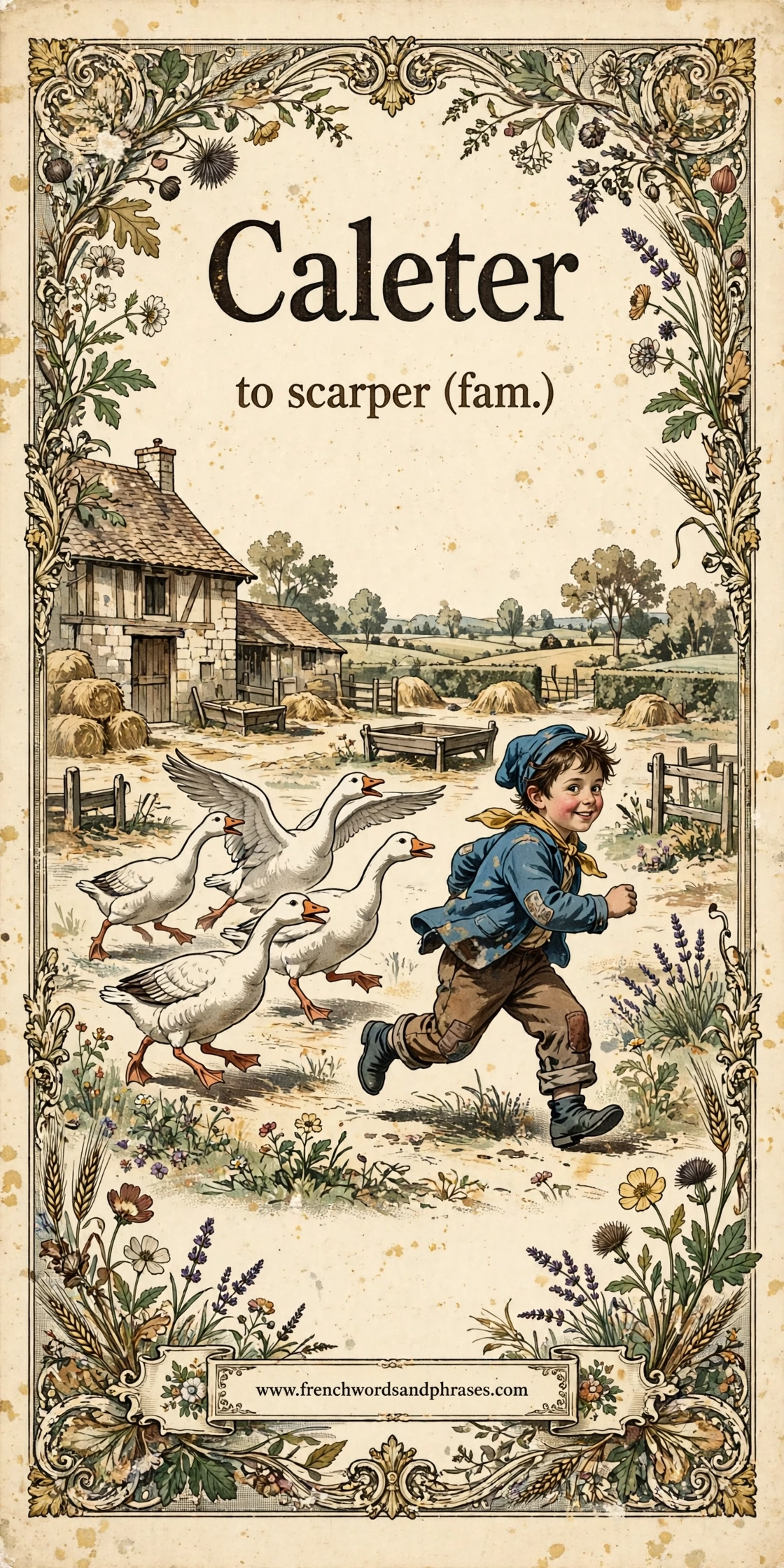
A French Word to Live By
How to Conjugate Caleter in French
/kal.te/
Caleter means to make off, to scarper — in familiar French, to slip away quickly and quietly before anyone can stop you.
A schoolboy vanishing through the garden gate at the first bell, a cat gone before the door has finished opening — caleter is the familier verb of the quick getaway: no announcement, no goodbye, just an empty space where someone stood.
In this guide, you’ll learn how to conjugate caleter in all the major French tenses and moods. Explore complete conjugation tables, French examples, English translations, and practice quizzes.
Understanding the French Verb Caleter
Caleter is a regular French verb belonging to the first group of verbs, those ending in-er.
It means to make off, to scarper (fam.). It is used of people (and animals) who leave fast and discreetly, usually to avoid something — a lesson, a chore, a telling-off. It always carries a smile: the person who calète is quicker than the situation, and the verb belongs to spoken, familiar French.
Verb classification: First group (-er)
Auxiliary verb: Avoir
Past participle: caleté
Present participle: caletant
English equivalents: To make off, to scarper, to slip away (familiar); caleter sans un bruit — to slip away without a sound; il a caleté — he scarpered; caleter avant l’arrivée de quelqu’un — to make off before someone arrives.
One important detail: caleter is familier — slang — and it follows the acheter-type spelling: the plain e of the stem opens to è in the present singular and third plural, in the subjunctive singular and third plural, and in the tu imperative — je calète, tu calètes, il calète, ils calètent — and the è runs right through the future and conditional stems: je calèterai, je calèterais. But the è never appears where the ending is sounded: nous caletons, vous caletez, je caletais, and the infinitive and participle keep the plain e: caleter, caleté. Its close cousin calter means the same thing; everyday neutral French says filer or déguerpir.
Experience the Word
Caleter is the verb of the empty chair — the art of being gone before anyone thinks to look for you.
Imagine the last lesson of a hot June afternoon. The teacher turns to the blackboard, chalk in hand — and in the third row, discrètement, un élève calète: bag on shoulder, down the corridor, through the garden gate, free. When the teacher turns back, there is only an empty desk and warm air.
No door slammed, no excuse given. He has simply caleté — scarpered, in the time it takes to write one word on a board.
How to Conjugate Caleter: Complete French Conjugation Guide
Let’s explore every major conjugation of caleter, beginning with the indicative mood.
How to Conjugate Caleter in the Indicative Mood
The indicative mood is used to express facts, observations, actions, and events.
How to Conjugate Caleter in the Present Tense (Présent)
Used for actions happening now, habitual actions, and general truths.
| Subject | Conjugation |
|---|---|
| je | calète |
| tu | calètes |
| il / elle | calète |
| nous | caletons |
| vous | caletez |
| ils / elles | calètent |
Example
Dès qu’il aperçoit le surveillant, il calète sans un bruit.
As soon as he spots the supervisor, he slips away without a sound.
Quick Quiz 1
Complete the sentence:
Nous ______ toujours avant la corvée de vaisselle.
Reveal the answer
caletons
Nous caletons toujours avant la corvée de vaisselle.
We always slip away before the washing-up chore.
How to Conjugate Caleter in the Passé Composé
Used for completed actions in the past. Caleter takes the auxiliary verb avoir.
| Subject | Conjugation |
|---|---|
| j’ | ai caleté |
| tu | as caleté |
| il / elle | a caleté |
| nous | avons caleté |
| vous | avez caleté |
| ils / elles | ont caleté |
Example
Il a caleté avant même la fin du cours.
He scarpered before the lesson had even ended.
How to Conjugate Caleter in the Imparfait (Imperfect Tense)
Used for habitual past actions, descriptions, and ongoing situations in the past.
| Subject | Conjugation |
|---|---|
| je | caletais |
| tu | caletais |
| il / elle | caletait |
| nous | caletions |
| vous | caletiez |
| ils / elles | caletaient |
Example
Chaque vendredi, il caletait par la petite porte du jardin.
Every Friday, he used to slip away through the little garden gate.
Quick Quiz 2
Choose the correct form:
He scarpered before the end of the lesson.
Il ______ avant la fin du cours. (a caleté / est caleté)
Reveal the answer
a caleté
Il a caleté avant la fin du cours.
Caleter takes avoir.
How to Conjugate Caleter in the Plus-que-parfait
Used to describe an action that had already been completed before another past event.
| Subject | Conjugation |
|---|---|
| j’ | avais caleté |
| tu | avais caleté |
| il / elle | avait caleté |
| nous | avions caleté |
| vous | aviez caleté |
| ils / elles | avaient caleté |
Example
Elle avait caleté avant le retour du gardien.
She had made off before the caretaker came back.
How to Conjugate Caleter in the Passé Simple
Primarily used in formal writing, literature, and historical narratives. It is rarely used in everyday conversation.
| Subject | Conjugation |
|---|---|
| je | caletai |
| tu | caletas |
| il / elle | caleta |
| nous | caletâmes |
| vous | caletâtes |
| ils / elles | caletèrent |
Example
Il caleta par la fenêtre du rez-de-chaussée et disparut.
He made off through the ground-floor window and vanished.
How to Conjugate Caleter in the Passé Antérieur
A literary tense used to express an action completed immediately before another past action, generally in the passé simple.
| Subject | Conjugation |
|---|---|
| j’ | eus caleté |
| tu | eus caleté |
| il / elle | eut caleté |
| nous | eûmes caleté |
| vous | eûtes caleté |
| ils / elles | eurent caleté |
Example
Dès qu’il eut caleté, la cour redevint silencieuse.
As soon as he had slipped away, the yard fell silent again.
How to Conjugate Caleter in the Future Tense (Futur Simple)
Used to describe actions that will take place in the future.
| Subject | Conjugation |
|---|---|
| je | calèterai |
| tu | calèteras |
| il / elle | calètera |
| nous | calèterons |
| vous | calèterez |
| ils / elles | calèteront |
Example
Il calètera dès que la cloche sonnera, comme toujours.
He will scarper as soon as the bell rings, as always.
How to Conjugate Caleter in the Futur Antérieur (Future Perfect)
Used for an action that will have been completed before a particular point in the future.
| Subject | Conjugation |
|---|---|
| j’ | aurai caleté |
| tu | auras caleté |
| il / elle | aura caleté |
| nous | aurons caleté |
| vous | aurez caleté |
| ils / elles | auront caleté |
Example
À midi, il aura caleté depuis longtemps.
By midday, he will have made off long ago.
How to Conjugate Caleter in the Near Future (Futur Proche)
Used to describe something that is going to happen soon. Formed with aller + infinitive.
| Subject | Conjugation |
|---|---|
| je | vais caleter |
| tu | vas caleter |
| il / elle | va caleter |
| nous | allons caleter |
| vous | allez caleter |
| ils / elles | vont caleter |
Example
Regarde-le, il va caleter dès que le gardien tournera le dos.
Look at him, he is going to slip away as soon as the caretaker turns his back.
How to Conjugate Caleter in the Conditional Mood
The conditional mood expresses what would happen under certain circumstances. It is also frequently used to make polite requests or express wishes.
How to Conjugate Caleter in the Present Conditional
| Subject | Conjugation |
|---|---|
| je | calèterais |
| tu | calèterais |
| il / elle | calèterait |
| nous | calèterions |
| vous | calèteriez |
| ils / elles | calèteraient |
Example
Sans la fenêtre ouverte, il ne calèterait jamais à temps.
Without the open window, he would never make off in time.
How to Conjugate Caleter in the Past Conditional
| Subject | Conjugation |
|---|---|
| j’ | aurais caleté |
| tu | aurais caleté |
| il / elle | aurait caleté |
| nous | aurions caleté |
| vous | auriez caleté |
| ils / elles | auraient caleté |
Example
Il aurait caleté si la porte n’avait pas été fermée à clé.
He would have scarpered if the door had not been locked.
Caleter in the Literary Past Conditional Form
This less common literary form uses the imperfect subjunctive of avoir.
| Subject | Conjugation |
|---|---|
| j’ | eusse caleté |
| tu | eusses caleté |
| il / elle | eût caleté |
| nous | eussions caleté |
| vous | eussiez caleté |
| ils / elles | eussent caleté |
Example
Il eût caleté par le jardin sans l’arrivée du directeur.
He would have made off through the garden if the headmaster had not arrived.
How to Conjugate Caleter in the Subjunctive Mood
The subjunctive is used to express wishes, emotions, doubts, necessity, and uncertainty. It frequently follows expressions such as il faut que (it is necessary that) or bien que (although).
How to Conjugate Caleter in the Present Subjunctive
| Subject | Conjugation |
|---|---|
| que je | calète |
| que tu | calètes |
| qu’il / qu’elle | calète |
| que nous | caletions |
| que vous | caletiez |
| qu’ils / qu’elles | calètent |
Example
Il faut qu’il calète avant l’arrivée du directeur.
He must slip away before the headmaster arrives.
Quick Quiz 3
Complete the sentence using the subjunctive:
On craignait qu’il ______ pendant l’inspection.
Reveal the answer
caletât
On craignait qu’il caletât pendant l’inspection.
People feared he might slip away during the inspection.
How to Conjugate Caleter in the Imperfect Subjunctive
A literary tense, rarely encountered in modern spoken French.
| Subject | Conjugation |
|---|---|
| que je | caletasse |
| que tu | caletasses |
| qu’il / qu’elle | caletât |
| que nous | caletassions |
| que vous | caletassiez |
| qu’ils / qu’elles | caletassent |
Example
On craignait qu’il caletât pendant l’inspection.
People feared he might slip away during the inspection.
How to Conjugate Caleter in the Pluperfect Subjunctive
A literary construction used to express an action completed before another past action.
| Subject | Conjugation |
|---|---|
| que j’ | eusse caleté |
| que tu | eusses caleté |
| qu’il / qu’elle | eût caleté |
| que nous | eussions caleté |
| que vous | eussiez caleté |
| qu’ils / qu’elles | eussent caleté |
Example
On disait qu’il eût caleté bien avant la cloche.
People said he had made off well before the bell.
How to Conjugate Caleter in the Past Subjunctive
| Subject | Conjugation |
|---|---|
| que j’ | aie caleté |
| que tu | aies caleté |
| qu’il / qu’elle | ait caleté |
| que nous | ayons caleté |
| que vous | ayez caleté |
| qu’ils / qu’elles | aient caleté |
Example
Je suis étonné qu’il ait caleté si tôt aujourd’hui.
I am amazed he scarpered so early today.
How to Conjugate Caleter in the Imperative
The imperative is used to give commands, instructions, invitations, or suggestions. Subject pronouns are omitted.
How to Conjugate Caleter in the Present Imperative
| Person | Conjugation |
|---|---|
| (tu) | calète |
| (nous) | caletons |
| (vous) | caletez |
Example
Calète, vite, voilà le gardien !
Scarper, quick, here comes the caretaker!
Quick Quiz 4
How would you say Scarper, quick (tu form)?
Reveal the answer
Calète, vite !
French Participles of Caleter
Participles are verb forms that can be used in compound tenses and other grammatical constructions.
Present Participle of Caleter
caletant
En caletant discrètement, il a évité le directeur.
By slipping away discreetly, he avoided the headmaster.
Past Participle of Caleter
caleté
Caleté par la fenêtre, l’élève avait disparu dans la cour.
Having made off through the window, the pupil had vanished into the yard.
Caleter in Everyday French: Real-Life Examples
Now that you know the conjugations, let’s see how caleter appears in everyday French.
Example 1 — Present
Il calète dès qu’il voit le surveillant.
He slips away as soon as he sees the supervisor.
Example 2 — Passé composé
Il a caleté avant la fin du cours.
He scarpered before the end of the lesson.
Example 3 — Imparfait
Il caletait chaque vendredi par le jardin.
He used to slip away every Friday through the garden.
Example 4 — Future
Il calètera dès la sonnerie.
He will scarper at the bell.
Example 5 — Conditional
Il calèterait sans la fenêtre fermée.
He would make off if the window were not shut.
Example 6 — Imperative
Calète, vite !
Scarper, quick!
Beyond Translation: The Meaning of Caleter
English to scarper is the perfect twin — Cockney rhyming slang with the same grin; French caleter belongs to the same family of getaway words as calter and filer.
It is the getaway as a minor art form.
Nobody calète in a panic or in a boardroom: you calète out of lessons, chores and boring afternoons — quickly, quietly, and just a little bit pleased with yourself.
How to Remember the French Verb Caleter
Remember it this way: Caleter is about the schoolboy gone through the garden gate at the first bell.
- Acheter-type spelling: je calète with è in the present, and je calèterai with è right through the future.
- Familier register: caleter is slang for slipping away — filer and déguerpir are the neutral words.
- The classic scene: caleter avant l’arrivée de quelqu’un — gone before the boss arrives.
The key idea is the schoolboy gone through the garden gate at the first bell.
Test Your Knowledge of Caleter
Let’s see how much you’ve learned. Try answering these questions before revealing the answers.
Question 1
Why does je calète have a grave accent but nous caletons none?
Reveal the answer
The acheter-type rule — the stem e opens to è before a mute ending (je calète, ils calètent) and throughout the future (je calèterai), but stays plain e in nous caletons.
Question 2
How do you say He scarpered before the lesson had even ended in French?
Reveal the answer
Il a caleté avant même la fin du cours.
Question 3
Translate: He will scarper as soon as the bell rings.
Reveal the answer
Il calètera dès que la cloche sonnera.
Question 4
What is the past participle of caleter?
Reveal the answer
Caleté — with a plain e, never calèté.
Question 5
Complete the sentence:
Il faut qu’il ______ avant l’arrivée du directeur.
Reveal the answer
calète
Il faut qu’il calète avant l’arrivée du directeur.
He must slip away before the headmaster arrives.
Your Final Challenge
Can You Use It?
How would you say this in French?
As soon as the bell rings, he slips away through the garden, free as air.
Reveal the answer
Dès que la cloche sonne, il calète par le jardin, libre comme l’air.
As soon as the bell rings, he slips away through the garden, free as air.
A little French. A little curiosity. A richer everyday life.
LEARN FRENCH ONE WORD AT A TIME




