
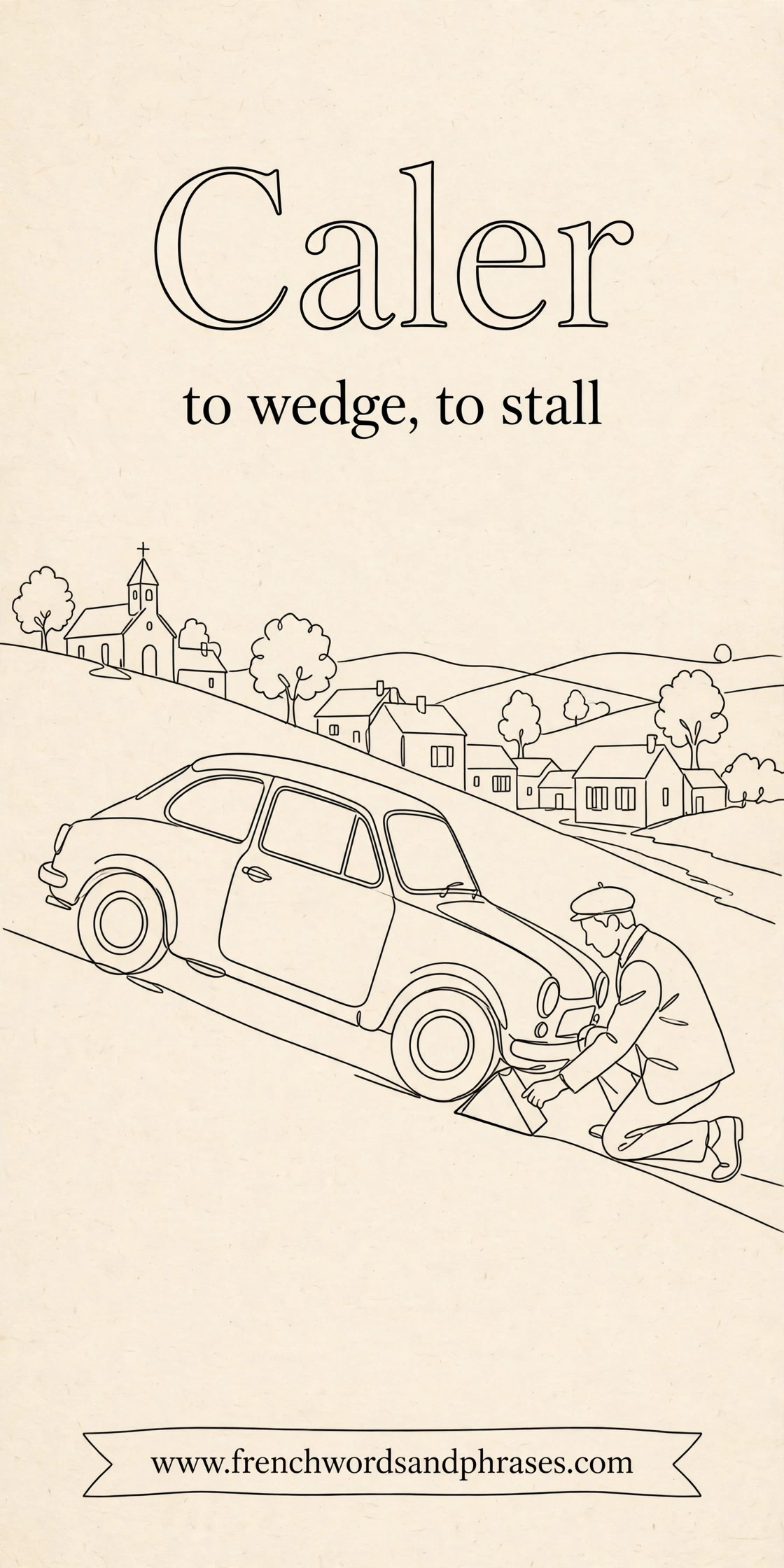
A French Word to Live By
How to Conjugate Caler in French
/ka.le/
Caler means to wedge, to clamp, to stall — to block something firmly in place with a wedge, and, for an engine, to cut out and stop dead.
A stone wedged under a wheel on a hill, a door blocked with a chair, a learner driver’s engine dying at the lights — caler is the verb of the firm block and the sudden stop: things held fast, and engines that give up.
In this guide, you’ll learn how to conjugate caler in all the major French tenses and moods. Explore complete conjugation tables, French examples, English translations, and practice quizzes.
Understanding the French Verb Caler
Caler is a regular French verb belonging to the first group of verbs, those ending in-er.
It means to wedge, to clamp, to stall (car). Every learner driver in France knows caler: the engine stalls at the worst moment — caler au feu rouge. Mechanics and movers use it for wedging wheels, furniture and loads so they cannot roll or slip, and at the table se caler means to settle yourself comfortably and firmly in place.
Verb classification: First group (-er)
Auxiliary verb: Avoir
Past participle: calé
Present participle: calant
English equivalents: To wedge, to chock, to stall; caler une roue — to chock a wheel; caler une porte — to wedge a door shut (or open); le moteur cale — the engine stalls; caler au démarrage — to stall when setting off; se caler dans un fauteuil — to settle oneself into an armchair.
One important detail: caler is built on la cale, a wedge or chock — and also a ship’s hold, which is why caler covers both wedging things fast and settling deep into a seat: se caler dans un fauteuil. The engine sense is the same picture in reverse: a stalled motor is blocked, stuck fast. The verb is a perfectly regular -er: je cale, nous calons, ils calent, past participle calé. Do not confuse it with its near-twin calter and caleter, slang verbs for making off.
Experience the Word
Caler is the verb of the wedge — it holds wheels, doors and loads exactly where you put them, and it stops engines exactly where you do not want them.
Imagine a removal van parked on a steep street in Lyon. Before opening the back doors, the driver slides a wooden block behind the rear wheel — il cale la roue — because forty years of hills have taught him that brakes alone are optimists.
One wedge, no drama. The van stays put — calé — while the piano comes down the ramp.
How to Conjugate Caler: Complete French Conjugation Guide
Let’s explore every major conjugation of caler, beginning with the indicative mood.
How to Conjugate Caler in the Indicative Mood
The indicative mood is used to express facts, observations, actions, and events.
How to Conjugate Caler in the Present Tense (Présent)
Used for actions happening now, habitual actions, and general truths.
| Subject | Conjugation |
|---|---|
| je | cale |
| tu | cales |
| il / elle | cale |
| nous | calons |
| vous | calez |
| ils / elles | calent |
Example
Il cale la roue avec une grosse pierre avant de changer le pneu.
He wedges the wheel with a big stone before changing the tyre.
Quick Quiz 1
Complete the sentence:
Nous ______ les caisses dans le camion pour le voyage.
Reveal the answer
calons
Nous calons les caisses dans le camion pour le voyage.
We are wedging the crates in the lorry for the journey.
How to Conjugate Caler in the Passé Composé
Used for completed actions in the past. Caler takes the auxiliary verb avoir.
| Subject | Conjugation |
|---|---|
| j’ | ai calé |
| tu | as calé |
| il / elle | a calé |
| nous | avons calé |
| vous | avez calé |
| ils / elles | ont calé |
Example
La voiture a calé au milieu du carrefour.
The car stalled in the middle of the junction.
How to Conjugate Caler in the Imparfait (Imperfect Tense)
Used for habitual past actions, descriptions, and ongoing situations in the past.
| Subject | Conjugation |
|---|---|
| je | calais |
| tu | calais |
| il / elle | calait |
| nous | calions |
| vous | caliez |
| ils / elles | calaient |
Example
Au début, elle calait à chaque démarrage.
At first, she used to stall at every start.
Quick Quiz 2
Choose the correct form:
The car stalled at the junction.
La voiture ______ au carrefour. (a calé / est calé)
Reveal the answer
a calé
La voiture a calé au carrefour.
Caler takes avoir.
How to Conjugate Caler in the Plus-que-parfait
Used to describe an action that had already been completed before another past event.
| Subject | Conjugation |
|---|---|
| j’ | avais calé |
| tu | avais calé |
| il / elle | avait calé |
| nous | avions calé |
| vous | aviez calé |
| ils / elles | avaient calé |
Example
Le déménageur avait calé l’armoire avant de la descendre.
The removal man had wedged the wardrobe before bringing it down.
How to Conjugate Caler in the Passé Simple
Primarily used in formal writing, literature, and historical narratives. It is rarely used in everyday conversation.
| Subject | Conjugation |
|---|---|
| je | calai |
| tu | calas |
| il / elle | cala |
| nous | calâmes |
| vous | calâtes |
| ils / elles | calèrent |
Example
Le moteur cala soudain, et le silence retomba sur la route.
The engine suddenly stalled, and silence fell back over the road.
How to Conjugate Caler in the Passé Antérieur
A literary tense used to express an action completed immediately before another past action, generally in the passé simple.
| Subject | Conjugation |
|---|---|
| j’ | eus calé |
| tu | eus calé |
| il / elle | eut calé |
| nous | eûmes calé |
| vous | eûtes calé |
| ils / elles | eurent calé |
Example
Quand il eut calé la remorque, il détacha le câble.
When he had chocked the trailer, he unhooked the cable.
How to Conjugate Caler in the Future Tense (Futur Simple)
Used to describe actions that will take place in the future.
| Subject | Conjugation |
|---|---|
| je | calerai |
| tu | caleras |
| il / elle | calera |
| nous | calerons |
| vous | calerez |
| ils / elles | caleront |
Example
Si tu lâches l’embrayage trop vite, tu caleras.
If you let the clutch out too fast, you will stall.
How to Conjugate Caler in the Futur Antérieur (Future Perfect)
Used for an action that will have been completed before a particular point in the future.
| Subject | Conjugation |
|---|---|
| j’ | aurai calé |
| tu | auras calé |
| il / elle | aura calé |
| nous | aurons calé |
| vous | aurez calé |
| ils / elles | auront calé |
Example
À la fin de la journée, ils auront calé toutes les caisses dans le camion.
By the end of the day, they will have wedged all the crates in the lorry.
How to Conjugate Caler in the Near Future (Futur Proche)
Used to describe something that is going to happen soon. Formed with aller + infinitive.
| Subject | Conjugation |
|---|---|
| je | vais caler |
| tu | vas caler |
| il / elle | va caler |
| nous | allons caler |
| vous | allez caler |
| ils / elles | vont caler |
Example
Doucement avec l’embrayage, tu vas caler !
Easy with the clutch, you are going to stall!
How to Conjugate Caler in the Conditional Mood
The conditional mood expresses what would happen under certain circumstances. It is also frequently used to make polite requests or express wishes.
How to Conjugate Caler in the Present Conditional
| Subject | Conjugation |
|---|---|
| je | calerais |
| tu | calerais |
| il / elle | calerait |
| nous | calerions |
| vous | caleriez |
| ils / elles | caleraient |
Example
Avec un peu de pratique, tu ne calerais plus jamais au démarrage.
With a little practice, you would never stall when setting off again.
How to Conjugate Caler in the Past Conditional
| Subject | Conjugation |
|---|---|
| j’ | aurais calé |
| tu | aurais calé |
| il / elle | aurait calé |
| nous | aurions calé |
| vous | auriez calé |
| ils / elles | auraient calé |
Example
Tu aurais calé sans les conseils du moniteur.
You would have stalled without the instructor’s advice.
Caler in the Literary Past Conditional Form
This less common literary form uses the imperfect subjunctive of avoir.
| Subject | Conjugation |
|---|---|
| j’ | eusse calé |
| tu | eusses calé |
| il / elle | eût calé |
| nous | eussions calé |
| vous | eussiez calé |
| ils / elles | eussent calé |
Example
Le moteur eût calé sans le nouveau carburateur.
The engine would have stalled without the new carburettor.
How to Conjugate Caler in the Subjunctive Mood
The subjunctive is used to express wishes, emotions, doubts, necessity, and uncertainty. It frequently follows expressions such as il faut que (it is necessary that) or bien que (although).
How to Conjugate Caler in the Present Subjunctive
| Subject | Conjugation |
|---|---|
| que je | cale |
| que tu | cales |
| qu’il / qu’elle | cale |
| que nous | calions |
| que vous | caliez |
| qu’ils / qu’elles | calent |
Example
Il faut que tu cales la porte pour qu’elle reste fermée.
You must wedge the door so it stays shut.
Quick Quiz 3
Complete the sentence using the subjunctive:
Je craignais qu’elle ______ devant tout le monde.
Reveal the answer
calât
Je craignais qu’elle calât devant tout le monde.
I feared she might stall in front of everyone.
How to Conjugate Caler in the Imperfect Subjunctive
A literary tense, rarely encountered in modern spoken French.
| Subject | Conjugation |
|---|---|
| que je | calasse |
| que tu | calasses |
| qu’il / qu’elle | calât |
| que nous | calassions |
| que vous | calassiez |
| qu’ils / qu’elles | calassent |
Example
Je craignais qu’elle calât devant tout le monde.
I feared she might stall in front of everyone.
How to Conjugate Caler in the Pluperfect Subjunctive
A literary construction used to express an action completed before another past action.
| Subject | Conjugation |
|---|---|
| que j’ | eusse calé |
| que tu | eusses calé |
| qu’il / qu’elle | eût calé |
| que nous | eussions calé |
| que vous | eussiez calé |
| qu’ils / qu’elles | eussent calé |
Example
On racontait que le moteur eût calé trois fois pendant l’examen.
People said the engine had stalled three times during the test.
How to Conjugate Caler in the Past Subjunctive
| Subject | Conjugation |
|---|---|
| que j’ | aie calé |
| que tu | aies calé |
| qu’il / qu’elle | ait calé |
| que nous | ayons calé |
| que vous | ayez calé |
| qu’ils / qu’elles | aient calé |
Example
Je suis étonné que la voiture ait calé avec un moteur neuf.
I am amazed the car stalled with a new engine.
How to Conjugate Caler in the Imperative
The imperative is used to give commands, instructions, invitations, or suggestions. Subject pronouns are omitted.
How to Conjugate Caler in the Present Imperative
| Person | Conjugation |
|---|---|
| (tu) | cale |
| (nous) | calons |
| (vous) | calez |
Example
Cale bien la roue avant de monter le cric !
Wedge the wheel properly before jacking the car up!
Quick Quiz 4
How would you say Wedge the wheel properly (tu form)?
Reveal the answer
Cale bien la roue !
French Participles of Caler
Participles are verb forms that can be used in compound tenses and other grammatical constructions.
Present Participle of Caler
calant
En calant la porte avec une chaise, il a bloqué le couloir.
By wedging the door with a chair, he blocked the corridor.
Past Participle of Caler
calé
Calée par une pierre, la roue ne pouvait plus reculer.
Wedged by a stone, the wheel could no longer roll back.
Caler in Everyday French: Real-Life Examples
Now that you know the conjugations, let’s see how caler appears in everyday French.
Example 1 — Present
Il cale la roue avec une pierre.
He wedges the wheel with a stone.
Example 2 — Passé composé
La voiture a calé au carrefour.
The car stalled at the junction.
Example 3 — Imparfait
Au début, elle calait à chaque démarrage.
At first, she used to stall at every start.
Example 4 — Future
Tu caleras si tu lâches l’embrayage trop vite.
You will stall if you let the clutch out too fast.
Example 5 — Conditional
Tu aurais calé sans le moniteur.
You would have stalled without the instructor.
Example 6 — Imperative
Cale bien la roue !
Wedge the wheel properly!
Beyond Translation: The Meaning of Caler
English splits the picture in two — wedge for the block, stall for the engine; French caler keeps them as one verb, because a stalled engine is simply a blocked one.
One wedge explains the whole verb.
Hold a wheel fast, jam a door, settle deep into an armchair, or feel the motor die at the lights — in every scene something has been stopped and held, and that is exactly what la cale, the wedge, is for.
How to Remember the French Verb Caler
Remember it this way: Caler is about the stone under the wheel — and the engine dying at the lights.
- La cale is the wedge: caler is to wedge fast — une roue, une porte, une armoire.
- The learner driver’s word: le moteur cale, caler au feu rouge — the engine stalls.
- Regular -er: je cale, nous calons, past participle calé.
The key idea is the stone under the wheel — and the engine dying at the lights.
Test Your Knowledge of Caler
Let’s see how much you’ve learned. Try answering these questions before revealing the answers.
Question 1
What are the two everyday faces of caler?
Reveal the answer
Wedging something fast (caler une roue) and an engine stalling (le moteur cale).
Question 2
How do you say The car stalled in the middle of the junction in French?
Reveal the answer
La voiture a calé au milieu du carrefour.
Question 3
Translate: If you let the clutch out too fast, you will stall.
Reveal the answer
Si tu lâches l’embrayage trop vite, tu caleras.
Question 4
What is the past participle of caler?
Reveal the answer
Calé.
Question 5
Complete the sentence:
Il faut que tu ______ la porte pour qu’elle reste fermée.
Reveal the answer
cales
Il faut que tu cales la porte pour qu’elle reste fermée.
You must wedge the door so it stays shut.
Your Final Challenge
Can You Use It?
How would you say this in French?
He wedges the wheel, checks twice, and only then does he jack the car up.
Reveal the answer
Il cale la roue, vérifie deux fois, et seulement alors il monte le cric.
He wedges the wheel, checks twice, and only then does he jack the car up.
A little French. A little curiosity. A richer everyday life.
LEARN FRENCH ONE WORD AT A TIME




