A French Word to Live By
How to Conjugate Cacheter in French
/kaʃ.te/
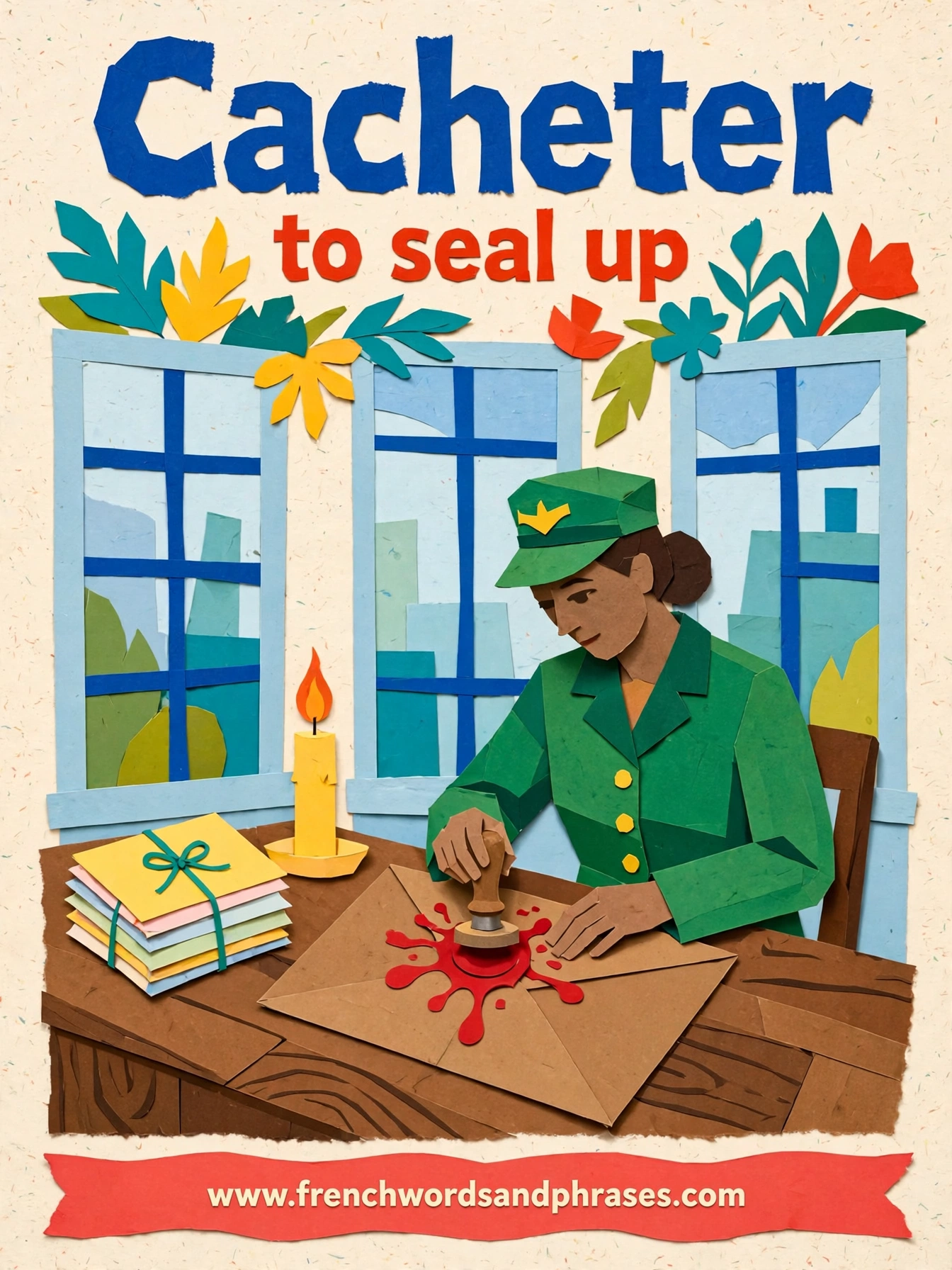
Cacheter means to seal up — to close a letter or a parcel with wax, a stamp or a seal so that nobody can open it unseen.
A letter closed with red wax and a signet ring, a parcel sealed at the post office — cacheter is the verb of the official closure: once it is done, the contents are private, and any opening will show.
In this guide, you’ll learn how to conjugate cacheter in all the major French tenses and moods. Explore complete conjugation tables, French examples, English translations, and practice quizzes.
Understanding the French Verb Cacheter
Cacheter is a regular French verb belonging to the first group of verbs, those ending in-er.
It means to seal up. It is used of letters, envelopes, parcels and official documents — anything closed so that opening leaves a trace. In the age of wax and signet rings it was a daily word; today you will meet it at the post office, in notaries’ offices, and in every historical novel where a letter must not be read.
Verb classification: First group (-er)
Auxiliary verb: Avoir
Past participle: cacheté
Present participle: cachetant
English equivalents: To seal, to seal up; cacheter une lettre — to seal a letter; cacheter à la cire — to seal with wax; cacheter un colis — to seal a parcel; une enveloppe cachetée — a sealed envelope; le cachet — the seal, the stamp.
One important detail: cacheter behaves like appeler — the t of the stem doubles before a mute e. So the present runs je cachette, tu cachettes, il cachette, ils cachettent, but nous cachetons, vous cachetez keep a single t; the same doubling runs through the future and conditional — je cachetterai, je cachetterais — and the subjunctive singular and third plural: qu’il cachette, qu’ils cachettent. The noun behind it all is le cachet, the seal itself — the little stamp of wax or ink that closes the letter.
Experience the Word
Cacheter is the verb of the trusted closure — wax, seal and silence until the right hands open it.
Imagine a clerk in a Paris office in 1880. The letter is folded, the wax is melting over the candle, and the ring comes down with a firm press — il cachette la lettre, and the red seal, still warm, now guards a secret that only one person in Lyon will ever read.
The letter is only paper and ink. Sealed — cachetée — it has become private property on its journey.
How to Conjugate Cacheter: Complete French Conjugation Guide
Let’s explore every major conjugation of cacheter, beginning with the indicative mood.
How to Conjugate Cacheter in the Indicative Mood
The indicative mood is used to express facts, observations, actions, and events.
How to Conjugate Cacheter in the Present Tense (Présent)
Used for actions happening now, habitual actions, and general truths.
| Subject | Conjugation |
|---|---|
| je | cachette |
| tu | cachettes |
| il / elle | cachette |
| nous | cachetons |
| vous | cachetez |
| ils / elles | cachettent |
Example
Je cachette chaque lettre avant de l’envoyer.
I seal every letter before sending it.
Quick Quiz 1
Complete the sentence:
Nous ______ le courrier chaque matin à neuf heures.
Reveal the answer
cachetons
Nous cachetons le courrier chaque matin à neuf heures.
We seal the post every morning at nine o’clock.
How to Conjugate Cacheter in the Passé Composé
Used for completed actions in the past. Cacheter takes the auxiliary verb avoir.
| Subject | Conjugation |
|---|---|
| j’ | ai cacheté |
| tu | as cacheté |
| il / elle | a cacheté |
| nous | avons cacheté |
| vous | avez cacheté |
| ils / elles | ont cacheté |
Example
Elle a cacheté l’enveloppe à la cire rouge.
She sealed the envelope with red wax.
How to Conjugate Cacheter in the Imparfait (Imperfect Tense)
Used for habitual past actions, descriptions, and ongoing situations in the past.
| Subject | Conjugation |
|---|---|
| je | cachetais |
| tu | cachetais |
| il / elle | cachetait |
| nous | cachetions |
| vous | cachetiez |
| ils / elles | cachetaient |
Example
Autrefois, on cachetait toutes les lettres importantes.
In the old days, all important letters were sealed.
Quick Quiz 2
Choose the correct form:
She sealed the envelope with wax.
Elle ______ l’enveloppe à la cire. (a cacheté / a cachetté)
Reveal the answer
a cacheté
Elle a cacheté l’enveloppe à la cire.
The past participle keeps a single t: cacheté.
How to Conjugate Cacheter in the Plus-que-parfait
Used to describe an action that had already been completed before another past event.
| Subject | Conjugation |
|---|---|
| j’ | avais cacheté |
| tu | avais cacheté |
| il / elle | avait cacheté |
| nous | avions cacheté |
| vous | aviez cacheté |
| ils / elles | avaient cacheté |
Example
Il avait cacheté le colis avant l’arrivée du facteur.
He had sealed the parcel before the postman arrived.
How to Conjugate Cacheter in the Passé Simple
Primarily used in formal writing, literature, and historical narratives. It is rarely used in everyday conversation.
| Subject | Conjugation |
|---|---|
| je | cachetai |
| tu | cachetas |
| il / elle | cacheta |
| nous | cachetâmes |
| vous | cachetâtes |
| ils / elles | cachetèrent |
Example
Le notaire cacheta le testament devant les témoins.
The notary sealed the will in front of the witnesses.
How to Conjugate Cacheter in the Passé Antérieur
A literary tense used to express an action completed immediately before another past action, generally in the passé simple.
| Subject | Conjugation |
|---|---|
| j’ | eus cacheté |
| tu | eus cacheté |
| il / elle | eut cacheté |
| nous | eûmes cacheté |
| vous | eûtes cacheté |
| ils / elles | eurent cacheté |
Example
Quand elle eut cacheté la lettre, elle la porta elle-même à la poste.
When she had sealed the letter, she took it to the post office herself.
How to Conjugate Cacheter in the Future Tense (Futur Simple)
Used to describe actions that will take place in the future.
| Subject | Conjugation |
|---|---|
| je | cachetterai |
| tu | cachetteras |
| il / elle | cachettera |
| nous | cachetterons |
| vous | cachetterez |
| ils / elles | cachetteront |
Example
Demain, la secrétaire cachettera tout le courrier du matin.
Tomorrow, the secretary will seal all the morning’s post.
How to Conjugate Cacheter in the Futur Antérieur (Future Perfect)
Used for an action that will have been completed before a particular point in the future.
| Subject | Conjugation |
|---|---|
| j’ | aurai cacheté |
| tu | auras cacheté |
| il / elle | aura cacheté |
| nous | aurons cacheté |
| vous | aurez cacheté |
| ils / elles | auront cacheté |
Example
À midi, ils auront cacheté tous les dossiers confidentiels.
By midday, they will have sealed all the confidential files.
How to Conjugate Cacheter in the Near Future (Futur Proche)
Used to describe something that is going to happen soon. Formed with aller + infinitive.
| Subject | Conjugation |
|---|---|
| je | vais cacheter |
| tu | vas cacheter |
| il / elle | va cacheter |
| nous | allons cacheter |
| vous | allez cacheter |
| ils / elles | vont cacheter |
Example
Attention, je vais cacheter l’enveloppe, donne-moi vite ta lettre.
Careful, I am going to seal the envelope, give me your letter quickly.
How to Conjugate Cacheter in the Conditional Mood
The conditional mood expresses what would happen under certain circumstances. It is also frequently used to make polite requests or express wishes.
How to Conjugate Cacheter in the Present Conditional
| Subject | Conjugation |
|---|---|
| je | cachetterais |
| tu | cachetterais |
| il / elle | cachetterait |
| nous | cachetterions |
| vous | cachetteriez |
| ils / elles | cachetteraient |
Example
Elle cachetterait la lettre si elle trouvait la cire.
She would seal the letter if she could find the wax.
How to Conjugate Cacheter in the Past Conditional
| Subject | Conjugation |
|---|---|
| j’ | aurais cacheté |
| tu | aurais cacheté |
| il / elle | aurait cacheté |
| nous | aurions cacheté |
| vous | auriez cacheté |
| ils / elles | auraient cacheté |
Example
Il aurait cacheté le colis avec plus de soin.
He would have sealed the parcel more carefully.
Cacheter in the Literary Past Conditional Form
This less common literary form uses the imperfect subjunctive of avoir.
| Subject | Conjugation |
|---|---|
| j’ | eusse cacheté |
| tu | eusses cacheté |
| il / elle | eût cacheté |
| nous | eussions cacheté |
| vous | eussiez cacheté |
| ils / elles | eussent cacheté |
Example
Le secrétaire eût cacheté la dépêche avant la nuit.
The secretary would have sealed the dispatch before nightfall.
How to Conjugate Cacheter in the Subjunctive Mood
The subjunctive is used to express wishes, emotions, doubts, necessity, and uncertainty. It frequently follows expressions such as il faut que (it is necessary that) or bien que (although).
How to Conjugate Cacheter in the Present Subjunctive
| Subject | Conjugation |
|---|---|
| que je | cachette |
| que tu | cachettes |
| qu’il / qu’elle | cachette |
| que nous | cachetions |
| que vous | cachetiez |
| qu’ils / qu’elles | cachettent |
Example
Il faut que tu cachettes cette enveloppe avant de partir.
You must seal this envelope before you leave.
Quick Quiz 3
Complete the sentence using the subjunctive:
Il faut que vous ______ tous les dossiers ce soir.
Reveal the answer
cachetiez
Il faut que vous cachetiez tous les dossiers ce soir.
You must seal all the files this evening.
How to Conjugate Cacheter in the Imperfect Subjunctive
A literary tense, rarely encountered in modern spoken French.
| Subject | Conjugation |
|---|---|
| que je | cachetasse |
| que tu | cachetasses |
| qu’il / qu’elle | cachetât |
| que nous | cachetassions |
| que vous | cachetassiez |
| qu’ils / qu’elles | cachetassent |
Example
On exigeait que le greffier cachetât chaque acte.
They required the clerk to seal every deed.
How to Conjugate Cacheter in the Pluperfect Subjunctive
A literary construction used to express an action completed before another past action.
| Subject | Conjugation |
|---|---|
| que j’ | eusse cacheté |
| que tu | eusses cacheté |
| qu’il / qu’elle | eût cacheté |
| que nous | eussions cacheté |
| que vous | eussiez cacheté |
| qu’ils / qu’elles | eussent cacheté |
Example
On racontait qu’il eût cacheté le testament de sa main.
People said he had sealed the will with his own hand.
How to Conjugate Cacheter in the Past Subjunctive
| Subject | Conjugation |
|---|---|
| que j’ | aie cacheté |
| que tu | aies cacheté |
| qu’il / qu’elle | ait cacheté |
| que nous | ayons cacheté |
| que vous | ayez cacheté |
| qu’ils / qu’elles | aient cacheté |
Example
Je suis content que vous ayez cacheté le dossier à temps.
I am glad you sealed the file in time.
How to Conjugate Cacheter in the Imperative
The imperative is used to give commands, instructions, invitations, or suggestions. Subject pronouns are omitted.
How to Conjugate Cacheter in the Present Imperative
| Person | Conjugation |
|---|---|
| (tu) | cachette |
| (nous) | cachetons |
| (vous) | cachetez |
Example
Cachette cette lettre avant midi !
Seal this letter before midday!
Quick Quiz 4
How would you say Seal this letter (tu form)?
Reveal the answer
Cachette cette lettre !
French Participles of Cacheter
Participles are verb forms that can be used in compound tenses and other grammatical constructions.
Present Participle of Cacheter
cachetant
En cachetant le colis, il a vérifié l’adresse une dernière fois.
While sealing the parcel, he checked the address one last time.
Past Participle of Cacheter
cacheté
Cachetée à la cire rouge, la lettre attendait sur le bureau.
Sealed with red wax, the letter was waiting on the desk.
Cacheter in Everyday French: Real-Life Examples
Now that you know the conjugations, let’s see how cacheter appears in everyday French.
Example 1 — Present
Je cachette chaque lettre avant l’envoi.
I seal every letter before sending it.
Example 2 — Passé composé
Elle a cacheté l’enveloppe à la cire.
She sealed the envelope with wax.
Example 3 — Imparfait
On cachetait toutes les lettres importantes.
All important letters were sealed.
Example 4 — Future
La secrétaire cachettera le courrier demain.
The secretary will seal the post tomorrow.
Example 5 — Conditional
Elle cachetterait la lettre avec de la cire.
She would seal the letter with wax.
Example 6 — Imperative
Cachette cette lettre !
Seal this letter!
Beyond Translation: The Meaning of Cacheter
English seal covers wax, stamps and even approval; French cacheter keeps the physical object in view — le cachet, the little seal itself, pressed into warm wax.
A cachetée letter is a promise.
For centuries the unbroken seal was the only privacy a letter had: cacheter was not decoration but security, and the verb still carries that gravity wherever documents are closed against curious eyes.
How to Remember the French Verb Cacheter
Remember it this way: Cacheter is about the signet ring pressing into warm red wax on a folded letter.
- Appeler-type doubling: je cachette with two t’s, but nous cachetons with one.
- The future doubles too: je cachetterai, je cachetterais — never a single t before the mute e.
- Le cachet is the seal: cacheter une lettre, cacheter à la cire.
The key idea is the signet ring pressing into warm red wax on a folded letter.
Test Your Knowledge of Cacheter
Let’s see how much you’ve learned. Try answering these questions before revealing the answers.
Question 1
Why does je cachette have two t’s but nous cachetons only one?
Reveal the answer
The appeler-type rule — the stem consonant doubles before a mute e (je cachette, ils cachettent), but not before a sounded ending (nous cachetons, vous cachetez).
Question 2
How do you say I seal every letter before sending it in French?
Reveal the answer
Je cachette chaque lettre avant de l’envoyer.
Question 3
Translate: She sealed the envelope with red wax.
Reveal the answer
Elle a cacheté l’enveloppe à la cire rouge.
Question 4
What is the past participle of cacheter?
Reveal the answer
Cacheté — with a single t: the doubling belongs to the stem before a mute e, not to the participle.
Question 5
Complete the sentence:
Il faut que tu ______ cette enveloppe avant de partir.
Reveal the answer
cachettes
Il faut que tu cachettes cette enveloppe avant de partir.
You must seal this envelope before you leave.
Your Final Challenge
Can You Use It?
How would you say this in French?
She seals the letter with red wax, as secrets were closed a hundred years ago.
Reveal the answer
Elle cachette la lettre à la cire rouge, comme on fermait les secrets il y a cent ans.
She seals the letter with red wax, as secrets were closed a hundred years ago.
A little French. A little curiosity. A richer everyday life.
LEARN FRENCH ONE WORD AT A TIME